

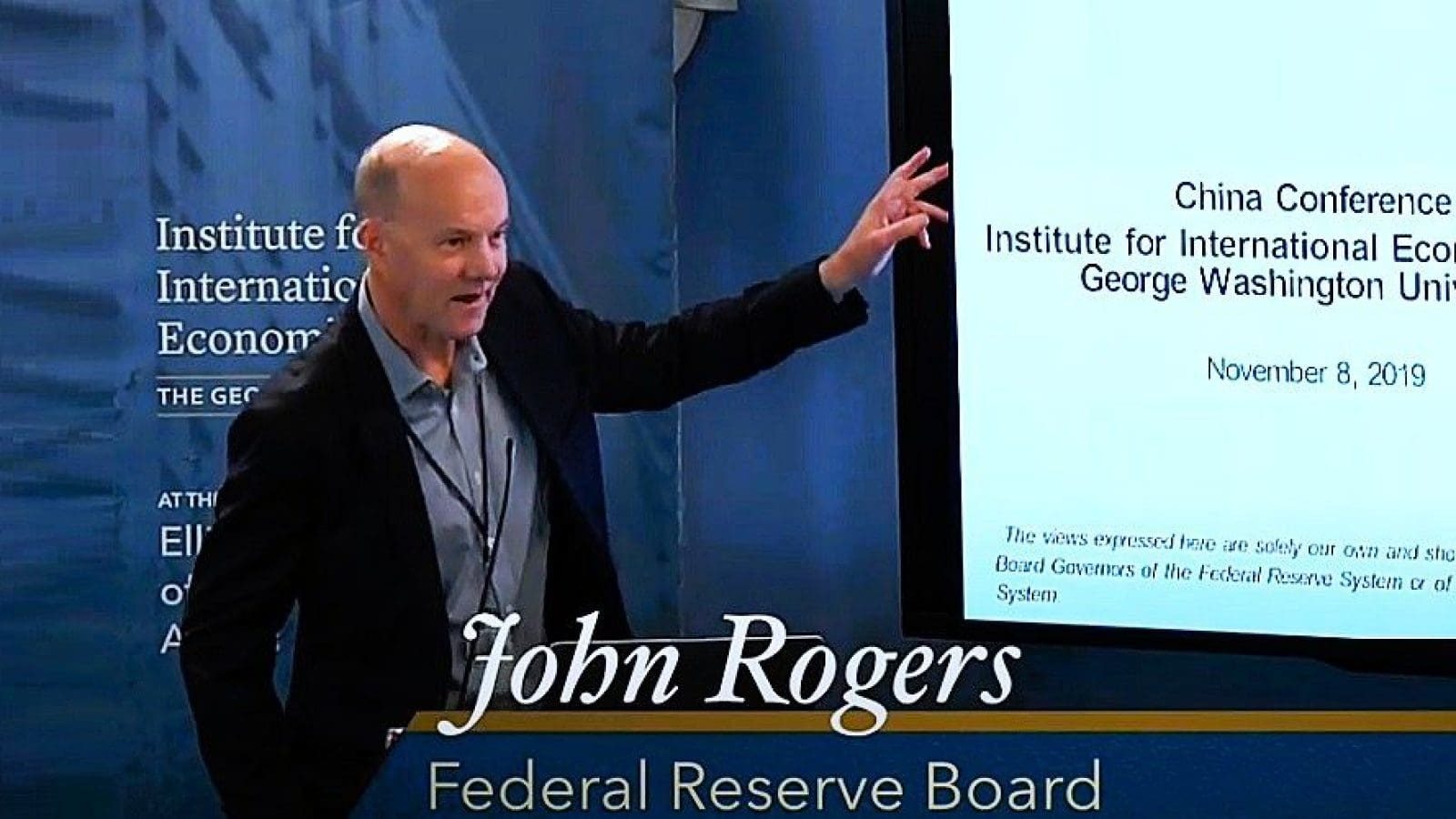
A former senior adviser inside the Federal Reserve is going to federal prison.
John Harold Rogers was sentenced Wednesday to 38 months behind bars after a jury convicted him of lying to federal investigators about sharing restricted Federal Reserve information with Chinese intelligence operatives.
Rogers, 64, worked for decades at the central bank and once held a senior position in its powerful Division of International Finance.
Now he will spend more than three years in federal custody.
U.S. Attorney Jeanine Pirro delivered a blunt response after the sentence was handed down:
John Rogers spent years secretly funneling sensitive Federal Reserve information to Chinese spies, then looked investigators in the eye and lied about it. And when that wasn’t enough, he lied again under oath at trial. Federal Reserve employees entrusted with America’s most sensitive economic information cannot sell out their country and their colleagues for personal gain and then expect to hide behind a single word.
— US Attorney Pirro (@USAttyPirro) July 15, 2026
The U.S. Attorney’s Office for the District of Columbia announced that U.S. District Judge Dabney Friedrich imposed the 38-month sentence and ordered Rogers to serve another 12 months under supervised release. Federal prosecutors had asked the court for the maximum five-year term available on the false-statements conviction.
A federal jury deliberated for two days before finding Rogers guilty on February 3. The charge stemmed from answers he gave investigators with the joint inspector general’s office for the Federal Reserve Board and the Consumer Financial Protection Bureau.
The central lie was stunningly simple. During a February 2020 interview, investigators asked Rogers whether he had ever shared restricted Federal Reserve information outside the Board.
His answer was one word: “Never.”
The government said the evidence told a very different story.
According to court papers summarized by the Justice Department, Rogers began a clandestine relationship in 2017 with Hummin Lee, whom prosecutors identified as a Chinese intelligence operative. The two met at a conference in China.
Over the years that followed, Rogers allegedly met Lee and his associates in Chinese hotel rooms under the cover of teaching academic “classes.” Prosecutors said those sessions were used to pass along Federal Reserve information that Lee had specifically asked Rogers to collect.
The Justice Department said Rogers printed restricted documents before traveling to China, removed classification markings before sending materials to his personal email account, and forwarded sensitive information to a professor at Fudan University before another meeting with Lee.
Prosecutors said Rogers understood that Lee was preparing reports for the Chinese government using the information he supplied.
They also said Rogers knew exactly why advance access could be so valuable.
China was trading roughly $1.5 trillion in U.S. Treasury securities, and advance knowledge of a Federal Reserve interest-rate decision could create an enormous advantage when buying or selling those holdings.
In return, the government said Rogers received help involving his new wife, university professorships and substantial financial benefits from Lee and Chinese universities.
At one point, Rogers reportedly told investigators that he “owed everything” to Lee.
The official sentencing announcement is here:
John Harold Rogers, 64, a former senior adviser for the Federal Reserve Board of Governors (FRB), was sentenced today to 38 months in federal prison in connection with making false statements to federal investigators about sharing restricted Federal Reserve information with Chinese intelligence operatives, announced @USAttyPirro.
— U.S. Attorney DC (@USAO_DC) July 15, 2026
There is an important legal distinction in this case.
Bloomberg Law reported after the February verdict that the same jury acquitted Rogers of the more serious charge of conspiracy to commit economic espionage. He was convicted only of making false statements to government investigators.
That means Rogers was not sentenced as a convicted spy, and it would be inaccurate to describe the 38 months as punishment for an espionage conviction.
It was punishment for the lies the jury found he told while investigators were trying to determine what happened to restricted material from one of the most economically powerful institutions in the world.
The acquittal also helps explain why the final sentence may strike many Americans as light when compared with the national-security conduct described by prosecutors.
At the indictment stage in January 2025, the Justice Department said investigators were examining the handling of proprietary economic data, internal discussions about tariffs targeting China, briefing books prepared for Federal Reserve governors, and sensitive information about Federal Open Market Committee deliberations and upcoming announcements.
The indictment alleged that Rogers sent material to his personal email account or printed it before trips to China, then met purported graduate students in hotel rooms under the cover of academic classes.
It also alleged that Rogers received approximately $450,000 in 2023 as a part-time professor at a Chinese university. Those allegations were tested at trial, where the jury rejected the espionage-conspiracy count.
The same trial established that Rogers lied when investigators asked whether he had shared restricted information outside the Federal Reserve. The Justice Department now says he compounded that misconduct by lying again under oath.
Rogers’ former position made the stakes especially serious.
From 2010 through 2021, he served as a senior adviser in the Federal Reserve’s Division of International Finance.
He held a Ph.D. in economics and had access to nonpublic material dealing with monetary policy and the Federal Open Market Committee.
This was not a junior employee stumbling into a restricted folder.
It was a longtime insider entrusted with information capable of moving markets and affecting the economic interests of the United States.
The FBI’s Washington Field Office and the Federal Reserve Board’s inspector general investigated the case.
Pirro’s office prosecuted it alongside the Justice Department’s National Security Division.
Prosecutors wanted 60 months. Judge Friedrich imposed 38.
That number will not satisfy everyone, especially after reading what the government says Rogers did with sensitive information and whom it says he was dealing with.
But the sentence is now real, the conviction is on the books, and a former Federal Reserve insider who lied to conceal his China-linked conduct is headed to federal prison.

Join the conversation!
Please share your thoughts about this article below. We value your opinions, and would love to see you add to the discussion!