

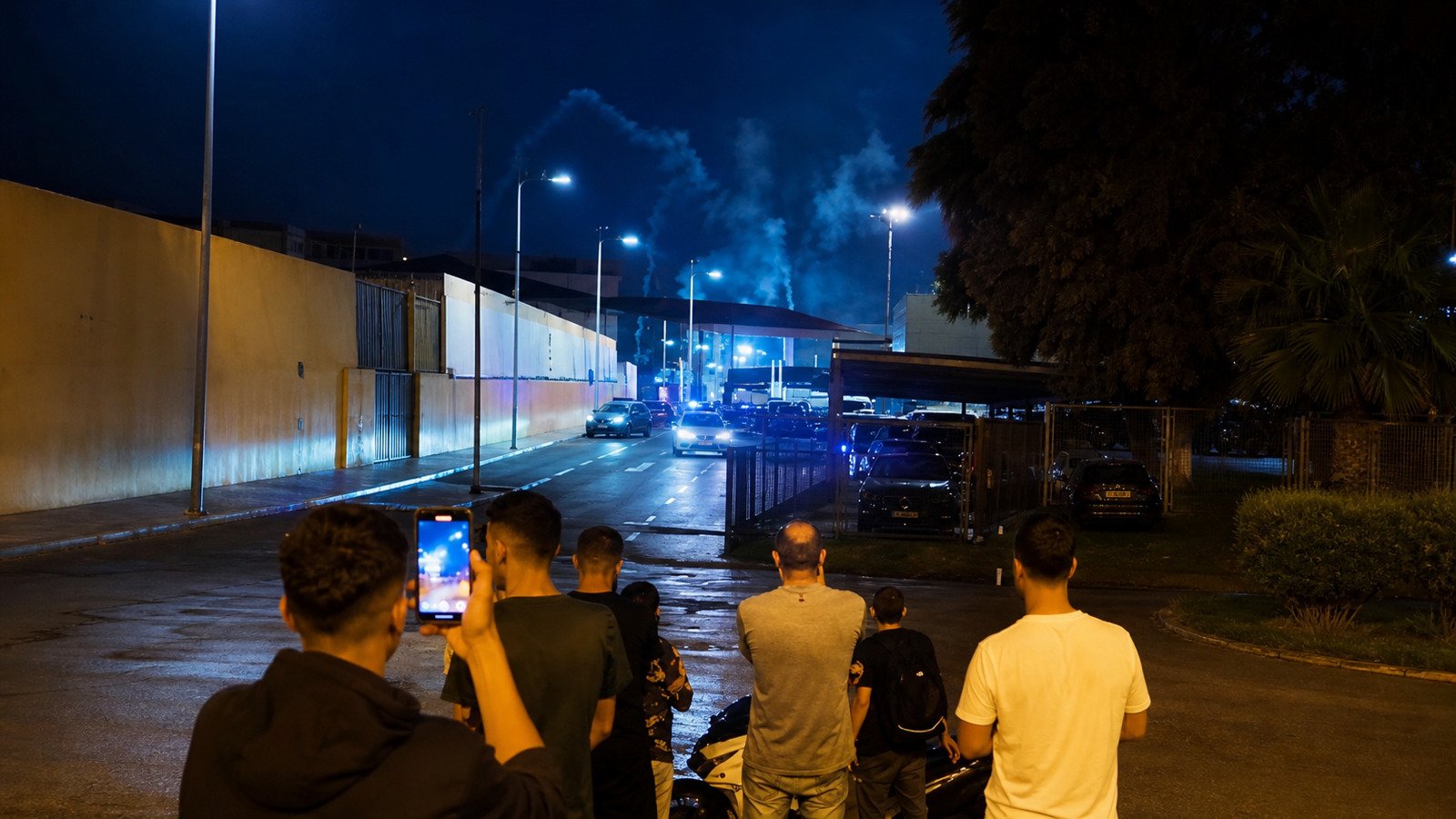
Spain is facing a full-blown border catastrophe tonight.
Thousands of migrants poured into the Spanish enclave of Ceuta from Morocco on Thursday, overwhelming border forces, flooding streets, and forcing Madrid to deploy the Army.
Then a second front erupted.
Authorities shut down the Beni Enzar crossing in Melilla after hundreds more people attempted a mass entry at roughly 10:00 p.m. local time.
A post from the scene reported smoke rising over the border area while loud reports echoed through the night:
🚨 BREAKING: EXPLOSIONS heard at the border of Spain’s Melilla as THOUSANDS of African Muslim illegals storm a second Spanish city while screaming “ALLAHU AKBAR”
Smoke is seen rising through the air.
It’s unclear what the explosions were, but could be munitions fired by… https://t.co/DP5WL1YyL9
— Nick Sortor (@nicksortor) July 30, 2026
The exact source of those sounds and the smoke had not been officially established at the time of publication.
What is confirmed is extraordinary enough.
Cadena SER reported that the Beni Enzar crossing — the only operating border checkpoint between Melilla and Morocco — was closed after a mass-entry attempt at both the main crossing and the Dique Sur area at approximately 10:00 p.m. Thursday.
Spain’s Government Delegation in Melilla confirmed the closure while national security forces moved to contain the situation. Officials said they could not immediately say when the crossing would reopen.
Residents were told to stay away from the border perimeter so they would not obstruct police and Guardia Civil operations. The order effectively sealed the main legal route between Melilla and Morocco while authorities confronted an attempted crossing outside normal controls.
Hours earlier, the border at Ceuta had effectively buckled.
People entered by swimming and wading around the Tarajal breakwater, crossing on foot, and scaling sections of the border fence. Spanish television estimated that between 2,000 and 3,000 people reached the enclave in a matter of hours.
The Guardian reported that a Guardia Civil spokesman described people as entering “massively” from the sea. Spanish broadcaster TVE placed the number who reached Ceuta between 2,000 and 3,000, while the state news agency EFE reported that some scaled the border fence.
The head of the association representing Guardia Civil officers in Ceuta said the situation was absolute chaos and that the border had totally collapsed. Crowds moved across breakwaters, beaches, and roads as personnel tried to keep pace.
The arrivals were not limited to young men. Families, women, and children were also visible, while Moroccan riot police reportedly used tear gas and water cannons against people massed near the border.
Another clip circulating Thursday night appeared to show men using a ladder against a residential building while others gathered below:
🚨 JUST IN: African invaders are now attempting to BREAK INTO HOMES in Ceuta, Spain as midnight approaches
This is a reminder to NEVER, EVER give up your firearms.
When you need them most, the government WILL NOT be there to save you. pic.twitter.com/w3MQ0AZB9D
— Nick Sortor (@nicksortor) July 30, 2026
The footage is alarming. The claim that the people shown were breaking into homes had not yet been independently confirmed by Spanish authorities or local reporting.
There is no such uncertainty about the scale of the overall emergency.
At least 18 people died attempting to swim into Ceuta, according to police sources cited in the latest Spanish coverage. The preliminary cause was drowning as people tried to reach the enclave through the waters near the southern Tarajal breakwater.
Spain has now ordered Army units already stationed in Ceuta to support the Guardia Civil.
El País reported that Army units already stationed in Ceuta will reinforce the Guardia Civil in its border duties and provide any other support required to maintain security in the city.
The deployment followed repeated warnings that officers were overwhelmed by the volume of people entering from the sea. Sixty members of the armed forces were initially assigned, while Guardia Civil reinforcements were also being sent to the enclave.
The same live coverage documented the growing human toll. Police sources said at least 18 people died while trying to swim into Ceuta, with early findings pointing to drowning near the southern Tarajal breakwater.
The operation mirrors the military support used during the 2021 Ceuta crisis, when thousands crossed after Moroccan controls suddenly weakened.
Think about what that means.
Soldiers are now operating inside Spanish territory because civilian border forces could no longer contain the crossings. That fact alone separates Thursday’s events from the routine border pressures Spain has faced for years.

Every political party represented in Ceuta’s Assembly agreed that the situation had crossed a line.
Radio Television Ceuta reported that the Assembly unanimously demanded an urgent national response: declaration of a national emergency, reinforcements for the security services, deployment of the Army to protect the border and public safety, and closure of the Tarajal crossing. The joint statement said the crisis had made a “qualitative leap” as mass crossings expanded from the water to people moving on foot around the breakwater.
What are your thoughts?

The Assembly asked residents to remain calm. But it also made clear that Ceuta had reached a limit.
Spain’s central government refused the formal national-emergency request, arguing that the country’s civil-protection law reserves that designation for disasters such as floods, earthquakes, wildfires, nuclear incidents, and other listed hazards.
That legal distinction will not reassure families watching crowds move through their neighborhoods while soldiers are sent to the border.
Prime Minister Pedro Sánchez and Interior Minister Fernando Grande-Marlaska are now scheduled to travel to Ceuta on Friday.
RTVE reported that Sánchez will visit the Tarajal border before attending a noon coordination meeting at the Palace of the Assembly.
The meeting will bring together Ceuta President Juan Jesús Vivas, the Government Delegate, commanders from the National Police and Guardia Civil, and directors of the migrant reception center and local Red Cross. Sánchez is expected to address the media afterward.
By the time the prime minister arrives, troops will already be on the ground, thousands of new arrivals will be inside Ceuta, and Melilla’s main crossing will have spent the night closed.
The visit will therefore begin as an active security operation, not a ceremonial review after the danger has passed.
The immediate question is how this happened so quickly.
The Spanish Interior Ministry says human-smuggling networks exploited a recent Supreme Court ruling involving migrants intercepted at sea.
Spain’s Interior Ministry said trafficking organizations were using the court decision to encourage irregular migration, predominantly among young people who believed the sea route now offered an easier entry.
Madrid insisted that Morocco was cooperating and rejected claims that Rabat had deliberately opened the gates during Thursday’s crisis. The government said Moroccan forces had blocked thousands of attempted crossings in recent days.
Spanish and Moroccan officials agreed to strengthen coordination and review measures for returning people who entered illegally as quickly as possible. That pledge came after the scale of Thursday’s crossings had already overwhelmed Ceuta’s available security and reception capacity.
The ministry’s explanation puts organized smuggling networks at the center of the surge, while Madrid now depends on Rabat to help reverse it.
That cooperation will be tested immediately on both borders.
The court did not erase Spain’s border law.
El País’ legal analysis explained that the Supreme Court did not rewrite Spain’s immigration law. It interpreted the special border-rejection rule that allows immediate rejection of people caught overcoming physical barriers such as the fences surrounding Ceuta and Melilla.
The case involved an Algerian migrant intercepted at sea in 2024 while swimming toward Ceuta. Lower courts found that a person stopped in the water had not crossed a physical border barrier and therefore could not be returned under the enclave’s expedited rejection provision.
The Supreme Court agreed with that reading. Migrants intercepted at sea still face immigration proceedings, but authorities cannot use the same immediate-return mechanism that applies at the land barriers.
Whether that ruling triggered the surge, accelerated it, or merely became a sales pitch for smugglers will be fought over for months.
The consequences are visible right now.
Ceuta’s border forces were overwhelmed and its reception systems were saturated.
Soldiers were called in, and Melilla’s crossing was closed after another mass attempt.
People died in the water.
And scenes from both enclaves were already being viewed as a warning far beyond Spain:
Spain is currently up in flames as migrant invaders violently conquer the country.
This is America's warning that Democrats cannot be allowed to regain power.
They will import the third world and destroy our nation. pic.twitter.com/eE6rUzf8ol
— Benny Johnson (@bennyjohnson) July 30, 2026
At the borders of Ceuta and Melilla, the Spanish state lost control badly enough to call out the Army and shut down a major crossing.
That is what national collapse looks like when it begins at the edge.
And every Western country still pretending border sovereignty is optional should study these images very carefully.

Join the conversation!
Please share your thoughts about this article below. We value your opinions, and would love to see you add to the discussion!