

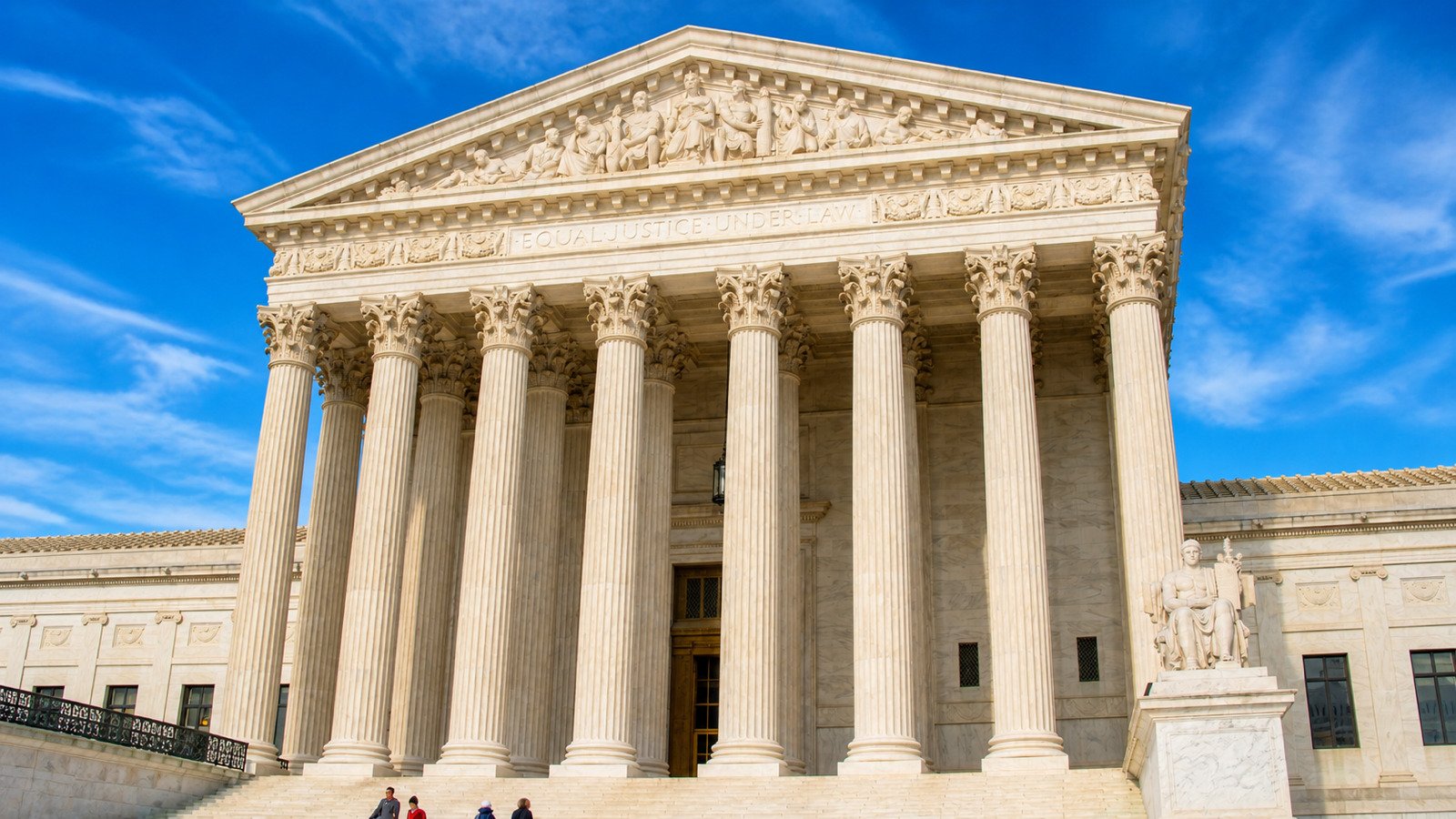
The Supreme Court just dealt a serious blow to a legal maneuver that has repeatedly been used to stall President Trump’s immigration agenda.
The immediate result is that the lower-court stay keeping Haiti’s Temporary Protected Status designation alive is gone.
But the larger ruling reaches beyond one immigration program and one Biden-appointed judge.
The justices rejected the idea that a court can dodge a congressional ban on judicial review simply by calling its objections “procedural.”
That distinction had allowed U.S. District Judge Ana Reyes to freeze the administration’s policy even though federal law says courts cannot review a Homeland Security secretary’s TPS determinations.
Now that tactic has hit a wall.
The final lower-court response came Wednesday, when Reyes acknowledged that the order postponing the termination of Haiti’s TPS designation is no longer in effect.
🚨 Judge Lifts Stay on Termination of Haiti Temporary Protected Status.
U.S. District Judge Ana Reyes issued an order confirming that her prior stay of the Department of Homeland Security’s termination of Temporary Protected Status for Haitians is no longer in effect. The ruling…
— Morse Report (@MorseReport) August 5, 2026
The practical consequence is immediate. Haiti TPS beneficiaries who lack another lawful status can no longer rely on the designation for protection from removal or permission to work.
The lawsuit itself may continue, but it will continue without the same nationwide restraint that kept the policy frozen.
That is where the new legal angle matters.
Congress created TPS in 1990 to provide temporary relief when war, disaster or extraordinary conditions made it unsafe for foreign nationals already in the United States to return home.
Congress also wrote an unusually direct limitation into the law.
Under 8 U.S.C. §1254a(b)(5)(A), there is no judicial review of a Homeland Security secretary’s determination concerning the designation, extension or termination of TPS for a foreign country.
That language would seem hard to misunderstand.
Yet the lower courts found a workaround.
Reyes said the Haitian plaintiffs were not asking her to review Secretary Kristi Noem’s ultimate decision to terminate Haiti’s designation. She said they were challenging how Noem reached that decision.
That allowed the court to examine agency consultations, the review of conditions inside Haiti and the steps preceding the final termination.
In other words, the final decision was supposedly protected from review while nearly every component used to reach it remained open to a judge’s second-guessing.
The Supreme Court refused to accept that split.
The Supreme Court’s opinion in Mullin v. Doe held that the word “determination” can describe both an individual decision and the process leading to that decision.
The majority also emphasized Congress’s use of the phrase “with respect to,” language the Court said broadens the provision to cover matters connected to the TPS determination.
That swept away the procedural workaround. The label attached to a claim cannot change the statutory source of the court’s authority.
The justices held that the review bar covers claims about subsidiary decisions, agency consultations and alleged errors in the process because those steps merge into the final agency action. That conclusion covered both the consultation dispute and the challenge to DHS’s assessment of conditions inside Haiti.
A court cannot treat the trunk as protected while chopping apart every branch.
The opinion also rejected the challengers’ attempt to define “determination” as nothing more than an assessment of country conditions. The majority said that narrow reading had no support in the statute’s text or ordinary meaning.

The Court reached the same conclusion under basic administrative-law principles. Subsidiary judgments merge into final agency action, so plaintiffs cannot pull those judgments back apart simply to manufacture review power Congress withheld.
The majority’s point was blunt: the statutory language “plainly bars” the nonconstitutional challenges used to postpone the Haiti and Syria TPS terminations.
Justice Samuel Alito wrote the controlling opinion, joined in full by Chief Justice John Roberts and Justices Clarence Thomas and Brett Kavanaugh. Justices Neil Gorsuch and Amy Coney Barrett supplied the remaining votes for the result and most of the majority’s reasoning.
Justice Elena Kagan dissented with Justices Sonia Sotomayor and Ketanji Brown Jackson.
The Congressional Research Service’s legal analysis traces exactly how the lower courts built their theory.
CRS explains that the district courts tried to separate the Secretary’s final TPS decision from the procedures and subsidiary judgments leading up to it. The Supreme Court rejected that distinction because ordinary meaning and administrative law both treat those steps as part of the determination.
The report also highlights the importance of “with respect to” in the statute. Those words made Congress’s review bar broader than a ban covering only the final sentence of a termination notice.
That reasoning carries a warning for judges looking for creative ways to preserve policies the executive branch has lawfully ended.
If Congress has clearly withheld judicial review, a court cannot recreate that power by relabeling a challenge.
The Supreme Court also rejected the basis Reyes used for the plaintiffs’ constitutional claim.
The Haitian challengers alleged that racial animus motivated the termination. The justices held that the equal-protection claim was unlikely to succeed on the record before them.
The majority observed that the administration had ended every TPS designation that came up for renewal, providing a strong race-neutral explanation for its policy.
That holding does not erase every imaginable constitutional claim in a future case.
It does mean this record could not support the extraordinary relief Reyes imposed against the administration.
The result was a 6-3 reversal and a remand to the lower courts.
Once the Supreme Court’s mandate worked its way back down, the stay had nowhere left to stand.
Federal immigration officials are now acting on the changed legal landscape.
.@SecMullinDHS on Haitians with terminated TPS: “We’re going after them right now…These individuals can either self-deport or we’ll arrest you and send you back. It’s that simple.” https://t.co/YGo3uuNvrE pic.twitter.com/sGCvqmtFam
— Homeland Security (@DHSgov) August 5, 2026
The administration’s public message is that temporary status cannot quietly become permanent status through repeated extensions and years of litigation.
Haiti first received TPS after the catastrophic 2010 earthquake. The designation was repeatedly extended and later redesignated as violence, political instability and humanitarian problems continued.
By the time of the Supreme Court case, the protection had lasted roughly sixteen years.
The Department of Homeland Security’s termination notice records the agency’s review of country conditions and its conclusion that Haiti no longer met the statutory requirements for continued designation.
DHS acknowledged serious remaining problems, including gang violence. The department nevertheless concluded that the statutory conditions for TPS were no longer satisfied and that continued designation conflicted with the national interest.
The notice also described concerns about visa overstays, unavailable criminal-history information and the need to align immigration policy with a secure and self-reliant Haiti.
DHS said it consulted appropriate federal agencies before reaching the decision. The department distinguished the new termination from the earlier effort to shorten a prior extension, presenting it as a fresh determination under the governing statute.
The notice directed affected beneficiaries to prepare to leave or pursue another lawful immigration option available in their individual circumstances. It also warned that TPS does not create permanent immigration status.
Critics can dispute that policy judgment.
Congress assigned the judgment to the Secretary and barred courts from reviewing it through ordinary nonconstitutional claims.
That was the line the lower courts crossed.
USCIS says Haiti’s TPS designation terminated effective July 27, 2026.
USCIS says employment authorization documents issued to Haiti TPS beneficiaries in categories A12 and C19 are no longer valid solely on that basis. Employers must reverify affected workers and cannot continue employing anyone who cannot provide current proof of employment authorization.
Those instructions show why the legal fight was never academic. The termination changes both deportation protection and ordinary eligibility to remain on an employer’s payroll.
The guidance superseded USCIS’s July 24 notice and translated the Supreme Court ruling into employment rules for businesses nationwide. Its focus on document reverification shows how quickly a high-court decision reaches payroll offices and individual households.
The agency did not say every former beneficiary automatically loses every possible legal avenue. It addressed the validity of TPS-based documents and the work authorization that flowed from Haiti’s terminated designation.
The lower-court stay controlled whether hundreds of thousands of people could continue relying on TPS to work legally and remain protected from removal.
Individual cases will still differ.
Some Haitian nationals may have asylum claims, family-based petitions, another lawful status or other proceedings that affect whether they can remain in the United States.
The end of TPS does not produce 350,000 instant deportations.
It removes the categorical shield supplied by that one program.
Reaction spread quickly once Reyes formally lifted the stay.
🚨 BIG MOVE
Federal Judge Ana Reyes just cleared the final roadblock.
The stay blocking the end of Temporary Protected Status for Haitians is GONE.
The Trump administration can now move forward with terminating TPS.
Lawsuit isn’t over, but the protections are no longer… pic.twitter.com/22HwUL0XCN
— Gunther Eagleman™ (@GuntherEagleman) August 5, 2026
The Justice Department’s Supreme Court case page identifies the consolidated disputes as Mullin v. Doe and Trump v. Miot, docket numbers 25-1083 and 25-1084.
Those cases gave the administration a direct route to defend the authority Congress placed in the executive branch. They also gave the Supreme Court an opportunity to close the procedural loophole the lower courts had opened.
DOJ’s merits-stage briefing asked the justices to enforce the text Congress chose and reject the effort to separate the final decision from the process producing it. The government also argued that the evidence did not establish a race-based reason for ending Haiti’s designation.
The consolidated posture mattered because the Court considered parallel lower-court orders involving Haiti and Syria together. One decision could therefore settle the same review-bar question across two TPS termination disputes.
The administration won both points that mattered for interim relief.
The nonconstitutional claims were barred, and the equal-protection claim was unlikely to prevail.
For President Trump, the victory is bigger than the formal lifting of one stay.
Lower courts have repeatedly tried to delay his immigration policies through nationwide orders, aggressive readings of administrative law and procedural objections that keep executive decisions trapped in litigation.
The Supreme Court has now made clear that procedure is not a magic word capable of erasing a statutory review bar.
When Congress says there is no judicial review of a TPS determination, judges do not get to review the same determination piece by piece.
That is the precedent with consequences long after the Haiti case leaves the headlines.
Read the full Supreme Court ruling here: Mullin v. Doe.

Join the conversation!
Please share your thoughts about this article below. We value your opinions, and would love to see you add to the discussion!