

If President Trump brings evidence Thursday night, the next question will be brutally simple:
Who is willing to put it under oath, under the lights and into the public record?
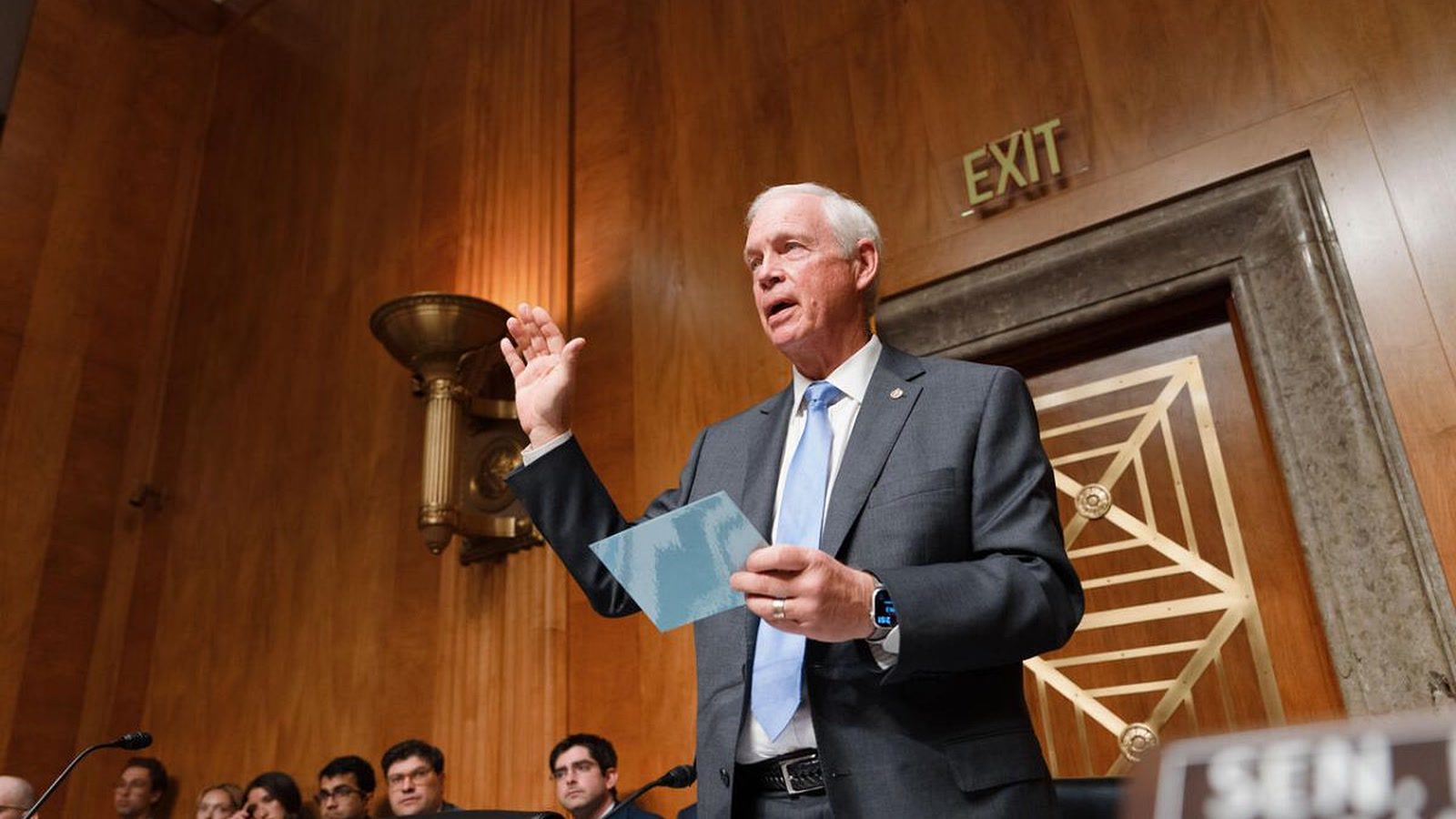
Sen. Ron Johnson just volunteered.
Johnson says he is prepared to hold a public Senate hearing if the President’s address produces evidence that warrants one.
Watch the full exchange:
Sen. Johnson Announces He Will Spearhead Senate Fraud Hearings That Could Lead To REMOVALS From Office If Trump Unveils Evidence That Elections Were STOLEN:
"We have to see the evidence, I'm happy to hold a hearing and lay it all out in its gory detail—this needs to be made public"
Trump's speech on Thursday could change everything. pic.twitter.com/5FIQTZkoIZ
— Benny Johnson (@bennyjohnson) July 14, 2026
The sequence matters.
Johnson was asked whether he would seek the removal of senators if President Trump’s evidence showed that any had been elected illegitimately.
He did not claim the evidence had already proved that. He did not promise instant removals.
He said the evidence must come first.
Then he made the consequential offer: if the evidence is there, he is willing to hold a Senate hearing and expose it in what he called its full “gory detail.” A hearing, he added, would be completely appropriate once lawmakers have the evidence in hand.
The insistence on evidence makes the promise more credible. A serious investigation should move from documents and testimony to a public record, then to consequences supported by the facts.
President Trump personally previewed the address Tuesday and called it “really, really big news.”
.@POTUS on Thursday's address to the nation: "It's really, really big news — and our country has to shape up… because without free and fair elections, you don't have a country. We'll be discussing other things, too, but it's going to be a very big announcement." pic.twitter.com/sQ7H6f0Oa1
— Rapid Response 47 (@RapidResponse47) July 14, 2026
The Washington Post reports that the address is expected to draw on reexamined government files and claims about vulnerabilities in American election infrastructure.
President Trump told reporters Tuesday that voting machines would be one subject, but he declined to reveal the announcement in advance. White House Press Secretary Karoline Leavitt cautioned that outside reports remained speculation and said the public would have to tune in to learn what the President ultimately presents.
According to the Post, the administration has reviewed old FBI records and a forensic analysis of voting software used in Puerto Rico. That analysis reportedly identified serious security flaws but found no evidence that anyone had exploited them.
The paper also reports that officials have revisited questions involving China, Venezuela and the 2020 election. The plans remain fluid, and none of the material expected in Thursday’s speech had been publicly released as of Tuesday.
The distinction is crucial: a vulnerability is not proof that an election result was changed.
Thursday’s address will rise or fall on whether the administration connects its claims to verifiable records, specific conduct and evidence capable of surviving public scrutiny.
Axios reports that election integrity will be one of several subjects in the prime-time speech, along with an update on Iran. A senior adviser described the planned address as a “potpourri,” while President Trump has emphasized that a major announcement is coming.
The White House has pushed Congress to pass the SAVE America Act and has made voter identification, citizenship verification and voting-machine security major parts of its election agenda. The precise evidence the President plans to reveal Thursday has not yet been released.
That uncertainty is exactly why Johnson’s formulation matters. He is not asking the country to accept a viral caption as a verdict.
He is offering a venue where documents can be entered into the record and witnesses can be questioned in public.
The White House says the address begins Thursday at 9 p.m. Eastern, or 8 p.m. Central:
🚨 President Donald J. Trump will be speaking to the nation this Thursday, July 16th, at 9PM EST. pic.twitter.com/21wdwEqFN8
— The White House (@WhiteHouse) July 13, 2026
Johnson is not making an empty offer from the sidelines.
The Senate Permanent Subcommittee on Investigations identifies Johnson as its chairman and describes PSI as the Homeland Security Committee’s chief investigative subcommittee.

Its jurisdiction includes the efficiency of operations across every branch of government, compliance with federal rules and laws, crime affecting the national welfare and computer fraud. Senate investigations can call witnesses, demand records and build the public factual record that may support legislation, referrals or further proceedings.
The panel’s current Republican membership also includes Sens. James Lankford, Rick Scott, Josh Hawley and Bernie Moreno.
Johnson has already used that power alongside Judiciary Committee Chairman Chuck Grassley. Earlier this year, the two worked together on subpoenas seeking records tied to the Arctic Frost investigation.
So when Johnson talks about putting evidence into a hearing, he is speaking as the chairman of a panel with real investigative machinery.
There is also direct precedent.
On December 16, 2020, Johnson chaired a Senate hearing titled “Examining Irregularities in the 2020 Election.” The witness list included former CISA Director Christopher Krebs, former federal judge Kenneth Starr, attorneys presenting election challenges and an Election Assistance Commission member.
Johnson said at the time that the country could not sustain a situation in which a large share of Americans rejected the legitimacy of election results. His stated goal was to air disputed claims, confront them with testimony and restore confidence through public examination.
Thursday may present him with the chance to do it again, this time from the chair of the Senate’s most prominent investigative subcommittee.
One guardrail should remain clear amid the talk of “removals.”
A committee hearing cannot simply eject an elected senator. The U.S. Senate’s own constitutional history explains that expulsion requires a two-thirds vote of the chamber.
The Senate has expelled only 15 members since 1789, and 14 of those expulsions came during the Civil War over support for the Confederacy. In other cases, proceedings ended without expulsion or became moot when the senator left office.
The Constitution also gives the Senate authority to judge the elections, returns and qualifications of its members. Contested-election proceedings and expulsion are distinct processes, each with its own rules and voting threshold.
Any effort to unseat a sitting senator would therefore require action by the full chamber, not a declaration from one subcommittee chairman. Johnson’s hearing could investigate facts and recommend a course, but it could not deliver removal by itself.
A hearing can still be the event that changes everything. It can expose records, force answers, establish misconduct, produce referrals and make denial politically impossible.
The evidence has to come first.
Johnson said that twice in less than two minutes. That caution makes his final point more powerful, not less:
This needs to be made public.
President Trump now has the national stage. Sen. Johnson has offered the Senate forum.
On Thursday night, America finds out whether the receipts are real.

Join the conversation!
Please share your thoughts about this article below. We value your opinions, and would love to see you add to the discussion!