

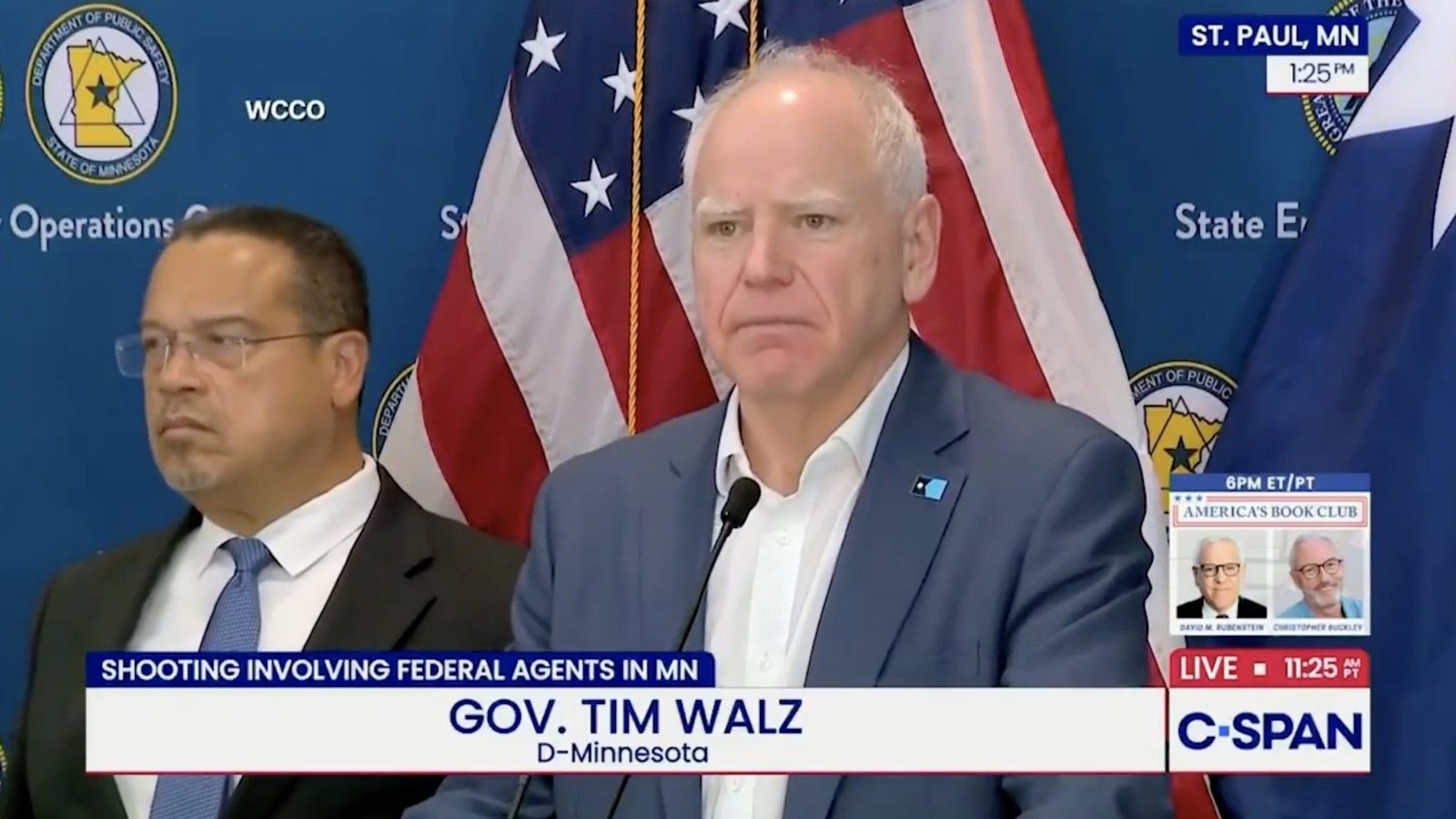
Minnesota Gov. Tim Walz moved fast to pardon a convicted armed robber after federal immigration agents took the man into custody and set him for deportation to Laos.
FOX 9 reported on May 27 that Walz pardoned Jai Vang before he could potentially be removed from the country.
This is the kind of state-level resistance that has followed President Trump’s immigration crackdown city by city.
Vang was taken into ICE custody on May 14 and was set to be deported in June, before the board’s next regular meeting. So Walz called a special one.
Minnesota Gov. Tim Walz on Wednesday pardoned a man taken into ICE custody during Operation Metro Surge before he could potentially be deported to Laos, his native country. https://t.co/mWV904UYnj
— FOX 9 (@FOX9) May 27, 2026
The conviction at issue is not a paperwork offense.
FOX 9 reported that Vang was arrested, tried, and convicted of aiding and abetting armed robbery in an October 1994 Hennepin County incident, when he was 18.
Walz held the special Board of Pardons meeting with Minnesota Supreme Court Chief Justice Natalie Hudson and Attorney General Keith Ellison. The pardon was granted unanimously after a Clemency Review Commission recommendation.
FOX 9 laid out the timeline and the board’s makeup in its local report.
The local timeline starts with the May 14 notice to Walz’s office that Vang had been taken into ICE custody. The deportation timeline was not abstract; the local account says he was set to be removed in June, before the board’s next regular meeting.
The case centered on a 1994 Hennepin County conviction from when Vang was 18. He was arrested, tried, and convicted of aiding and abetting armed robbery, then later sought a pardon as the federal immigration process moved toward removal.
The special meeting brought together Walz, Minnesota Supreme Court Chief Justice Natalie Hudson, and Attorney General Keith Ellison. After a Clemency Review Commission recommendation, the board voted unanimously to grant the pardon instead of waiting for the normal schedule.
The local story also included the argument supporters used to justify the move. Vang had not been accused of new crimes since serving his sentence, had started a family, and had built a painting and carpentry business in Minnesota.
FOX 9 also reported that Vang had not committed additional crimes since serving his sentence and had built a family and a painting and carpentry business.
Fox News carried the story nationally the next day and put it squarely in the immigration enforcement context.
According to Fox News, Walz inaccurately referred to Vang as a citizen during the hearing.
The national account adds the immigration-enforcement context that makes the pardon politically explosive. Vang is described as a Laotian national who had been convicted in the armed robbery case and was in federal immigration custody before Walz moved the state clemency process ahead.
During the hearing, Walz referred to Vang as a citizen even though the case was tied to possible deportation to Laos. He argued that he could not see how Minnesota would be safer or better if Vang were removed from the country.
The same account ties Vang’s ICE custody to Operation Metro Surge, the federal push that targeted criminal illegal aliens in the Minneapolis area. That detail matters because the federal government was not simply reacting to paperwork status; it was acting through a named enforcement operation.
The political contrast is the story. Walz presented the case through rehabilitation, family, and business ties, while the federal side treated it as an immigration-enforcement case involving a noncitizen with an armed robbery conviction.
For WLTR readers, that is the fault line: a Democrat governor using state clemency power while President Trump’s federal immigration operation was already moving.
That last detail matters to the federal side of this. He was picked up under a named DHS operation.
The state pardon does not by itself erase federal immigration authority, and the sources do not claim it does.
What it does is set aside the conviction and lift many of its lingering consequences, which can complicate the deportation lane the federal government was already moving down.
That is how Minnesota’s clemency machinery works, and Walz sits at the center of it.
The Minnesota Board of Pardons page spells out the structure plainly.
The official state page identifies the Board of Pardons as a three-member body made up of the governor, the Minnesota attorney general, and the chief justice of the Minnesota Supreme Court. That is why Walz was not a background figure in this decision.
ADVERTISEMENTThe same page defines a pardon as an act of forgiveness that sets aside a conviction and lifts many lingering consequences. In a deportation-adjacent case, that kind of state action can become a direct pressure point against the federal government’s removal effort.
The voting rule also gives the governor real control. For a pardon or commutation to be granted, the governor must support clemency along with at least one other board member.
In other words, this was not some independent panel acting while Walz watched from the sidelines. The governor had to be part of the yes vote, and he chose to convene the process early.

So Walz was more than a bystander signing off on someone else’s decision. His vote is required for any pardon to happen at all.
And he chose to convene the board early, on a special schedule, after learning the federal deportation clock was running.
Pardoning an illegal immigrant armed robber who victimizes Minnesotans to own Trump.
An absolute clown. https://t.co/kNcMd9NbWZ
— Elliott Engen (@elliottengenMN) May 28, 2026
The pattern is the part conservatives keep flagging.
Federal agents do the work of identifying and detaining a convicted offender, and a Democrat governor moves to neutralize the consequence before the removal can finish.
Walz framed it as rehabilitation and community ties. The federal government framed Vang as a deportable noncitizen with an armed robbery conviction picked up in a targeted enforcement surge.
Both of those things were true at the same time, and Walz used the power he holds to land on the side that stops the deportation.

Join the conversation!
Please share your thoughts about this article below. We value your opinions, and would love to see you add to the discussion!