

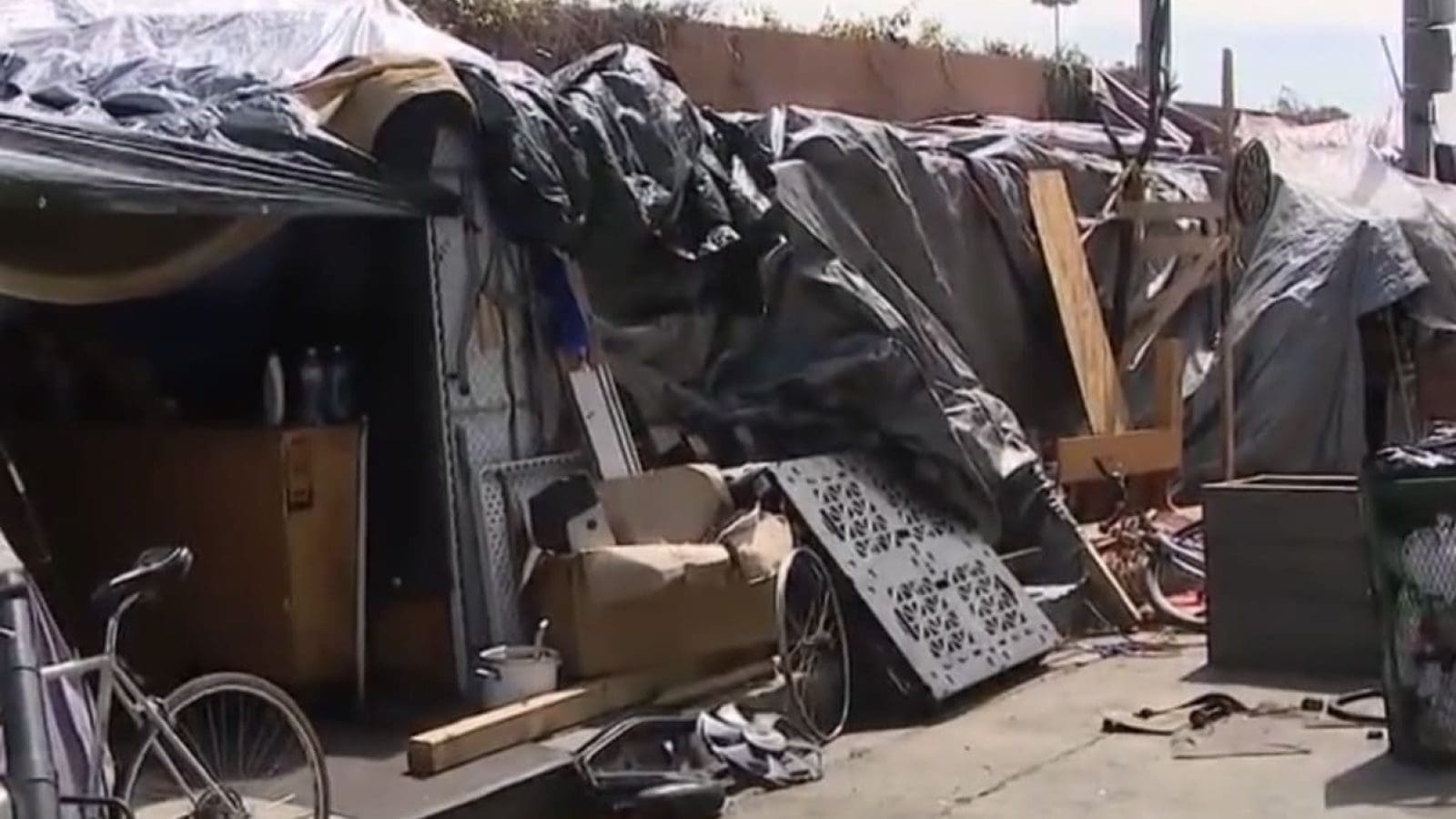
President Trump signed an executive order aimed at restoring public safety to streets across the United States.
The order pushes cities and states to remove homeless people off the streets and into treatment centers.
Trump to sign order pushing cities and states to remove homeless people from streetshttps://t.co/OBE85q17Xq
— Karoline Leavitt (@PressSec) July 24, 2025
“Endemic vagrancy, disorderly behavior, sudden confrontations, and violent attacks have made our cities unsafe. The number of individuals living on the streets in the United States on a single night during the last year of the previous administration — 274,224 — was the highest ever recorded. The overwhelming majority of these individuals are addicted to drugs, have a mental health condition, or both. Nearly two-thirds of homeless individuals report having regularly used hard drugs like methamphetamines, cocaine, or opioids in their lifetimes,” the order read.
“An equally large share of homeless individuals reported suffering from mental health conditions. The Federal Government and the States have spent tens of billions of dollars on failed programs that address homelessness but not its root causes, leaving other citizens vulnerable to public safety threats,” it continued.
“Shifting homeless individuals into long-term institutional settings for humane treatment through the appropriate use of civil commitment will restore public order. Surrendering our cities and citizens to disorder and fear is neither compassionate to the homeless nor other citizens. My Administration will take a new approach focused on protecting public safety,” the order added.
“It’s not compassionate to let our homeless brothers and sisters suffer on our streets with no pathway to self-sufficiency. We cannot surrender our cities and citizens to illicit drug-induced disorder without addressing the root cause of substance abuse,” Secretary of Housing and Urban Development Scott Turner said.
“@POTUS’ executive order reflects a compassionate, commonsense approach by helping the homeless off the streets and into treatment centers, off of drugs and onto roads of recovery,” he added.
It’s not compassionate to let our homeless brothers and sisters suffer on our streets with no pathway to self-sufficiency.
We cannot surrender our cities and citizens to illicit drug-induced disorder without addressing the root cause of substance abuse.@POTUS’ executive order… https://t.co/NfrUdrErpX
— Scott Turner (@SecretaryTurner) July 25, 2025
More from Fox News:
It directs Attorney General Pam Bondi to “reverse judicial precedents and end consent decrees” stopping or limiting cities and states from removing homeless individuals from the streets and moving them to treatment centers.
Though it is unclear how much money will be allocated to the effort, Trump’s order redirects federal funds to ensure that removed homeless individuals are sent to rehabilitation, treatment and other facilities.
Additionally, the order requires Bondi to partner with Health and Human Services Secretary Robert F. Kennedy Jr., Housing and Urban Development Secretary Scott Turner and Transportation Secretary Sean Duffy to prioritize federal grants to cities and states that “enforce prohibitions on open illicit drug use, urban camping and loitering, and urban squatting, and track the location of sex offenders,” according to USA Today.
The order also stipulates that discretionary grants for substance-use disorder prevention, treatment and recovery programs “do not fund drug injection sites or illicit drug use.”
ADVERTISEMENT
“As part of his effort to ‘Make America Safe Again,’ President Donald Trump signed an executive order to allow cities and states to remove homeless people off the streets and into treatment centers.”https://t.co/Ov5c49A6OU
— Karoline Leavitt (@PressSec) July 25, 2025
The National Homelessness Law Center criticized the order, saying “criminalization doesn’t help anyone.”
“Trump’s new Executive Order directs states to treat homelessness and mental illness as crimes. Criminalization doesn’t help anyone – we need housing and healthcare, not handcuffs and budget cuts. #HousingNotHandcuffs,” it stated.
BREAKING: Trump’s new Executive Order directs states to treat homelessness and mental illness as crimes. Criminalization doesn’t help anyone – we need housing and healthcare, not handcuffs and budget cuts. #HousingNotHandcuffs
Our statement: https://t.co/YPJsrRXlJe
— National Homelessness Law Center (@homeless_law) July 24, 2025
Journalist Michael Shellenberger applauded the Trump administration’s crackdown on government policies that encourage addiction.
“It’s better to let mentally ill people buy and use meth and fentanyl on sidewalks, believes Gavin Newsom, than arrest their drug dealers, and them, and mandate rehab. But enabling Mexican-Chinese drug mafias to murder mentally ill Americans with fentanyl, as they do everyday and did again a few hours ago in San Francisco, as the video below by @war24182236 shows, is barbaric and pathological,” Shellenberger wrote.
“I thus applaud Trump’s announcement that he will crack down on open air drug use and the government policies that encourage addiction. Harm reduction led to drug deaths rising from 20,000 in 2000 to over 100,000 in 2023. The federal government should have acted decades ago to stop the barbarism,” he continued.
“Seventy percent of Californians last November voted to crack down on fentanyl. Newsom opposed that measure (Prop 36) and is starving its implementation of resources, for the simple reason that he needs Soros money for his presidential run. Californians should support the federal government in, finally, doing the right thing on addiction and the drug death crisis,” he added.
It’s better to let mentally ill people buy and use meth and fentanyl on sidewalks, believes Gavin Newsom, than arrest their drug dealers, and them, and mandate rehab.
But enabling Mexican-Chinese drug mafias to murder mentally ill Americans with fentanyl, as they do everyday… pic.twitter.com/9U8pR8osBD
— Michael Shellenberger (@shellenberger) July 24, 2025
“From the US to Europe to Asia, there is one and only one humane way to deal with ‘homelessness’ and it’s this, below. It’s wonderful to see it in this new Executive Order by @realDonaldTrump,” Shellenberger added.
From the US to Europe to Asia, there is one and only one humane way to deal with “homelessness” and it’s this, below. It’s wonderful to see it in this new Executive Order by @realDonaldTrump :
“The Order redirects funding to ensure that individuals camping on streets and causing… pic.twitter.com/P93s6awhQJ
— Michael Shellenberger (@shellenberger) July 24, 2025
Read the full text of the executive order:
NEW: President Donald J. Trump just signed an executive order to restore order to American cities and remove vagrants from our streets.
Here is the text of the order:
By the authority vested in me as President by the Constitution and the laws of the United States of America, it…
— Rapid Response 47 (@RapidResponse47) July 24, 2025
By the authority vested in me as President by the Constitution and the laws of the United States of America, it is hereby ordered:
Section 1. Purpose and Policy. Endemic vagrancy, disorderly behavior, sudden confrontations, and violent attacks have made our cities unsafe. The number of individuals living on the streets in the United States on a single night during the last year of the previous administration — 274,224 — was the highest ever recorded. The overwhelming majority of these individuals are addicted to drugs, have a mental health condition, or both. Nearly two-thirds of homeless individuals report having regularly used hard drugs like methamphetamines, cocaine, or opioids in their lifetimes. An equally large share of homeless individuals reported suffering from mental health conditions. The Federal Government and the States have spent tens of billions of dollars on failed programs that address homelessness but not its root causes, leaving other citizens vulnerable to public safety threats.
Shifting homeless individuals into long-term institutional settings for humane treatment through the appropriate use of civil commitment will restore public order. Surrendering our cities and citizens to disorder and fear is neither compassionate to the homeless nor other citizens. My Administration will take a new approach focused on protecting public safety.
Sec. 2. Restoring Civil Commitment. (a) The Attorney General, in consultation with the Secretary of Health and Human Services, shall take appropriate action to:
(i) seek, in appropriate cases, the reversal of Federal or State judicial precedents and the termination of consent decrees that impede the United States’ policy of encouraging civil commitment of individuals with mental illness who pose risks to themselves or the public or are living on the streets and cannot care for themselves in appropriate facilities for appropriate periods of time; and
(ii) provide assistance to State and local governments, through technical guidance, grants, or other legally available means, for the identification, adoption, and implementation of maximally flexible civil commitment, institutional treatment, and “step-down” treatment standards that allow for the appropriate commitment and treatment of individuals with mental illness who pose a danger to others or are living on the streets and cannot care for themselves.
Sec. 3. Fighting Vagrancy on America’s Streets. (a) The Attorney General, the Secretary of Health and Human Services, the Secretary of Housing and Urban Development, and the Secretary of Transportation shall take immediate steps to assess their discretionary grant programs and determine whether priority for those grants may be given to grantees in States and municipalities that actively meet the below criteria, to the maximum extent permitted by law:
ADVERTISEMENT(i) enforce prohibitions on open illicit drug use;
(ii) enforce prohibitions on urban camping and loitering;
(iii) enforce prohibitions on urban squatting;
(iv) enforce, and where necessary, adopt, standards that address individuals who are a danger to themselves or others and suffer from serious mental illness or substance use disorder, or who are living on the streets and cannot care for themselves, through assisted outpatient treatment or by moving them into treatment centers or other appropriate facilities via civil commitment or other available means, to the maximum extent permitted by law; or
(v) substantially implement and comply with, to the extent required, the registration and notification obligations of the Sex Offender Registry and Notification Act, particularly in the case of registered sex offenders with no fixed address, including by adequately mapping and checking the location of homeless sex offenders.
(b) The Attorney General shall:
(i) ensure that homeless individuals arrested for Federal crimes are evaluated, consistent with 18 U.S.C. 4248, to determine whether they are sexually dangerous persons and certified accordingly for civil commitment;
(ii) take all necessary steps to ensure the availability of funds under the Emergency Federal Law Enforcement Assistance program to support, as consistent with 34 U.S.C. 50101 et seq., encampment removal efforts in areas for which public safety is at risk and State and local resources are inadequate;
(iii) assess Federal resources to determine whether they may be directed toward ensuring, to the extent permitted by law, that detainees with serious mental illness are not released into the public because of a lack of forensic bed capacity at appropriate local, State, and Federal jails or hospitals; and
(iv) enhance requirements that prisons and residential reentry centers that are under the authority of the Attorney General or receive funding from the Attorney General require in-custody housing release plans and, to the maximum extent practicable, require individuals to comply.
Sec. 4. Redirecting Federal Resources Toward Effective Methods of Addressing Homelessness. (a) The Secretary of Health and Human Services shall take appropriate action to:
(i) ensure that discretionary grants issued by the Substance Abuse and Mental Health Services Administration for substance use disorder prevention, treatment, and recovery fund evidence-based programs and do not fund programs that fail to achieve adequate outcomes, including so-called “harm reduction” or “safe consumption” efforts that only facilitate illegal drug use and its attendant harm;
ADVERTISEMENT(ii) provide technical assistance to assisted outpatient treatment programs for individuals with serious mental illness or addiction during and after the civil commitment process focused on shifting such individuals off of the streets and public programs and into private housing and support networks; and
(iii) ensure that Federal funds for Federally Qualified Health Centers and Certified Community Behavioral Health Clinics reduce rather than promote homelessness by supporting, to the maximum extent permitted by law, comprehensive services for individuals with serious mental illness and substance use disorder, including crisis intervention services.
(b) The Attorney General shall prioritize available funding to support the expansion of drug courts and mental health courts for individuals for which such diversion serves public safety.
Sec. 5. Increasing Accountability and Safety in America’s Homelessness Programs. (a) The Secretary of Health and Human Services and the Secretary of Housing and Urban Development shall take appropriate actions to increase accountability in their provision of, and grants awarded for, homelessness assistance and transitional living programs. These actions shall include, to the extent permitted by law, ending support for “housing first” policies that deprioritize accountability and fail to promote treatment, recovery, and self-sufficiency; increasing competition among grantees through broadening the applicant pool; and holding grantees to higher standards of effectiveness in reducing homelessness and increasing public safety.
(b) The Secretary of Housing and Urban Development shall, as appropriate, take steps to require recipients of Federal housing and homelessness assistance to increase requirements that persons participating in the recipients’ programs who suffer from substance use disorder or serious mental illness use substance abuse treatment or mental health services as a condition of participation.
(c) With respect to recipients of Federal housing and homelessness assistance that operate drug injection sites or “safe consumption sites,” knowingly distribute drug paraphernalia, or permit the use or distribution of illicit drugs on property under their control:
(i) the Attorney General shall review whether such recipients are in violation of Federal law, including 21 U.S.C. 856, and bring civil or criminal actions in appropriate cases; and
(ii) the Secretary of Housing and Urban Development, in coordination with the Attorney General, shall review whether such recipients are in violation of the terms of the programs pursuant to which they receive Federal housing and homelessness assistance and freeze their assistance as appropriate.
(d) The Secretary of Housing and Urban Development shall take appropriate measures and revise regulations as necessary to allow, where permissible under applicable law, federally funded programs to exclusively house women and children and to stop sex offenders who receive homelessness assistance through such programs from being housed with unrelated children.
(e) The Secretary of Housing and Urban Development, in consultation with the Attorney General and the Secretary of Health and Human Services, shall, as appropriate and to the extent permitted by law:
(i) allow or require the recipients of Federal funding for homelessness assistance to collect health-related information that the Secretary of Housing and Urban Development identifies as necessary to the effective and efficient operation of the funding program from all persons to whom such assistance is provided; and
(ii) require those funding recipients to share such data with law enforcement authorities in circumstances permitted by law and to use the collected health data to provide appropriate medical care to individuals with mental health diagnoses or to connect individuals to public health resources.
Sec. 6. General Provisions. (a) Nothing in this order shall be construed to impair or otherwise affect:
(i) the authority granted by law to an executive department or agency, or the head thereof; or
(ii) the functions of the Director of the Office of Management and Budget relating to budgetary, administrative, or legislative proposals.
(b) This order shall be implemented consistent with applicable law and subject to the availability of appropriations.
(c) This order is not intended to, and does not, create any right or benefit, substantive or procedural, enforceable at law or in equity by any party against the United States, its departments, agencies, or entities, its officers, employees, or agents, or any other person.
(d) The costs for publication of this order shall be borne by the Department of Housing and Urban Development.
DONALD J. TRUMP
THE WHITE HOUSE,
July 24, 2025.Your thoughts?

Join the conversation!
Please share your thoughts about this article below. We value your opinions, and would love to see you add to the discussion!