

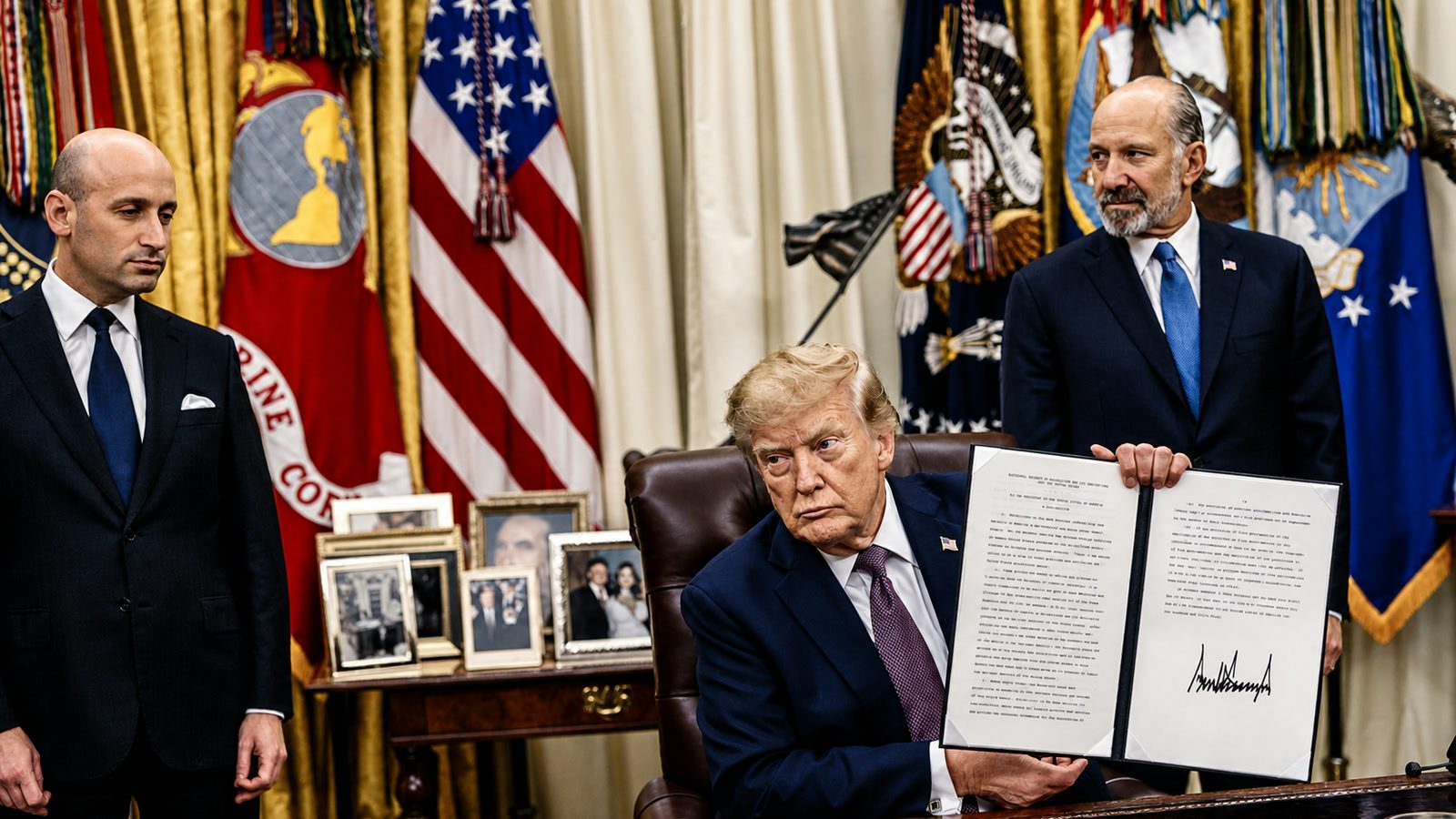
President Trump just announced a new route around the Supreme Court’s birthright-citizenship ruling, and this time the administration is attacking the problem from two directions.
During an Oval Office signing ceremony Thursday, President Trump said the Court’s June decision was “very unfair” and harmful to the country. He then signed two narrower executive actions aimed at shutting down specific citizenship loopholes and stopping commercial “birth tourism.”
“Our country suffers because of it, and we’re ending it a different way,” President Trump declared.
Watch President Trump announce the new approach:
🚨 NOW: President Trump says he's going AROUND the Supreme Court ruling on birthright citizenship to stop the birthright scam
This is MASSIVE!
"Our country suffers because of it, and we're ending it a different way!" 🔥
"Give us the right to do it in a much more forceful… pic.twitter.com/bPnCnWz7hj
— Eric Daugherty (@EricLDaugh) August 6, 2026
The first action is not a replay of the sweeping order the justices struck down in June. It identifies narrower categories of children whom the administration says fall within historical exceptions to automatic citizenship.
The second action directs the Secretary of State and the Secretary of Homeland Security to use their existing authority to halt birth tourism—the practice of entering the United States for the purpose of giving birth and obtaining American citizenship for the child.
The White House says the first order protects the exceptions the Supreme Court itself recognized in Trump v. Barbara, while the second delegates presidential immigration authorities to State and Homeland Security. The administration says the policy is aimed at malign foreign actors, fraudulent schemes and commercial networks that exploit temporary admission into the country.
The fact sheet also places the orders inside President Trump’s broader immigration enforcement campaign. It says the government will deny entry to birth tourists who work with syndicates to evade immigration law and will continue pursuing denaturalization cases against people who fraudulently obtained citizenship.
That makes the second order an enforcement directive as much as a citizenship policy. State and DHS are being told to stop the traveler before the planned birth, disrupt the organizers and close the commercial pipeline that turns a temporary visa into a citizenship transaction.
The strategy is more targeted than President Trump’s original 2025 order. Instead of trying to deny citizenship to every child born to an illegal alien or temporary visitor, the new action focuses on categories the administration believes the Court left open.
Axios reports that the new framework applies only to future births and centers on four lanes: children tied to certain foreign-government personnel, children of people designated as alien enemies, births in U.S. territories if Congress changes the governing law, and children born through deliberate commercial birth-tourism fraud. The second order also directs new rules and guidance aimed at the businesses that organize those schemes.
White House Deputy Chief of Staff Stephen Miller immediately laid out the administration’s legal theory when reporters challenged the move.
Miller cited Section 215(a) of the Immigration and Nationality Act, which gives the executive branch authority to prescribe rules governing the entry and departure of aliens. His argument is straightforward: The government does not have to admit someone who is entering under false pretenses to exploit American citizenship law.
Here is Miller’s response:
🚨 WOW! The Fake News claimed President Trump's executive order against birthright citizenship tourism is illegal and Stephen Miller IMMEDIATELY began citing the specific US federal statute that gives 47 that power
Stephen Miller is a freaking patriot 🔥
"Section 215A of the… pic.twitter.com/pTAaiK2gKC
— Eric Daugherty (@EricLDaugh) August 6, 2026
That distinction could become the heart of the next court fight.
The Supreme Court ruled 6-3 on June 30 that children born in the United States to parents who are here illegally or temporarily are citizens at birth under the Fourteenth Amendment. The majority rejected President Trump’s broad attempt to treat those parents as outside U.S. jurisdiction.
But the Court also discussed historically recognized exceptions involving foreign ministers and circumstances in which American sovereignty or jurisdiction does not fully apply. The administration is now testing how far those exceptions extend—and pairing that argument with the president’s separate power to police fraudulent entry into the United States.
The new policy does not pretend the June ruling never happened. It is written around the boundaries of that decision, backed by separate immigration authorities and almost certain to trigger fresh litigation.
The White House followed the signing ceremony with official confirmation and its detailed fact sheet:
Today, President Donald J. Trump signed two Executive Orders to continue to protect the meaning and value of American citizenship after Trump v. Barbara.
Read the facts. ⬇️https://t.co/2vKuCTQXLy
— The White House (@WhiteHouse) August 6, 2026
The administration’s strongest immediate ground may be the birth-tourism crackdown. Federal immigration law already permits officials to deny entry when a visitor’s real purpose is to obtain citizenship for a child through a planned U.S. birth.
President Trump is directing his agencies to enforce that authority aggressively and to go after the syndicates that profit from the scheme.
The citizenship categories will face harder legal scrutiny. Opponents will argue that the new order reaches beyond the narrow exceptions described by the justices.
The administration will answer that the Court did not convert fraud, foreign sovereign status or hostile allegiance into an untouchable citizenship machine.
The Supreme Court’s full opinion shows exactly why President Trump changed tactics. The 6-3 majority held that children born in the United States to parents here illegally or temporarily are citizens at birth, rejecting the administration’s broader allegiance theory.
The opinion also traced several narrow historical exceptions. It discussed children of foreign ministers, births in territory outside the sovereign’s control and births connected to enemy occupation—situations in which the ordinary rule of American jurisdiction did not apply.
Justice Brett Kavanaugh agreed that the original order was invalid because federal law uses the same citizenship language. He wrote separately that Congress could amend that law or establish new exceptions, but had not yet done so.
Those holdings explain the two-track response now underway. President Trump is pressing the exceptions he believes remain open while using independent entry-control powers to attack deliberate birth-tourism fraud before a child is born on American soil.
President Trump lost one sweeping route. He did not surrender the field.
He is now using narrower constitutional exceptions, statutory immigration powers and a direct attack on birth-tourism fraud to keep the fight alive.
That is what leadership looks like when the easy road is closed: Read the ruling, find the authority that remains and move.
Read the full Supreme Court ruling here: Trump v. Barbara.

Join the conversation!
Please share your thoughts about this article below. We value your opinions, and would love to see you add to the discussion!