

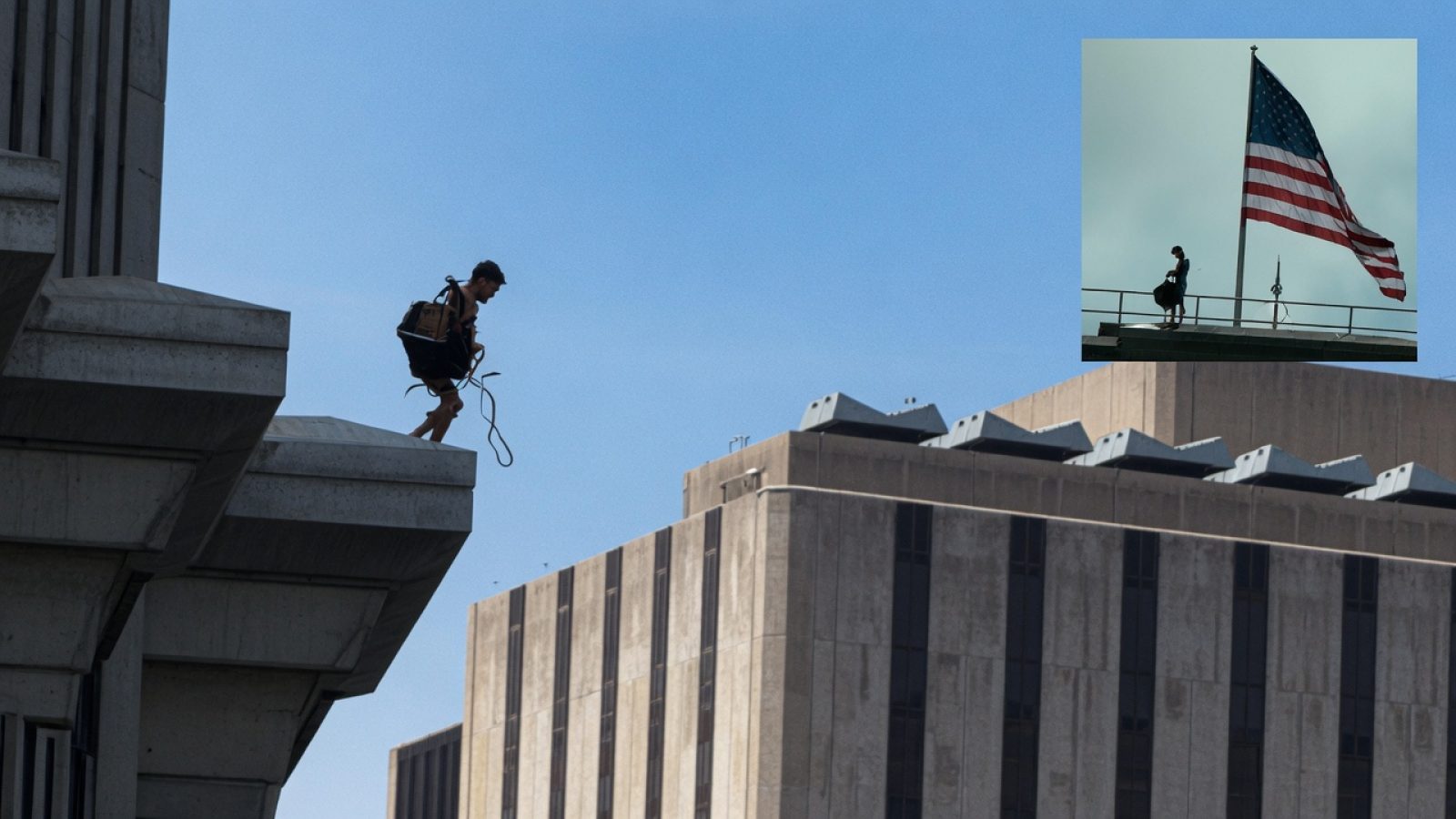
Well, this is a new one…
This weekend, a crazy idiot climbed to the top of the famous Brooklyn Bridge in New York.
There, he proceeded to attach several flags to the top, including the Kazakh flag, as well as a blanket with unknown writing on it.
After this, he stripped butt naked before jumping off the bridge as witnesses watched in terror.
Footage of that jump is going viral online:
🇺🇸🇰🇿 In New York, a naked man climbed one of the towers of the Brooklyn Bridge, affixed multiple flags, including a Kazakh flag and a blanket covered in random writing, and then jumped into the river.
The man survived. Rescuers pulled him from the water and took him to the… pic.twitter.com/Fab1PHXKxh
— Visegrád 24 (@visegrad24) August 3, 2026
Here’s another angle:
Man jumps off the Brooklyn bridge and survives pic.twitter.com/GTgwedki7M
— Daily Loud (@DailyLoud) August 3, 2026
Somehow, this man survived the jump.
He was rescued by Harbor cops from the water and taken to a hospital, where he is in stable condition.
Call it a miracle or just sheer, dumb luck.
Still, the man, identified as 44-year-old Galymzhan Abaildayev, may be going to jail for the stunt. He is facing multiple charges.
NBC News reported further:
Galymzhan Abaildayev is facing charges of reckless endangerment, graffiti, public lewdness, criminal trespass and disorderly conduct, the New York Police Department said in a statement to NBC News on Monday. It’s unclear whether he has retained an attorney.
ADVERTISEMENTPolice were called to the Brooklyn Bridge on Sunday afternoon after reports that a man was scaling the 143-year-old bridge with a backpack. Abaildayev allegedly stripped down after reaching the top of the bridge’s north tower.
He then jumped from the top of the bridge’s tower into the East River, where police said he was rescued by the department’s harbor unit. He was then taken to a city hospital in stable condition.
In case you’re thinking about following in this lunatic’s footsteps, I probably wouldn’t.
The Brooklyn Bridge is nearly 300 feet tall. Typically, hitting water after jumping from so high up can result in death or injuries just as serious as colliding with concrete.
The New York Post dove deeper into the possible reason why this guy might have survived the usually-fatal jump:
The miraculous survival of a disturbed man who leaped from the Brooklyn Bridge on Sunday could have come down to a handful of factors — the likeliest being the precise position of his body when he landed in the East River, an expert told The Post.
“Jumping or falling from extreme heights – such as a 270-foot bridge tower – is overwhelmingly fatal,” said Dr. David S. Shapiro, a trauma surgeon with more than 30 years of experience.
“It generates extreme kinetic energy that causes widespread, life-threatening trauma,” added Shapiro, who now works at New England Donor Services.
ADVERTISEMENTIncredibly, cops said the 44-year-old jumper, identified as Galymzhan Abaildayev, is in stable condition after his 278-foot leap from the top of the Brooklyn Bridge, which Shapiro said could be attributable to several variables, though not many of them likely.
The bag Abaildayev was carrying could have served as a “makeshift parachute” that reduced his descent speed just enough to spare his life before he crashed into the water’s surface, which Shapiro said was likely at a speed between 79-87 mph.
Another remote possibility is that an object such as a rock could have fallen just ahead of Abaildayev, disturbing and thereby slightly softening the surface of the water, reducing the impact on his body.
Shapiro points out that there’s absolutely no evidence that either of those conditions existed, noting Abaildayev’s best, and most likely chance for survival was his body’s position when he entered the water.
ADVERTISEMENT“If you slap your hand on the water palm down, it makes a big splash … if you hit it vertically like a karate chop you’ll see it slice through the water. The position your body is in when it enters the water makes a big difference.”
He made the comparison to cliff-divers, who position their bodies so that they are able to hit the water at speeds up to 60 mph before coming to a near dead stop.
“They don’t head-first dive. If you lock your body in, perfectly straight vertically, you’ll go through the water a lot easier,” he said.


Join the conversation!
Please share your thoughts about this article below. We value your opinions, and would love to see you add to the discussion!