
Wall Street spent the week staring at a war with Iran, a jump in oil prices, higher Treasury yields and another round of violent swings in the stocks powering the artificial-intelligence boom.
Then Friday’s closing bell rang.
The S&P 500 stood at 7,575.39 – just 0.6% below a fresh all-time high.
That was not the market sleepwalking through a quiet week. It was the market absorbing one geopolitical shock after another and still finding buyers.
President Trump said talks with Iran would continue while also warning that the ceasefire was over.
Oil remained above where it began the week, and bond yields ticked higher.
Wall Street bought anyway.
BREAKING: The S&P 500 closes rises for a second straight week and closes just 0.6% away from a fresh record high. pic.twitter.com/F4IS9UkBOe
— The Kobeissi Letter (@KobeissiLetter) July 10, 2026
One green Friday can be noise.
This was the S&P 500’s fourth winning week in the last five.
The Associated Press market scorecard shows the S&P gained 31.75 points, or 0.4%, on Friday. The Dow Jones Industrial Average added 149.60 points, or 0.3%, while the Nasdaq composite climbed 74.72 points, also 0.3%.
For the week, the S&P rose 1.2% and the Nasdaq gained 1.7%. The Dow slipped 0.5%, and the Russell 2000 index of smaller companies fell 0.6%.
Zoom out to the beginning of the year, however, and the picture gets much harder to dismiss. The S&P 500 is up 10.7%, the Dow is up 9.5%, the Nasdaq is up 13.1%, and the Russell 2000 is leading them all with a 20% gain.
That last number matters.
The 2026 rally reaches beyond a handful of enormous technology companies carrying every other stock on their backs. Small-company shares have had a remarkable year, even after taking a breather this week.
The market is not the entire economy, and it is not a substitute for the price of groceries, housing or insurance.
A family squeezed by those bills cannot spend a paper gain in an index fund it does not own.
Still, the market is a real-time vote on where millions of investors believe profits, growth and American business are headed. On Friday, with every obvious reason to run for cover sitting in plain sight, that vote remained bullish.
The biggest threat hanging over the week was oil.
The Associated Press reported that Brent crude dipped 0.4% Friday to $76.01 per barrel. That was still above the roughly $72 level where it began the week, but dramatically below the wartime spike that had taken it close to $120.
The danger has not disappeared. Continued fighting with Iran could threaten tanker traffic through the Strait of Hormuz, choking off a major artery for oil moving out of the Persian Gulf.
Higher oil can feed inflation, squeeze consumers and force central banks to keep interest rates higher. The 10-year Treasury yield rose Friday to 4.56%, another pressure point that normally makes stocks less attractive.
The market did not declare those risks gone. It priced them in and kept climbing.
Friday also had a star.
SK hynix, the South Korean memory-chip giant, raised roughly $26.5 billion through American depositary shares priced at $149 each. Once trading began, the stock jumped and finished its first Wall Street session up 13.1%.
Nvidia rose 4% and supplied the single largest lift to the S&P 500, another reminder that the AI investment cycle still has enormous force behind it.
Nasdaq says SK hynix came to MarketSite at 4 Times Square on Friday to mark its American listing under the symbol SKHYV. Chairman Chey Tae-won and company president and CEO Kwak Noh-Jung rang the opening bell as the chipmaker expanded its reach into U.S. capital markets.
The company is a leader in high-bandwidth memory and also competes across DRAM and NAND flash. Those are the memory technologies feeding data centers and advanced AI systems.
Investors have spent months arguing over whether the AI boom has run too far, yet demand for the chips is producing real revenue and real profits. A $26.5 billion American offering followed by a double-digit first-day gain is powerful evidence that the appetite for that growth has not vanished.
There is plenty of reason for discipline. SK hynix shares in Seoul had already surged 634% over the prior year, and even strong businesses can become dangerously expensive.
But Friday’s debut showed that investors are not finished financing the buildout.
"SK hynix is an AI technology leader. But leadership is not a title. It is something we must earn every single day."
@SKhynix President and CEO, Kwak Noh-Jung, takes the @Nasdaq podium on listing day. pic.twitter.com/gbqNmi7xyF
— Nasdaq Exchange (@NasdaqExchange) July 10, 2026
The week also carried a political bookend that should not be overlooked.
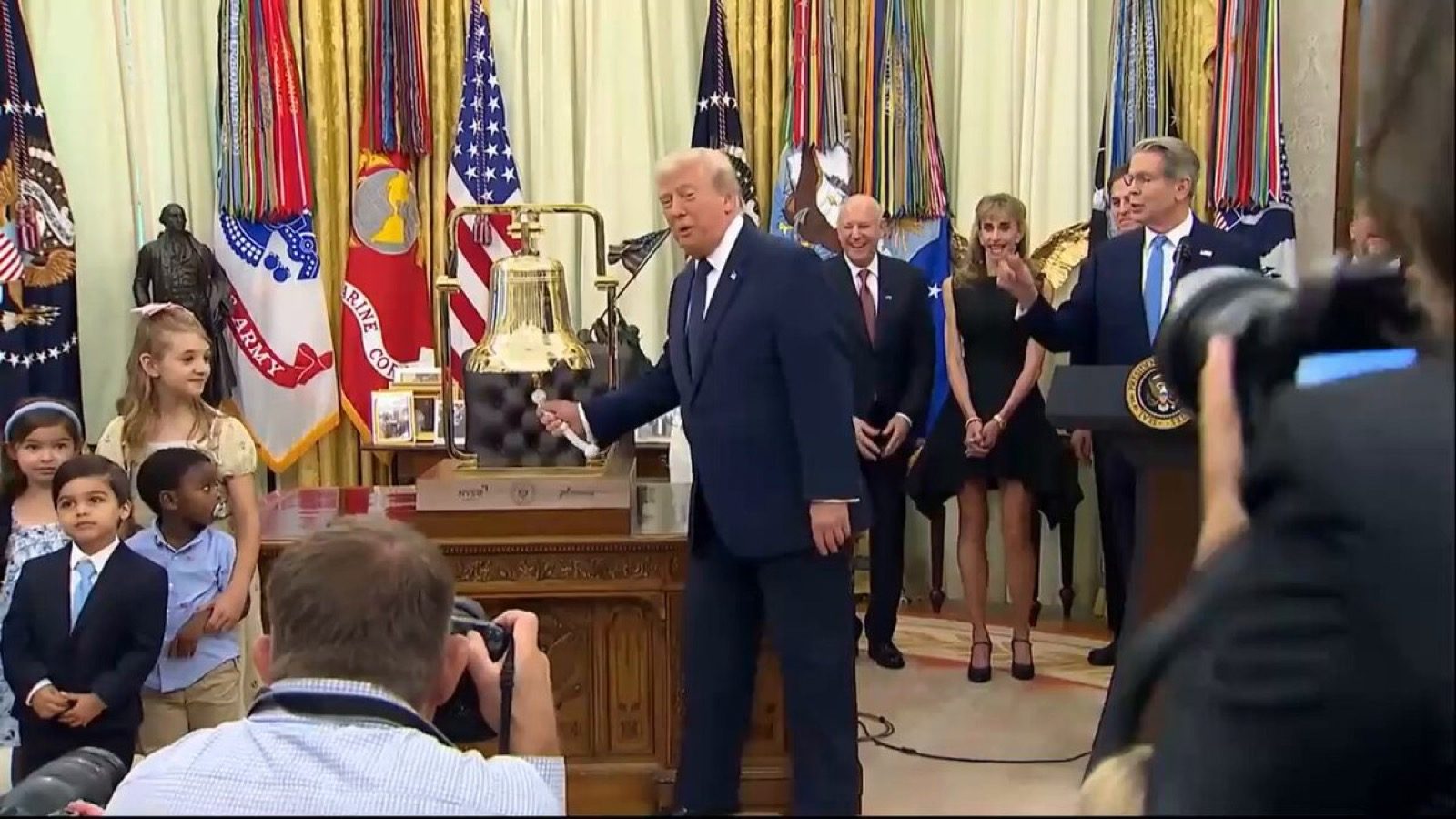
On Monday, President Trump rang the opening bells for both the New York Stock Exchange and Nasdaq from the Oval Office as Trump Accounts formally entered the market.
He said the accounts would begin growing alongside the American economy and that $800 million in seed money and private contributions would be invested for children during launch week.
The White House described the ceremony as a historic first: President Trump ringing both the NYSE and Nasdaq opening bells from the Oval Office as more than six million Trump Accounts had already been requested. More than 86% of those requests came from families earning under $200,000 per year, and the administration said the tax-advantaged accounts were created to give children a direct stake in American business.
The accounts are free to open for every U.S. citizen under 18, including children who fall outside the window for an automatic federal deposit. Children born from January 1, 2025, through December 31, 2028, are eligible for the $1,000 seed investment, while older children can receive family, employer, charitable and government contributions once an account is opened.
More than 50 companies have committed to making additional contributions for employees’ children. Private gifts and employer contributions can reach children outside the newborn window, giving older minors a path into the same ownership program.
The launch puts money behind the speeches. Instead of telling young Americans that the stock market matters, it gives them an account, a balance and years for compound growth to do its work.
The Treasury Department says parents can now fund accounts, link bank accounts, track investment performance and use 15 financial-education modules covering saving, diversification and compound growth.
That is where a booming market can become more than a headline for people who already own plenty of stock.
Treasury Secretary Scott Bessent said 38% of American families still have no exposure to the equity markets. A country that celebrates record highs while leaving more than a third of its families outside the ownership economy is leaving too much opportunity on the table.
The app also gives parents recurring-contribution tools and lets children follow their balances over time. Treasury says employers, charities and governments can contribute, while participating companies can use the accounts as a tax-preferred family benefit for workers.
Trump Accounts will not solve every cost-of-living problem, and no honest person should pretend they will.
They do something more basic: put a real asset in a child’s name, give families a reason to learn how markets work and let compound growth begin before adulthood.
That makes Friday’s close more tangible.
Wall Street can reverse on Monday. It always can.
But the closing number is a fact: 7,575.39, only 0.6% below the S&P 500’s all-time high after a week dominated by war, oil, interest rates and AI volatility.
The market took all of it and moved higher.
For now, capital is still betting on America.

Join the conversation!
Please share your thoughts about this article below. We value your opinions, and would love to see you add to the discussion!