

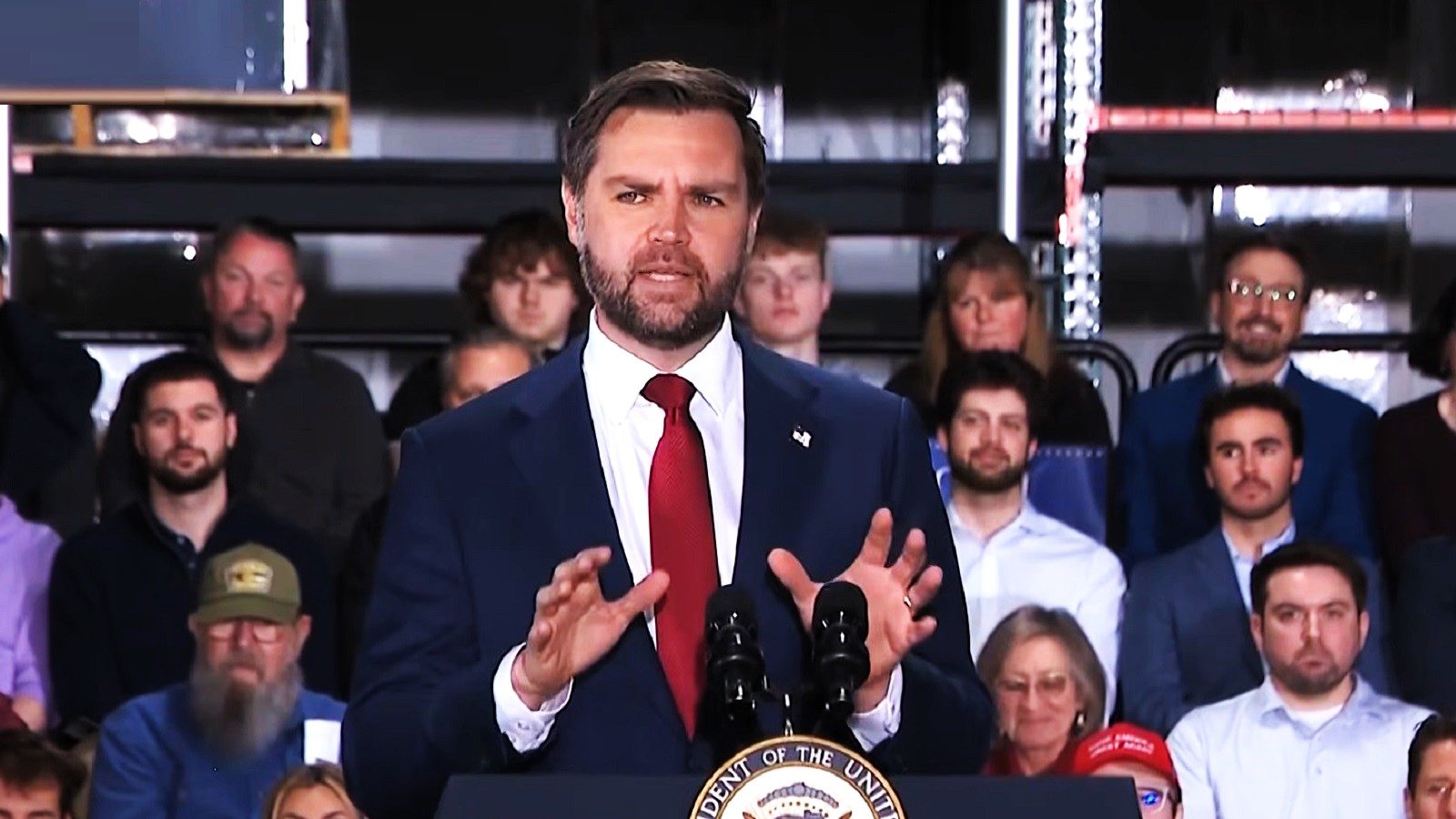
Vice President JD Vance stepped to the podium on Tuesday and delivered a message Tehran would be wise to hear clearly.
Speaking to reporters, Vance said the Iranians understand exactly where the line is drawn and that they want to make a deal. But he was careful not to declare victory before the ink is dry.
“The Iranians recognize that a nuclear weapon is the red line for the United States of America,” Vance said. “But we’re not going to know until we’re actually putting pen to paper on signing” a deal.
That framing is deliberate. The President Trump administration is negotiating from a position of overwhelming strength, and Vance made no effort to sugarcoat the reality that diplomacy only works when the alternative is credible force.
The comments came as President Trump weighed military options alongside diplomatic efforts.
Axios reported on the White House meeting behind the latest Iran pressure campaign.
President Trump held a meeting on Iran war plans after pausing an attack, according to the report.
The room included Vice President Vance, Secretary of State Marco Rubio, White House envoy Steve Witkoff, Defense Secretary Pete Hegseth, Joint Chiefs Chairman Gen. Dan Caine, and other senior officials.
That lineup shows this was not idle talk from a podium. The White House was weighing military options while continuing to test whether Tehran is serious about a deal.
The key point is leverage. President Trump has not taken force off the table, and Vance’s briefing made clear that the administration still sees military pressure as the backup option if Iran refuses the nuclear red line.
Axios framed the bottom line around Trump’s warning that the U.S. may have to deliver another major strike if Iran does not move. That is the backdrop for Vance’s message: diplomacy is open, but the threat is real.
The timing also matters. Vance was not speaking in a vacuum; he was explaining the administration’s position after President Trump had already shown Iran that another strike was being seriously considered.
This is classic Trump-era deterrence. You do not walk into negotiations without the other side knowing you are fully prepared to act.
The pressure campaign extends well beyond the negotiating table. U.S. military assets remain positioned throughout the Gulf region, and tensions around the Strait of Hormuz have kept global energy markets on edge for weeks.
The Guardian carried the key lines from Vance’s briefing on Iran and the administration’s two-path strategy.
Vance said the U.S. has a simple proposition for Iran: the regime cannot have a nuclear weapon. He warned that Iran becoming the first domino in a wider nuclear arms race would make the world much less safe.
He said the U.S. is willing to cut a deal if Iran meets the core issue of never having a nuclear weapon. He also said the administration believes a deal is possible and that Washington is negotiating in good faith.
Then came the hard edge. Vance said Option B is restarting the military campaign to continue pursuing America’s objectives if Iran will not meet the red line.
He said that is not what President Trump wants and not what he believes Iran wants either. But he also said the president told him the United States is locked and loaded, willing and able to go down that path if necessary.
AP also tracked the White House briefing and Vance’s effort to draw a line between pressure and endless war.
Vance described the conflict as something different from the open-ended wars that exhausted the country for years. He said the active period of conflict had lasted roughly five weeks, with a large part of the broader timeline unfolding under a ceasefire.
ADVERTISEMENTThat matters because the Trump administration is making two arguments at once. Iran cannot be allowed to cross the nuclear threshold.
At the same time, America does not need to stumble into another endless Middle East commitment to enforce that red line.
Vance’s answer was built around that balance. He defended the pressure campaign, kept the door open to negotiations, and insisted the objective is to take care of business and bring American forces home.
That is the America First lane: no nuclear Iran, no weak paper deal, and no forever war.
ADVERTISEMENTIt also gives President Trump room to negotiate without surrendering the leverage that brought Iran back to the table in the first place.
The contrast with the old Washington model is clear. This is not a blank check for intervention; it is a deadline-backed demand that Iran choose between a real nuclear concession and renewed American pressure.
Vance also had a lighter moment during the press conference that caught attention online. When a reporter raised her hand, the Vice President said he didn’t know her name but complimented her cross necklace before taking her question.
JD VANCE: I don’t know your name. You have a beautiful cross necklace though, so go ahead
Q: Cara Castronuova, Lindell TV pic.twitter.com/yHX05h5cSV
— Aaron Rupar (@atrupar) May 19, 2026
The reporter identified herself as Cara Castronuova from Lindell TV. It was a small moment, but the kind of genuine, unscripted exchange that rarely makes it out of a press briefing without being twisted by hostile media.
The bigger picture remains serious. Iran’s nuclear ambitions have been the defining security challenge in the Middle East for more than two decades.
Multiple administrations have tried diplomacy, sanctions, and strategic ambiguity.
The Trump administration is trying something different: making the threat unmistakable while leaving the door open for a real agreement.
Vance’s words were carefully chosen. He did not promise a deal or predict one.
He simply made the consequences of failure crystal clear.
That is how you negotiate with a regime that has spent years stalling, enriching uranium, and testing the patience of the civilized world. You make the red line real, and you make sure everyone knows it.

Join the conversation!
Please share your thoughts about this article below. We value your opinions, and would love to see you add to the discussion!