

Ok, buckle up folks because I’ve got a LOT to unpack here….
A lot of rumors are flying about what President Trump will or won’t do soon, and most of it centers around rumors that he will soon invoke these 18th century Presidential Powers like the “Wartime Alien Enemies Act of 1978” or the “Insurrection Act of 1807”.
We covered the first one earlier today:
President Trump Will Invoke Wartime Alien Enemies Act Of 1798
Now I want to dig into the other one, because they are, in fact, two totally different things, but rumors are flying about both and I'm seeing a lot of people conflating the two.
Here's a quick summary:
Alien Enemies Act of 1798
Rumors have swirled since the "Summer of Love" in 2020 that President Trump would invoke the Insurrection Act:
What Is the Insurrection Act? Trump Threatened to Use it to Deploy the Military... Along with the Patriot act any misdemeanor such as protesting past curfew can land people in legal semantics ‘Terrorist List’. Vote if you want to make a change. https://t.co/SneC0AgFcs
— Michelle Rodriguez (@MRodOfficial) June 3, 2020
And quite frankly? I think he should have during all the BLM and ANTIFA chaos.
That's exactly what it was made for.
But President Trump exercised extreme restraint and did not use it.
That's our first clue as to whether or not President Trump might use it now in 2025....if he didn't use it when BLM and ANTIFA were burning down major US Cities, is it likely he will use it now? It could surely happen, but let's just say I'm not fully convinced.
But Liberals are melting down:
Here’s a crazed liberal claiming Trump will invoke the Insurrection Act of 1807 to deploy military force against American citizens.
This will apparently happen on April 20th. pic.twitter.com/RnF8xX8QmU
— Natalie Jean Beisner (@NJBeisner) March 11, 2025
So why is this coming up now?
Because of an Executive Order signed by President Trump on his first day in office back on January 20th titled: "DECLARING A NATIONAL EMERGENCY AT THE SOUTHERN BORDER OF THE UNITED STATES".
In that Executive Order was this paragraph:
(b) Within 90 days of the date of this proclamation, the Secretary of Defense and the Secretary of Homeland Security shall submit a joint report to the President about the conditions at the southern border of the United States and any recommendations regarding additional actions that may be necessary to obtain complete operational control of the southern border, including whether to invoke the Insurrection Act of 1807.
So to be fair, the Democrats aren't freaking out for no reason....it turns out they actually read the Executive Order -- or at least one person did and then it started going viral.
And that 90 day period is up on April 20th, but that's just the deadline -- it could happen earlier. In fact, the report could already be on President Trump's desk, we don't know for sure.
Fox News had more analysis:
On his first day back in office, the president signed a litany of executive orders, including one declaring a state of emergency at the southern border.
ADVERTISEMENTAccording to the order, the Secretary of Defense and the Secretary of Homeland Security have 90 days to submit a report about the conditions at the border and any recommended actions that need to be taken to secure, "including whether to invoke the Insurrection Act of 1807."
Here’s what the act is, and what it could mean if invoked:
What is the Insurrection Act of 1807?
Dig deeper:
The Insurrection Act allows presidents to call on reserve or active-duty military units to respond to unrest in the states, an authority that is not reviewable by the courts. One of its few guardrails requires the president to request that the participants disperse.Congress passed the act in 1792, just four years after the Constitution was ratified. Joseph Nunn, a national security expert with the Brennan Center for Justice, told The Associated Press it’s an amalgamation of different statutes enacted between then and the 1870s, a time when there was little in the way of local law enforcement.
ADVERTISEMENT"It is a law that in many ways was created for a country that doesn’t exist anymore," he added.
It also is one of the most substantial exceptions to the Posse Comitatus Act, which generally prohibits using the military for law enforcement purposes.
VP Vance Delivers Remarks at U.S.-Mexico Border
Vice President JD Vance toured the U.S.-Mexico border Wednesday, meeting with law enforcement to highlight immigration policies that the White House says have led to fewer arrests since Trump’s second term. Accompanied by Defense Secretary Pete Hegseth and DNI Director Tulsi Gabbard, Vance is among the highest-ranking Republicans to visit the border. After a helicopter tour of Eagle Pass, they visited a Border Patrol facility and joined a roundtable discussion.Past use of the Insurrection Act
The backstory:
Presidents have issued a total of 40 proclamations invoking the law, some of those done multiple times for the same crisis, Nunn said. Lyndon Johnson invoked it three times — in Baltimore, Chicago and Washington — in response to the unrest in cities after the assassination of Dr. Martin Luther King Jr. in 1968.During the Civil Rights era, Presidents Johnson, John F. Kennedy and Dwight Eisenhower used the law to protect activists and students desegregating schools. Eisenhower sent the 101st Airborne to Little Rock, Arkansas, to protect Black students integrating Central High School after that state’s governor activated the National Guard to keep the students out.
George H.W. Bush was the last president to use the Insurrection Act, a response to riots in Los Angeles in 1992 after the acquittal of the white police officers who beat Black motorist Rodney King in an incident that was videotaped.
Could Trump invoke the Insurrection Act?
Almost anything and everything is on the table during a Trump presidency.Big picture view:
He’s already fired top Pentagon officials and military lawyers, leading some critics to say the firings are an ominous sign, given that Trump has long made clear his desire to involve the military in his domestic policy goals, including his crackdown on immigration.ADVERTISEMENTIn Congress, which has the power to restrict the use of military force through funding and other authorizations, Republicans are largely on board with Trump’s plans.
The other side:
Democrats in Congress tried to update presidential powers like the Insurrection Act before Trump’s second term but found little success.That left them instead issuing dire warnings that Trump now has fewer guardrails on how he could use the military. He has shown an ability to bend institutions to his goals, from a Supreme Court willing to reconsider long-standing interpretations of presidential powers to a military scrubbed of officers and leaders likely to push back on his plans.

Newsweek had more on what we're hearing from key figures:
What People Are Saying
Homeland Security Secretary Kristi Noem, in a recent statement: "The drop in illegal border crossings has been fantastic: 95% since President Trump took office. We'll keep our military at the border until it is entirely closed."
Homeland Security Secretary Kristi Noem, on X, formerly Twitter, on Monday: "In February, there were just 8,326 apprehensions at the U.S. Mexico border. That is lowest number in recorded history. President @realDonaldTrump has delivered a powerful message and the world is taking notice: America's borders are CLOSED to lawbreakers."
President Donald Trump, in a March 4 address to Congress: "The territory to the immediate south of our border is now dominated entirely by criminal cartels that murder, rape, torture and exercise total control. They have total control over a whole nation. posing a grave threat to our national security."
Ruth Ben-Ghiat, a historian and political commentator, on X on Friday: "Americans, Trump is apparently now considering the invocation of the Insurrection Act. He has asked Hegseth & Noem to weigh in on the issue. Autocrats use such measures to speed power consolidation, repress protests and demonstrate force to the world."
White House spokesperson Kush Desai told Politico in February: "After four years of a lackadaisical approach to border security and immigration, every lever of executive power is now being marshaled to enforce our laws, mass deport criminal illegal immigrants, safeguard our borders, and put American citizens first."
Brett Wagner, a retired professor of national security decision making for the U.S. Naval War College, in an opinion piece in the San Francisco Chronicle on Wednesday: "Many of us are now holding our collective breath, knowing that the report and what it contains could put us on the slippery slope toward unchecked presidential power under a man with an affinity for ironfisted dictators."
Here's a deeper analysis on how likely this is to happen:
What It Would Take for Trump to Invoke the Insurrection Act
The Insurrection Act (codified in 10 U.S.C. §§ 251–255) grants the president broad authority to deploy federal troops under certain circumstances. Below is an organized overview of the conditions, practical scenarios, administrative steps, political justification, and the likelihood analysis regarding its potential invocation by Trump.
ADVERTISEMENT
Legal Triggering Conditions
For the Act to be invoked, the president must determine that an “insurrection, domestic violence, unlawful combination, or conspiracy” exists. This determination typically falls into one of two categories:
State-Requested Intervention (§ 251):
When a state is unable to enforce its own laws and formally requests federal assistance from its legislature or governor.Federal Law Enforcement Impediment (§ 252–253):
When domestic disturbances hinder the execution of federal laws or infringe on constitutional rights to the extent that ordinary judicial processes become impracticable.Additional Note:
No formal congressional approval is required; however, the president must issue a proclamation ordering insurgents to disperse before deploying troops (§ 254).
Practical Scenarios
Several potential scenarios might provide a pretext for invoking the Act:
Border Security Crisis:
- Trump’s administration has underscored a southern border emergency.
- An executive order mandates a report from the Secretaries of Defense and Homeland Security within 90 days (due around April 20, 2025).
- Should the report cite overwhelming illegal migration or violence (e.g., cartel-related unrest) as an "unlawful obstruction" to federal immigration law, it could justify invoking the Act.
Widespread Protests or Riots:
- Significant civil unrest, such as mass protests against Trump’s policies (immigration crackdowns, tariffs, or D.E.I. rollbacks), could be portrayed as an insurrection if it disrupts federal operations or state governance.
State Resistance:
- If a state—such as sanctuary cities resisting federal immigration enforcement—refuses to comply with federal directives, it might be argued that this obstruction necessitates military intervention.
Administrative Steps
The decision-making process would likely involve several key actions:
Consultation:
- Trump would consult with key advisors (e.g., Defense Secretary Pete Hegseth, National Security Adviser Mike Waltz) and review the outcomes of the border report.
Proclamation and Deployment:
- A public proclamation ordering insurgents to disperse would be issued.
- This would be followed by the deployment of active-duty military or federalized National Guard units.
Political Justification
To justify such a drastic measure, Trump would need to frame it as a necessary response to a crisis:
- Rhetorical Framing:
- Emphasizing "law and order" and national security, as seen in his March 4, 2025, congressional address.
- Selling to the Base and Public:
- The move would be presented as decisive leadership during a time of crisis, aligning with his history of strong executive actions.
Historical Precedents
- 1992 Los Angeles Riots:
- The Act was invoked during the riots under President George H.W. Bush.
- Enforcement of Desegregation (1957):
- President Eisenhower also relied on the Act to enforce desegregation.
While the threshold is not exceedingly high, historical uses of the Act have been tied to acute, visible disorder.
Likelihood Analysis
Supporting Factors
Border Focus:
- Early executive orders and the upcoming border report might provide a tailored justification if they highlight significant disorder linked to migration.
Historical Precedent and Advisory Support:
- Trump’s consideration of the Act during the 2020 George Floyd protests, coupled with recent Pentagon purges and consultations with hawkish advisors, indicates a readiness to flex executive power.
Political Climate:
- With a Republican-controlled Congress and strong base support, there is less immediate legislative pushback against a decisive, albeit controversial, action.
Countervailing Factors
Lack of an Acute Crisis:
- As of March 12, 2025, there are no widespread insurrections or riots on the scale of previous events (e.g., the 1992 LA riots).
Judicial Oversight:
- The potential for federal courts to intervene if the use of the Act appears disproportionate or politically motivated.
Congressional and Public Reaction:
- While some Republicans may support such a move, moderates and Democrats could mobilize against perceived overreach, particularly if public opinion (as per recent polls) favors addressing economic issues over security theater.
Military Reluctance:
- There may be internal military resistance to deploying troops domestically, especially given sensitivities following January 6, 2021.
Probability Assessment
Short-Term (Next 3 Months):
- Moderate Likelihood (40–50% chance):
The outcome of the border report is pivotal. Should it provide a clear justification tied to specific incidents, action might be taken by May 2025. In the absence of a clear crisis, however, Trump is likely to refrain.Longer-Term (Within the First Year):
ADVERTISEMENT
- Higher Likelihood (60–70% chance):
If his policies continue to provoke protests or state defiance, Trump may find sufficient pretext to invoke the Act as part of a broader strategy to expand executive power.
Critical Perspective and Conclusion
The narrative in mainstream media (e.g., NYT, WaPo) suggests that Trump’s flirtation with the Insurrection Act borders on authoritarian overreach. While his supporters may view it as decisive leadership, the truth seems to be opportunistic rather than premeditated. The upcoming border report is critical; a mild report may keep this hypothetical, whereas an alarmist one could significantly increase the odds.
In summary:
For Trump to invoke the Insurrection Act, a plausible crisis—whether at the border or in the form of civil unrest—must emerge, providing both legal and political justification. Presently, the necessary groundwork (executive orders, loyal advisors, and a supportive base) is in place, but no definitive crisis has materialized. The likelihood is moderate in the near term, with potential to rise if conditions change.
I actually first warned you about this nearly a year ago...
We were one of the first outlets to even cover this idea.
See here from early 2024:
Biden Panicked That Trump Will Invoke The Insurrection Act” — Here’s What That Actually Means
Biden Panicked That Trump Will Invoke The Insurrection Act" -- Here's What That Actually Means
We've heard a lot about "Insurrection" over the last 3 years...
Way more than I ever care to hear for the rest of my life.
A made up and fake "scandal" designed to divert your attention from the truth.
Basically, this meme:
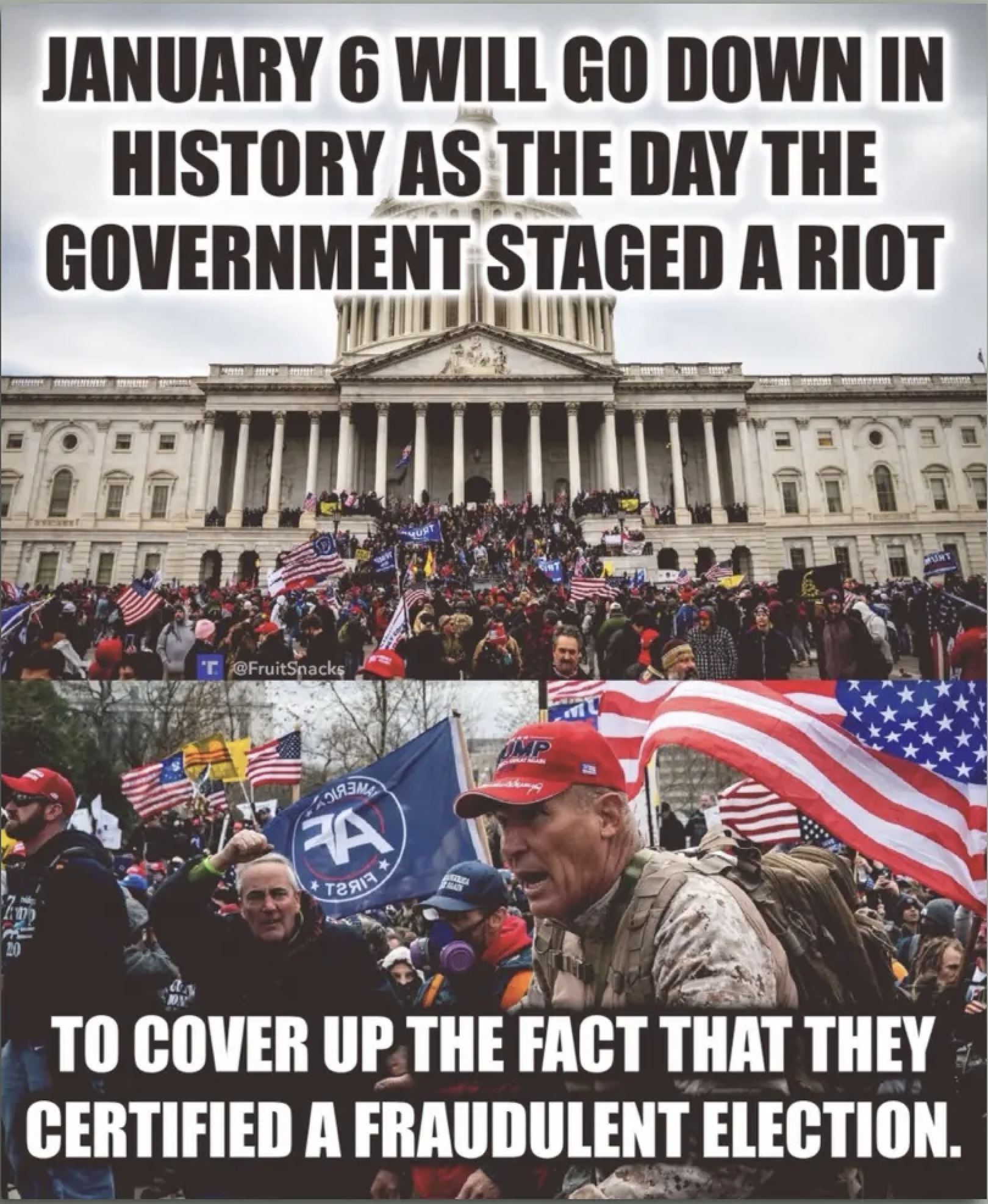
But while we've heard copious amounts of talk about "acts of insurrection" we haven't heard much about the "Insurrection Act".
Two very different things.
I'm going to explain the "Insurrection Act" to you in just a moment, but first let me show you this very angry, panicked video from a recent Biden speech.
If you ask me, they know what's coming and they are terrified:
Biden says that “Trump plans to invoke the Insurrection Act which will allow him to deploy US military forces on the streets of America.”
This panic-ridden speech is absolutely hilarious. It’s so cartoonish that they are either scared to death of what’s to come or they are… pic.twitter.com/0JrxtkjIo7
— Noah Christopher (@DailyNoahNews) January 5, 2024
Biden says that “Trump plans to invoke the Insurrection Act which will allow him to deploy US military forces on the streets of America.”
This panic-ridden speech is absolutely hilarious. It’s so cartoonish that they are either scared to death of what’s to come or they are purposely sabotaging themselves.
Cartoonish is absolutely right.
Just look at how his face contorts with anger and evil, that's some wild stuff!
But back to the topic at hand, why is Joe Biden so panicked about President Trump using the Insurrection Act?
Let me explain....
Trump May Deploy "Ironic" 1795 Law To Clean Up America
Occam's Razor says that the simplest answer is usually correct.
Elon Musk often jokes that the most "ironic" outcome is usually the most likely to occur.
And he might just be right on this one.
What is the one word the Crooked Media and Crooked Congress has tried to sink President Trump with since January 2021?
"Insurrection"
In that context, people afraid that President Trump will win again (big league) in 2024, have tried to use the "Insurrection Clause" of the 14th Amendment to bar him from the ballot:
- Prohibition Against Holding Office: Section 3 of the 14th Amendment states that no person shall hold any office, civil or military, under the United States or under any state, who, having previously taken an oath as a member of Congress, or as an officer of the United States, or as a member of any state legislature, or as an executive or judicial officer of any state, to support the Constitution of the United States, shall have engaged in insurrection or rebellion against the same, or given aid or comfort to the enemies thereof.
Of course we know that's completely bogus, but did you know there is actually a different law on the books from 1795 called The Insurrection Act?
Totally different thing, and the irony above all ironies is that President Trump may deploy it on Day 1 of his Presidency to clean up America:
The Insurrection Act of 1795 is a United States federal law that empowers the President to deploy U.S. military and federalized National Guard troops within the United States in specific circumstances, such as to suppress civil disorder, insurrection, and rebellion. The key aspects of this act include:
- Authorization for Use: The Act allows the President to use the armed forces to address an insurrection in any state which requests it, or in situations where it's necessary to enforce federal law.
- Conditions for Deployment: Before deploying troops, the President must first issue a proclamation ordering the insurgents to disperse within a limited time. If the situation does not resolve after this proclamation, the President can then use military force.
- Historical Context: Enacted in 1795, the law was a response to the Whiskey Rebellion, a 1794 uprising against federal tax collections in western Pennsylvania.
- Subsequent Amendments: The Act has been amended several times, most notably by the Posse Comitatus Act of 1878, which limits the use of military personnel under federal command for law enforcement purposes within the United States.
- Modern Usage: The Insurrection Act has been invoked on several occasions throughout history, including during the Los Angeles riots in 1992 and in response to Hurricane Hugo in 1989.
America has become a third world country.
Our major cities are not even safe to walk in any more.
Have you seen this from Chicago?
Chicago has fallen. Third world
Shithole!— Noah Christopher (@DailyNoahNews) September 17, 2023
Or this filth from New York?
Breaking News:
Democrats Piss Themselves on Trains Now... https://t.co/oBdPGn6RF7
— Rob/1865 (@Rob1865_) November 28, 2023
Or this TERRIFYING attack on a woman in Chicago?
THIS IS THIRD WORLD COUNTRY SHIT! Lock these thugs up or just execute them if needed....YES or NO? https://t.co/tAUZsRlQsA
— Noah Christopher (@DailyNoahNews) November 28, 2023
Time to clean it up, and President Trump is just the man to do it.
Here is The Associated Press:
“You look at these great cities Los Angeles, San Francisco you look at what’s happening to our country… We cannot let it happen any longer. And one of the other things I’ll do.. Because you know you’re supposed to not be involved in that you just have to be asked by the governor or the mayor to come in…
The next time, I’m not waiting. One of the things I did was let them run it, and we’re going to show how bad a job they do,” he added.
You can see the clip in this speech at the 1:50:00 mark -- the play button should cue it up right to that spot:
The Insurrection Act allows presidents to call on reserve or active-duty military units to respond to unrest in the states, an authority that is not reviewable by the courts. One of its few guardrails merely requires the president to request that the participants disperse.
“The principal constraint on the president’s use of the Insurrection Act is basically political, that presidents don’t want to be the guy who sent tanks rolling down Main Street,” said Joseph Nunn, a national security expert with the Brennan Center for Justice. “There’s not much really in the law to stay the president’s hand.”
A spokesman for Trump’s campaign did not respond to multiple requests for comment about what authority Trump might use to pursue his plans.
Congress passed the act in 1792, just four years after the Constitution was ratified. Nunn said it's an amalgamation of different statutes enacted between then and the 1870s, a time when there was little in the way of local law enforcement.
“It is a law that in many ways was created for a country that doesn’t exist anymore,” he said.
It also is one of the most substantial exceptions to the Posse Comitatus Act, which generally prohibits using the military for law enforcement purposes.
Trump has spoken openly about his plans should he win the presidency, including using the military at the border and in cities struggling with violent crime. His plans also have included using the military against foreign drug cartels, a view echoed by other Republican primary candidates such as Florida Gov. Ron DeSantis and Nikki Haley, the former U.N. ambassador and South Carolina governor.
What do you think?
Here's something else that's very interesting....
Apparently, AI was asked what would have happened if President Trump had used the Insurrection Act back in January of 2020 before he left office....
The answer?
It would have destroyed the country.
In other words, this is EXACTLY why we had to have the 3-year "Pause".
President Trump Once Again Explains “The Pause” — This Time In More Detail
WOW: AI Confirmed The Insurrection Act Would Have Destroyed The Country
This is really interesting...
Yes, this is from the Charlie Ward show, but let me explain.
I've been fairly public over the years of saying I'm not a big fan of Charlie Ward and I'm a much lesser fan of Simon Parkes.
But I do really like Juan O'Savin (which I'm sure is not his real name).
I do believe Juan is not just a casual observer, I believe he's probably someone very connected, which I assume from the way he speaks.
Just my two cents.
I also really appreciate his Biblical world view.
Even in this interview he tells people to not "follow a guru" but to get a direct connection to "Our Father in Heaven".
And he's made many comments in the past that lead me to believe that's a Biblical, Christian view of God and not what these evil Elites think of their "gods".
But anyway, back to the interview.
Juan was on with Charlie Ward and Simon Parkes and while I d0n't put too much stock in what they say, I did find the interview fascinating.
And most of it was Juan speaking.
This is an entirely new interview, so even if you've heard some of his recent interviews there is a lot new in here.
Perhaps the most interesting part to me was his discussion of The Insurrection Act and whether or not Trump signed it.
Juan says absolutely not.
And for the record, President Trump has also said absolutely not.
Although it was considered.
According to Juan, President Trump was extremely close to signing it but then decided not to after Artificial Intelligence computer modeling ran all the scenarios and determined it would send our country into a new Civil War (65% vs. 35%) -- one we likely would never have recovered from.
There's a lot more in here too, including a full breakdown of the Brunson Supreme Court case and why it's likely to succeed.
FRAUD VITIATES EVERYTHING.
The whole interview is great (just take Charlie and Simon with a grain of salt, although they do say we're going to have a very good Christmas, so that is encouraging if true).
Please enjoy this one...
Watch here on Rumble:
And speaking of the SCOTUS case, we could use your help!
Brunson vs. Adams, Here's What Can You Do To Help!
Calling all patriots!
Since early November, I've been telling you about the Brunson Brothers Supreme Court case, Brunson v. Adams.
I've been telling you it's special.
I've been telling you it's unlike all the rest.
And now I'm calling for your help...
Thanks to WomenImpactingNation and PrayingMantis, I've got a great Q&A for you to answer some of the top questions...
...as well as a call to action that everyone can help with!
I know the deadline says December 15, but if you take action today it may still make a big difference.
So please jump in.
From WIN (originally sourced from PrayingMantis), please read the following:
This post is about the very important Brunson vs. Alma S. Adams, et al. case that is now before the U.S. Supreme Court. Please read to the end!
THE INFORMATION BELOW HAS BEEN REPRINTED IN PART WITH PERMISSION FROM PRAYING MANTIS at SUBSTACK. Links to the full, original posts are at the end of this article, with instructions and links to the letter you are being asked to write and mail ASAP! It must be mailed BEFORE DECEMBER 15!
If you attended the W.I.N. Christmas party, you heard a little intro to what’s going on. Perhaps you have read a newsletter or an online media report about how critical this case is to our freedom.
You need to know what is at stake and the “Hail Mary” action that we the people must take to save our United States of America republic.Please read this post in its entirety to get a better understanding of what the case is about and how it impacts every American.This is not about party or politics – each person has the right to their own opinions and affiliations. However, we can’t have a functioning society or country unless our voting system is trustworthy. Since 2020, many have investigated and proven electoral malfeasance. Now, after the 2022 midterms, most have realized that our electoral system is untrustworthy. Without election integrity, we are no longer a free nation.Brunson v. Adams would seem to be a rather obscure case originating in Utah that seeks redress for the violation of Mr. Brunson’s constitutional rights to participate in a fair and honest election.
After the overwhelming irregularities observed in the 2020 Presidential election, ordinary citizens questioned the validity of those results. So did some intelligence agencies. In fact, there was palpable concern that foreign entities colluded with domestic actors to subvert the election, affect the outcome, and perform maneuvers favoring of a candidate aligned with their interests. Some congressmen and a few senators raised valid arguments regarding electoral malfeasance.
United States law provides a 10-day pause for Congress to review election-related data when such circumstances arise. This examination should have been conducted prior to certifying the electors that placed Biden into office.
Instead, Congress rushed to install what is arguably a Manchurian candidate into the Presidency of the United States. 291 Representatives failed to perform the legal requirement of reviewing prior to certifying.
They intentionally refused to investigate the evidence and conspired to cover it up. By allowing fraudulent votes to be counted, they knowingly mocked their oath to support and protect the U.S. Constitution against all enemies, foreign and domestic.
Brunson v. Adams focuses not on the outcome of the Presidential election, but on the representatives’ failure to fulfill their legal duties. The defendants should have rejected the electoral college votes from those states with untrustworthy, unreliable, and unworthy electoral systems. Instead, they committed what technically amounts to an act of war and treason.
Should Brunson v. Adams succeed, the implications are staggering and life-altering. 291 Representatives, 94 US Senators, President Biden, V.P. Harris, and former V.P. Pence are defendants who could be removed from office and/or tried for high crimes for their participation in this illegal operation.
We MUST convey to the Supreme Court our support of case 22-380. We feel our nation has been captured by corruption at the highest levels and are concerned that our country has experienced a national security breach. Our greatest right as citizens has been violated because our vote has been compromised and devalued. We are asking the Justices to grant Brunson’s petition. So we are IMMEDIATELY writing letters to the Supreme Court of the United States – and are asking you to do the same.
Imagine if SCOTUS received one million letters from ordinary Americans. How about if 10 million students, grandmas, aunts, moms and dads sent them a note of encouragement? If America falls, so does the rest of the world. How about letters from Australia, Canada, Italy, Brazil … China? We must speak up now!
While SCOTUS can choose to hear this case at any time, interestingly enough, it is scheduled to be in conference on January 6, 2023. Therefore, it is critical the justices receive a wave of our letters before they break for Christmas – so we must act TODAY. Tell your friends and family and coworkers. Have them tell theirs and those folks tell theirs! Share this post. Copy-and-paste it into an email. Forward the W.I.N. newsletter. Get this out to every single person you know.
Here is how (please read all of the instructions):
1) Mail a letter to SCOTUS. The text is provided in the link but please make sure you add a P.S. Handwritten is best since personalization is extremely meaningful. Have your kids and grandkids send a letter as well. Ask them to draw a picture or decorate with stickers!
CLICK HERE to go directly to the document which you can print, edit, personalize and mail.
2) Copy your letter.
3) MAIL the original to the Supreme Court and MAIL a copy to the Brunson Brothers. This is critical so the Brunson legal team can validate the amount of letters the Supreme Court is receiving.
Supreme Court Address:
Supreme Court of the United States
Attn: Chief Justice John Roberts, Jr. and All Associate Justices
1 First Street N.E.
Washington, DC 20543.Brunson Address:
Loy & Raland Brunson
4287 South Harris Blvd. Apt. 132
Ogden, Utah 844034) Consider donating to the Brunsons to help pay for the legal costs of this litigation – CLICK HERE.
5) Send these instructions to your friends and family. Have letter-writing parties or host a zoom call to write letters together. Be creative, action-oriented, and effective! Reach out overseas: America may be the last light out unless we all come together.
6) Time is of essence. Please mail NOW.
To read the original posts with greater detail, go to:Here is the link to the letter itself:
https://docs.google.com/document/d/1vpq- CWbB7mAihrYbmFNVM0FDfIKKWWkg2N t8HQSZ2oA/edit# Here is a link to a site with a chronology of the lawsuit:DO YOUR OWN RESEARCH – THIS CASE IS ALL OVER THE INTERNET.BUT GET THOSE LETTERS WRITTEN TODAY!
This thing is really heating up...
When I very first reported on it, people didn't even think it could be real.
Now?
Now EVERYONE is talking about it...
👇👇👇👇👇
Mike Huckabee: "I Guarantee This Supreme Court Case Is Real..."
When I first started covering the Brunson Brothers Supreme Court case, I got a lot of doubts and complaints.
Grumbling, really.
I compared it to the Israelites in the desert.
Fair comparison.
People saying the case wasn't real...
People asking why The Gateway Pundit and Epoch Times hadn't covered it if it was real....
All this despite the fact that I showed the Supreme Court website and docket confirming it was real.
Still, grumbling.
And then?
Then the Gateway Pundit covered it.
Then the Epoch Times covered it.
Now?
Now Mike Huckabee is covering it, and not only that he says "I guarantee this is real".
The leader paving the way always gets some slings and arrows in his back, and that's ok. I'm used to it.
But I was right and you should trust my reporting.
We don't run with a story if it's not verified.
And I had this one locked down to the "T".
As in, President T may be returning soon!
Here is Mike Huckabee:
The Supreme Court has agreed to a hearing for a case that could conceivably --- PLEASE consider this the longest of long shots --- overturn the election of 2020, throw out all the legislators who voted to certify the results and leave them ineligible to run for office ever again, even for town dogcatcher.
The case has been added to the docket for, appropriately, January 6, 2023.
There’s essentially no media attention being given to this case; most news outlets find it much too hot to touch. But the heat doesn’t faze us; we keep a pair of oven mitts close by for times like this.
As Joshua Philipp reported in a podcast for EPOCH TV, the case Brunson v. Alma Adams, et. al., alleges that members of Congress who voted against the proposed 10-day audit of the 2020 elections and certifying those results --- with no investigation after being “properly warned” of a credible threat from enemies of the Constitution --- were violating their oath of office to “preserve, protect and defend the Constitution from enemies both foreign and domestic.” It says that “this action unilaterally violated the rights of every citizen of the U.S.A. and perhaps the rights of every person living, and all courts of law.”
If SCOTUS ruled in favor of the plaintiffs, the remedy would conceivably involve removing the sitting President and Vice President and all those representatives and empower the Court to authorize the swearing-in of the rightful President and Vice President. Not kidding; that’s the remedy the plaintiffs are asking for.
The Brunson brothers are an interesting group –- literally a band of brothers, as they play in a trumpet band. Here they are, with their summary of the suit, which was reportedly written by just themselves, without legal counsel (!).
https://ralandbrunson.com
Note: Philipp’s report was made before SCOTUS agreed to hear the case, and he said then he would be “very surprised” if they did. So I guess he’s very surprised right now. Actually, I am, too, considering the way the Court refused to look into those very allegations in the weeks after the election, when they were brought by President Trump. (Of course, now we know much more about the lengths to which Trump’s enemies went to interfere with the outcome. Maybe enough Justices are feeling some guilt right now about calling the issue “moot.”)
Philipp also pointed out that this segment of his show, “Crossroads,” would not be allowed on YouTube. (Good news, though: he can now post the link on Twitter!) We’ll include the EPOCH TV link here…
https://www.theepochtimes.com/supreme-court-weighs-on-brunson-v-alma-case-that-could-overturn-2020-election_4907648.html
The argument in this case is that by not looking into serious allegations of election fraud, those who voted to confirm the results of the 2020 election broke their oath of office and are ineligible to run for any elected office again. To give you an idea of the scope of the potential fallout, Kamala Harris is in that group, and so is Mike Pence.
This started as two separate lawsuits brought by four brothers in Utah, but only one of them is advancing to the Supreme Court. To get it there, the brothers bypassed the 10th Circuit Court of Appeals, where it was stalled, by saying in a cover letter that this suit was a matter of national security. The Court was apparently so interested in this case that they received a personal call from the Court clerk asking how soon they could get their documents together. The brothers got it all to them in one week.
The suit names President Biden, VP Harris, former VP Pence, and 385 members of Congress, and, no, that is not a typo. Those are all the members who voted against a proposition for them to investigate claims that “enemies of the Constitution rigged the 2020 election.” So, this case is NOT about whether or not election fraud occurred. It’s about whether or not these people violated their oath by failing to investigate credible allegations of election rigging by enemies of the Constitution –- allegations that had been made by over a hundred of their own colleagues.
In their words: “Is this about a rigged election? No, it’s about the members of Congress who voted AGAINST the investigation, thereby thwarting the investigation. Was this a clear violation of their oath? YES.” The suit says this violation is an act of treason and fraud. “A successfully rigged election has the same effect as an act of war: to place into power whom the victor wants, which in this case is Biden, who, if not stopped immediately, will continue to destroy the fundamental freedoms of Brunson and all U.S. Citizens and courts of law.”
“When the allegations of a rigged election came forward, the Respondents had a duty under law to investigate it or be removed from office.”
According to Philipp, a finding for the plaintiffs would “also restore Trump to office because he would have been the legitimate candidate.” We’re not yet sure how that part of the argument works but are researching. Even if a majority of the Justices found merit in this case, would they be willing to do something this huge? They would be keeping in mind the potential consequences and, of course, possible effects on the balance of power. If this happened, it would be the wildest things ever to happen within our government --- a purge, really, which, I have to admit, sounds pretty great with the state our country is currently in. But you know the saying, if something sounds too good to be true, it probably is.
And here is more of my original reporting:
TRUMPet Supreme Court Case Moving Forward!
Several weeks ago, I was one of the ONLY websites to tell you about Brunson v. Adams, the Supreme Court Case that may upend the 2020 election steal.
In fact, I was so early that many people doubted it was real.
Our articles are ALWAYS real.
If I can't vet the article, I don't run it.
And this was 100% vetted by the best source possible: the Supreme Court website!
That's kind of what it means to be a journalist....
You take in all the information and sometimes you break the story!
That's what we did here.
So much so that one comment I read to my article said: I don't think it's real, I haven't seen the Epoch Times or Gateway Pundit cover it!
Well....with all apologies to the commenter, the Epoch Times covered it shortly thereafter and The Gateway Pundit covered it today....again.
I'm still waiting for my apology from the commenter (I forget who it was, they are not memorable) but I won't stay up all night waiting.
In all seriousness, the story is VERY real and very exciting!
From my friends at The Gateway Pundit, here is Tim Canova:
While there has been much public attention on the U.S. Supreme Court’s present consideration of the “independent state legislature” theory in Moore v. Harper involving North Carolina’s redistricting, that case would not immediately upend the 2020 Presidential Election. In contrast, a little-known case that appeared recently on the Court docket could do just that. The case of Brunson v. Adams, not even reported in the mainstream media, was filed pro se by ordinary American citizens – four brothers from Utah — seeking the removal of President Biden and Vice President Harris, along with 291 U.S. Representatives and 94 U.S. Senators who voted to certify the Electors to the Electoral College on January 6, 2021 without first investigating serious allegations of election fraud in half a dozen states and foreign election interference and breach of national security in the 2020 Presidential Election. The outcome of such relief would presumably be to restore Donald Trump to the presidency.
TRUMPet Brothers Supreme Court Case Update! Simplified and Next Steps EXPLAINED!
I continue to be laser focused on this Brunson Brothers Supreme Court case...
And the more I learn the more I am blown away!
And the more I am encouraged we have something very big happening here!
I have a simplified summary of the case for everyone who is still confused and I also have an INCREDIBLE video you need to watch.
Plus my take on what the next key date is...
First, a few housekeeping comments.
I know there is general fatigue out there.
People are tired.
People are weary.
We've seen disappointments and defeats along the way and I fear that just as the victory is about to present itself, too many people have fallen asleep, became complacent or became downright grumpy!
Take heart friends!
I can't guarantee this case will be successful, but it does seem to have almost everything going for it.
And I can promise you this: God will not fail. That part I know.
There might be a delay --- and how appropriate this is ADVENT season --- the season of waiting.
Did you know that?
Speaking of the Bible, I have a general warning and caution for anyone who has fallen asleep, became complacent or outright grumpy, and that warning is this: make sure you don't become an Exodus 14:11-12 Israelite.
So...what is next?
That's the really fun part.
A ruling could come at ANY minute!
Literally today (on a Sunday), tomorrow, Friday, later this month, January....we don't know.
But there is nothing stopping the SCOTUS from ruling on this immediately.
Here's my speculation....what if it came on December 24?
Bo Polny has told us to watch 9/24, 10/24, 11/24 and 12/24.
Many people said nothing has happened, except if you look at the filings in this case, they've all happened on the 23/24 of the month:



Next up: December 24.
Christmas Eve.
And what did Kim Clement say about Winter and Christmas?
"I will make them happy, says the LORD!"
Is this the year we get our big Christmas surprise?
Keep reading for the video...
The "Trumpet Brothers" Supreme Court Case Could RULE At Any Moment! Simple Explanation!
This is gonna blow some minds...
A lot of minds I assume!
Let's start with October 24 and November 24, two key dates Bo Polny told us to watch.
Nothing happened, right?
Wrong!
It turns out, perhaps the biggest Supreme Court case EVER to be filed was filed on October 24 with reply deadline on November 24 and this thing is going to absolutely blow your mind!
We've covered it before, but I know it can be a little confusing so I have the PERFECT explanation of what is going on.
Juan O'Savin (who I really like!) was on Elijah Streams today and he laid it all out.
I mean, everything!
It was SO easy to understand and by the end I couldn't even sit down, I was just pacing in my room with excitement!
Folks, it's all coming together.
You have to understand this: the Clerk of the Supreme Court contacted the Brunson Brothers and asked them if they could speed up their filing!
That is almost unprecedented!
The Supreme Court wants this case!
And if it's successful, the end result means all 388 people elected in 2020, including Joe Biden and Kamala Harris were elected Unconstitutionally and they DO NOT HOLD public office!
They'd be gone in one moment!
Just like Bo Polny told us, in a 24 hours period, everything changes!
Wiped out!
Gone!
Trump immediately back in, as if he never left!
And here's more beauty to the case: they don't have to prove election fraud!
The case is much simpler than that.
Oh, and the case comes from four TRUMPet players, and the meaning of "four" is actually very significant, as Juan explains.
It's the final act!
The final kill shot to the Bull.
I don't want to spoil too much, but the Bull = Moloch.
Just trust me on this, this will be the BEST video you've seen in a long time, perhaps ever!
Yes, I mean that.
Watch here on Rumble and then leave a comment and let me know what you think:
Here's a lot more about the Brunson Brothers and their Supreme Court case....
Remember, we were one of the FIRST news outlets to report on this!
Check this out:
For more on that, you can watch their interview below, and near the end they talk about how they play the TRUMPet...
What a coincidence!
Watch here on Rumble:
Now let's wrap things up by getting back to my friend Bo Polny.
And if you still have no idea about what I'm talking about, keep reading and I will fill you in...
HUGE Update On “Miracle” SCOTUS Case!
About a week ago, we reported on a HUGE case to reach the Supreme Court.
We were one of the first to do so.
In fact, even now not many outlets are reporting on this.
But it's 100% real and verified by the court docket.
Let me bring everyone up to speed on what the case is first before I give you the updates.
It turns out, a huge case (a Petition for a writ of certiorari) was filed with the Supreme Court of the United States (SCOTUS) just last month...
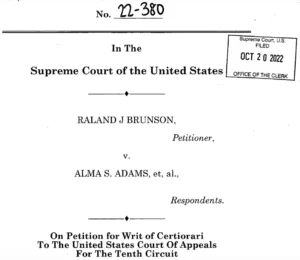
The case is captioned: Raland J. Brunson, Petitioner v. Alma S. Adams, et al.
And now the updates!
A response was due from the Defendants by November 23, 2022...and we got one!
Actually we got a VERY STRANGE one.
They didn't ignore it or refuse to reply.
They actually filed a reply but waived their right to respond!
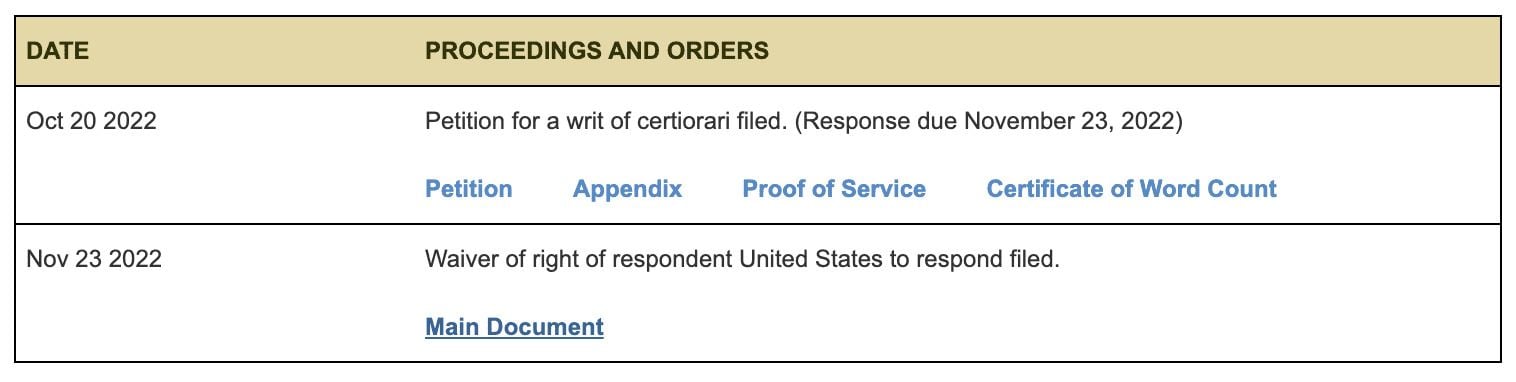
Yes, you read that and understood that correctly...
The Government WAIVED its right to respond.
Here is the actual filing (which you can see for yourself is real right here on SupremeCourt.gov):

Folks, this is crazy!
The case is real.
It's moving forward.
The Government just WAIVED its rights.
And the stage is set for something truly epic!
Bo Polny Predicted The Bitcoin Crash TO THE DAY, Here's What Comes Next...
I had Bo Polny back on my show today and we talked a LOT about crypto...
If you've been following the crypto markets or even just the news in general, you know crypto had an ugly week.
Huge crash...
Big players and exchanges going bankrupt over night!
In fact, I'm working on a big story right now that is set to expose and explain exactly how we may have just uncovered the biggest money laundering operation of all time...
And it may just be the thing that brings down Joe Biden and the entire evil regime.
Yes, it's that big.
Here's a sneak-peak:
— Kim Dotcom (@KimDotcom) November 13, 2022
But here's the deal...
Bo Polny predicted the EXACT DAY of the crash with perfection!
He told his Newsletter subscribers back in October this was coming.
I couldn't post about it ahead of time out of respect for the people that subscribe to his Newsletter, but now that it happened and he was right to the very day, I had to have him back on my show to break it all down.
We had a blast, and yes we also talked about September 24, October 24 and November 24.
You might be surprised to learn some of the details!
We also talked about Switzerland, the Egyptian Sphinx on top of Europe, gold and silver and a lot more!
Oh and of course Donald Trump!
This is so good and I'm excited for you to hear it.
Watch safely here on Rumble:
Backup here on YouTube:
👉 Download Bo's slides for free: https://qrco.de/bdUurf
👉 If you want Bo's trading Newsletter, go to https://www.gold2020forecast.com/cryptocurrency-index ➡️ use code WLT49. (LIMITED TIME)
💥 For access to the Easy Crypto School, go to https://www.easycryptoschool.com ➡️ use code WLT49. (LIMITED TIME)
The discounts are only good for a short time, so grab them if you want now.
The entire history of the Newsletter is available to you when you sign up, which is something I love.
You can go back and read and see exactly how accurate Bo has been:

And then for anyone who wants to get started but is scared to do it wrong or doesn't know how, this is for you.
A trusted guide, from a trusted friend.
There's a lot of bad stuff out there, but I'm always happy to send people to Bo's Easy Crypto School:

Enjoy!

Join the conversation!
Please share your thoughts about this article below. We value your opinions, and would love to see you add to the discussion!