

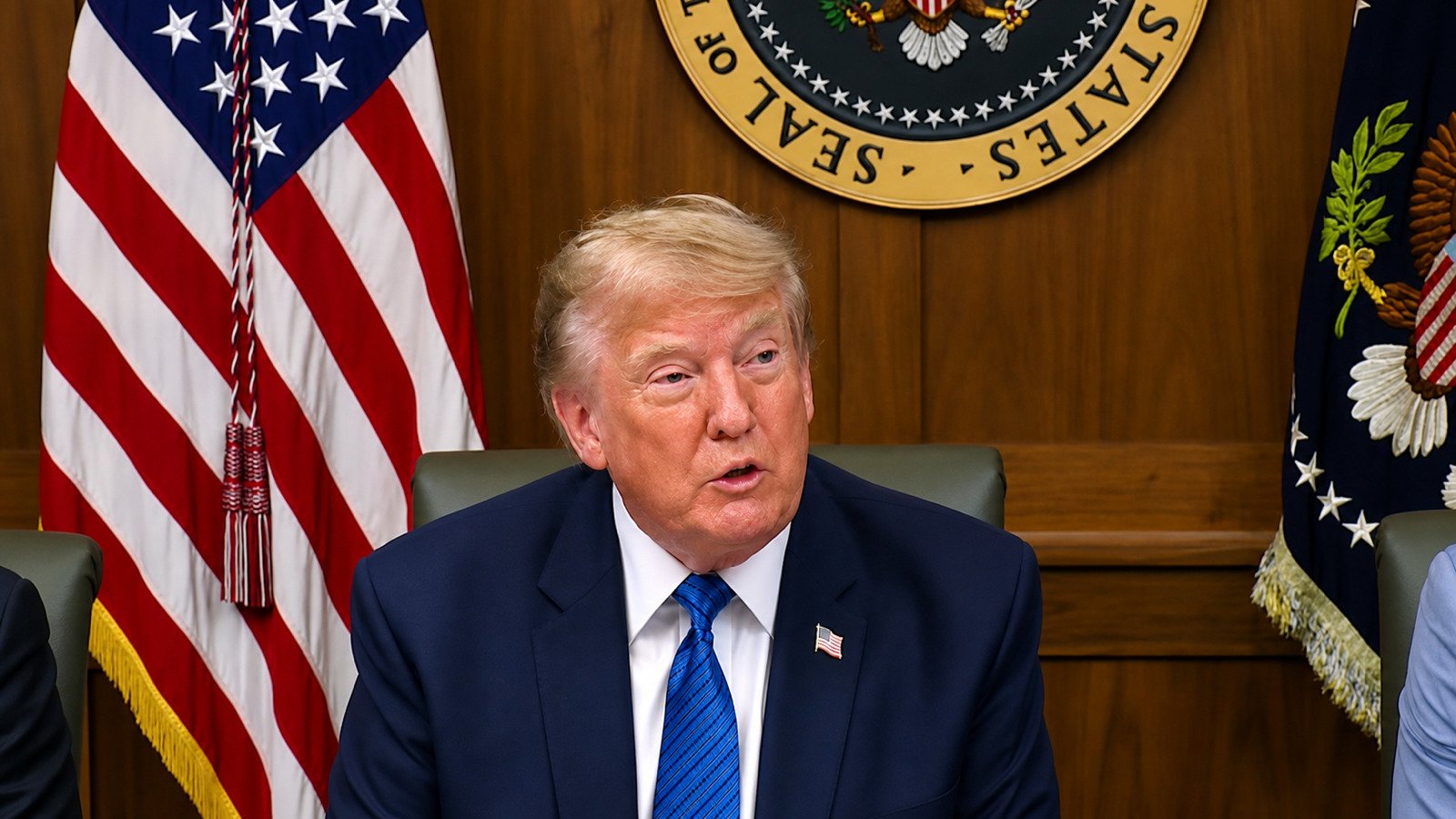
President Trump just put Minnesota on notice.
Speaking during Friday’s Cabinet meeting at Camp David, the President said federal investigators had already uncovered “tremendous corruption” in the state.
Then came the warning: much bigger developments are still ahead.
President Trump did not identify a new defendant, agency action, dollar amount, or release date in the clip.
He also did not name Minnesota Gov. Tim Walz or Rep. Ilhan Omar. Benny Johnson added those names in his own commentary; the President’s statement was broader.
The federal enforcement record gives that warning real weight.
Just ten days ago, the Department of Health and Human Services announced that the Centers for Medicare and Medicaid Services was deferring approximately $199 million in federal Medicaid payments to Minnesota.
The deferral followed a focused review of claims across 14 high-risk service areas. HHS said some expenditures were connected to providers flagged in program-integrity reviews, while other claims raised potential eligibility or billing questions.
Minnesota now has to provide supporting documentation before those federal matching funds are released. The state has an opportunity to show that the questioned claims meet federal requirements.
More here:
👀 President Trump teases that when it comes fraud and corruption uncovered so far, “YOU HAVEN’T SEEN ANYTHING YET. We have things happening people aren’t going to believe.”
“Minnesota, California, and Maine…” the level of corruption is incredible.https://t.co/Ew32kXampI https://t.co/T7EIQ2z9mw pic.twitter.com/ciE34lRtgp
— MJTruthUltra (@MJTruthUltra) July 31, 2026
HHS emphasized that the move is a payment deferral, not a permanent funding cut. CMS Administrator Dr. Mehmet Oz described it as a shift toward stopping questionable payments before the money goes out instead of chasing it afterward.
That distinction matters. A review is not a conviction, and a questioned claim is not automatically a fraudulent one.
It is still an extraordinary amount of money to hold while the paperwork is examined—and it puts Minnesota’s controls under a very bright federal spotlight.
President Trump Hosts a Cabinet Meeting, Jul. 31, 2026 https://t.co/mq0BbjwgvO
— The White House (@WhiteHouse) July 31, 2026
The scrutiny reaches far beyond one Medicaid review.
In May, the Department of Justice announced criminal charges against 15 defendants accused of participating in Minnesota fraud schemes involving more than $90 million in intended losses.
Those cases covered seven different state-managed Medicaid programs. Prosecutors called one portion the largest autism-fraud case ever charged by the department and said the overall takedown included the two largest Medicaid fraud cases ever charged in the district.
The alleged conduct was not limited to inflated invoices. Federal officials described kickbacks paid to parents, child-care and therapy services that were never delivered, and billing connected to a Medicaid recipient who had already died.
DOJ also tied the Minnesota cases to a larger expansion of Medicaid-fraud enforcement, including new prosecutors and additional strike-force resources.
These are criminal accusations, not verdicts. The defendants are presumed innocent unless and until the government proves its charges in court.
At the announcement, the Justice Department’s National Fraud Enforcement Division said it was expanding the Midwest Health Care Fraud Strike Force into Minnesota and adding 15 prosecutors for Medicaid fraud cases nationwide.
Assistant Attorney General Colin McDonald said the Minnesota cases involved programs that had been systematically pilfered and described one program as having been shut down after its money was exhausted.
He urged people inside the community to report suspicious activity and warned alleged fraudsters that the government intended to find them, prosecute them, and claw back stolen taxpayer money.
What are your thoughts?
The expansion adds permanent investigative muscle beyond a one-day press conference. More specialized prosecutors and a strike-force presence mean more data reviews, more subpoenas, more coordinated cases, and more pressure on schemes that once depended on overwhelmed oversight.
The message was unmistakable: the May takedown was presented as the beginning of the federal effort in Minnesota, not the end.
On July 16, the Justice Department announced that Abdikerm Abdelahi Eidleh had been transferred from Somalia to Minnesota to face 31 charges tied to the Feeding Our Future scheme.
Eidleh, a Burnsville resident, had been charged by indictment in September 2022. Federal officials said investigators located him in Somalia in June 2026 and returned him to Minnesota through cooperation among the FBI, IRS Criminal Investigation, Somalia’s National Intelligence and Security Agency, and Somali police.
He now faces allegations including conspiracy to commit wire fraud, wire fraud, federal-program bribery, money laundering, and related conspiracy counts.
Prosecutors accuse participants in Feeding Our Future of stealing money from a federal program meant to provide meals to children during the COVID-19 pandemic.
Eidleh remains presumed innocent. His transfer puts a defendant who had been outside the United States back before a federal court.
Those 31 charges will now be tested through the judicial process.
Then, on July 24, the DOJ announced that four Minnesota men had pleaded guilty in a separate $2.2 million Medicaid fraud scheme.
The defendants admitted exploiting Minnesota’s now-defunct Housing Stabilization Services program, which was supposed to help people with disabilities, seniors, and people struggling with mental illness or substance abuse find and maintain housing.
According to prosecutors, the men enrolled roughly 350 Medicaid recipients and billed for assistance they either did not provide or dramatically inflated. When insurers asked for records, the defendants used ChatGPT to fabricate supporting documents in an attempt to make the claims look legitimate.
The pleas cover conduct from April 2022 through April 2025 and approximately $2.2 million stolen from Minnesota Medicaid. Each man pleaded guilty to one count of wire fraud and faces up to 20 years in prison, with sentencing dates still to be set.
It is a small case beside the larger Minnesota totals, but the use of AI to manufacture records shows how quickly fraud tactics are evolving.
None of those announcements proves what President Trump was referring to Friday.
That is the open question.
But when the President says “massive” corruption developments are happening right now, Minnesota’s recent record makes this much more than an offhand remark.
Something is coming.
Now the question is who—or what—the next announcement will expose.

Join the conversation!
Please share your thoughts about this article below. We value your opinions, and would love to see you add to the discussion!