

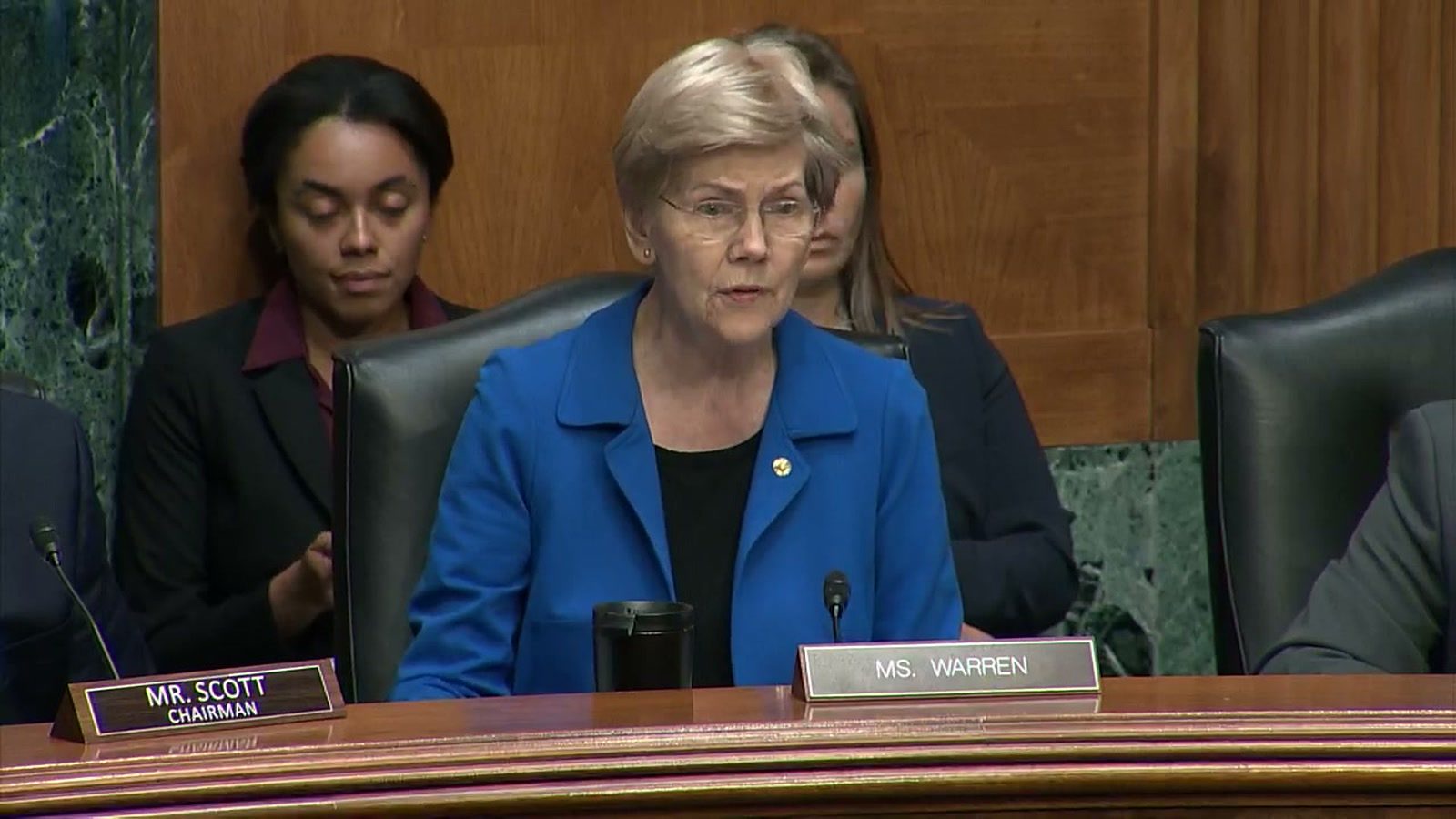
Elizabeth Warren returned to the Senate Banking Committee this week ready to defend the crown jewel of her political career.
The immediate target was Brian Johnson, President Trump’s nominee to lead the Consumer Financial Protection Bureau.
But Warren’s fury made the larger story impossible to miss.
The agency she helped build is no longer moving in the direction she designed it to move.
And while Warren fights over who will run it next, the Trump administration is already using the CFPB to advance a very different idea of consumer protection—one that accounts for immigration status, deportation risk and the consequences of lending money to borrowers who are not legally authorized to work in the United States.
For families and small businesses, access to affordable financial products can be the difference between getting by and getting ahead.
Chairman @SenatorTimScott made clear that the next CFPB Director must protect consumers without cutting off the products they rely on. pic.twitter.com/lQqqcJBcgp
— U.S. Senate Banking Committee GOP (@BankingGOP) July 23, 2026
Thursday’s nomination hearing put the fight into the open.
The Senate Banking Committee said Johnson would take over the CFPB at an important moment, with its enforcement posture, legal limits and relationship with lenders all under fierce debate.
Chairman Tim Scott said the bureau’s next director must protect consumers, keep the agency inside the law and preserve access to affordable financial products for families and businesses.
His message was not that the CFPB should disappear or leave dishonest financial companies untouched. It was that the bureau should operate with clear rules, fair treatment, congressional accountability and respect for the limits lawmakers placed on its power.
That is a sharp departure from the left’s preferred model: an aggressive regulator with broad discretion to pressure banks, lenders and financial companies.
Scott placed Johnson’s nomination inside a broader promise to make government work for the people who finance it. He said agency leaders must respect taxpayer dollars, remain accountable to Congress and remember whom they serve.
For the CFPB, that means protecting borrowers without cutting off the loans, credit cards and other products families and small businesses rely on.
Warren clearly understood what was at stake.
In her opening remarks, she attacked the Trump administration’s stewardship of the bureau and warned that Johnson would continue it.
The committee’s Democratic minority published Warren’s full statement after the hearing, preserving her objections to Johnson and her broader attack on the administration’s direction for the bureau.
She accused acting CFPB Director Russ Vought of weakening enforcement, closing investigations, reducing penalties and favoring major financial companies. Those were Warren’s allegations, and the administration disputes her portrayal of an agenda it says is restoring legal limits and consumer choice.
Warren then framed the Johnson nomination as a choice between “watchdogs” and “lapdogs” at the bureau, making clear that she sees Johnson as a threat to the CFPB model she created.
She also attacked Johnson’s work in both government and the private financial sector, arguing that his industry experience should disqualify him from leading the regulator.
Her statement barely engaged with the administration’s case for a more disciplined CFPB. Instead, Warren treated any move away from her preferred enforcement posture as proof that the bureau was being corrupted.
The CFPB is supposed to protect consumers. But Trump has used it to protect his big corporate donors instead.
I asked Trump's CFPB nominee if he'll stand up to the corruption. pic.twitter.com/ppj04fJmYy
— Elizabeth Warren (@SenWarren) July 24, 2026
The clash is personal for Warren because the CFPB is the signature federal agency of her political career.
It is her creation.
After the 2008 financial crisis, Warren became the public face of the effort to establish a new federal regulator devoted to consumer finance. The Dodd-Frank law created the bureau, and the Obama administration placed Warren in charge of setting it up.
In a 2011 letter preserved in the CFPB’s own archive, Warren described the new bureau as a single point of accountability for consumer financial markets and a permanent referee over lenders.
She said it would serve as a “cop on the beat” for credit cards, mortgages, student loans and other products, enforcing federal law and making financial terms easier to compare.
Warren wanted a durable federal machine that could survive elections, oversee every major provider under one roof and keep pressing her theory of financial regulation long after she left the room.
Her letter also argued that borrowers and lenders should see the real costs and risks before signing a deal, creating what she called a level field built on transparency and accountability.

She tied that transparency to personal responsibility, writing that Americans expected consequences when debts went unpaid. Fourteen years later, that same ability-to-repay principle is being applied in a way she never intended.
She got the durable machine.
What she did not get was permanent control over its mission.
President Trump has now turned the bureau toward a risk Warren’s original model largely ignored: whether a borrower’s ability to earn income in the United States can vanish because that person is not legally authorized to work here.
On May 19, the White House issued Executive Order 14406, directing the CFPB and other federal financial regulators to address risks across America’s banking system created by extending credit and services to inadmissible and removable aliens.
The order instructed the CFPB to consider clarifying that potential deportation and the resulting loss of wages may affect a non-work-authorized borrower’s ability to repay a loan.
It also directed the other federal financial regulators to issue guidance on managing credit risk connected to the non-work-authorized population.
The order went beyond loan underwriting. It called for stronger customer-identification safeguards and a federal response to illicit cross-border financial activity tied to threats such as narcotics trafficking, human trafficking and money laundering.
In other words, the administration placed credit policy inside a larger financial-integrity and public-safety strategy.
This was not an order to reject every noncitizen who applies for credit.
It was an order to stop pretending that legal authorization to remain employed in the United States has nothing to do with a borrower’s future income.
The CFPB followed through on June 8.
A Federal Register notice reminded lenders that federal law already requires a reasonable, good-faith assessment of a borrower’s ability to repay certain mortgages and open-end credit products.
For decisions based on employment income, the bureau said lenders may consider information showing whether that income is likely to remain available.
If application records indicate that a borrower is not lawfully present, lacks work authorization and may be removed from the country, the lender may have to consider the resulting risk to future U.S.-based wages.
The guidance also acknowledged that lawful immigration statuses vary widely. It did not declare every noncitizen a bad credit risk, and it did not create an automatic loan denial based on nationality.
Most importantly, the bureau stated that the document was guidance, not a binding new law.
That distinction matters. The policy does not turn loan officers into immigration agents.
It tells them they cannot ignore documented facts that directly affect whether an applicant will continue earning the income used to qualify for the loan.
Then came the next step.
On July 13—just ten days before Warren confronted Johnson at his nomination hearing—the Office of the Comptroller of the Currency, the FDIC and the National Credit Union Administration issued joint guidance to national banks, federally insured banks and credit unions.
The agencies warned that lending to people who are not legally authorized to work in the United States may create elevated credit risk because their employment, income, continued residence and financial stability can be more uncertain.
Banks and credit unions were told to identify, measure, monitor and control those risks through ordinary underwriting practices.
The regulators also specifically instructed institutions to consider the CFPB’s June 8 statement during their own credit-risk reviews.
That moved the policy beyond a single bureau announcement and into the supervisory expectations of the agencies overseeing national banks, federally insured banks and credit unions.
By the time Johnson sat before Warren, the administration’s approach had already spread across the federal banking system.
That is the policy reversal Warren is now fighting.
The CFPB was built by the left as a powerful federal lever over the financial system. President Trump did not need to invent a competing agency or ask Congress for a new bureaucracy.
He used the one Warren already gave him.
The Trump administration could have kept popular consumer protections that returned money to cheated families.
Instead, they're dismantling the CFPB.
Same playbook, different day—voting rights, housing, taxes. They're pulling apart the institutions designed to protect us.
— Elizabeth Warren (@ewarren) July 23, 2026
Warren says the bureau is being dismantled.
The more revealing truth is that it is being redirected.
Under the Trump administration, consumer protection is no longer defined only as shielding borrowers from lenders. It also means protecting depositors, taxpayers and the financial system from risks the government can plainly see coming.
A lender considers job history, income stability, debt and the value of collateral because repayment depends on real-world conditions.
If an applicant has no legal authorization to work and faces a foreseeable loss of U.S.-based income, treating that fact as irrelevant is not compassion.
It is politically motivated underwriting.
Thursday’s hearing showed Warren trying to preserve the old mission by stopping the man President Trump selected to carry the new one forward.
But the transformation is already underway.
The executive order is signed. The CFPB guidance is published.
The banking regulators have carried it into their supervisory instructions.
Warren built an agency she expected to police the financial system according to the left’s priorities.
President Trump is making it account for the costs of illegal immigration instead—and her latest Senate eruption shows she knows exactly what has been lost.

Join the conversation!
Please share your thoughts about this article below. We value your opinions, and would love to see you add to the discussion!