

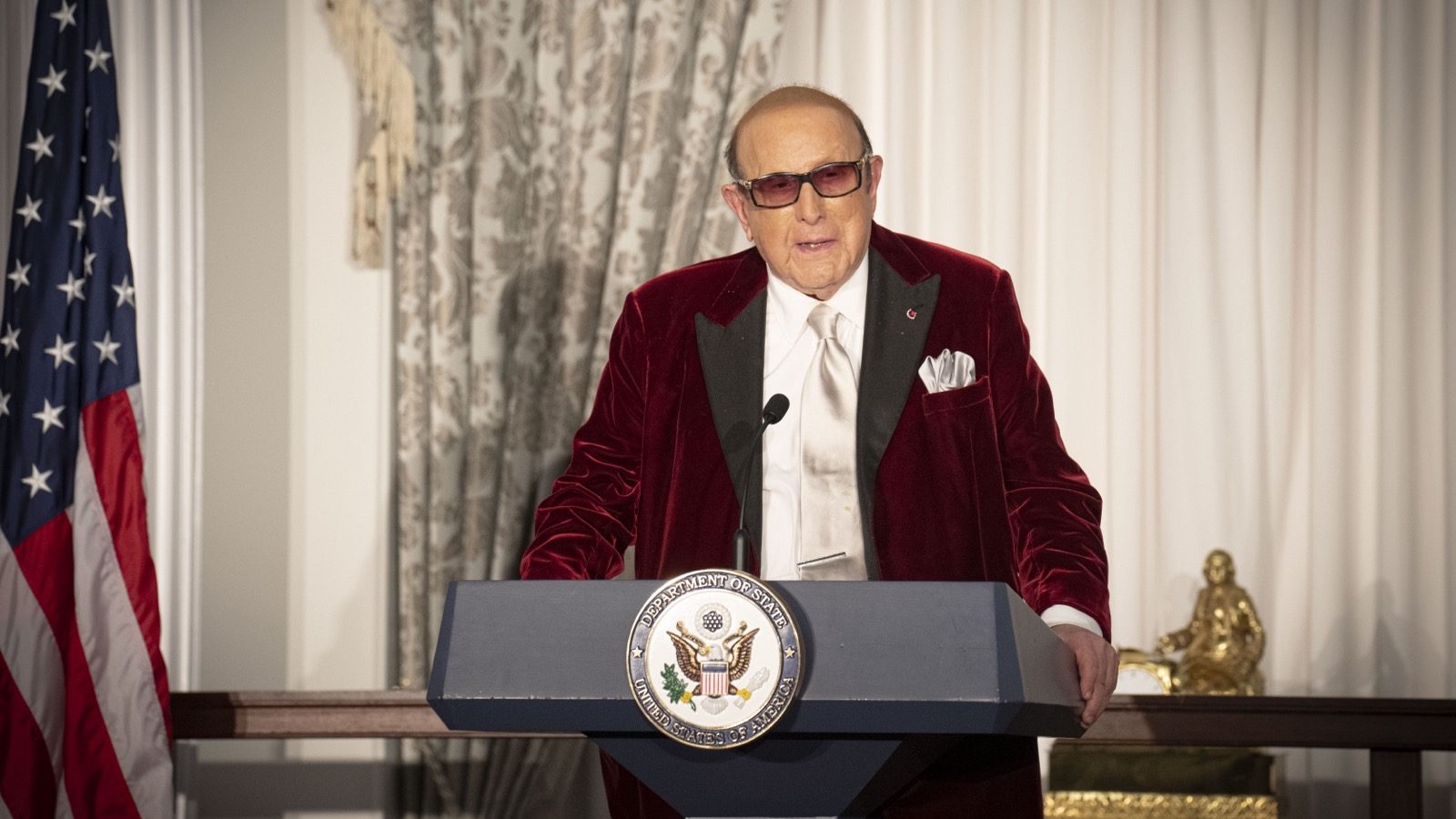
Clive Davis, the legendary music executive who shaped six decades of American popular music, has died at age 94.
He passed away on Monday, June 22, 2026.
Billboard reports that Davis died at his home in New York from an age-related illness.
The outlet traced the arc that earned him the nickname “The Man With the Golden Ears”: his rise at Columbia Records, the founding of Arista and J Records, and a roster of artists that reads like a history of modern music.
Whitney Houston, Barry Manilow, Alicia Keys, Aretha Franklin, Patti Smith, Dionne Warwick, Santana, Bruce Springsteen, and Jennifer Hudson all crossed his path. His 2000 induction into the Rock Hall and his Recording Academy Trustees Award sit in that same report, alongside the family who survive him.
Billboard also included the family remembrance, which framed Davis as both a cultural force and a father and grandfather whose private life remained central even while his public career kept reshaping the industry.
Davis was born in Brooklyn on April 4, 1932.
He attended New York University and Harvard Law School before walking into the music business through Columbia Records.
By 1967 he was running the place as president.
That is where the legend really starts. Davis signed Janis Joplin and Bruce Springsteen, and from there he kept finding the next voice the country did not yet know it needed.
The Hollywood Reporter notes that Davis was most recently chief creative officer at Sony Music Entertainment, a working title he still carried late in life.
The outlet credits him with leading Columbia, Arista, and J Records, bringing Joplin, Houston, and Springsteen to enormous audiences, and reshaping or reviving careers for Santana, Rod Stewart, Aretha Franklin, and others.
It also notes his five Grammys, that 2000 Trustees Award, and the famous pre-Grammy gala he hosted every year.
The Hollywood Reporter adds a useful piece of the Davis story: he did not begin as a teenage rock obsessive. He came through law school, joined Columbia through the legal department, and turned that unlikely entry point into one of the longest executive runs music has ever seen.
That gala became one of the most coveted invitations in entertainment, a single room that could hold the biggest names across every genre.
The respect from the industry came fast after the news broke.
Clive Davis Dead at 94: Music Executives Remember the Influential Label Mogulhttps://t.co/VUD0mWx2LH
— billboard (@billboard) June 22, 2026
Pitchfork reports that Davis’s publicist confirmed he passed away peacefully from age-related illness, surrounded by family and loved ones.
The site frames him as a producer, A&R man, and label president whose ear touched Whitney Houston, Bruce Springsteen, Janis Joplin, Aerosmith, Santana, Pink Floyd, and Patti Smith.
It also notes his hand in Columbia’s modern era, Arista, Bad Boy with Sean Combs, and J Records, which helps explain why his death landed across so many different corners of the music world at once.
That matters because Davis was not tied to one era or one sound. The same career touched rock, pop, R&B, hip-hop-adjacent label work, and adult contemporary, giving him a reach most executives never come close to matching.
For readers who know the songs better than the man behind them, this is the simple truth: a stunning amount of the music you grew up on passed across Clive Davis’s desk first.
He helped shape Whitney Houston’s rise, launched Alicia Keys with J Records, and played a defining role in Santana’s late-career comeback.
KISS frontman Paul Stanley spoke for a lot of the industry.
RIP CLIVE DAVIS. The music world and all those who have loved music for 6 decades have lost the visionary and champion of so many artists in so many genres. A one of a kind genius. My condolences to his entire family. pic.twitter.com/6DfcMf5xMW
— Paul Stanley (@PaulStanleyLive) June 22, 2026
The institutions that keep the history agree.
The GRAMMY Museum describes Davis as one of the record industry’s most innovative and influential executives, a champion and critic of music, and a visible spokesman who helped guide the business into the new millennium.
Its list of artists he signed or nurtured runs deep: Janis Joplin, Whitney Houston, Chicago, Santana, Aerosmith, Laura Nyro, Earth, Wind & Fire, Dionne Warwick, Aretha Franklin, Barry Manilow, Alicia Keys, Kelly Clarkson, and Jennifer Hudson.
That institutional framing is important because the Davis story goes beyond hit records. The museum presents Davis as someone who helped define how the modern record business found, developed, marketed, and protected major artists across several changing generations.
It also shows why his name remained attached to music education, preservation, and the commercial side of the industry.
The Rock & Roll Hall of Fame lists Davis as a 2000 inductee in the non-performer category, the official record of where he stands in music history.
That category is reserved for the builders and power brokers who changed rock and popular music without necessarily being the voice on the record. Davis fit it perfectly because his influence lived in the careers he recognized early, the albums he backed, and the artists he refused to treat as disposable trends.
Few people outside the spotlight have ever earned that placement. In Davis’s case, it reflected a career spent hearing star power before most of the public ever had a chance to hear the record.
For some artists, the loss landed as something closer to family than business.
I needed a moment…This was a huge blow to wake up to. I know Nobody lives forever, but Clive’s impact and legacy will always live on! Yes, he was the legendary music mogul, but he was family to me. My heart goes out to his family and loved ones. You will be missed, Clive ! We… pic.twitter.com/zyxSLaC3TI
— Jennifer Hudson (@IAMJHUD) June 22, 2026
His family remembered him as a father and grandfather whose vision and excellence shaped music culture, while making clear that family stayed central to his life through all of it.
Davis is survived by his partner Greg Schriefer, his children, grandchildren, great-grandchildren, and extended family.
Clive Davis lived 94 years and spent most of them deciding which songs the rest of us would carry around for a lifetime.
The voices he discovered are still playing today, and they will keep playing long after the man who heard them first is gone. That is the rarest kind of legacy there is, and he leaves it behind in full.

Join the conversation!
Please share your thoughts about this article below. We value your opinions, and would love to see you add to the discussion!