

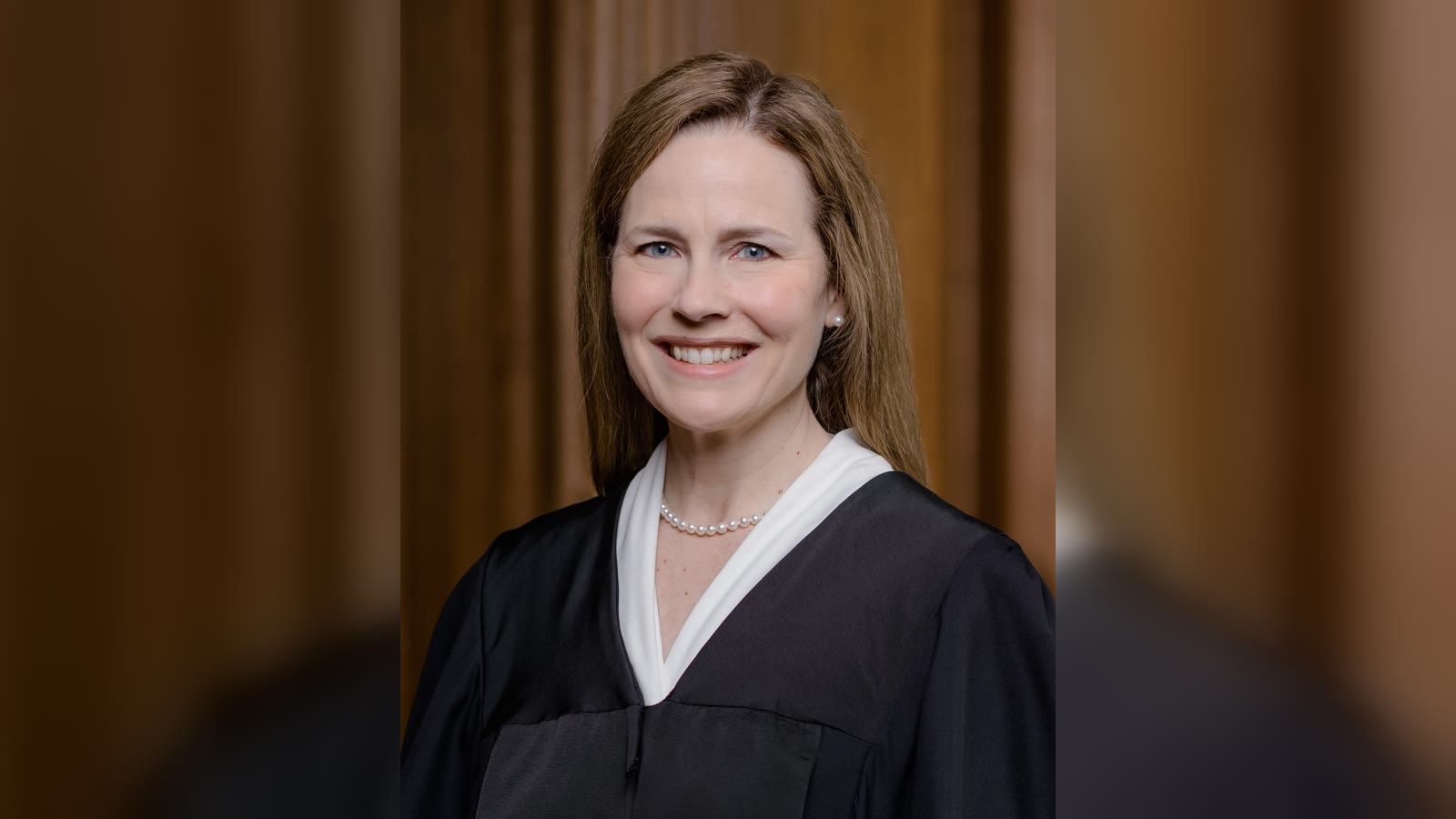
Fairfax County, Virginia police responded Wednesday night to a report of gunshots near the home of Supreme Court Justice Amy Coney Barrett.
Officers arrived on scene and quickly coordinated with Supreme Court police and Barrett’s security detail, determining that the report was fictitious.
The incident is being treated as a swatting call, a dangerous tactic in which a fake emergency is phoned in to trigger an armed law enforcement response at a target’s home.
Journalist Andrew Leyden shared partial police dispatch audio from the incident on X.
Leyden posted the partial dispatch audio that first brought the incident into public view:
Police responded to a call for the sound of gunshots at the home of Supreme Court Justice Amy Coney Barrett last night, but quickly realized it was a swatting call and cleared after meeting with her security detail. This is partial police audio, redacted pursuant to media reporting guidelines on coverage of swatting incidents.
— Andrew Leyden (@PenguinSix) May 28, 2026
Police cleared the scene after meeting with Barrett’s security personnel and determining that the report was false.
No one was reported harmed, and the scene was cleared without further incident.
The incident drew immediate condemnation from lawmakers. Senator Mike Lee of Utah did not mince words about what swatting really is.
Sen. Mike Lee said the stakes are exactly why swatting cannot be treated like a prank:
Swatting is an attempt to get an innocent person killed—in this case, a sitting Supreme Court Justice.
The proper response will be putting the offender in prison for many, many years.
— Mike Lee (@SenMikeLee) May 28, 2026
Lee is right.
Swatting is more than a prank.
It is a deliberate effort to weaponize armed police against an unsuspecting target.
When the target is a sitting Supreme Court justice, the implications are as serious as they get.
Barrett is hardly the first conservative member of the high court to face threats at home.
In 2022, an armed man was arrested outside Justice Brett Kavanaugh’s Maryland residence after traveling from California with the stated intent to kill him.
Conservative justices have faced an escalating pattern of harassment and intimidation since the Dobbs decision overturned Roe v. Wade, including sustained protests outside their homes in violation of federal law.
Barrett, a mother of seven, has been a particular target of left-wing hostility since her confirmation in 2020.
Whoever placed the fake gunfire call to Barrett’s home needs to be found and prosecuted to the fullest extent of the law.
Swatting a Supreme Court justice is a crime that could easily end in someone’s death.
The Daily Signal gave the police-confirmed timeline:
Fairfax County Police are investigating the incident as a swatting call at Justice Amy Coney Barrett’s residence.
The public information officer placed the police response at approximately 9:02 p.m. Wednesday night.
ADVERTISEMENTThe call came through the department’s non-emergency line.
Officers immediately coordinated with Supreme Court police personnel assigned to the residence.
That coordination mattered because Barrett already has protective personnel at the home.
The responding officers quickly determined that the report was fictitious.
ADVERTISEMENTThe department said no additional police resources were used after officers verified the situation.
The police contact described every such call as something investigators review.
Charges can follow in some cases when the person behind the false report is identified.
The same report placed the incident against a broader backdrop of recent threats against President Trump administration officials and conservative Supreme Court justices.
It also referenced the 2022 attempted assassination of Justice Brett Kavanaugh after the Supreme Court reversed Roe v. Wade.

Bloomberg Law added the dispatch-audio details:
Fairfax County dispatchers received the emergency report shortly after 9 p.m. Wednesday.
The dispatch audio described a report of two or three gunshots and voices arguing at Barrett’s address.
ADVERTISEMENTResponding officers were also told dispatchers could not reach the caller on the number provided.
A dispatcher warned that the situation might be a swatting incident.
Fairfax County Police later confirmed that they believed the call was a swatting attempt.
The department said officers coordinated with Supreme Court Police personnel at Barrett’s residence.
After that coordination, the report was determined to be false.
The county declined to release the emergency call audio while the criminal investigation remains open.
The legal-security context is significant because the justices have received 24-hour security details since 2022.
Threats against Supreme Court justices and federal judges have risen sharply in recent years.
Barrett herself previously said pizzas had been sent to members of her family as part of a harassment pattern aimed at judges and their relatives.
Mediaite captured the public audio and reaction angle:
Washington, D.C. journalist Andrew Leyden posted partial police audio from the incident Thursday.
Leyden said police responded to a call about the sound of gunshots at Barrett’s home.
ADVERTISEMENTHe also said officers quickly realized the call was swatting and cleared after meeting with the security detail.
The audio included a dispatcher telling responding units that callback attempts to the complainant had failed.
The dispatcher also warned officers that the call might be a swatting situation.
Police knew the address involved a high-priority resident of the county.
One responding officer said police had made contact with security on scene and would meet with that security contact first.
That detail appears to be the reason the response did not spiral into a larger tactical incident.
Sen. Mike Lee then condemned the swatting attempt and said the offender should face prison time.
Lee described swatting as an attempt to get an innocent person killed, especially when the target is a sitting Supreme Court justice.
The Gateway Pundit framed the conservative-security stakes this way:
The original conservative report put the incident in the same lane as other threats aimed at conservative officials and judges.
Its central point was the same confirmed sequence now visible across the stronger reports: police responded to reports of gunfire near Barrett’s home, checked the situation with the protective detail, and determined the call was false.
The report highlighted the dangerous nature of swatting because it weaponizes police response against the person being targeted.
That danger is amplified when the target is a Supreme Court justice with a security detail already in place.
The story also pointed readers to Leyden’s police-audio post and to Lee’s public condemnation.
The key factual distinction is important.
The public record supports a reported gunfire call and a police response, not proof that actual gunfire occurred.
It also supports the police view that the call was fictitious and is now part of an investigation.
For readers, the story is not just that the hoax failed.
The story is that someone placed a false emergency call tied to a conservative justice’s private residence in a climate where threats against judges have already become real.
What are your thoughts?

Join the conversation!
Please share your thoughts about this article below. We value your opinions, and would love to see you add to the discussion!