


I came across a really incredible video today and I wanted to share it with all of you.
Because my mission around here since Day 1 has always been to get the TRUTH out to as many people as possible.
Most of the time, we do that regarding politics, but today we’re going to shift into a way more important truth.
God’s truth.
And is it really true?
Because isn’t that the most important question when it really comes down to it?
We either have this book called the Bible that is reliable and trustworthy and came to use from the Creator of the Universe or we don’t.
But if we do actually have that book, shouldn’t that be revolutionary?
Shouldn’t that change everything about how we think and act and behave?
If you essentially have the cheat code to life literally written out for you, isn’t that a game-changer?
It is if we can reliably count on that book and it’s author.
Spoiler alert: I believe we can, but I know many people have a lot of questions about it and I have never heard anyone cover this better than Dr. Michael S. Heiser in this video I’m about to show you.
Dr. Heiser was the pre-eminent Biblical and semitic languages scholar of the 21st century, and basically one of the biggest brains I have ever come across, but even more impressive than that was his ability to explain things in such an easy way where you understand almost immediately.
And you wouldn’t think it could be so, but he is FUN to listen to!
You almost can’t put the video down, it’s honestly that fascinating.
Look, I’m not here to sell you anything, this article and this video below are all completely free, I’m not associated with Dr. Heiser in any way and sadly he died a few years ago, I just happen to love his videos and I think you will too.
Please enjoy and then share this with a friend or two:
FULL TRANSCRIPT:
All scripture is inspired. It’s from God. It ultimately originates with God.
And I’m going to present a providential model of inspiration to you.
But not every portion of scripture utters a truth proposition. In other words, a point that the writer and God wants you to believe and not deny.
The superscriptions on the cross in the four Gospels — none of them are identical. Okay?
ADVERTISEMENTNow let me put on my antagonistic professor hat for a moment.
“Well, you’d think if the Spirit of God was producing this stuff that He could have gotten at least this right.”
Just before I jump into our subject here, it’s really important to be oriented to the text of scripture.
Part of my own heritage was that I grew up as a believer. I became a Christian when I was a teenager.
ADVERTISEMENTSome of you have probably heard parts of my testimony in different interviews and whatnot.
I knew nothing when I first really understood the Gospel. I was sort of brought under the wing of this particular church in my hometown, and they took scripture seriously.
I was talking to your pastor just before this morning. This is the third Calvary Chapel church I’ve been in. I’ve talked to maybe half a dozen Calvary Chapel pastors, and I always ask them, “Why do Calvary Chapel churches grow?”
And it was sort of a trivia question at the beginning, but it’s more intentional now.
The answer is always, “Well, we actually go through scripture verse by verse.”
And I used to think that was a gimmick answer because I grew up with that.
I thought, “Well, what else happens in church?”
And I’ve come to realize now — I’ve been dragged kicking and screaming toward the conclusion — that that isn’t what happens in most churches, even most evangelical churches. So it’s actually a meaningful answer.
ADVERTISEMENTI don’t want to dismiss my own background.
In some ways, I’m living off the capital of the original investment that was put in me by the pastors of the church I went to and grew up in.
But what often happens is you get trained not to pay attention so much to the text as you are trained to think about the text through the filter that you either are given or that you kind of pick up along the way.
And that was me.
I loved the Bible. I loved anything old and strange.
I’m very open about being one-dimensional. I was a geek.
I remember the day — this will tell you how dumb I was — I was close to graduation from high school and didn’t know what to do.
I remember the day I discovered that people paid my pastor. Like, he got paid to teach the Bible.
I didn’t know that.
You ask, “Well, how did you think he bought groceries?”
I never thought about it.
It was like, “Wow. You mean people actually pay?”
ADVERTISEMENTWell, not very much, but it’s like, “You’ve got to be kidding. I could actually do this and get paid for it?”
So I figured this is what I want to do.
I want to be a professor or something like that.
Again, I was the geek. I figured I’m going to have to go get a PhD and all this kind of stuff. So I knew that.
But you go through the training that I had gone through, and there I am as a doctoral student at Wisconsin.
Again, if you’ve read Unseen Realm or Supernatural, you know what’s coming.
Someone just sort of yanks your chain and says, “You need to look at the text over here.”
And you do.
And it’s like, “How in the world did I not see that before?”
So I’ve had my theology messed with quite a bit.
Providentially, I always had the sense that you’re going to run into people who hate scripture.
Even if they don’t hate scripture, they don’t like what you do with scripture.
They don’t like the fact that you actually believe it.
So they’re going to try to undermine your faith.
In my own decision-making going through graduate school, I intentionally wanted each place I went to to be harder academically and more antagonistic because my attitude was, “Give me your best shot.”
I just felt like when the dust settles, the Bible’s still going to be here because people have been shooting at this thing for a long time.
So it’s like, “Okay. It’s still here. Give me your best shot and we’ll see how that works out.”
Fortunately, providentially, I sort of had that either hardwired into me or built into me.
So when I went to Wisconsin — the Berkeley of the Midwest, as it were — and a believing friend showed me this issue, I understood completely what it’s like to get your cage rattled theologically.
But at the end of the day, it’s your Bible.
Train yourself to pay attention to the text.
That’s really what you should care about.
ADVERTISEMENTYou shouldn’t care about denominational stuff.
You shouldn’t care about other filters you pick up along the way.
And they can be good filters. They can be really helpful.
I’ve been in a variety of denominational contexts, and I could honestly say all of them were helpful at some point.
But they are not substitutions for the text.
They just aren’t.
And if you’re not being taught to trace what is said through the text, then you’re being undertaught.
Perhaps not mistaught — maybe a little mistaught — but you’re not being shown the best thing.
As I’ve been speaking a lot over the last few years, meeting a lot of people, getting a lot of interaction online, this question comes up all the time.
So in your schedule, this topic is listed as something like “Why We Need a Better View of Inspiration.”
We’re going to talk about the “why” first.
ADVERTISEMENTThen I’m going to try to walk you through what I sincerely believe is a better way of looking at inspiration that will address all the problems I’m going to show you this morning.
And it’s just a little smidgen of them.
I have intentionally picked things in this talk that undergrad students — and in some cases even seminary students — will run into in the course of their education.
I used to do this to people in class.
I would tell them, “Look, I would rather have me be the one who rattles your cage because I’m your friend. I’m not here to destroy you.”
“I could destroy you in five minutes. I’m not here to do that.”
“I’m here because I want to have a controlled environment where I can show you the kind of things that your friends in high school who went off to university — this is what they’re getting.”
“This is what they’re being told, and this is how it’s being explained to them, and it’s undermining their confidence in scripture.”
I know that because I went through all that.
I did all that.
So what I want to talk to you about today is something important.
It’s not just pie-in-the-sky theory.
It is current.
You will find this if you spend five minutes on Google looking.
Especially if you go to an organized religion class or Bible class taught by someone who either rejects any sense of inspiration or defines inspiration in such a way that it strips God out of the process.
The Bible becomes something less than supernatural.
So what we’re going to talk about today is important.
There’s a creeping suspicion even among many Christians.
The first time I gave this set of talks, a pastor in Washington asked me to do it because he said:
“In my congregation, there are a lot of people, especially younger people, who just have this sense that the Bible isn’t completely trustworthy because of something they ran into on YouTube, Facebook, social media, a class, whatever.”
So he asked, “Can you talk about that?”
That’s the orientation here.
Here’s what I don’t mean and what I’m not talking about, because frankly this is the easy stuff.
Creation versus evolution.
Jesus mythicism — the idea that Jesus was not a historical person, just a myth.
Claims of other religions.
Militant atheism.
This is the obvious stuff.
This is the stuff already on the radar for someone who takes scripture seriously.
This isn’t going to cause internal turmoil with someone grounded in the faith.
The Jesus mythicist stuff might, because it sort of has this veneer of biblical scholarship.
At least in some cases.
There’s one scholar unfortunately who writes for a popular audience, so it gets out there on social media and sounds bigger than it really is.
But we’re not talking about that stuff.
What I want to talk about is trustworthiness.
Is the Bible reliable and authoritative?
Is it reliable and authoritative for faith and practice?
Those terms come out of 2 Timothy 3:16.
Another way of saying it: are its truth propositions true?
Is what it asks you to believe believable?
In other words, is it coherent?
Is it true?
Now, what kinds of things are you really focusing on then?
Well, there’s stuff that if you actually read the text of scripture closely, you’re going to run into.
You encounter things when you read, and that’s going to affect how this question surfaces in your mind.
“What does that mean?”
“How can this be the case?”
“How do I think about this thing I’ve encountered either in a sermon or in my own reading?”
How we’ve been taught about what the Bible is and how we got the Bible directly affects how we process things we run into.
And this is the problem we have.
As I’ll talk about in the next session, the way we have been taught traditionally about inspiration actually creates problems for the stuff we find in the Bible.
That sounds kind of goofy, I understand that.
But when I show you examples, you’ll know exactly what I’m talking about.
There are things you actually find in the text that do not conform to the way you were traditionally taught about inspiration.
And the moment you realize that, it creates internal conflict.
These are the kinds of things that people who want to undermine confidence in scripture will target.
They’re not obvious.
If they’re not obvious and then someone shows them to you in a university class, it creates the impression:
“Oh, my pastor was hiding that from me.”
“He skipped that.”
“There’s something my parents and pastor didn’t tell me.”
“Why didn’t they want me to know that?”
“Why didn’t they want me to think about that?”
All I have to do as a professor is say exactly that in an audience full of undergrads, and I’ve got half of you already.
Because I’m instilling the hermeneutic of suspicion within you.
It’s not hard to do.
Happens a lot.
I’m going to go through some examples of why this is the case.
Why the way we’ve traditionally been taught about scripture doesn’t work in some places.
And if you see that it doesn’t work, then it creates this “Well, what is the Bible then? How did we get it then?”
Simple.
I’m going to start with two obvious illustrations and then go into less obvious ones.
Ezekiel 1.
You’ve probably read this at least four or five times. I was going to say fifty times.
Yeah, everybody reads the prophets, I know.
Ezekiel 1:1–3:
“In the thirtieth year, in the fourth month, on the fifth day of the month…”
ADVERTISEMENTBlah blah blah.
Okay, it’s Ezekiel getting into the material that’s going to be his life and message to the captives in Babylon.
Does anything look odd to you?
Just take a moment and read through the rest of that.
Is there something odd about the wording?
I’ll give you a few more seconds.
Let me go to the next slide.
Is there anything odd about the highlighted portions now?
The colored portions?
What’s the problem?
There’s a switch between first person and third person.
See, we’re taught, “All scripture is given by inspiration of God.”
The word “inspiration” there is theopneustos — God-breathed.
Most evangelicals will not say that means God dictated the words.
The dictation view is kind of passé.
But instead, you’ll read in evangelical theologies lots of things that don’t really mean a whole lot.
For instance — and I don’t want to pick on Erickson because he’s a good guy, a wonderful theologian — but if you read his theology textbooks, he wants to get away from dictation.
Instead of God literally whispering words into ears, he says things like:
“The Holy Spirit impressed upon the writers so strongly what He wanted them to write that all the words are the result of that impression.”
But what does that mean?
What does “intensity of Holy Spirit impression” mean if it doesn’t mean dictation?
And if it does mean dictation — or something close to it — then is the Holy Spirit schizophrenic?
Can’t He make up His mind whether it’s first person or third person?
Is Ezekiel writing Ezekiel?
That sounds like Ezekiel because he’s there among the captives.
He tells you that plenty of other times in the book.
But why is he talking about himself in the third person?
Is he a narcissist?
Is he confused?
Why is he doing this?
The obvious answer is: there was an editor.
And now we’re all transfixed with horror because now we don’t just have biblical writers — we have people editing the stuff biblical writers produced.
So now we have “non-Holy-Spirit” portions of the Bible. Thank you very much.
We’ll put that bullet in the chamber to use on someone at some point.
But when you’re actually arrested by the text, when you actually look at it, it creates questions.
And I’ve got news for you:
If you’re reading your Bible and you don’t have questions, I don’t know what you’re reading.
You’re not reading very closely.
Questions are good.
It’s just your Bible.
ADVERTISEMENTThere’s no need to put it down and back away slowly.
But again, the way we’re traditionally taught about how we got it makes this uncomfortable.
We’ll come back to that.
Here’s another obvious one: the superscriptions on the cross.
Four Gospels.
None of them are identical.
Now let me put on my antagonistic professor hat for a moment:
“Well, you’d think if the Spirit of God was producing this stuff that He could have gotten at least this right.”
I mean, it’s pretty important. It’s the superscription on the cross.
So either the biblical writers couldn’t get it right, or the Spirit of God couldn’t get it right.
Which is it?
See, I’ve put you in a dilemma because you have to pick one of two things.
And no matter what you pick, it undermines your confidence in whether the biblical text is trustworthy.
The real question is:
Why is it different?
Am I forced to pick between the two alternatives my professor just gave me?
That’s the old either-or fallacy.
And academics are really good at that.
“Either you accept the way I think about it or the way your pastor thought about it.”
Did your pastor ever tell you that?
If he did, did he answer the question as to why they’re all different?
Again, this is a game that is played every day in classrooms, on the internet, on social media.
It never ends.

Backup here on Rumble:
And if you want more from Dr. Heiser, here you go:
Dr. Michael S. Heiser Perfectly Explains John 10:34 and Psalm 82 (UPDATED: Parts 1 and 2)
For the past few weeks, I've been on a strange YouTube kick of watching old Dr. Michael Heiser videos.
You know how once you watch one video on something, then YouTube recommends all of those same videos to you for the next two weeks?
And it's not "strange" because it's strange content, quite the contrary.
Heiser is one of the people who I could listen to for hours on end and be endlessly fascinated.
I hated school, but oddly I can learn from someone like Dr. Heiser for hours without interruption and take it in like a sponge.
So that's not the strange part.
The strange part is I have so much going on right now (running this website, for one) and I don't have enough time to get to everything, but I still found myself spending time listening to videos from Dr. Heiser.
But after the war has broken out in Israel, it now makes perfect sense.
Because I have a platform here that over 5 million people each month tune in to.
I don't take that responsibility lightly.
I try to do this job with excellence and with integrity, and a big part of that means simply publishing the truth!
That means not censoring stories the way the MSM does...
It means honestly researching and honestly reporting each story, even if it doesn't fit "my" narrative...
And it also means being able to decipher competing stories to FIND the truth in a sea of lies.
It's that last part that suddenly makes Dr. Heiser so relevant and now I see what I was irrationally captivated by those videos for the last two weeks -- it was so I would be prepared to navigate this propaganda war we find ourselves in and report to you the Biblical truth of what is going on here so we don't just blindly substitute SUPPORT ISRAEL in place of SUPPORT UKRAINE!
I know that last line may make many of you nervous, and so let me say clearly two things: (1) I absolutely support Israel. That's not up for negotiation. But (2) I am not Israel's keeper and neither are you and neither is America. YHWH is. Israel is Yahweh's portion. He, himself, defends Israel and he neither slumbers nor sleeps.
So I want to get that clear right out of the gate.
Now what I want to do next is introduce you to this idea of "Cosmic Geography".
This is the Bible your pastor probably never taught you on Sunday morning, but it's very real.
Dr. Heiser was famous for saying "I've never had an original thought in my life" meaning that all of his work is thoroughly sourced and credentialed by other scholars and by history.
That's important.
I'm not interested in following someone who has created something "new" in Christianity, that's very dangerous, but I am interested in learning from someone who says "this is what the Church taught for centuries until modern churches stopped teaching it."
Now you've got my attention.
Heiser's basic premise is if you ask a modern Christian "why is the world so messed up" they'd give you the normal answer: because sin entered the world through Adam and Even in the Garden of Eden.
But if you asked an ancient Israelite, they'd say there are three reasons!
Yes, you have the Garden of Eden event, thats #1.
But second, you have the Genesis 6:4 event where the Fallen Angels leave the spiritual realm, come to Earth, mate with women, and create the Nephilim, and it's these Nephilim that become the Giant Clans through most of the Old Testament.
Look it up, it's all in there.
The third event is the splitting up of Nations, which comes right after the Tower of Babel.
The Garden of Eden is taught in church a lot.
Genesis 6:4 is almost never taught in church, but we talk about it here.
But this third event is very rarely talked about.
Because it confuses pastors so they just skip over it.
It's Deuteronomy 32:8 which reads:
8 When the Most High divided their inheritance to the nations,
When He separated the sons of Adam,
He set the boundaries of the peoples
According to the number of the [c]children of Israel.
9 For the Lord’s portion is His people;
Jacob is the place of His inheritance.
Translation: that says God divided up the people of the world into Nations according to the "Sons of God" (i.e. the Principalities that Paul so often talks about in the New Testament).
These are real beings, and they were members of the Divine Council.
More on that in a moment.
Not co-equal gods, but certainly members of God's council (something else almost never taught in church).
If you look at the footnote of the quoted text above, some translations translate it "children of Israel" because they are not comfortable with "Sons of God", it creeps them out.
But look at the footnote Bible Gateway gives you on what the true language is:
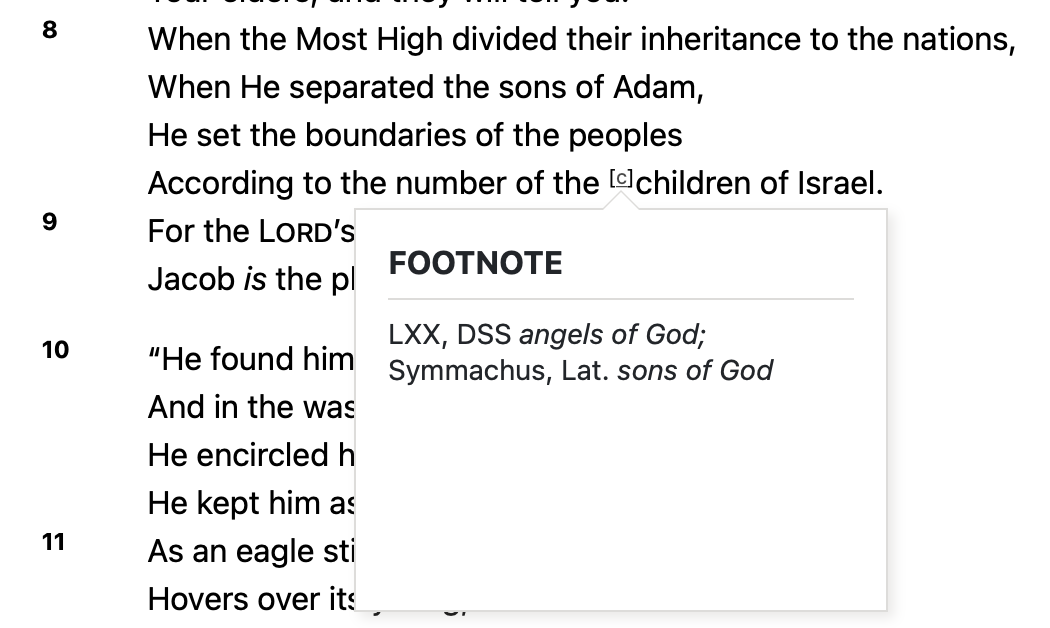
Angels of God, or Sons of God.
The "DSS" refers to the Dead Sea Scrolls, which were only recently uncovered and which are widely believed by scholars to be one of the oldest and thus most reliable translations available.
That is the correct translation.
Then read verse 9: "But Israel is the LORD's portion".
In other words, let me sum it all up for you: God is angry with what people have done at Babel. They have not disbursed and spread out on the Earth the way he instructed them, so he divides them up into Nations and he assigns each a ruler -- an Angel or a Son of God.
But God keeps Israel for himself so that in the event all other Nations become corrupt (and they do), he can still fulfill his original plan that he had in the Garden of Eden through Israel.
I hope you're tracking with me, because you're going to see the News in an entirely new light when you understand this.
It's Ephesians 6:12: "12 For we wrestle not against flesh and blood, but against principalities, against powers, against the rulers of the darkness of this world, against spiritual wickedness in high places."
I know you've all read that verse many times, but does it make a lot more sense now?
Each Nation does indeed has a ruler over it, a "Principality".
It's Daniel 1013: "But the prince of the kingdom of Persia withstood me one and twenty days; but lo, Michael, one of the chief princes, came to help me, and I remained there with the kings of Persia."
I'm telling you, this stuff is all over your Bible, and once you start to see it and connect the dots, things come alive!
One more quote to pull it all home for you....
Psalm 82:
Psalm 82
A Plea for Justice
A Psalm of Asaph.
1 God has taken his place in the divine council;
in the midst of the gods he holds judgment:
2 “How long will you judge unjustly
and show partiality to the wicked? Selah
3 Give justice to the weak and the orphan;
maintain the right of the lowly and the destitute.
4 Rescue the weak and the needy;
deliver them from the hand of the wicked.”5 They have neither knowledge nor understanding;
they walk around in darkness;
all the foundations of the earth are shaken.6 I say, “You are gods,
children of the Most High, all of you;
7 nevertheless, you shall die like mortals
and fall like any prince.”[a]8 Rise up, O God, judge the earth,
for all the nations belong to you!
If anything I have said so far makes you nervous, understand this is ALL in your Bible.
Have you ever read Psalm 82?
It connects with everything I just told you.
YHWH takes his place in the Divine Council, in the midst of the gods he holds judgment!
Don't be made at me, I didn't write that....Jesus did! It's in your Bible!
So does that mean we have multiple gods?
No.
But we do have multiple "Sons of God" that YHWH put on his Divine Council.
And you can't read that to just be the Trinity because in the remainder of the Psalm, these other "gods" (Elohim, simply meaning spiritual beings created by God living in the spiritual realm) they all turn evil and go bad.
Psalm 82 is recounting what happens after Deuteronomy 32.
God assigned the Nations of the world each to one of his members of his Divine Council.
He trusted them to rule fairly and justly but they all turn corrupt.
Sound familiar?
So they face judgment and God/YWHW carries out his original plan through HIS PORTION, which is Israel.
That's my effort to introduce this concept to you and for you to get a better understanding of what is happening with Israel right now on the world stage.
But of course Dr. Michael Heiser does it better than I ever could.
So for the visual learners out there, I have some videos for you.
The first is Dr. Heiser talking about this in a Q&A format:
https://www.youtube.com/watch?v=FiX4F_1gBuQ

Join the conversation!
Please share your thoughts about this article below. We value your opinions, and would love to see you add to the discussion!