

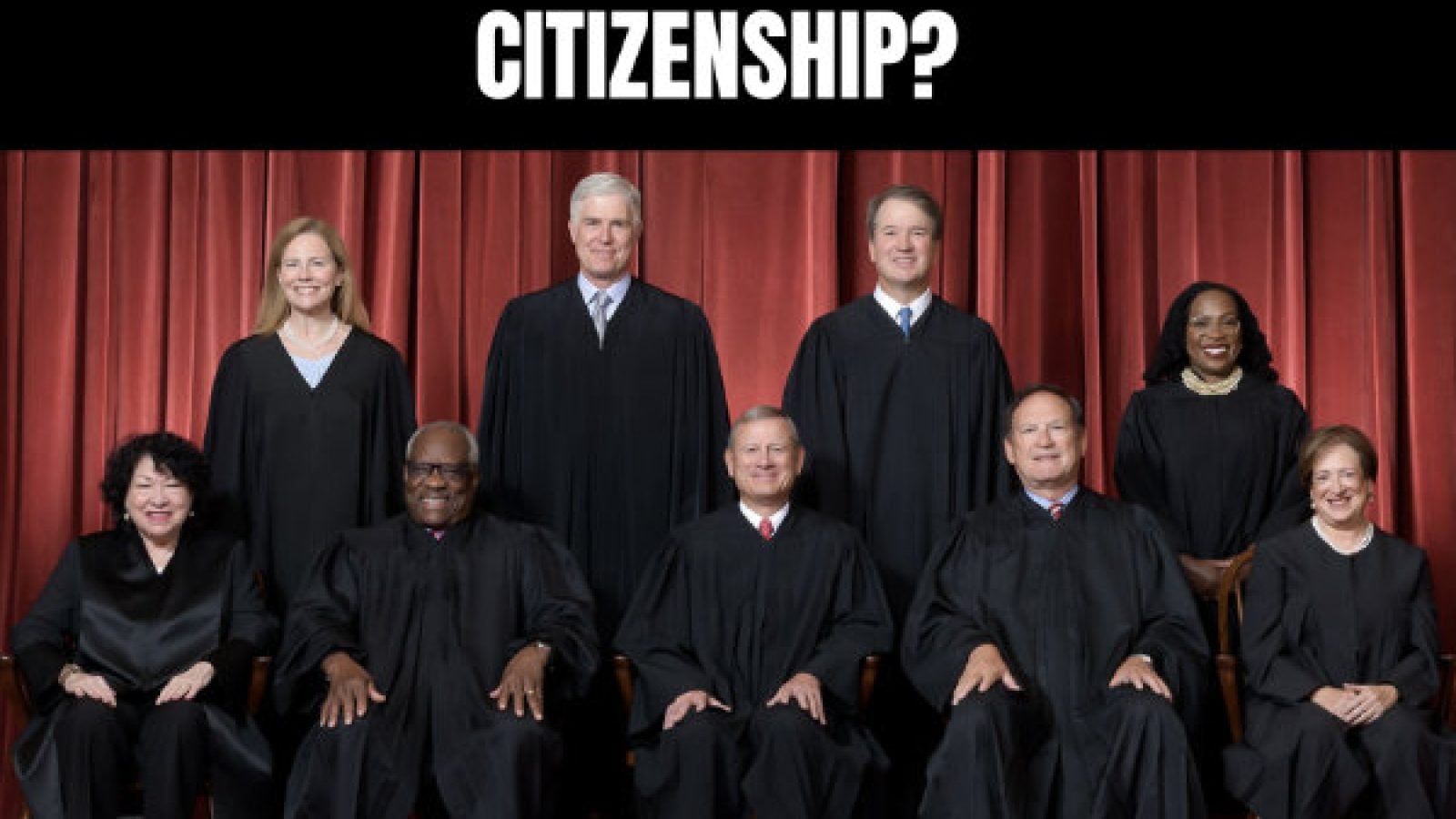
The U.S. Supreme Court is stepping into a huge immigration fight this week: whether the Trump administration can terminate Temporary Protected Status (TPS) for Haiti and Syria.
The justices are scheduled to hear oral arguments on Wednesday, April 29, 2026, in Mullin v. Doe and Trump v. Miot, which will be argued together.
At the center of the dispute is a basic question: when Congress says TPS is temporary, who gets the final say on when it ends?
Here are the case basics, plus the administration’s stated rationale for ending both designations.
BREAKING: I took to the House floor to force a vote on extending Temporary Protected Status for Haiti.
— Congresswoman Ayanna Pressley (@RepPressley) April 15, 2026
We won the first important vote in this process, and now we're a step closer to getting this done.
The House must move with urgency and pass this legislation without delay. pic.twitter.com/9XXc5nVg1J
If you’re not familiar with TPS, Cornell’s Legal Information Institute lays out what the program is, why these two designations existed, and what the Supreme Court is being asked to decide.
The Legal Information Institute explainer frames the question like this:
Can the Trump administration terminate Temporary Protected Status designations for Syrian and Haitian nationals?
This case asks the Supreme Court to consider whether the Trump administration can end the Temporary Protected Status (“TPS”) program for Syrian and Haitian nationals. Markwayne Mullin, Secretary of the Department of Homeland Security, asserts that the former Secretary of the Department of Homeland Security appropriately consulted with other agencies about the TPS decisions as required by statute, and that neither the President’s nor the Secretary’s comments about immigration support equal-protection claims. Mullin argues that Section 1254a(b)(5)(A) bars judicial review of all TPS decisions, including the process and methodology preceding those decisions. TPS Applicants counter that judicial review of compliance with required procedures is permitted even if judicial review of the ultimate decisions by the Secretary are not. TPS Applicants argue former-Secretary Noem’s consultations were insufficient and did not comply with the statute, and President Trump’s speech and actions have exhibited a pattern of impressible racial animus. The case implicates the safety of Haitian and Syrian TPS holders, national security, and the understanding of judicial-review bars.
Whether the Trump administration can end the Temporary Protected Status program for Syrian nationals.
Congress implemented the Temporary Protected Status (“TPS”) program in 1990 to place guardrails on the executive branch’s ability to alter “pre-existing humanitarian relief programs.” The program allows the Secretary of Homeland Security to extend refuge and work privileges to people who would face “armed conflict, natural disaster, or other extraordinary and temporary conditions” in their home country. These protections apply only to people who were physically in the United States when their home country received the TPS designation and last only as long as their home country maintains its designation. Once a country receives TPS designation, the designation will automatically extend every six months until the country no longer meets the criteria for designation. The statute prohibits the Secretary from revoking TPS designations from countries that still meet the relevant criteria.
Laila Doe, Dahlia Doe, Dr. Sara Doe, et al. (collectively, “Doe”) are Syrians currently living and working in the United States under work authorizations given because of Syria’s TPS designation, which was first granted in 2012. Most recently, Syria’s TPS designation was renewed in 2024 due to “dire economic and humanitarian conditions” resulting from civil war, government repression, violence, and a major earthquake. However, following a campaign promise to revoke TPS, President Trump directed then-Secretary of Homeland Security Kristi Noem to re-evaluate the program. Noem terminated Syria’s TPS designation on September 19, 2025, concluding that the country was now safe for its citizens to return home to and emphasizing that there is a national interest in not having Syrian nationals in the United States. Doe sued Noem and the United States to halt the termination of their TPS protections.
Miot et al. (collectively, “Miot;” with Doe, “TPS Applicants”) are Haitians currently living in the United States under Haiti’s TPS designation, which it received in 2010 after a major earthquake. Similar to Syria, Haiti has had its TPS designation renewed by multiple administrations due to the “inadequate food, shelter, and medical care” in the country. Although the first Trump administration attempted to revoke Haiti’s TPS designation, the designation prevailed through the Biden administration and was renewed again for eighteen months in 2024. In 2024, then-Secretary of Homeland Security Mayorkas concluded that “political corruption, human-rights abuses, escalating gang violence, limited health care, food insecurity,” and natural disasters supported his decision to extend the protections for Haitian nationals. Then-Secretary Noem terminated Haiti’s TPS status on November 28, 2025. Noem again pointed to Haiti’s safety and a national interest in removing Haitian nationals from the United States. Miot sued President Trump and the United States to halt the termination of their TPS protections.
Right now, 350,000+ Haitians in the U.S. are at risk of losing Temporary Protected Status and being forced back into instability and violence.
— Congressman Maxwell Alejandro Frost (@RepMaxwellFrost) April 15, 2026
I urge my colleagues to vote “yes” tomorrow to protect TPS and do what is right. pic.twitter.com/FVFjgNIKyx
DHS has publicly argued TPS has drifted from its original purpose. In its Syria termination announcement, DHS emphasized both country-conditions and what it called the national-interest case for ending the designation.
In a September 19, 2025 release, DHS explained its rationale for ending Syria’s TPS designation:
After careful consideration and deliberation of country conditions, the Secretary issues a termination of TPS status for Syria
WASHINGTON – Today, Department of Homeland Security (DHS) Secretary Kristi Noem announced her decision to cancel the Temporary Protected Status (TPS) designation for Syria.
“This is what restoring sanity to America’s immigration system looks like,” said DHS Assistant Secretary Tricia McLaughlin. “Conditions in Syria no longer prevent their nationals from returning home. Syria has been a hotbed of terrorism and extremism for nearly two decades, and it is contrary to our national interest to allow Syrians to remain in our country. TPS is meant to be temporary.”
Syrian nationals have 60 days to voluntarily depart the United States and return home. Aliens leaving the United States are encouraged to use the U.S. Customs and Border Protection CBP Home app to report their departure from the United States and take advantage of a safe, secure way to self-deport that includes a complimentary plane ticket, a $1,000 exit bonus, and potential future opportunities for legal immigration.
ICYMI: My discharge petition to extend Temporary Protected Status for Haiti has advanced in the House.
— Congresswoman Ayanna Pressley (@RepPressley) April 16, 2026
Democrats, Republicans, & Independents voted for it because they know it's good policy & the right thing to do.
Tomorrow, the House must pass this bill & help save lives. pic.twitter.com/3eLnxIktPx
And in the Haiti termination notice, DHS framed the move as a statutory review and a return to the ‘temporary’ intent of the program.
DHS made a similar case for terminating Haiti’s TPS designation:
WASHINGTON – Secretary of Homeland Security Kristi Noem today announced the termination of Temporary Protected Status for Haiti. The TPS designation for the country expires on Aug. 3, 2025, and the termination will be effective on Tuesday, September 2, 2025.
At least 60 days before a TPS designation expires, the Secretary, after consultation with appropriate U.S. government agencies, is required to review the conditions in a country designated for TPS to determine whether the conditions supporting the designation continue to be met, and if so, how long to extend the designation.
ADVERTISEMENT“This decision restores integrity in our immigration system and ensures that Temporary Protective Status is actually temporary,” said a DHS spokesperson. “The environmental situation in Haiti has improved enough that it is safe for Haitian citizens to return home. We encourage these individuals to take advantage of the Department’s resources in returning to Haiti, which can be arranged through the CBP Home app. Haitian nationals may pursue lawful status through other immigration benefit requests, if eligible.”
After conferring with interagency partners, Secretary Noem determined that conditions in Haiti no longer meet the TPS statutory requirements. The Secretary’s decision was based on a U.S. Citizenship and Immigration Services review of the conditions in Haiti and in consultation with the Department of State. The Secretary determined that, overall, country conditions have improved to the point where Haitians can return home in safety. She further determined that permitting Haitian nationals to remain temporarily in the United States is contrary to the national interest of the United States. Haitian nationals returning home are encouraged to use the U.S. Customs and Border Protection CBP Home app to report their departure from the United States.
We’ll be watching for what the justices say about the scope of judicial review, and whether the government’s consultation process is something courts can police in the first place.
How do you feel about it?
Join the conversation!
Please share your thoughts about this article below. We value your opinions, and would love to see you add to the discussion!