

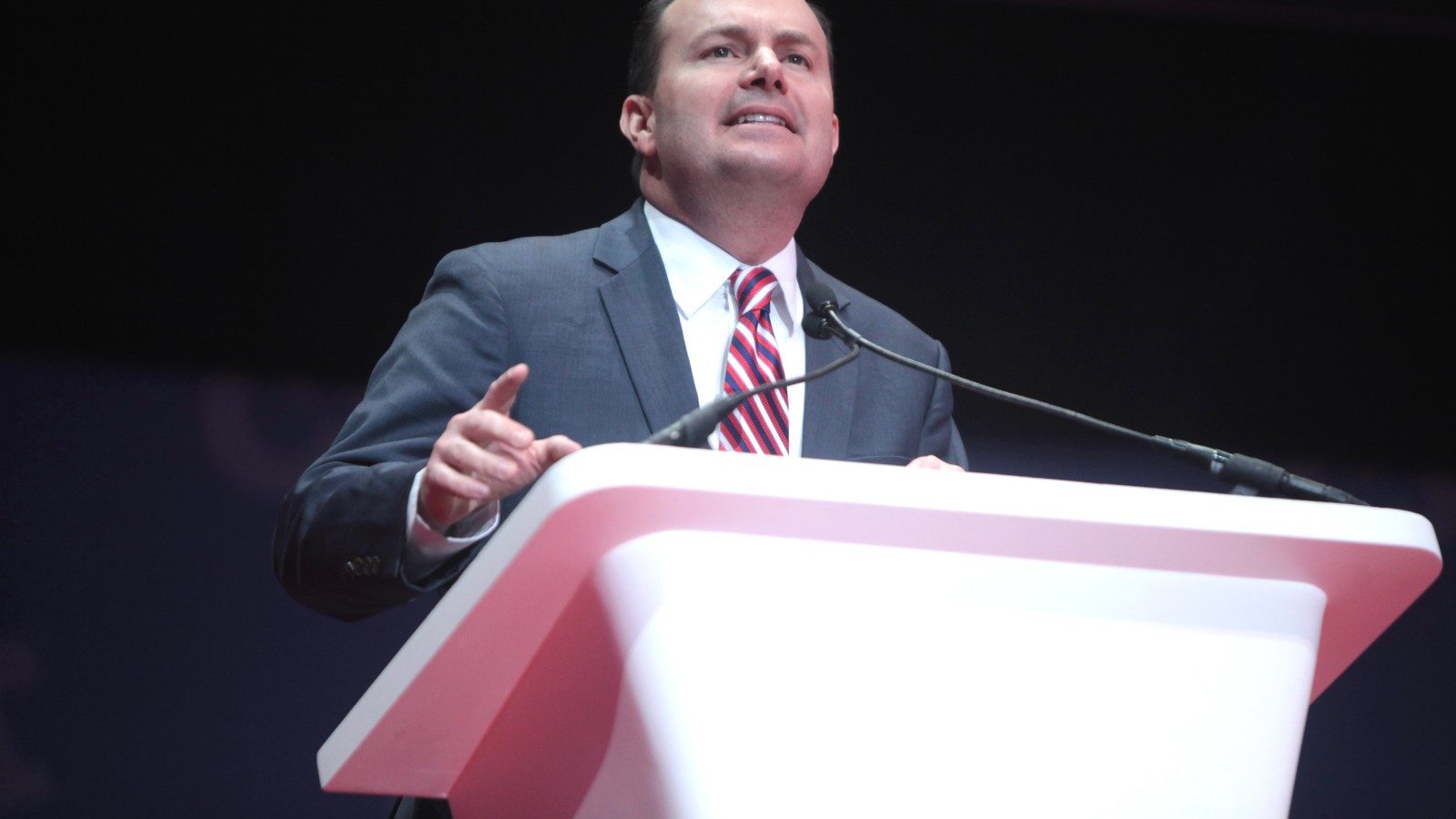
Sen. Mike Lee isn’t messing around.
While most of Congress was off enjoying their spring recess — some reportedly spotted at casinos and resorts — the Utah Republican was making the case that President Trump should dust off one of the most rarely used powers in the entire Constitution.
The goal? Force lawmakers back to Washington to fund the Department of Homeland Security and pass the SAVE America Act, the landmark election integrity bill that would require proof of citizenship to vote in federal elections.
And honestly, it’s hard to argue with the logic.
Lee took to X to lay out his case, and he didn’t hold back:
He’s right. Sitting around waiting for Chuck Schumer to come to the table has produced exactly nothing. The DHS shutdown stretched on for weeks — the longest single-agency shutdown in American history — while 260,000 federal employees went without paychecks.
And yet Congress went home anyway.
So what’s this “rare constitutional power” Lee is talking about?
It comes from Article II, Section 3 of the Constitution. The exact text says the President “may, on extraordinary Occasions, convene both Houses, or either of them.” It’s one of those powers the Founders built into the system as a kind of emergency lever — a way for the President to pull Congress back to work when the situation demands it.
Lee made the constitutional case directly:
It’s a fair point. If a quarter of a million DHS employees going without pay while the border remains a top national concern doesn’t qualify as “extraordinary,” what exactly does?
Here’s what makes this so interesting from a historical standpoint.
This power has barely been used in the modern era. The last time a President convened Congress in a special session was way back in 1948, when Harry Truman called what became known as the “Turnip Day Session.” Truman, facing a Republican-controlled Congress that had adjourned for the year, used his nomination acceptance speech to call both houses back to Washington. He challenged them to live up to their own party platform on civil rights, Social Security, and healthcare.
The nickname came from an old Missouri saying: “On the twenty-sixth of July, sow your turnips, wet or dry.” Truman picked July 26th to make his point.
The session itself only lasted about eleven days, and Congress didn’t accomplish much — the Republican leadership essentially blocked everything. But the political move was brilliant. Truman used it to paint Congress as a do-nothing body, and he rode that message all the way to a come-from-behind victory in the 1948 election.
Before Truman, presidents had used the power about 27 times going all the way back to John Adams in 1797. But since 1948? Not once. That’s nearly 80 years.
Fox News had more details on Lee’s push:
Lee, a sponsor of the SAVE Act, argued that requiring proof of citizenship to vote is a vital enough reason for lawmakers to cut their vacation short and get back to work.
The constitutional power in question would allow the president to convene one or both chambers of Congress in extraordinary circumstances — a power that has rarely been exercised in American history.
“It was made a possibility back in 1787 when they wrote Article II, Section 3 of the Constitution, which gives him this power in extraordinary occasions,” Lee said.
“This would give us a chance to get back and get DHS funded, and I hope, next, turn to the SAVE America Act.”
Lee has been one of the loudest voices in the Senate pushing for the SAVE America Act. The bill, which he co-sponsored alongside Rep. Chip Roy, would require Americans to show documentary proof of citizenship when registering to vote — things like a birth certificate, U.S. passport, or naturalization certificate. It would also require a photo ID at the time of voting.
The House already passed the bill back in February. But the Senate hit a wall. Democrats used the filibuster to block it, meaning Republicans would need 60 votes to move forward — and they don’t have the numbers.
That’s part of what makes Lee’s strategy here so compelling. If Trump were to invoke Article II, Section 3 and force the Senate back into session, the pressure to actually hold a vote — on camera, on the record — would be enormous. Senators would have to go on record either supporting or opposing proof-of-citizenship requirements for voting.
Deseret News reported on the broader context:
The Department of Homeland Security has been closed since February 14, 2026 — the longest shutdown for a single government agency in U.S. history.
ADVERTISEMENTBoth the House and Senate adjourned for a two-week recess without resolving the funding impasse. The DHS shutdown has left approximately 260,000 employees without paychecks.
Lee called the situation “insane” and urged lawmakers to return immediately. He emphasized this is the Senate’s second recess since the shutdown began.

Two recesses during a shutdown. Let that sink in.
Now, there are some who argue there’s a procedural wrinkle that could complicate things. Because Congress has been holding brief “pro forma” sessions every three days, some legal experts say they technically never fully adjourned — which could make it harder for the President to formally convene them. But that feels more like a technicality designed to avoid accountability than a real constitutional argument.
President Trump himself said the option was “under consideration,” telling the New York Post he was open to using the power. And Lee made it clear he wasn’t just talking about DHS funding — he wanted the SAVE America Act on the floor too.
He later doubled down on the constitutional argument:
Whether Trump ultimately pulls the trigger on this or not, Lee’s push has done something important. It’s put the spotlight on a constitutional tool that most Americans didn’t even know existed — and reminded Congress that the Founders built in a mechanism for exactly this kind of situation.
When 260,000 Americans aren’t getting paid, when the border agency is running on fumes, and when a critical election integrity bill is being blocked by procedural games — yeah, that sounds like an “extraordinary occasion” to most people.

Join the conversation!
Please share your thoughts about this article below. We value your opinions, and would love to see you add to the discussion!