

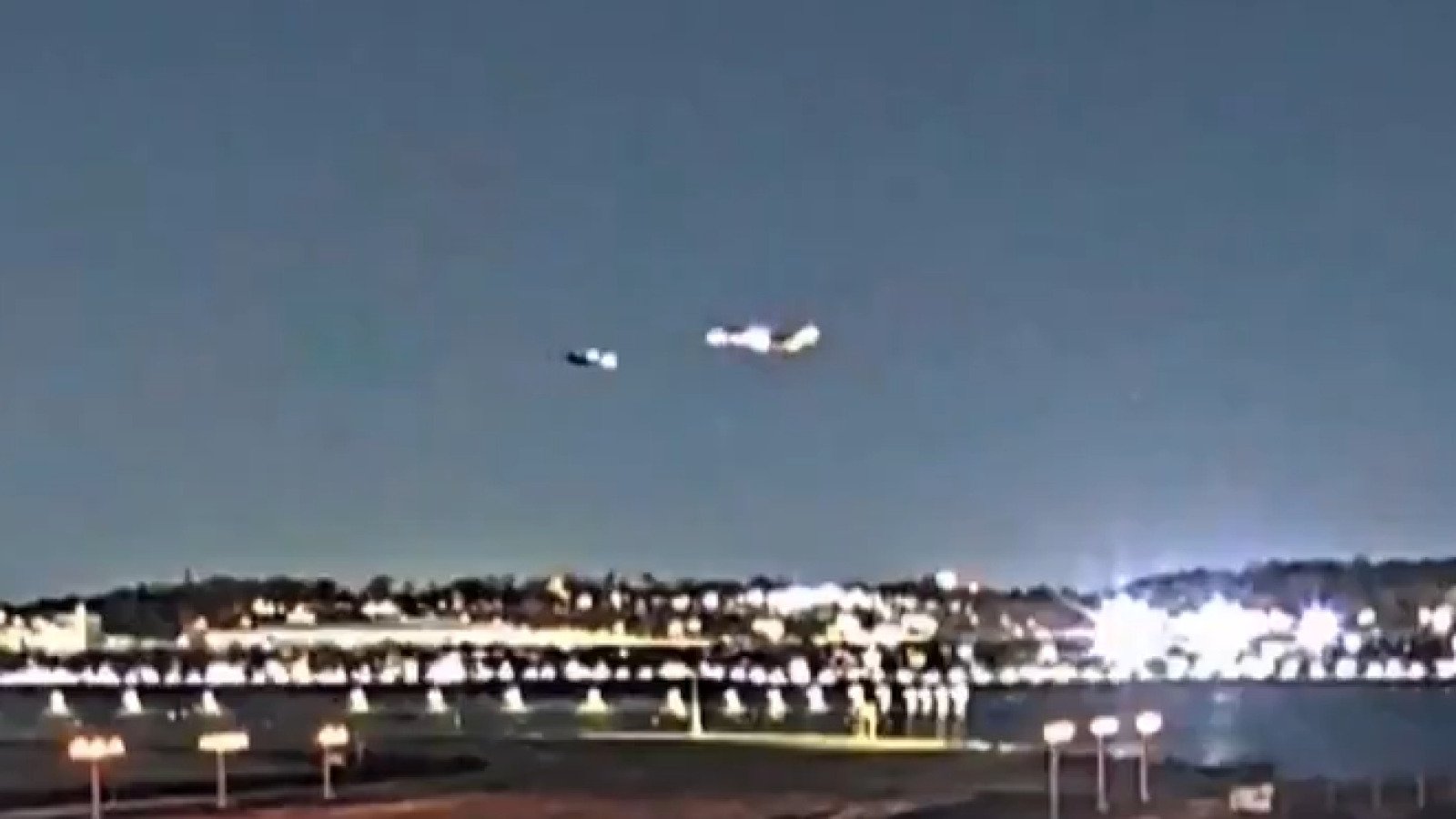
This is hard to watch.
New footage has been released of the fatal collision between an American Airlines jet and a U.S. military blackhawk helicopter in Washington, D.C.
The crash resulted in the deaths of 64 passengers and three military personnel.
Watch it here:
New footage released by 60 Minutes shows last year’s mid-air collision between an American Airlines passenger jet and a Black Hawk helicopter at Reagan National Airport near Washington, D.C.
The crash, which occurred on January 29, 2025, killed 67 people, including 64 on the… pic.twitter.com/sGHKn1qF6M
— AZ Intel (@AZ_Intel_) March 30, 2026
News 18 provided further context:
A newly released video has captured the moment an American Airlines passenger jet collided mid-air with a US Army Black Hawk helicopter near Ronald Reagan Washington National Airport, killing all 67 people on board the two aircraft last year.
In a video shared by 60 Minutes, footage shows the aircraft coming together mid-air, followed by a fireball and plumes of smoke as both crash into the Potomac River.
The crash took place on January 29, 2025, when the jet — operating as American Airlines Flight 5342 — was approaching the airport after flying in from Wichita, Kansas.
The Black Hawk helicopter was on a routine training mission in restricted airspace at the time of the collision, officials said.
All 64 passengers and crew on the aircraft, along with three military personnel on the helicopter, were killed, making it one of the deadliest aviation disasters in the US since November 12, 2001.
“You had frontline controllers ringing that bell for years and years, saying this is not safe. This cannot continue. Please send help,” says air traffic controller Emily Hanoka, who was working hours before last year’s deadly collision between a passenger jet and a helicopter at… pic.twitter.com/evRMIkcZTW
— 60 Minutes (@60Minutes) March 29, 2026
The New York Post reported an air traffic controller who was on duty the night of the crash shared that there were warning signs:
A former Washington DC air traffic controller on duty the night of the fatal January 2025 mid-air collision involving an American Airlines plane and a US Army helicopter warned how there were “obvious holes” already in the system at the time of the disaster.
ADVERTISEMENT“The warning signs were all there,” Emily Hanoka told CBS 60 Minutes Sunday, revealing how controllers had identified safety concerns and staffers were forced to keep Ronald Reagan Washington National Airport moving, even though its capacity was being stretched.
“You had frontline controllers ringing that bell for years, and years, saying this is not safe,” she said.
“This cannot continue. Please change this and that didn’t happen.”
Hanoka, who clocked off just hours before the smash over the Potomac River that killed 67, said safety recommendations were made – but they never went too far.
“Controllers formed local safety councils and every time that a controller made these safety reports, another controller was compiling data to back up the recommendation. And many recommendations were made, and they never went too far,” she said.
Air traffic controllers were tasked with keeping the airport moving – even though 800 flights a day would take off from its main runway.
“Some hours are overloaded, to the point where it’s over the capacity that the airport can handle,” she said.
“There was definitely a pressure. If you do not move planes, you will gridlock the airport.”
ADVERTISEMENT
Any thoughts?

Join the conversation!
Please share your thoughts about this article below. We value your opinions, and would love to see you add to the discussion!