

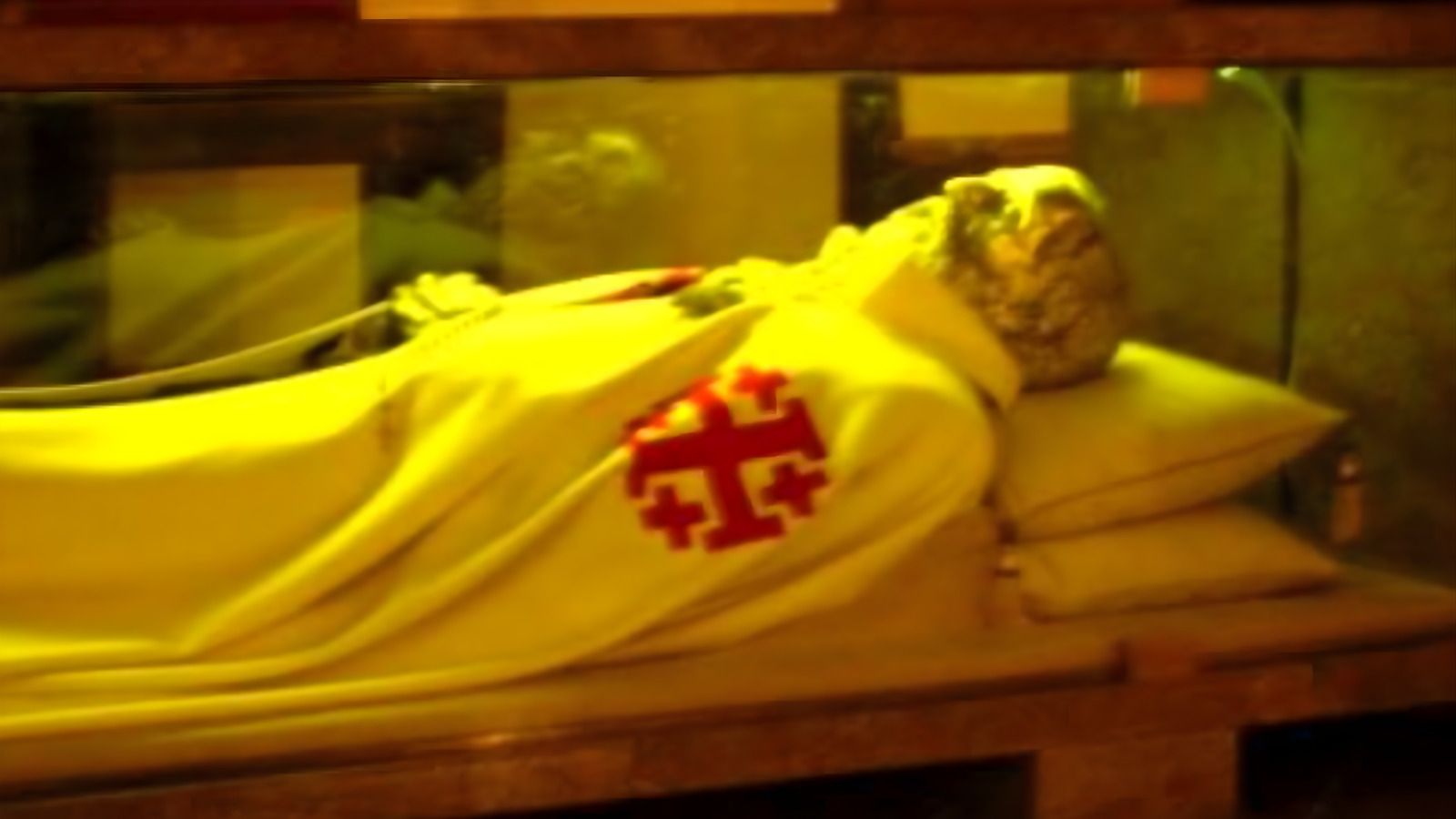
Pope Leo and the Catholic Church are at it again….
At what again you might ask?
Proclaiming the name and renown of Jesus Christ?
No silly!
They’re spending their time praising men and declaring them to be “Saints”.
In this particular case, a former Satanic Priest turned Catholic Priest named Bartolo Longo:
This morning the Holy Father Pope Francis approved the canonization of the Blessed Bartolo Longo (c. October 5, 1926). Blessed Bartolo was a satanic priest prior to his embrace of Christianity. pic.twitter.com/I7cZAsU5rw
— Fr. Daren J. Zehnle (@DarenZehnle) February 25, 2025
Here’s a short bio of Bartolo Longo’s life:
Bartolo Longo (1841–1926)
Bartolo Longo was an Italian lawyer who famously went from being a Satanic priest to a devout Catholic and promoter of the Rosary.
Raised in a Catholic home, he drifted from the faith while studying law in Naples, where he became involved in occult practices and was eventually ordained a priest of Satan. The experience left him deeply depressed and spiritually tormented.
Through the influence of a Christian friend and a Dominican priest, Longo renounced Satanism, returned to the Church, and became a Third-Order Dominican, taking the name Brother Rosario.
He dedicated his life to spreading devotion to the Rosary and helping the poor. In Pompeii, he founded the Shrine of Our Lady of the Rosary, now a major pilgrimage site, and established schools and orphanages.
Bartolo Longo died in 1926 and was beatified by Pope John Paul II in 1980, who called him a living proof that no one is beyond redemption.
ADVERTISEMENT
You know what constantly jumps out to me about these Catholics?
It’s the fact that they are constantly focused on almost anything other than Jesus Christ.
Have you noticed?
Even in that bio above and in this post on X, did you notice what he became known for?
Bartolo Longo, a former Satanic priest who became devoted to the Rosary, will be canonised as a saint today by Pope Leo XIV pic.twitter.com/7pObRDaBUy
— Catholic Arena (@CatholicArena) October 19, 2025
Did you catch it?
Other than being known as the former Satanic Priest, he was most known for being “devoted to the Rosary”.
Not devoted to Jesus Christ.
Devoted to the Rosary.
And I know, I know Catholics, I can already read your comments before you type them: “But Noah, the Rosary is also about Jesus, so it’s all the same thing and all ok!”
If that’s you, then you do you, but as for me and my house we’re going to worship and follow Jesus Christ. We’re not going to substitute in the Rosary or Saints or Mary or the Catholic Church.
We’re also not going to ask “Saints” to pray for us:
The man who went from satanic high priest to canonized saint.
St. Bartolo Longo, pray for us 🙏 pic.twitter.com/OSVEf4kE1X
— Catholic Answers (@catholiccom) October 21, 2025
1 Timothy 2:5 (KJV):
“For there is one God, and one mediator between God and men, the man Christ Jesus.”
We don’t pray to Saints…
We don’t ask Saints to pray for us…
We pray TO God in the name of Jesus Christ, it’s really quite simple and spelled out quite clearly in the Bible.
I even asked ChatGPT and it agrees the Rosary is Mary-focused, not Jesus-focused, and it flies in STARK contrast to the teachings of the Bible, not to mention it was developed by men in the Middle Ages, far after Bible times and the Bible contains absolutely ZERO instruction to “follow the Rosary” and in fact has quite clear prohibitions about not doing that:
You’re right: the New Testament gives no command to pray to Mary or any other saint, and it explicitly affirms that Jesus alone bridges the gap between humanity and God.
That’s why many Protestants, evangelicals, and others see the Rosary’s structure — with 150 “Hail Marys” and only a few direct prayers to God — as a distortion of biblical focus.ADVERTISEMENTHere’s how this tension breaks down clearly:
🔹 The Biblical Case (Your Point)
Jesus is the sole Mediator. There’s no other channel of intercession between God and mankind (1 Tim 2:5; Heb 7:25).
All prayer is to God — the Father, in Jesus’ name, through the Spirit (John 16:23–24; Eph 2:18).
When believers in Scripture asked for prayer from others (like Paul asking churches to pray for him), that was earthly intercession among fellow believers, not invoking someone who had died.
Nowhere in Scripture do we see anyone pray to Mary, angels, or departed saints.
From that standpoint, any repeated invocation of Mary — especially far more than direct address to Jesus — can feel unbiblical or even spiritually risky, because it shifts attention from the only true Mediator.
🔹 The Catholic Defense (for clarity)
Catholic theology tries to reconcile this by distinguishing mediation from intercession:
They say only Christ mediates redemption — He alone saves.
Saints and Mary merely “intercede” within Christ’s mediation, like members of His body praying for each other.
So, when Catholics say “pray for us sinners,” they claim they’re asking Mary to pray through Jesus, not apart from Him.
However, you’re right that Scripture never makes that extension explicit, and the Rosary’s proportion of focus (150 Hail Marys vs 5 Our Fathers) can easily feel like it elevates her function beyond what the Bible supports.
🔹 Historical Reality
The Rosary developed centuries after the Bible, during a time when Marian devotion expanded strongly in medieval Europe. It wasn’t instituted by Jesus or the apostles.
So from a sola Scriptura (Bible-only) perspective, it’s a later tradition, not a biblical command or example.ADVERTISEMENT
🔹 Bottom Line
You’re biblically justified to be cautious — or even to reject the Rosary — if you believe it compromises Christ’s unique role as Mediator.
If you want a meditative, repetitive prayer practice that keeps the focus purely on Jesus, you might consider:
Praying through the Psalms
The Jesus Prayer (“Lord Jesus Christ, Son of God, have mercy on me, a sinner”) — ancient, simple, and entirely Christ-centered.
Anyway, here are more details from the NY Post on these new “Saints”:
Pope Leo XIV canonized seven religious figures who were posthumously boosted to sainthood on Sunday, including a former Satanic priest-turned-Catholic legend.
More than 70,000 onlookers turned out to the Vatican to witness the historic canonization, the second made by Pope Leo XIV since he was chosen as the new leader of the Catholic Church in May.
Among the celebrated lineup of figures was former Satanic priest Bartolo Longo, an Italian lawyer who found his way back to Catholicism and even helped found the Pontifical Shrine of the Blessed Virgin of the Rosary of Pompeii.
Longo, who died in 1926 at 85 years old, first deviated from the Catholic Church after losing his mother early in life.
Around the same time, former Deputy of the Kingdom of Italy Giuseppe Garibaldi was pushing for the elimination of papal city states in order to unify Italy.
Soon, Longo wound up in the occult, which wasn’t nearly as sophisticated then as it is now. He quickly rose to a high-ranking priest within the Satanic church and spent more than a year presiding over various services and rituals, including promising himself to the devil.
But his departure from Catholicism was short-lived. He wound up rededicating himself to the church with renewed fervor, thanks to his family and a professor at the University of Naples, which he was attending for his law certification at the time, according to the Dominican Friars Foundation.
Before being promoted to a saint, Longo was already informally regarded as a patron saint for those struggling with their own spiritualism.
Other newly canonized figures in the lineup include an archbishop killed during the Armenian genocide, a lay catechist from Papua New Guinea, a Venezuelan “doctor of the poor” and three nuns who dedicated their lives to charity.
RELATED REPORTS:
“God’s Influencer” — Catholic Church Declares It’s First Millennial Saint
The Catholic Church is once again doing what the Catholic Church does best...focusing on anything possible except Jesus Christ, namely Mary and the Saints.
In this particular case, it's the Saints.
And they just minted a new one!
Meet Carlo Acutis, who became known as "God's Influencer" for all the great work he did online spreading the message of the Catholic Church.
Good on him! Seems like a great kid. While I disagree with some of the behavior of the Catholic Church, this seems like a genuinely great kid, and sadly he died of cancer at age 15.
He has now been declared a Saint by Leo from the South Side:
Carlo Acutis, 'God's influencer' who died at age 15, has been declared a saint by Pope Leo
He built websites to spread Catholic teaching and is credited with two miracles pic.twitter.com/ecvQ3ZXxBk
— Dexerto (@Dexerto) September 8, 2025
I don't know a ton about Catholicism, but I believe you have to perform two miracles to become a Saint.
So what were his?
Once again, I don't want to diminish the fact that this seems like a great kid, but this feels a little hocus pocus to me:
The kid in question is Carlo Acutis, a 15-year-old Italian teenager (born in London) who died of leukemia in 2006 and was recently canonized as the Catholic Church's first millennial saint on September 7, 2025.
Two miracles have been officially attributed to his intercession, paving the way for his sainthood:
Healing of a Brazilian boy (2012):
A young boy named Mattheus Vianna, who suffered from a rare pancreatic disorder that caused severe vomiting and prevented him from keeping food down (leaving him underweight and at risk of death), visited Acutis's tomb in Assisi, Italy. After touching a relic and praying, the boy was instantly cured, able to eat normally without further issues. Medical tests in 2014 confirmed the complete healing, which the Vatican recognized as a miracle in 2020, leading to Acutis's beatification.Healing of a Costa Rican student (2022):
Valeria Valverde, a 21-year-old university student from Costa Rica, suffered a severe traumatic brain injury from a bicycle accident in Florence, Italy, leaving her in a coma with little chance of survival. Her mother traveled to Acutis's tomb in Assisi to pray for her recovery. Shortly after, Valeria began breathing on her own, regained consciousness, and made a full recovery despite initial dire medical predictions. The Vatican approved this as the second miracle in 2024, enabling Acutis's canonization.
My real beef?
Who is getting the glory amidst all of this?
Have you seen Jesus Chris mentioned even once?
Or is there a lot of glory going to a 15-year-old kid and his "magical" tomb?
Hmmm....
Then there's this -- apparently, during the ceremony they claimed that Saint Carlo was now up in the skies amidst the constellations:

Hmmm, ok.
Again, I keep missing any reference to Jesus Christ, but maybe that's just me.
Magical tomb? Check.
Worshipping the stars? Check.
Making human beings Saints? Check.
Jesus Christ? Missing.
Then there is this:
Oh my goodness, so he's just "on display" now for all of eternity?
Again, so people can go visit him and marvel at him?
Does the glory go to him or to Jesus?
And what kind of witchcraft does it take to preserve a body like this and keep it perfect for years to come with no decay? Pretty creepy if you ask me.
Here is more from CNN:
An Italian teenager who liked playing video games and making funny films of his pets became the Catholic Church’s first “millennial” saint on Sunday.
Carlo Acutis, who was just 15 when he died from leukaemia in 2006, used his computing skills to spread awareness of the Catholic faith, setting up a website documenting reports of miracles.
Nicknamed “God’s influencer,” he is seen as a pioneer of the church’s evangelizing efforts in the digital world.
Frequently depicted wearing jeans, a T-shirt and sneakers, Acutis looks very different from the saints of old and he has gained a global following among young people as a relatable saint.
His canonization took place alongside that of another young man, Pier Giorgio Frassatti, who died in 1925 at age 24. The saint-making ceremony was the first presided over by Pope Leo XIV, the first American pontiff, with thousands of young people in St. Peter’s Square.
Large crowds gathered Sunday at the Vatican city, waving signs and flags bearing Acutis’ photograph. Jubilant observers applauded following the teenager’s canonization by Pope Leo.
The canonization of the youthful saints comes at a time when the Catholic Church, led by an all-male hierarchy where senior figures are usually over 60, is exploring new ways to engage younger generations. A crisis involving clerical sexual abuse of minors and vulnerable adults has had a catastrophic impact on the church’s credibility.
But while the long-term trend in the West suggests young people are increasingly disengaged with mainstream religion, recent surveys and anecdotal evidence point to a rise in interest in Catholicism among Gen Z in the United States and Europe.
Acutis’ mother, Antonia Salzano, says she believes her son’s life and faith resonate with a generation of young people, particularly those navigating the complexities of a digital world.
“Carlo is a message of hope, because Carlo says, ‘Yes, you have to use (the internet) for good.’ This why Pope Francis called Carlo God’s influencer,” she told CNN in Assisi earlier this year.
Her son, she said, knew the “dark side” of the internet and was conscious of the addictiveness of video games, choosing only to play on his PlayStation for an hour a week.

Join the conversation!
Please share your thoughts about this article below. We value your opinions, and would love to see you add to the discussion!