

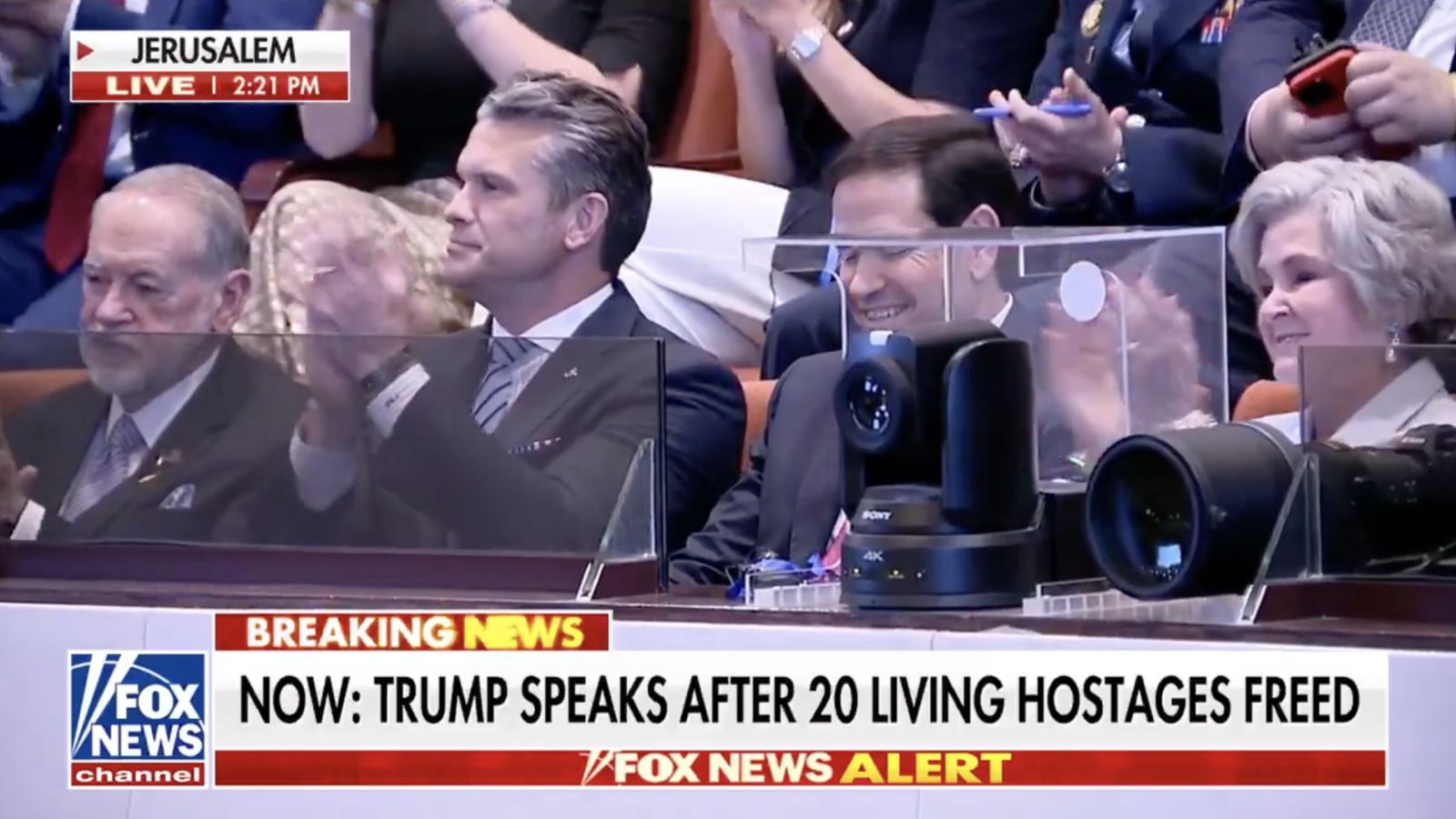
President Trump just went off-script again stopping his speech at the Israeli Knesset to praise Marco Rubio’s work as Secretary of State and going so far as to say he believes Marco will go down as the greatest Secretary of State in U.S. history!
Yes, even greater that Hillary Rodham Clinton! (I kid, I kid)
But it is quite an impressive list, here are arguably the Top 20 most famous and influential Secretaries of State in US history compiled by ChatGTP (I do not agree with all picks):
🇺🇸 Top 20 Most Famous U.S. Secretaries of State
Thomas Jefferson (1790–1793)
ADVERTISEMENT
The first Secretary of State and author of the Declaration of Independence.
Set the tone for U.S. foreign policy and states’ rights philosophy.
James Madison (1801–1809)
Later became the 4th U.S. President.
Managed diplomacy leading up to the War of 1812.
John Quincy Adams (1817–1825)
Negotiated the Adams–Onís Treaty (Florida acquisition).
Architect of the Monroe Doctrine; later became the 6th President.
Daniel Webster (1841–1843, 1850–1852)
Noted orator who shaped mid-19th century U.S. diplomacy and compromise on slavery.
ADVERTISEMENTWilliam H. Seward (1861–1869)
Served under Lincoln and Johnson; negotiated the purchase of Alaska (“Seward’s Folly”).
Kept Europe from recognizing the Confederacy.
John Hay (1898–1905)
Promoted the “Open Door Policy” in China.
Former Lincoln secretary turned major global statesman.
Cordell Hull (1933–1944)
Served under FDR; longest-serving Secretary of State.
ADVERTISEMENTConsidered the “Father of the United Nations”; won the Nobel Peace Prize (1945).
George C. Marshall (1947–1949)
Architect of the Marshall Plan that rebuilt Europe after WWII.
Nobel Peace Prize winner; symbol of postwar recovery and diplomacy.
ADVERTISEMENTDean Acheson (1949–1953)
Designed the postwar international order (NATO, Truman Doctrine).
Guided early Cold War containment strategy.
John Foster Dulles (1953–1959)
Eisenhower’s top diplomat; fierce anti-communist.
Defined the U.S. “brinkmanship” policy during the Cold War.
Henry Kissinger (1973–1977)
Architect of détente with the USSR and opening to China.
ADVERTISEMENTShared Nobel Peace Prize for Vietnam negotiations; one of the most famous diplomats in history.
George P. Shultz (1982–1989)
Served under Reagan; key player in ending the Cold War and arms control talks with the USSR.
Madeleine Albright (1997–2001)
First female Secretary of State.
Advocated U.S. intervention in the Balkans and NATO expansion.
Colin Powell (2001–2005)
First African-American Secretary of State.
Prominent military leader; presented the case for Iraq invasion at the U.N.
Hillary Rodham Clinton (2009–2013)
Former First Lady and later presidential candidate.
Oversaw the U.S. response to the Arab Spring and the pivot to Asia.
ADVERTISEMENT
John Kerry (2013–2017)
Negotiated the Iran Nuclear Deal (JCPOA) and the Paris Climate Agreement.
Condoleezza Rice (2005–2009)
Second female and first Black woman Secretary of State.
Promoted “transformational diplomacy” under George W. Bush.
Alexander Haig (1981–1982)
Served under Reagan; known for his military background and blunt style (“I’m in control here” during Reagan’s assassination attempt confusion).
James Baker III (1989–1992)
Key in the Gulf War diplomacy and German reunification; a close ally of George H.W. Bush.
Antony Blinken (2021–present)
Current Secretary of State; key figure in U.S. policy toward Ukraine, China, and Israel.
Known for restoring traditional diplomacy after the Trump era.
Watch President Trump here:
TRANSCRIPT:
Donald Trump:
And I have a prediction that Marco will go down — I mean this — as the greatest Secretary of State in the history of the United States.
I believe that. And he and I, you know, we really fought it out. You remember, he was tough.
He was nasty. Who the hell thought this was gonna happen, Marco, right?
And now I’m saying he’s gonna go down as the greatest — he will. He was always, he was always smart and sharp, and people respect him.
Backup here if needed:
NEW: President Trump declares Sec. Rubio will go down as the “greatest Secretary of State in the history of the United States.”
“Marco will go down—I mean this—as the greatest Secretary of State in the history of the United States. I believe that—I believe it." pic.twitter.com/PhIA0G09Vb
— Fox News (@FoxNews) October 13, 2025
RELATED REPORT:
WATCH: President Trump Brings The House Down When He Asks For Pardon For Netanyahu
President Trump is in Israel today celebrating the Gaza Peace Deal, and as part of that trip he visited the Israeli Knesset, their version of our Congress.
Watch as he received a thunderous standing ovation when welcomed to the podium:
President Trump receives a standing ovation in the Israeli Knesset. pic.twitter.com/p2oqFVB1wE
— 𝐍𝐢𝐨𝐡 𝐁𝐞𝐫𝐠 ♛ ✡︎ (@NiohBerg) October 13, 2025
But it's this next moment I really wanted you to see...
As he so often likes to do, President Trump went off script and suddenly asked the Israeli President to give Benjamin Netanyahu a pardon.
The entire crowd erupted!
Watch here:
Backup here if needed:
🚨 BREAKING: President Trump asks the President of Israel ON THE SPOT to give Benjamin Netanyahu "a PARDON."
The Knesset erupts into a standing ovation
"That was NOT in the speech! But I happen to like him, and it just seems to make so much sense. One of the greatest war time… pic.twitter.com/EgdBx2RtEj
— Eric Daugherty (@EricLDaugh) October 13, 2025
Now if you're a little confused, allow me to fill in the gaps here.
First question: Pardon for what?
Well, Benjamin Netanyahu has long been under prosecution for allegedly taking bribes.
That's what President Trump was referencing when he said "cigars and champagne, who cares?" Those were the alleged bribes he allegedly took at one point.
President Trump seems to be suggesting they are so inconsequential as to not matter. And if you ask me, I think President Trump probably views all of this through the lens of his own Witch Hunt he just lived through.
Critics of Netanyahu have even gone so far as to suggest he issued a stand down order on October 7th two years ago to allow the Hamas invasion of Israel to derail that corruption trial and cement his power as a "Wartime Prime Minister".
I'm not taking a side in that, I'm just giving you both sides.
Ok, now about the President....
If you are confused about why they have a Prime Minister AND a President and are curious about which is more powerful, I've got you covered:
In Israel, the President and the Prime Minister serve very different roles — one largely ceremonial, the other politically powerful.
🇮🇱 The President (Head of State)
- Role: The President of Israel is the symbolic head of state, similar to a monarch in a parliamentary system like the UK.
- Duties:
- Formally appoints the Prime Minister (usually the leader most likely to form a majority coalition).
- Signs laws passed by the Knesset (Israel’s parliament).
- Has the power to pardon prisoners or commute sentences.
- Represents the State of Israel at official events at home and abroad.
- Powers: Almost entirely ceremonial. The President doesn’t make policy or lead the government.
- Example: Isaac Herzog (as of 2025) is the current President. His influence is moral and symbolic rather than political.
🇮🇱 The Prime Minister (Head of Government)
- Role: The Prime Minister is the executive leader and wields the real political power.
- Duties:
- Leads the Cabinet (government ministers).
- Sets national policy, directs the military, and oversees government ministries.
- Represents Israel in international negotiations and diplomacy.
- Must maintain the confidence of the Knesset (120-seat parliament).
- Powers: Substantial — similar to the British Prime Minister or German Chancellor.
- Example: Benjamin Netanyahu (as of 2025) holds this position and exercises day-to-day control over government policy.
⚖️ Relationship Between Them
- The President formally appoints the Prime Minister after elections based on who can likely form a governing coalition.
- After that, the President has little involvement in government operations.
- The two may meet regularly for consultations or state events, but the Prime Minister leads the government, not the President.
🏛️ Summary: Who’s More Powerful?
Position Function Real Power Level President Symbolic, ceremonial ⚪ Low Prime Minister Executive, policymaker 🔵 Very High In short:
The President unites the nation, while the Prime Minister runs it.
It reminds me of King Charles vs. the actual head of state in England.
Now the final question, can the Israeli President actually pardon the Prime Minister as President Trump asks?
ANSWER: Yes, under certain conditions:
⚖️ The President’s Power of Pardon
Under Basic Law: The President of the State, the Israeli President has the constitutional authority to:
“Pardon offenders and lighten penalties by the reduction or commutation of sentences.”
This applies to any Israeli citizen, including elected officials — even a sitting or former Prime Minister, Minister, or Member of Knesset.
So in theory, yes, the President could pardon the Prime Minister.
🚫 Key Limitations
Only after conviction:
A pardon generally applies after a conviction in court, not to cancel an ongoing trial.
The President cannot intervene in active legal proceedings.
Once a Prime Minister is convicted (and possibly sentenced), then the President could issue a pardon or commute the sentence.
No power to stop investigations or indictments:
The President cannot block police investigations or prevent the Attorney General from filing charges. The justice system operates independently.Political backlash and checks:
While legal, pardoning a Prime Minister—especially one convicted of corruption or abuse of power—would trigger massive political and public controversy, and could be seen as undermining the rule of law.
🧩 Real-World Context
This issue came up with Benjamin Netanyahu, who has faced ongoing corruption charges. Some of his allies floated the idea of a future presidential pardon if convicted.
However, legal experts warned that granting such a pardon while he remained in office could create a constitutional crisis and appear as political favoritism.
🏁 Summary
Question Answer Can the Israeli President pardon the Prime Minister? ✅ Yes, constitutionally allowed. Can the President stop an investigation or trial? ❌ No, that’s outside their power. When can a pardon happen? Only after conviction and sentencing. Would it be controversial? Extremely — it would likely provoke public outrage and legal challenges.
In short:
The President of Israel can pardon anyone, including the Prime Minister — but only after conviction, and doing so would likely cause a political firestorm.

Join the conversation!
Please share your thoughts about this article below. We value your opinions, and would love to see you add to the discussion!