

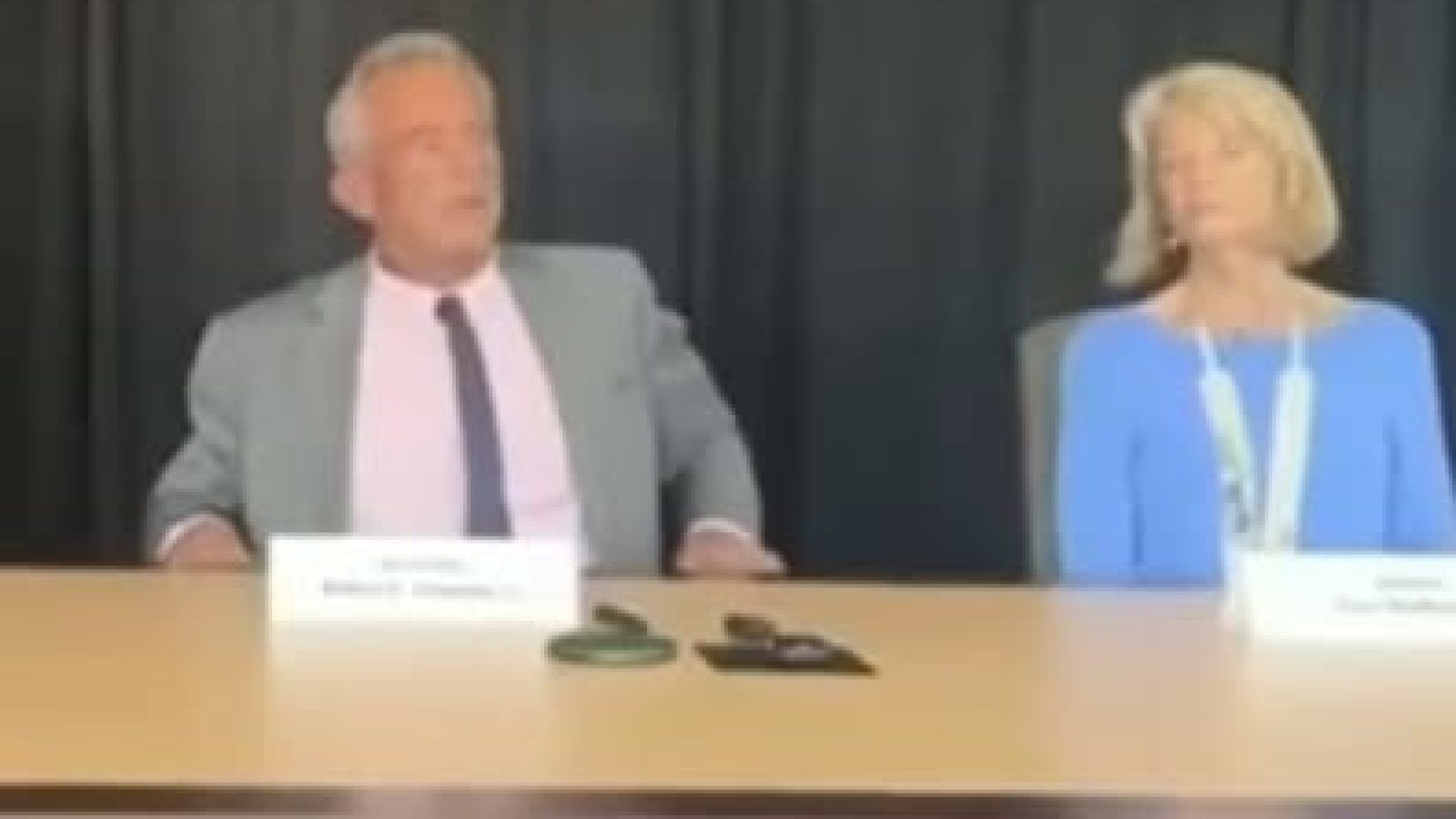
During a press conference in Anchorage, Alaska, Health and Human Services (HHS) Secretary Robert F. Kennedy Jr. said the National Institutes of Health (NIH) is developing a “universal vaccine.”
“Right now, we’re developing a universal vaccine at NIH, which is a vaccine that addresses the entire phylum of viruses,” RFK Jr. said.
“It’s a vaccine that mimics natural immunity, and it is effective against any kind of mutations,” he continued.
“We believe it’s going to be effective against not only coronaviruses but also flu,” he added.
Check it out:
RFK Jr says the NIH is developing a “universal vaccine” for COVID and Flu which mimics natural immunity pic.twitter.com/Te66wv0VIX
— Chief Nerd (@TheChiefNerd) August 8, 2025
The announcement follows RFK Jr. saying BARDA would terminate 22 mRNA vaccine development investments totaling about $500 million.
BARDA To Terminate “22 mRNA Vaccine Development Investments” – HHS Secretary RFK Jr. Says
“We reviewed the science, listened to the experts, and acted. BARDA is terminating 22 mRNA vaccine development investments because the data show these vaccines fail to protect effectively against upper respiratory infections like COVID and flu,” RFK Jr. said.
“We’re shifting that funding toward safer, broader vaccine platforms that remain effective even as viruses mutate,” he added.
“Let me be absolutely clear: HHS supports safe, effective vaccines for every American who wants them. That’s why we’re moving beyond the limitations of mRNA and investing in better solutions,” RFK Jr. said in a video.
Here's the announcement:
We reviewed the science, listened to the experts, and acted. BARDA is terminating 22 mRNA vaccine development investments because the data show these vaccines fail to protect effectively against upper respiratory infections like COVID and flu. We’re shifting that funding toward… pic.twitter.com/GPKbuU7ywN
— Secretary Kennedy (@SecKennedy) August 5, 2025
Alaska Beacon has more:
Also at the Anchorage news conference, Kennedy reiterated his more general criticism of vaccines administered to children. He falsely claimed they are untested and that the department plans to now do randomized testing to check their safety, although all vaccines have already been tested before federal approval.
“The current vaccine schedule is exempt from safety testing, and so none of the vaccines, with the exception of the COVID vaccine, has been tested against an inert placebo. That means that we don’t know the risk profiles for those products. And people need to know that, and doctors need to know it,” he said.
Without such testing, it is unknown whether the vaccines cause more harm than good, he said.
COVID vaccines have to go through three phases of clinical trials, according to the U.S. Centers for Disease Control and Prevention, to make sure they are safe and effective, especially against severe illness, hospitalization and death.
“So for the first time, we are now going to do real randomized trials on vaccines. Never happened before,” he said.
X users reacted to RFK Jr.'s announcement about the development of a "universal vaccine":
Natural immunity should not have to be mimicked. Eat well, exercise, hydrate, spend time in the sun, sleep well, decrease stress, vit D, and voila your immune system will do its job without a vaccine with potential side effects. Common sense medicine. https://t.co/4XcBkJDZUS
— Dr. Kat Lindley (@KLVeritas) August 8, 2025
Well, there is natural immunity, that not only mimics natural immunity, but is natural immunity! @RobertKennedyJr @SecKennedy
Fortify it with vitamin D and Zinc and vitamin V, and fresh air! @TheChiefNerd #NaturalImmunity https://t.co/R9GqJtKNfW— Craig M. Wax D.O. (@drcraigwax) August 8, 2025
Guess what else mimics naturally immunity? Natural immunity!
— Dr. Lynn Fynn-derella
(@Fynnderella1) August 8, 2025
In October 2019, at the Milken Institute Future of Health Summit, former National Institute of Allergy and Infectious Diseases (NIAID) Director Anthony Fauci discussed a "universal flu vaccine."
Here's the clip:
October 29th, 2019
Milken Institute: The Future of Health Summit
Anthony Fauci & Rick Bright discuss a “Universal Flu Vaccine” and a hypothetical scenario where a novel virus emerges from China.
Just over 4 months prior to that actually happening and 11 days after Event 201… pic.twitter.com/F4ryF0InQp
— Champagne Joshi (@JoshWalkos) November 4, 2023

Northeastern Global News talked to multiple professors about the development of a universal vaccine.
The outlet spoke with Mansoor Amiji, university distinguished professor of pharmaceutical sciences and chemical engineering, and Brandon Dionne, associate clinical professor of pharmacy and health systems sciences.
Northeastern Global News shared:
Traditionally, researchers developing seasonal vaccines for the flu, for instance, have grown bits of hemagglutinin in egg cultures or other media, called a subunit approach, Dionne says.
“It takes time to actually grow the virus or make those hemagglutinin proteins to then put in a flu vaccine for you to develop antibodies,” he says.
The whole virus approach to vaccine development involves inactivating it to make sure it is no longer pathogenic, Amiji says.
“It’s not going to cause the disease, but it still has the immune component that will prime or activate our immune system,” he says.
Dionne says mRNA vaccines have similar antibody responses to viruses but can be updated more quickly than other vaccine development methods by providing instructions for your body to develop the antibodies.
ADVERTISEMENT“It’ll either prevent the disease or reduce the symptoms and severity,” he says.
“Currently, you have to keep developing new vaccines every season to keep up with changes” in the viruses, Dionne says.
“The idea of a universal vaccine is that you pick a target in the virus that doesn’t change, that’s highly conserved, that doesn’t change from season to season,” he says.
“With flu, our vaccines normally target the hemagglutinin head, the top of the protein, which changes more frequently. A potential target could be the stem of hemagglutinin, which is more highly conserved,” Dionne says.
“If you could develop a universal flu vaccine, it wouldn’t be specific to last year’s H1N1 strain,” he says. “It would be all influenza A because you’re targeting a part of the virus that is common among all the different influenza A viruses and is the same from season to season.”
The idea is that “you don’t have to keep updating the vaccine every year,” Dionne says.
Thus far it’s been difficult to develop a robust immune response that can translate across different flu viruses and show “actual clinical effect,” Dionne says.
“It’s been a goal for a while, and it’s just been challenging to develop,” he says.
“There have been phase one trials of universal vaccines, but I don’t know of any phase two or phase three trials, and those take time,” Dionne says.
“So my bet would be that we are at least a year if not more out, and that depends on how the regulatory process goes,” he says.
There are different ways of trying to develop a universal vaccine, but mRNA “would be perfect for that because you can encode how to develop just the universal target and develop an antibody response to that,” Dionne says.
He called a universal vaccine, whether for influenza or COVID-19, “a valuable goal.”
ADVERTISEMENT“It’s something that we’ve been working on for a while, but haven’t gotten there yet,” Dionne says.
Amiji says “mRNA as a platform technology holds a lot of promise.”

Join the conversation!
Please share your thoughts about this article below. We value your opinions, and would love to see you add to the discussion!