

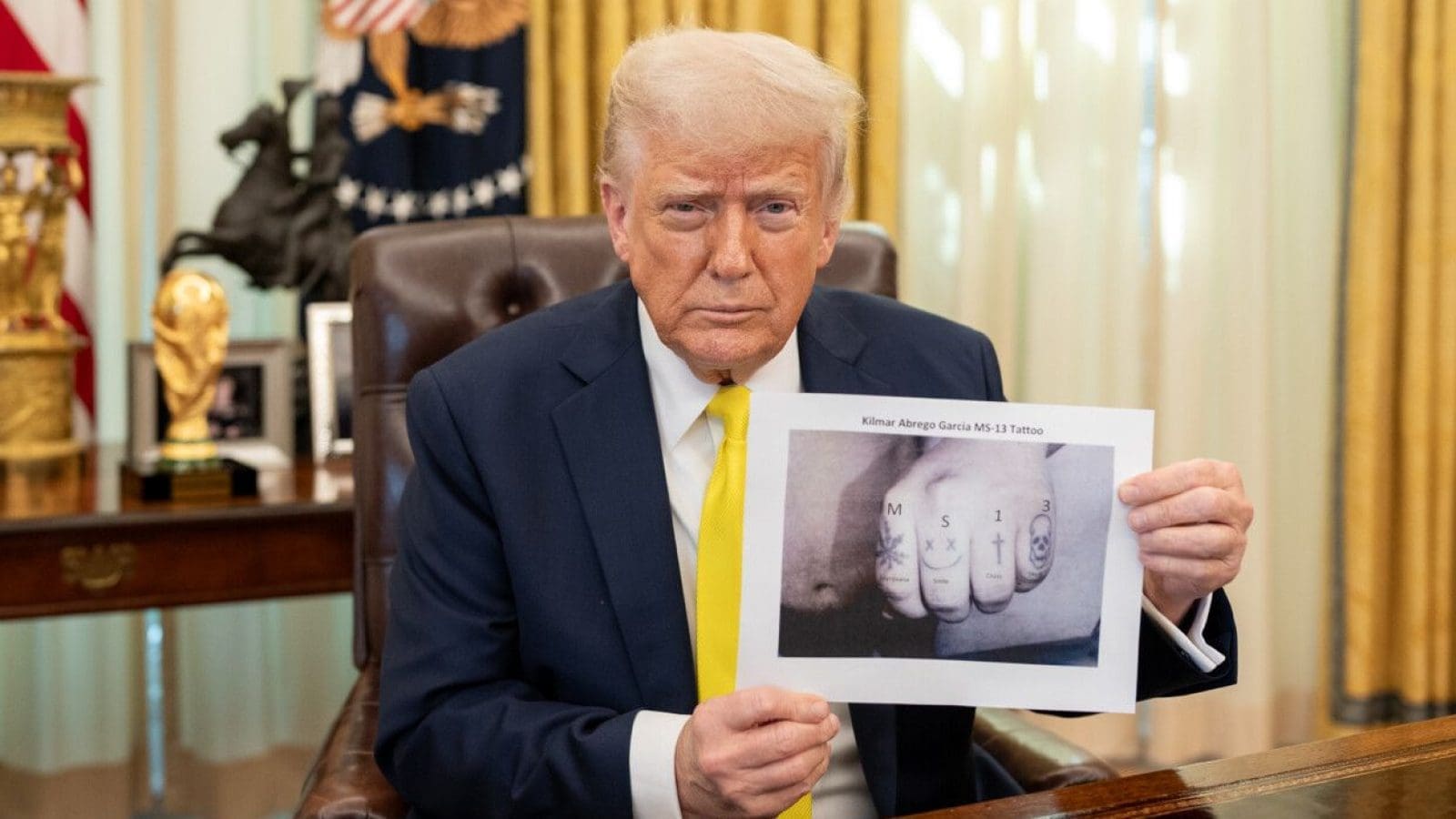
President Trump just settled the debate….with photographic evidence!
The so-called “Maryland Man”, you know the “Maryland Father” and “Maryland Husband”, the great person who got shipped off to El Salvador unjustly, you know him?
Turns out it’s all bogus (like we told you).
Turns out, he IS part of MS-13, so much so that he tattooed it on his hand!
President Trump just broke this story wide open with this post on his TruthSocial a few minutes ago:
Screenshot here:
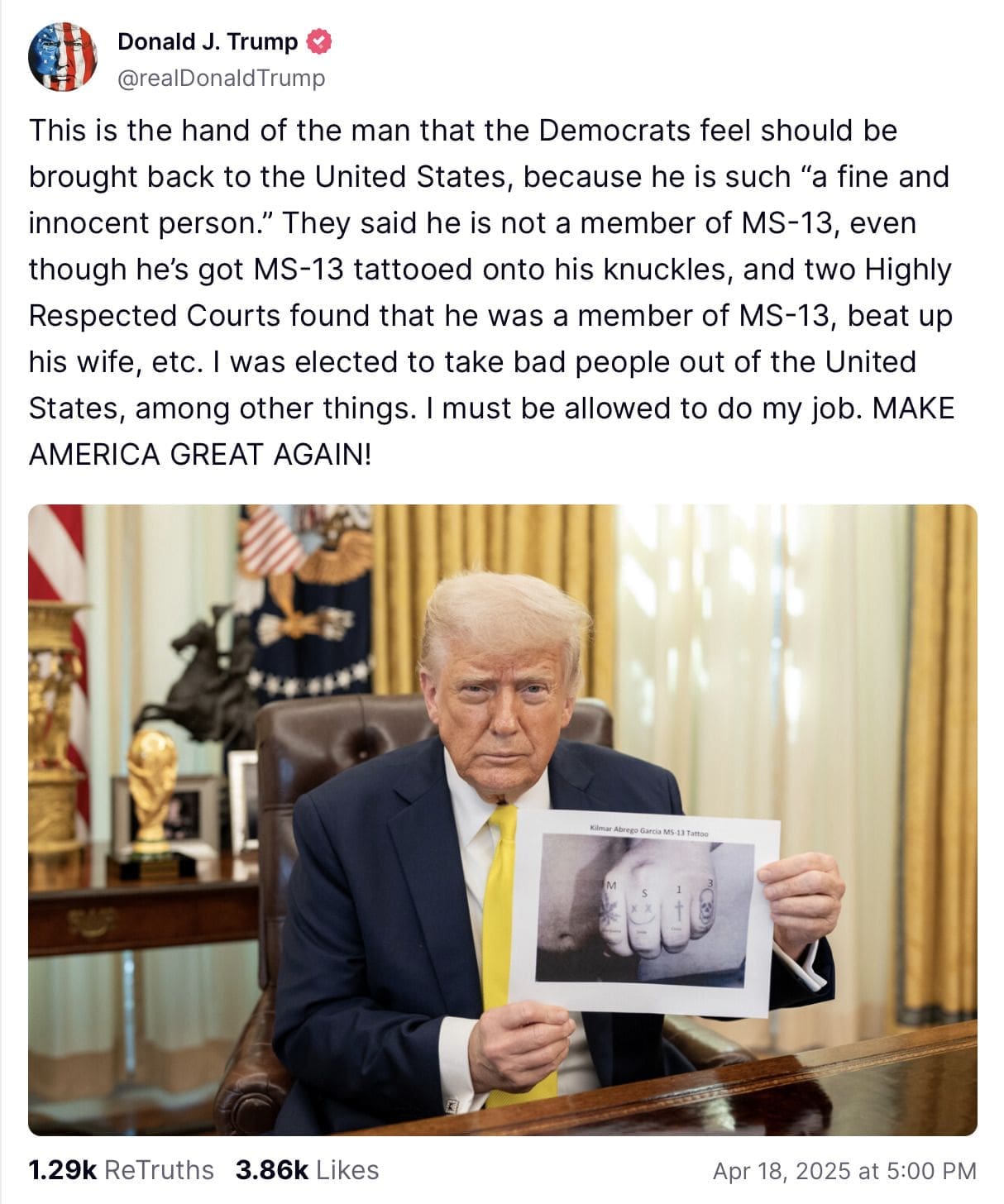
This is the hand of the man that the Democrats feel should be brought back to the United States, because he is such “a fine and innocent person.” They said he is not a member of MS-13, even though he’s got MS-13 tattooed onto his knuckles, and two Highly Respected Courts found that he was a member of MS-13, beat up his wife, etc. I was elected to take bad people out of the United States, among other things. I must be allowed to do my job. MAKE AMERICA GREAT AGAIN!
Debate over folks!
Meanwhile, this is the guy who Democrats fly a hemisphere away to protect, meanwhile leaving their actual U.S. citizen residents to be killed by illegal aliens.
These people are sick!
Sen. Chris Van Hollen: Clear Logan Act and Constitutional Violations — Charge Him Now!
Sen. Chris Van Hollen: Clear Logan Act and Constitutional Violations -- Charge Him Now!
By now, I'm sure you know Senator Chris Van Hollen of Maryland flew all the way to El Salvador to meet with, and try to bring back, "Maryland Man".
In case you don't know who Maryland Man is, or why it's one huge con-job lie from the MSM, read this:
Look at this clown holding the gang-banger's hand as they sip margaritas together in El Salvador, meanwhile his own constituent, Rachel Morin, was killed by an illegal alien and he's never even bothered to contact that family.
Why?
Because they're good, American citizens and these Far-Left clowns are truly enemies of the American People!
They hate American citizens but love illegal alien violent criminals.
It's sick!
There you have it.
Maryland Senator Chris Van Hollen says he is flying to El Salvador to secure the release of illegal immigrant and MS-13 gang member Kilmar Abrego Garcia, claiming he's been "kidnapped."
Democrats defend criminals and illegals over Americans.
Every. Single.… pic.twitter.com/GaE8E5eos5
— Charlie Kirk (@charliekirk11) April 15, 2025
This is a funny post, but it's also true....
Look at how he looks like he wants to "make love" to the illegal alien gang-banger:
Guys, pray day that your wife looks at you the same way that Senator Chris Van Hollen looks at an MS-13 terrorist who beats the crap out of his wife. pic.twitter.com/XfgrEFZKbH
— Vince Langman (@LangmanVince) April 18, 2025
One bit of good news is James Comer rejecting any payment from taxpayers for this ridiculous trip:
BREAKING: Rep. James Comer rejects the Democrats to request to have Senator Van Hollen’s trip to El Salvador payed by taxpayer dollars.
Good. pic.twitter.com/ytiKWzlpF1
— Ian Jaeger (@IanJaeger29) April 18, 2025
But that doesn't really go far enough, not even close.
Now I want to advance the story and talk about whether this foolish PR stunt was actually a violation of the US Constitution AND a violation of the Logan Act.
Spoiler alert: I think it is, in a big way!
So do others:
Chris Van Hollen broke the law.
He operated well outside of his scope and allowance.
He needs to be charged immediately. pic.twitter.com/bJruk3upCy
— Gunther Eagleman™ (@GuntherEagleman) April 18, 2025
Could it even be Treason?
Just a sitting U.S. Senator hanging out with a foreign terrorist and trying to bring him back to the U.S.
TREASON. https://t.co/eZHsbFKgn1
— Libs of TikTok (@libsoftiktok) April 18, 2025
I asked Grok to give me a full analysis, and while it told me Treason would be tough to actually prove, it IS a clear violation of The Logan Act and a clear violation of several parts of the US Constitution.
Please share this like crazy so that the Trump Administration sees this (I know they read this website and have for years).
The only way all this crap will stop is if the Trump DOJ charges Van Hollen for these violations and puts a stop to this. Throw the book at him! We need to start making examples of all these people, otherwise they will NEVER stop.
Here's the full analysis to show the Trump DOJ. Pam, I did your work for you, now charge this anti-American clown:
Let’s analyze whether Senator Van Hollen’s actions—planning to travel to El Salvador to discuss Kilmar Abrego Garcia’s release with President Bukele—violate the Logan Act and the U.S. Constitution. This analysis will focus solely on the text of the Logan Act, the Constitution, and first-principles reasoning under the separation of powers doctrine, without considering historical enforcement of the Logan Act.
Step 1: Analysis of the Logan Act Violation
Text of the Logan Act (18 U.S.C. § 953, from Web ID: 4):
"Any citizen of the United States, wherever he may be, who, without authority of the United States, directly or indirectly commences or carries on any correspondence or intercourse with any foreign government or any officer or agent thereof, with intent to influence the measures or conduct of any foreign government or of any officer or agent thereof in relation to any disputes or controversies with the United States, or to defeat the measures of the United States, shall be fined under this title or imprisoned not more than three years, or both.
This section shall not abridge the right of a citizen to apply, himself or his agent, to any foreign government or the agents thereof for redress of any injury which he may have sustained from such government or any of its agents or subjects."Elements of a Logan Act Violation:
U.S. Citizen: Van Hollen is a U.S. citizen, so this element is met.
Without Authority of the United States:
The Act requires that the individual act "without authority of the United States." The text does not specify who grants this authority, but in the context of foreign affairs, authority typically comes from the executive branch, which is responsible for diplomacy (as discussed below). There is no evidence in the provided data that Van Hollen has explicit authorization from the executive branch to negotiate with Bukele. His actions appear to be unilateral, driven by his disagreement with the Trump administration’s response to the Supreme Court ruling. Therefore, this element is likely met.Correspondence or Intercourse with a Foreign Government:
Van Hollen has already sent a letter to Bukele (Trend ID: 3) requesting a meeting to discuss Garcia’s release, and he plans to travel to El Salvador to further these discussions. This constitutes "correspondence or intercourse" with a foreign government (El Salvador) and its officer (Bukele). This element is met.Intent to Influence the Foreign Government’s Conduct in a Dispute with the United States:
The Act requires intent to influence the foreign government’s measures or conduct "in relation to any disputes or controversies with the United States." Garcia’s detention is a dispute between the U.S. and El Salvador: the U.S. Supreme Court ruled his deportation illegal, but El Salvador (under Bukele) has refused to release him, and the Trump administration has not secured his return. Van Hollen’s stated goal is to "check on Kilmar Abrego Garcia’s condition and discuss his release" (Trend ID: 3), which clearly aims to influence Bukele to release Garcia. This is a direct attempt to alter El Salvador’s conduct in the dispute, meeting this element.ADVERTISEMENTException for Personal Redress:
The Act’s exception allows citizens to seek redress for personal injuries from a foreign government. Van Hollen’s actions are not about personal redress but about a broader policy issue involving Garcia, a third party. This exception does not apply.Logan Act Conclusion:
Based on the text of the Logan Act, Van Hollen’s actions meet all elements of a violation. He is a U.S. citizen acting without apparent executive authorization, engaging in correspondence and planned intercourse with a foreign government, with the intent to influence its conduct in a dispute with the United States. Therefore, his actions violate the Logan Act, as written.
Step 2: Analysis of the U.S. Constitution Violation (Separation of Powers)
Relevant Constitutional Provisions:
Article II (Executive Powers):
Section 2:
The President "shall have Power, by and with the Advice and Consent of the Senate, to make Treaties, provided two thirds of the Senators present concur; and he shall nominate, and by and with the Advice and Consent of the Senate, shall appoint Ambassadors, other public Ministers and Consuls." The President is also the "Commander in Chief of the Army and Navy."Section 3:
The President "shall receive Ambassadors and other public Ministers" and "shall take Care that the Laws be faithfully executed."These provisions establish the President as the primary conductor of foreign affairs, responsible for diplomacy, treaty-making, and managing relations with foreign governments.
Article I (Legislative Powers):
Section 8:
Congress has the power to "regulate Commerce with foreign Nations," "declare War," and control funding for military and foreign affairs.Section 10:
States are prohibited from entering into treaties, but Congress is not similarly restricted, implying a role in foreign affairs.The Senate has a specific role in treaty approval and ambassadorial appointments (Article II, Section 2), but this is a check on executive power, not a grant to conduct diplomacy.
Separation of Powers Doctrine (First Principles):
The separation of powers doctrine, rooted in the Constitution’s structure, divides government into three branches—legislative, executive, and judicial—to prevent any one branch from dominating. In foreign affairs, this doctrine allocates primary authority to the executive while giving Congress checks and balances:
Executive Role in Foreign Affairs:
The President’s Article II powers—making treaties, appointing ambassadors, receiving foreign diplomats, and executing laws—position the executive as the lead in foreign relations. The President represents the U.S. in dealings with foreign governments, a role historically recognized since United States v. Curtiss-Wright Export Corp. (1936), though we’re focusing on the text here. The power to "receive Ambassadors" implies control over diplomatic relations, and the "faithful execution" clause includes implementing judicial rulings affecting foreign policy, such as the Supreme Court’s decision on Garcia.Legislative Role in Foreign Affairs:
Congress’s role is legislative and oversight-oriented. It regulates commerce, declares war, and controls funding, which can influence foreign policy indirectly. The Senate’s "Advice and Consent" on treaties and appointments gives it a specific check on executive actions, but this does not extend to direct diplomacy. Individual members of Congress, like Van Hollen, are not constitutionally empowered to negotiate with foreign leaders—that role belongs to the executive.
Application to Van Hollen’s Actions:
What Van Hollen is Doing:
Van Hollen is engaging directly with President Bukele to secure Garcia’s release, a matter involving a dispute between the U.S. and El Salvador. This includes sending a letter and planning to travel to El Salvador for further discussions.Does This Violate Separation of Powers?
Yes. Van Hollen’s actions encroach on the executive’s constitutional authority to conduct foreign affairs. Negotiating with a foreign leader is a diplomatic function reserved for the President, who represents the U.S. in international relations. The Constitution does not grant individual Senators the power to engage in direct diplomacy, even if they believe the executive is not fulfilling its duties (e.g., responding to the Supreme Court ruling). Congress’s role is to check the executive through legislation, oversight, or funding—not to step into the executive’s role by conducting foreign policy.Argument About the Supreme Court Ruling:
Even if the Trump administration’s interpretation of the Supreme Court ruling is incorrect (which is disputed), this does not authorize Van Hollen to violate the separation of powers. The Constitution provides mechanisms for Congress to address executive inaction, such as passing legislation, holding hearings, or using the power of the purse. Direct diplomacy with a foreign government is not one of those mechanisms. Van Hollen’s actions bypass these constitutional checks and usurp the executive’s role, violating the separation of powers.Speech or Debate Clause (Article I, Section 6):
This clause protects members of Congress from legal action for actions taken in their legislative capacity. However, negotiating with a foreign leader is not a legislative act (e.g., voting, debating, or oversight); it is a diplomatic act, which falls under the executive’s purview. Therefore, this clause does not shield Van Hollen’s actions from being a constitutional violation.
Constitution Conclusion:
Van Hollen’s actions violate the U.S. Constitution’s separation of powers doctrine by encroaching on the executive’s authority to conduct foreign affairs. The Constitution assigns diplomacy to the President, and Van Hollen’s direct engagement with Bukele oversteps his legislative role, regardless of the executive’s actions or the Supreme Court ruling.
Final Conclusion
Based on a first-principles analysis of the texts of the Logan Act and the U.S. Constitution:
Logan Act Violation:
Senator Van Hollen’s actions violate the Logan Act. He is a U.S. citizen acting without apparent executive authorization, engaging in correspondence and planned intercourse with a foreign government (El Salvador), with the intent to influence its conduct in a dispute with the United States (Garcia’s detention). The Act’s text provides no exemptions for members of Congress, and his actions do not fall under the personal redress exception.ADVERTISEMENTU.S. Constitution Violation (Separation of Powers):
Van Hollen’s actions also violate the U.S. Constitution by breaching the separation of powers doctrine. The Constitution assigns the President the primary role in conducting foreign affairs, including diplomacy with foreign governments. Van Hollen’s direct negotiations with Bukele usurp this executive authority, exceeding his legislative role as a Senator. Even if the Trump administration’s response to the Supreme Court ruling is inadequate, the Constitution does not permit Van Hollen to step into the executive’s role; Congress has other mechanisms to check the executive, such as legislation or oversight.
In summary, Senator Van Hollen’s actions violate both the Logan Act and the U.S. Constitution, based on their texts and the principles of separation of powers. The disputed nature of the Trump administration’s compliance with the Supreme Court ruling does not alter this conclusion, as it does not grant Van Hollen constitutional or statutory permission to engage in unauthorized diplomacy.
We'll end with Stephen Miller who absolutely hits it out of the park with this:
🔥 OMG: STEPHEN MILLER JUST BURIED CHRIS VAN HOLLEN.
He is so passionate about this.
"His heart is reserved for any illegal alien who's a member of a foreign terrorist organization. I am beyond appalled."
"I'm almost lost for words how outrageous it is. Here's the individual,… pic.twitter.com/gnimosf1Bp
— Eric Daugherty (@EricLDaugh) April 18, 2025
"His heart is reserved for any illegal alien who's a member of a foreign terrorist organization. I am beyond appalled."
"I'm almost lost for words how outrageous it is. Here's the individual, the man who has been deported to his home country of El Salvador, who has been repeatedly documented by multiple federal and state authorities to be a member of MS-13, one of the most violent and ruthless criminal organizations on planet Earth, which is now a designated foreign terrorist organization, an individual who has been incredibly implicated in human smuggling and human trafficking, an individual who is a documented woman beater, somebody who viciously assaulted a woman in ways that shock the human conscience."
"*THAT* is who the Democrat Party is going to provide aid, solace, and comfort to, not to Senator Van Hollen's own constituents like the Morin family."
"Rachel Morin was viciously beaten, brutally r*ped and m*rdered. And her mother never even got a phone call from Senator Van Hollen... or Kayla Hamilton a young girl who was attacked in a public restaurant, r*ped in the bathroom and beaten to d*ath and m*rdered by an illegal alien that Joe Biden set free into the country. None of those people elicit human sympathy from Senator Van Hollen."
"How broken is that man's heart? How broken is his conscience, that he doesn't have even an ounce of empathy or time or concern to share with those families, or how many of his citizen constituents have been k*lled by the fentanyl that Joe Biden allowed into this country by the cartels that made a fortune off of human trafficking smuggling into this country... or the children in his state that cannot even get a good education or good health care because of the mass migration that has occurred into his state."
"NONE OF THAT concerns him in the least."
Share!

Join the conversation!
Please share your thoughts about this article below. We value your opinions, and would love to see you add to the discussion!