
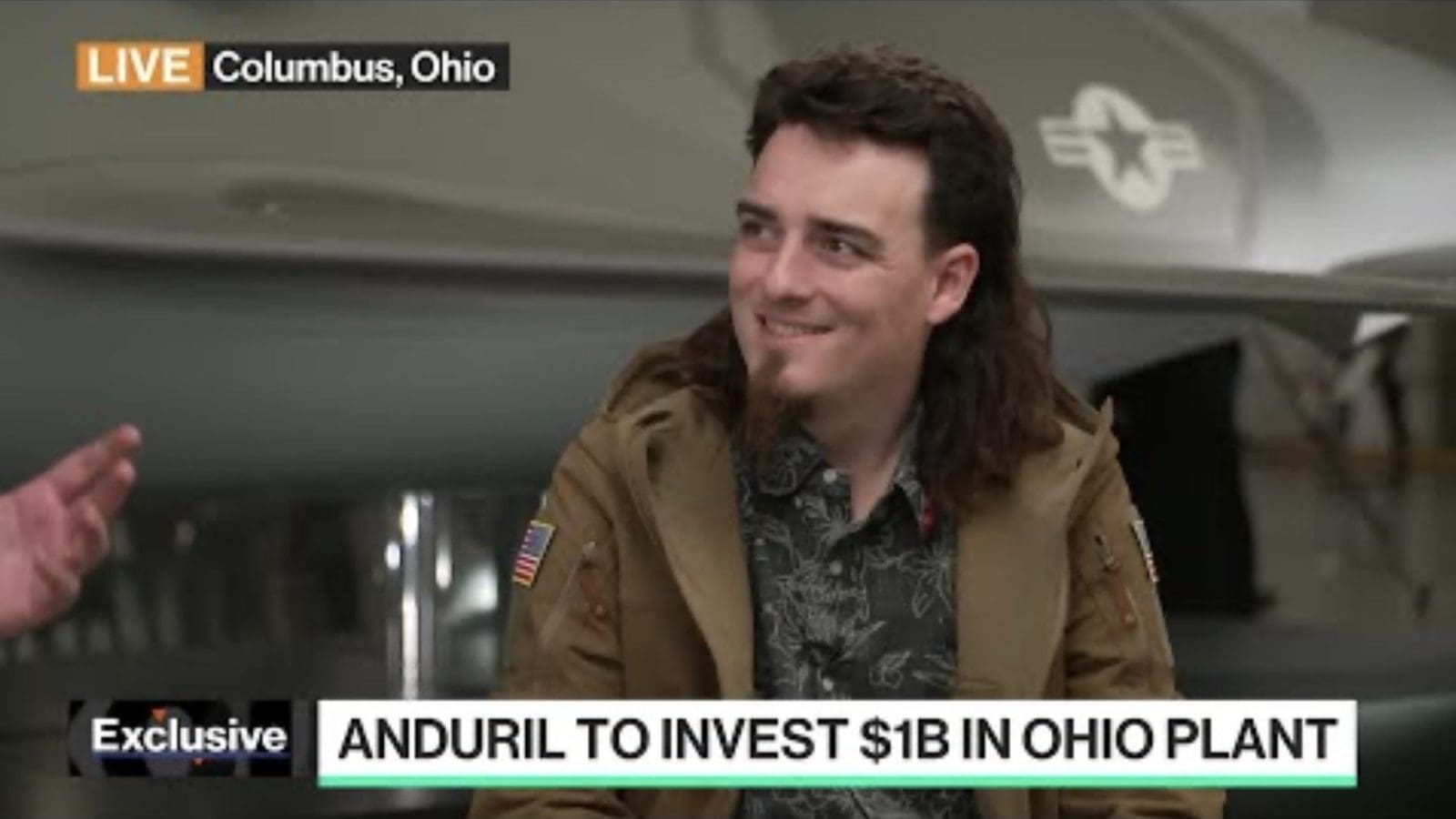
A few days ago, I introduced you to Palmer Luckey.
I called him the Big Tech anti-hero.
In case you missed that, you can catch up right here (well worth your time)”:
Now I want to advance the story a little bit.
Because the more I learn about this guy, the more impressed I continue to be!
Nobody is perfect and I'm not saying that, but I am saying our country would be a whole lot better off if we had 10 or 100 more people like this guy working this hard to save it!
You really need to read the article above if you don't know who he is because I can't recap that all here, but the new thing I wanted to show you was this interview where he talks about why he's doing what he's doing....why he's building a MASSIVE new manufacturing plant in Ohio, and why he's working with President Trump!
Trust me, I think you're going to like this one.
Enjoy:
FULL TRANSCRIPT:
Palmer:
It's incredibly aggressive, the timeline to manufacture the first phase of this site and then start production mid-2026.
How big a factor was that timeline in this selection?It has to be this fast because we don't have time for business as usual.
The types of threats that the United States and our allies around the world are facing demand rapid action.
The fact that we are predicted to run out of munitions within the first eight days of a potential conflict with China means that we need to hyper-scale our manufacturing of these weapons.
Was this the only state that could guarantee that timeline?I think that they were the state that gave us the best shot of hitting that timeline.
Look, we've really engaged well with JobsOhio and a lot of the politicians here—not just at the state level, but at the local level as well.
You know, like you said, we're hiring 4,000 people here in direct jobs, and many more indirectly.
It's the largest single job creation event in Ohio history.ADVERTISEMENTIt was a state that told us we have the workforce—we have a million people who are capable of working in this facility within a 45-minute drive.
We're willing to work with you on higher education to help train people so they can come in and work with you.
Our customer, in the form of the United States Air Force at the former Wright-Patterson Air Force Base, is a huge presence here.
So really, all the stars aligned to make Ohio a great place for us to do it—and to do it fast.And speaking candidly as someone from California, there are some states that are really good at pushing you out and slowing you down, and there are others that are great at pulling you in and speeding you up.
And that's what Ohio was.Let's go there.
Was California at any point a likely candidate? And if not, why?There was a 0% chance at any point of Arsenal One being located in California.
There are a lot of reasons for that—you can go through them.
It's the high cost of living, the very high energy cost, and in some cases, the unreliability of the energy systems.
It's the unreliability of the state politics and the worry on the regulatory side.And just, you know, the reality is California has enough money and enough really successful companies that they don't really have to worry about issues like this.
A company like mine—and all the jobs that we were bringing here to Ohio—are material, and they are something that the state really, really cares about.
And it doesn't hurt that one of our co-founders, Trey Stephens, is a native-born Ohioan.
I won't say that's why we made the final decision, but it definitely ensured that Ohio was at the top of the list from the beginning.What you did say as a company is that it had nothing to do with Vice President-elect J.D. Vance.
No, that was not a factor.
This decision has been going on a lot longer than that.
We're finally able to talk about it today.But, I mean, you saw the renders, you saw the site, the site plans—things like that take a long time to put together.
We raised our $1.5 billion round of financing last year specifically to build this facility.
One of the questions from our audience on social media was about the jobs.
You have 4,000 over ten years.There must be a mix of those originating from Ohio, but you must also be trying to attract talent from out of state to move here.
And I know you'll be spending a lot of time here as well.
Well, I'm definitely going to be buying a house out here.
I'm blessed with financial success from my first company, Oculus VR, which allows me to get a place so I don't have to resort to a hotel room when I'm spending time here.ADVERTISEMENTThe thing is, yes—we're going to hire a lot of native Ohioans.
I think we're also going to have a lot of people coming in from outside who will add to the economy here.
Look at our headquarters in California—we import about 80% of our employees from outside of the state.
And I think we're going to bring a lot of people here as well.Maybe not 80%, but there will be many people moving to the area.
Building up the supply chain in Ohio is actually very interesting.
So you will have the use of two runways where we are now, at Rickenbacker Airport.
That's right.But my understanding is that, for example, with the theory behind us, in some cases you will be able to literally take off from the runway—which is just a few feet from where we're sitting—and deliver that technology directly to the customer or straight to the action.
I mean, so this is Fury—this is our R-K collaborative combat aircraft.
It's basically an autonomous, loyal wingman fighter jet that can fight alongside the F-35 and other fighters of the United States and our allies.
But you're right that the goal here is that we can manufacture these aircraft at scale—thousands of these fighter jets here—
and then we can either fly them directly to the customer or, in some cases, directly to the theater (of course, probably with refueling stops along the way).ADVERTISEMENTBut that's what we did during World War II, and that's what we plan on doing again.
A high is quite busy—Intel has a fab going up nearby.
That's right—quite nearby.
Do you see that as a sort of competition for talent, or do you see it as a value-add to being here?It's both.
There's a value add, and of course, I'm going to hire some of their people while they're going to hire some of ours.
That's just the way that these things always go.
What you want to do is make the area more attractive overall.I like the idea that if Andrew were here and we were the only company in the area, it would be harder to attract world-class people to stay or move here, because there would be no healthy ecosystem of career choices.
It's a lot easier to get people to come if there's an established career ecosystem—even if you can manage to keep them around.
Parmar, when I spoke to Ohio Governor Mike DeWine earlier, I asked him what the single biggest factor was that gave him conviction about you meeting your timelines—not just manufacturing, but your commitment to this state.
In my career, I've respected every industrial technology company I've covered, no matter how many billions they've raised from private sources, but they've never met their manufacturing timelines.There's always slippage, granted the pandemic has been a factor.
Yeah, he said that the factor was you and your colleagues—just from meeting you all the points of difference.
What can you tell me about how the team guarantees that 2026 timeline?
I think, as I said earlier, we don't have time for business as usual.Right now, people are predicting that there's going to be a window of opportunity for G.E. in China that opens in 2027.
That means you necessarily need to be ready for a potential great power conflict with China in 2027—and for at least a few years after that.
So we have to be ready.
Right—there's no other option.The whole point here—the reason we raised that $1.5 billion round, the reason we've been accelerating this process, and the reason we're investing in building this factory ahead of the customer actually paying us to do it—is because we believe in that timeline.
It is critical that we hit it, and I think we will.
Are you getting some financial incentives from the state of Ohio?
Absolutely.They gave us a great incentive package, and that was definitely part of our decision.
What's the value, and what does it look like? What is its composition?
I'm going to let somebody else tackle that because I can tell you it's in the hundreds of millions, versus the billions that we're putting out.
Got 2.1 billion.Yeah, I think they did a better job negotiating than I did—maybe.
I don't know.
But I'm really glad that Intel is here.
They're a great partner—making a lot of semiconductors that are competitive with what’s being done in other countries.ADVERTISEMENTIt's critical for our products to have advanced semiconductors made in the United States.
So I'm really glad they're down the road from us.
PALMER: It's important to have some extended time with you to talk about Arsenal One.
I think one of the most common questions I get from the audience, even if they're familiar with Andrew, is: What does Andrew actually do?They might know you as a weapons manufacturer, or if they're more versed in autonomous defense systems.
But could we simply talk about what Arsenal One is going to manufacture—and where that technology will be sold and deployed?
The way we view ourselves is as a defense product company, not a contractor, but a product company.
That means we decide what to build, how to build it, when it's done, and we invest our own money into making that happen.Then we sell products to the customer.
We work hand in hand with our customers throughout that process.
It's not like I can just go off and build a Batmobile because I think it's cool.
I'm sorry—what was the second part of the question?The question is: What specifically?
The things that we're building are driven by what our customers need, but we are also investing a lot of our own money.
So obviously, we're building Fury and our autonomous fighter jets behind you.
You see all three of the different Barracuda cruise missile families: the Barracuda 100, Barracuda 250, and Barracuda 500—autonomous, swimming cruise missiles.We're also going to be building a lot of our ESR drones.
We're going to be building many of our mobile command and control systems here, and some combat heads-up displays as well.
I think you're going to be hearing some news about that soon.
There is a timeline—it doesn't all happen at once.Initially, the first phase of the facility is about five acres.
That's right—going up to 500 acres.
What does that process look like—building out what you call hyperscale defense or weapons manufacturing?
The process is building this place up in a way that only a madman would.Our CEO, Matt Grimm, has been the hero of the day in figuring out how we're going to go from a very minimal footprint today to, you know, 90 football fields in a very short period of time.
It wouldn't be possible without really close cooperation with local authorities on permitting, on the power and utility side, and on logistics—for example, rail, air, and road logistics—to move things in and out of this facility very quickly.
If everyone wasn't on board and moving lockstep together, this timeline would be absolutely unreasonable.
And you keep hitting it.But I will note we have competitors telling us that we are not going to hit these timelines, that we are madmen.
Look, anyone can be wrong, but I would love to do a follow-up piece in maybe 24 months to see if we're madmen or not—or if we pull off this seemingly impossible task.
Four months from now, you and I will sit down again, and an operational facility is what we're predicting.
We'll sit down at Arsenal One, and fighter jets will be coming off the line—that's my prediction.The other big question I get directly from the audience is: How can retail investors participate in this?
Well, why?
As you know, the United States government has taken a very un-American position by saying that you generally need to be an accredited investor to invest in companies like ours.
I think that's totally bogus.It's anti-American in a way, because being an accredited investor simply means you already have money.
I know a lot of people who have money who you would never label as accredited, and vice versa.
That said, we are on a path to being a publicly traded company.
I think that's important—I want us to be accessible to the American public.I think it's good for people to be able to invest in American defense companies rather than having them remain private forever.
I'm not taking an ideological stand here—it's just good for the country, good for us, and good for our customer.
As for when that happens, it's hard to say; we don't need to IPO because we're doing really well.
We were winning a lot of contracts and making quite a bit of money—we doubled last year to about a billion.That's the rumor—things are doing really, really well.
So we don't have to IPO just to raise money to keep the company going.
I want to do it when the markets are favorable, when people understand what we're doing.
And I also want to prove out some of these big bets.ADVERTISEMENTI don't really want to IPO when people are saying we're madmen and trying to do the impossible—I want to do the impossible and then say, "Look, we did it."
All you have to do is bet that we can do it again.
You will be doing business with somebody new in the Department of Defense.
President-elect Trump's pick is Mr. Hanks.That's right.
You know, he was not one of the names that I had in my head when we last spoke a few months ago.
That's right—you asked me about it.
And I said that I knew the names—I heard a lot of names coming around—and I was a big fan of all of them.You're right—he wasn't one of the names I had heard rattling around.
May I just make the point that, you know, looking at his CV, he doesn't have experience running an organization of that size.
You want change and improvement in how America does business with the private sector in defense.
So what was your approach with, potentially, Mr. BE—and what do you make of him?I think there's a lot of credentialism being levied against him that is totally unfair, and I personally empathize with him a lot.
I started Oculus VR when I was 19 years old, living in a camper trailer and putting myself through school, and I didn't have the experience to run that company.
And I grew it to thousands of people and shipped millions of virtual reality headsets all over the world.
I didn't have the experience to run Android either.I had absolutely no business experience running that company.
People made the exact same criticisms—"What does Partner know about the military? What the hell does he know about national security?"
Yeah, his heart's in the right place, but he's just not qualified.
The leap from where people say his credentials are and what he needs to do is much smaller than the best leaps I've seen in my career.So, I'm never going to be the guy to say, "Oh, I don't think he's qualified."
No, he's way more qualified than I've ever been for any job I've done—and I'm doing a pretty good job of it.
So, I mean, God bless him—I think he's a great pick.
I read his book, The War on Warrior, so I was familiar with him, though not his name being in the arena.I think he's going to kick ass.
HAMMER: Let's end on President-elect Trump.
But in the context of Arsenal One, you still believe change is needed in the military-industrial complex procurement process?
Absolutely.What specifically needs to change over the next four years to allow Arsenal One to be a success?
I think Arsenal One is going to be a success.
The amount of change we've already seen in the system will allow that.
I don't think we actually need radical changes in the system for Arsenal One to do very well.But for our country to do well, for us to build the national security apparatus, we need to move quickly.
We need to take targeted risks.
We need to get more companies into defense manufacturing.
That includes companies that are not currently defense companies, bringing in big tech, little tech, and many of our industrial providers.That is how we won World War II—by leveraging the whole nation.
I think that's the only way we are going to win in the future as well.
And I think the people who are being brought in have exactly that mindset.
We need to spend less, do more, and do it with the right things.
RELATED REPORT:
BIG TECH ANTI-HERO: Introducing Palmer Luckey
Some of you may be familiar with Palmer Luckey, but I'm guessing many of you will have no idea who he is.
It's not often that I'm so blown away by someone that I devote a whole article to it, but that's what I'm doing right here....because I watched his interview with Shawn Ryan and I was absolutely BLOWN AWAY.
Look, I'm not here to put him up on a pedestal and anoint him as God, but I was very impressed. Pleasantly surprised.
I was vaguely familiar with him as the founder of the Oculus Headset which he famously sold to Facebook for $2.3 billion, but other than that I didn't really know much about him.
In fact, I kind of figured he'd be like most of the rest of Silicon Valley. Weird. Creepy. Far Left. Anti-human. Basically like Sam Altman -- boy does that guy creep me out!
But Palmer's not like that.
He's actually more like the exact opposite of Silicon Valley, similar in a way to how Steve Jobs did not fully fit in with the Far-Left tech world.
An outsider.
A free thinker.
Self made from literally nothing.
And quite clearly a genius.
Not only that, but a $9,000 donation to a pro-Trump PAC back in 2015 ultimately got him FIRED from Facebook!
The more you dig, the more it's impossible to not like this guy and not be impressed by him.
I write this article not to go all "fan boy" on him, but to say we need more people like this in America.
Free thinkers who will not conform to what Far Left Big Tech tells us we have to think....
People who want to radically transform our Country for the better!
Oh, I didn't mention that part, did I?
After selling Oculus to Facebook, collecting $2.3 Billion, and then getting FIRED from Facebook for his Trump support, most people would probably just sail off into living a very easy life.
But similar to Elon Musk, that's not what Palmer did.
No, he started a new company designed to compete with all the weapons companies like Northrop Grumman, Lockheed Martin, Boeing, etc.
Why?
Because he saw that they were ripping off America and he wanted to put a stop to it.
He also saw they were provided sub-standard weapons for America and he wanted to make sure we had the absolute best of the best to secure America's future.
But he's not a war hawk....
In fact, he's very similar to President Trump. He wants peace through strength. He wants to bring our troops home, but also have the strongest military in the world, by such a large degree that no one dares challenge us.
Sounds just like Trump, doesn't it?
But he saw there was no path for that to happen in the corrupt Military Industrial Complex system we've been living in since Eisenhower, so he basically set out to become DOGE himself for an entire industry!
And that's what he's been doing, with remarkable and mind-blowing levels of success!
Ok enough of me talking, let me SHOW you.
I have the full interview down below, which I encourage you watch -- you will not be disappointed, I promise you that!
But first let me give you some shorter clips to get you warmed up and show you what I mean:
Starting here:
WATCH: Palmer Luckey reveals the truth about why he was FIRED by Facebook.
This guy is based! Patriot! pic.twitter.com/PMCKqu5xWQ
— Noah Christopher (@DailyNoahNews) February 21, 2025
FULL TRANSCRIPT:
Then here:
Palmer Luckey explains how a small donation to MAGA got him fired from Facebook pic.twitter.com/UjtOqClAiY
— Noah Christopher (@DailyNoahNews) February 21, 2025
FULL TRANSCRIPT:
Then here:
From VR to politics: Why Palmer Luckey supported President Trump while surrounded by Silicon Valley liberals pic.twitter.com/gmrwhDeJTN
— Noah Christopher (@DailyNoahNews) February 21, 2025
FULL TRANSCRIPT:
I'll say like I've long been a libertarian-minded person.
Politics were always something I had thought about but really didn't do anything about.
Like, I had given 40 dollars to Gary Johnson, right?
Like, I don't want to say politics weren't important to me, but they just weren't that important to me.I cared about VR—I was the VR guy, right?
And so here I am—I’ve sold my company for billions of dollars.
A few years pass and all of a sudden Donald Trump's running for president.
Now, Donald Trump is somebody who I had long had respect for.I actually wrote a letter to him when I was in college and 15 years old, telling him that he should run for president.
You might not remember this, but he had been on TV and they were asking if he was going to run against Barack Obama.
And he said, he said, "Well, I might have no choice—I might have to run. I don't want to run. No, nobody wants me to run."
It feels like, but if I have to do it, then I have to do it.You know, if people tell me that I have to run, then maybe I have to do it.
And so I wrote him a letter—I said, "You have to run. We need someone who's signed both sides of a check.
We need someone who is not a part of this giant government bureaucracy.
We need someone who understands what it's like to build a business, not to be a community organizer."I wrote that letter—I don't even want to say I thought too much of it.
I did it on an impulse because I saw him say, "If enough people tell me I have to run, then maybe I'll do it."
Years pass—Trump's running for president—and I said, "This is fantastic.
I'm so stoked that Donald Trump is finally running for president."Hold on—was there any, did you get a response?
No, I never got a response, which is fine.
I don't want to act like I was put off by it—I’m so glad I did this.
I posted on Facebook about it too—I said, "It looks like Donald Trump might run for president.
We can convince him."This would be awesome.
I'm so glad I did that because now I have proof that I supported him when I was 15 years old—all those years ago.
Because otherwise, this would be a ridiculous story—you'd never be able to prove it.
When I had Trump at my house years later for a fundraiser—which, by the way, was the biggest presidential fundraiser for a Republican that had ever been held—I put that little Facebook post up on the screen before he came up.Anyways, look—Trump's running for president.
Everyone in Silicon Valley was losing their mind, right?
I mean, it's like—I know you probably remember, but there's probably people listening who don't remember or they're too young to remember—twenty fifteen and twenty sixteen was insane.
The media hated Trump—everything was being twisted in these absurd ways.You remember when he said, "They're sending us their drugs, they're criminals, they're rapists."
And they said, "Trump says that Mexicans are rapists."
And their quote is, "They are rapists."
You can literally just watch what he says and it doesn't even make grammatical sense for that construct.Also, he's literally talking about the criminals and the drugs and the murderers and the rapists.
And, I mean, it was insane.
There was no ethics being used—it was a pure attack blitzkrieg by the media against Trump, and a lot of people fell for it.
And so I ended up giving nine thousand dollars to a pro-Trump, anti-Clinton group.And it's so funny because this started a media shitstorm that I'll get into in a moment, but I have to tell you what they actually did.
I gave them nine thousand dollars—they ran one single billboard in Ohio—I think in Columbus, Ohio—that was a picture of Hillary Clinton and it said, "Too big to jail."
And this was after she got away with mishandling classified information.
You might remember at exactly the same time you had U.S. submariners being put in prison for decades for much less expansive mishandling of classified information.It was an obvious double standard.
You have the deep state, the State Department apparatus protecting Hillary.
And on the other side, you have a serviceman going to prison for something that was not nearly as bad as anything.
So, "Too big to jail."So would you agree—like, that's pretty reasonable political discourse, right?
That's not crazy—I'm not saying Hillary's a bitch, like, you know, it's very reasonable.
So, two things happened: first, the media found out about my contribution.
And a few media outlets reported on it somewhat accurately, like, "Palmer Luckey—the guy who started Oculus—this Facebook executive has given nine thousand dollars to this pro-Trump, anti-Clinton group that's running a billboard."Then, a handful of people on Twitter—literally, it was a completely made-up story—said, "Palmer is funding white supremacist internet trolls to attack Clinton supporters on the internet."
It expanded from there: "Palmer is funding anti-Semitic memes.
Palmer is funding misogynist troll squads.
Palmer is funding— I believe Ars Technica called it—a tidal wave of racist memes on Reddit, Facebook, and beyond."It was literally fabricated—none of it ever happened.
It was a completely false story.
Then here:
Palmer Luckey reveals EXACTLY how the MSM spins their lies and how defamed him
"Radical Zionist" pic.twitter.com/94ne7nRigu
— Noah Christopher (@DailyNoahNews) February 21, 2025
FULL TRANSCRIPT:
And it was reported by dozens of outlets—CNN, Bloomberg, CNBC, Ars Technica, Wired Magazine, Gizmodo, Boing Boing, The Washington Post.
Taylor Lorenz reported on it—I mean, it was everywhere.
And they all just had this lockstep narrative: Palmer Luckey is a racist, misogynist, anti‑[something].
Which is so funny—I'm actually a radical Zionist.It was even in the moment—it was funny.
What is a radical Zionist?
I strongly believe in the right of Israel to exist as a Jewish state.
People are like, "That's so problematic, though. It's so ethnostate-adjacent."I say, "I don't care. After what happened to them in World War II, they deserve a place where they can do their own thing and protect their own people without getting wrecked by everybody else who hates them."
And you know what? Maybe someday everyone who hates Jews is going to be gone.
We are not living in that world today.
And people—it's a slippery slope, though.If they can have it, why can't the KKK have their own state?
I say, "That's not going to happen."
It's absurd for us to even have this discussion.
It is very reasonable for the Jews to have a place that is theirs.And they say, "Oh, but what about the Palestinians?"
You know what? That's a separate political issue.
Like, the existence of a Jewish state—which is what Zionism is: the belief that they have the right to a Jewish state—is separate from the issue of what do you do with refugees from some political, you know, from some physical area.
So it was so funny to me when, like, Palmer's this anti-Semitic guy, because it was literally made up.Like, it's not even like there were screenshots or made-up screenshots—journalists just said it was true with zero evidence, and they just repeated what each other said.
And I know people are going to hear this and say, "I must be mistaken—Palmer's ignoring, he's glossing over something. He must have said something about Jews on Twitter."
"Are you Jewish?"
"No, I'm not Jewish. I just believe in the existence of a Jewish state."ADVERTISEMENTAnd I bet even some of your listeners probably won't agree with me on that, and that's fine—we don't have to all agree on everything.
But I will say, it was pretty ridiculous in the moment when Palmer's an anti-Semite—I'm like, "No, I love the Jews more than anybody."
You Democrats would probably hate me for how much I love the Jews.
Anyway, it was—what happened was, as a result of this reporting, looking back, I should have pushed back.What happened is I wrote a statement saying, "Hey, this is all false. None of this is true. Here's what actually happened: I gave nine thousand dollars to this pro-Trump group.
They ran a single billboard.
Everyone is lying.
This is literally fake news."And that was when "fake news" was like a new phrase.
Facebook told me I couldn't publish it.
They said, "We won't let you make this statement. You cannot make this statement because it frames the media as the bad guy."
And in a world where Donald Trump is attacking the Fourth Estate, we can't appear to be aligned with him.I said, "Well, you guys don't have to appear to be aligned, but I will be.
I'm fine if people think that I'm being unfair because this is literally character assassination.
They are trying to destroy—"
They kept reporting, as of Thursday at 3:58 p.m. when read for comment, "Palmer Luckey is still employed by Facebook."That's how they ended the article—it was explicitly a scalp-taking operation from the very beginning.
All the articles were ending with, "Palmer's still employed ..."
According to Facebook, Palmer is currently still employed.
And they just couldn't wait for the follow-up where they could take my scalp.So Facebook tried to get me to resign, and I refused.
They tried to get me to not say anything.
Eventually, they wrote their own statement for me that basically just said, "I'm sorry for the negative impact this is having on Facebook's reputation, and I want to—I'm going to be taking a voluntary leave of absence."
In reality, they told me I couldn't come into the office until after the election—it was that explicit: "You can't come in until after the election."Their thinking was, "Okay, Palmer is like the leader of our virtual reality organization."
They knew they actually needed me; getting rid of me was not a thing that they could easily do.
And their thought was, "Okay, we know that Palmer didn't post these racist memes."
Like, Facebook did not know—Facebook knew none of this was true, right?So they knew that this was just a media invention, but they didn't want to push back.
They didn't want to say anything—kind of like when you see Mark now coming out and finally saying, "Okay, the Hunter Biden laptop thing—maybe, you know, that wasn't good; this was... it was a different universe."
So they were hoping that I would take this leave of absence, disappear until after the election.
They believed Hillary would win.And then, if Hillary won, they thought all their employees and the press would kind of forget about this whole thing, because it would just be this crazy time that Palmer supported that fringe candidate who lost in a landslide to Hillary Clinton.
Remember, she had a 95 percent chance of winning.
So now I told them this was a bad strategy—I said, "Guys, what you don't understand is Donald Trump is going to win."
And finally here:
Palmer Luckey explains how Donald Trump is one of the only people who understands the massive threat of manufacturing overseas.
Xi could cripple us overnight! pic.twitter.com/NVdlsyXxc6
— Noah Christopher (@DailyNoahNews) February 21, 2025
FULL TRANSCRIPT:
You are one of like the puzzle pieces that keeps everything held together for, you know, their missile program.
Come over to the United States—we'll give you a job at NASA and we'll give you a visa.
You can come over, you can get an American life, an American wife—it'll be fantastic.
You're going to love it.I think we need to start doing that again.
I think that that's one of the ways that we can beat China, because there's a lot of people in China—they're there, but they don't really want to be.
There's a lot of people who hate what China has become.
I would love it if we could say, you know what—we need a lot more people in America who know how to manufacture.I want American jobs, right?
To be clear, I'm not saying we need to import people because we can't survive without immigration—I'm not one of those people.
But if we can steal their very best manufacturing engineers, deprive China of those people, and then put them to work here helping us catch up with China on manufacturing, I mean, that's a great trade.
Let's haul over their best plant managers and then let's have a thousand jobs created by each of those guys here in America.I think we need to bring back defector visas.
We need to own it.
And it seems like a type of immigration that even the really anti-immigration people can get behind, because the point is, like, look—we're not trying to bring in millions of fruit pickers.
We're trying to steal the very best people from our greatest foe.Surely we can agree that that's usually worth doing.
It's better for us to have those people than for them to be running the missile factory that's going to blow up our nation.
There was a little bit of a debate on that not too long ago, correct?
You know, like, the skilled immigration versus not.So that's true.
The difference there is that H-Bs are about whether or not they're, like, it's on theory.
Of course, there's so much H-B abuse—you would not believe what I saw when I was in Silicon Valley.
It is insane.It's obviously a program to try and replace U.S. workers with basically slave labor that can't ever escape H-B abuse—it's crazy.
But in theory, H-Bs are to create a job for an immigrant if there is not a person who can be hired to do that job in the United States.
A defector visa adds an additional requirement: it has to be something that they care about that you're ripping away.
So, like, it's not just that there's a need for them here—it's that it's going to hurt China by taking them.If China has a million people that do something like, let's say...
Like, let's say that we need more rice pickers here and China's got more rice pickers—China's got plenty of rice pickers.
Taking a rice picker is not going to hurt.
Taking the head of an advanced silicon manufacturing facility that can make cutting-edge computer graphics chips—that is going to really, really hurt them.So I say that was the part of the debate that I didn't see present: using immigration not just as a tool to help the United States but to harm our adversaries.
I want to stop focusing on the plow and start turning it into a sword—to double win.
Exactly—because there's a lot of people around the world who would rather be here, who will cause catastrophic consequences for their home country if they leave.
Here's a fun one: think about the guys who are running the—what would it be like if China plucked you?Yes, that's a great example.
Imagine if I had no national allegiance and they made an offer over there and I really wanted to live in China, and they just—yeah, they got rid of me.
That would cause so much downstream damage.
And the best—like, I don't want to go to China.In fact, my company is sanctioned by China on account of our sales to Taiwan.
And so if I go to China or Hong Kong, I'll be arrested—it's fantastic.
Also Russia or Belarus—if I go to Belarus, I'll be arrested, I would imagine.
How do you know that? Oh, they put it out publicly.Russia has the so-called poison list where they say, "Here are the individuals that are under extreme sanctions," personally, individually, as individuals.
And Belarus also recognizes—the, I think, Belarus had maybe one other, one other weirdo Baltic break-off—I can't remember what it was, but there's a handful of countries in the world where I literally can't go.
But think about not even just China—is that public?
Oh yeah, it's public.I even tweeted about it.
I actually have the notice framed in my office.
I was just going to say, "I want to get that, have you sign it, and I'm going to frame it."
I will definitely send one to you—I have one in my office.Perfect.
My dream is to get it signed by Vladimir Putin somehow.
I just want to get it on his desk somehow, or at a signing or something.
By the way, he deserves a bit of credit on this AI stuff.He was saying, before I even started Anduril, "The country that wins in the sphere of artificial intelligence will become the ruler of the entire world."
I know that today that sounds not that interesting, but this was 9 years ago when everyone thought AI was crazy.
Xi Jinping said that too, right?
And you have all these world leaders who are saying things.Could you imagine, let's say—could you imagine Hillary Clinton having an opinion on something like that 8 or 9 years ago?
Absolutely not.
Could you imagine Joe Biden putting a stake in the ground?
Of course not.Anyway, even in growing China, look at Venezuela.
Let's take whoever's running their oil and gas machinery over there—imagine what would happen if we identified their top ten most competent people who are running their oil and gas organizations, and we gave them all defector visas and said, "Come to America and you can work at ExxonMobil on industrial refinement systems, and we're going to pay you twice as much as you make in..."
One other observation....
As I was watching this interview, I couldn't help but think this guy is almost EXACTLY the Donnie Douglas character from Frasier.
Remember him?
One of the best guest stars they ever had on the show, and that was a high bar.
But if the timeline wasn't completely impossible, I would say the Donnie Douglas character was simply inspired by Palmer Luckey, and a pretty obvious rip off at that!
Tell me I'm wrong:
Crazy, right?
Ok, here's the full interview if you'd like to watch the whole thing.
Please enjoy:
Share!

Join the conversation!
Please share your thoughts about this article below. We value your opinions, and would love to see you add to the discussion!