

Researchers cut away the skin over the rib cages of laboratory mice.
Then they grafted full-thickness scalp tissue from aborted babies into that space.
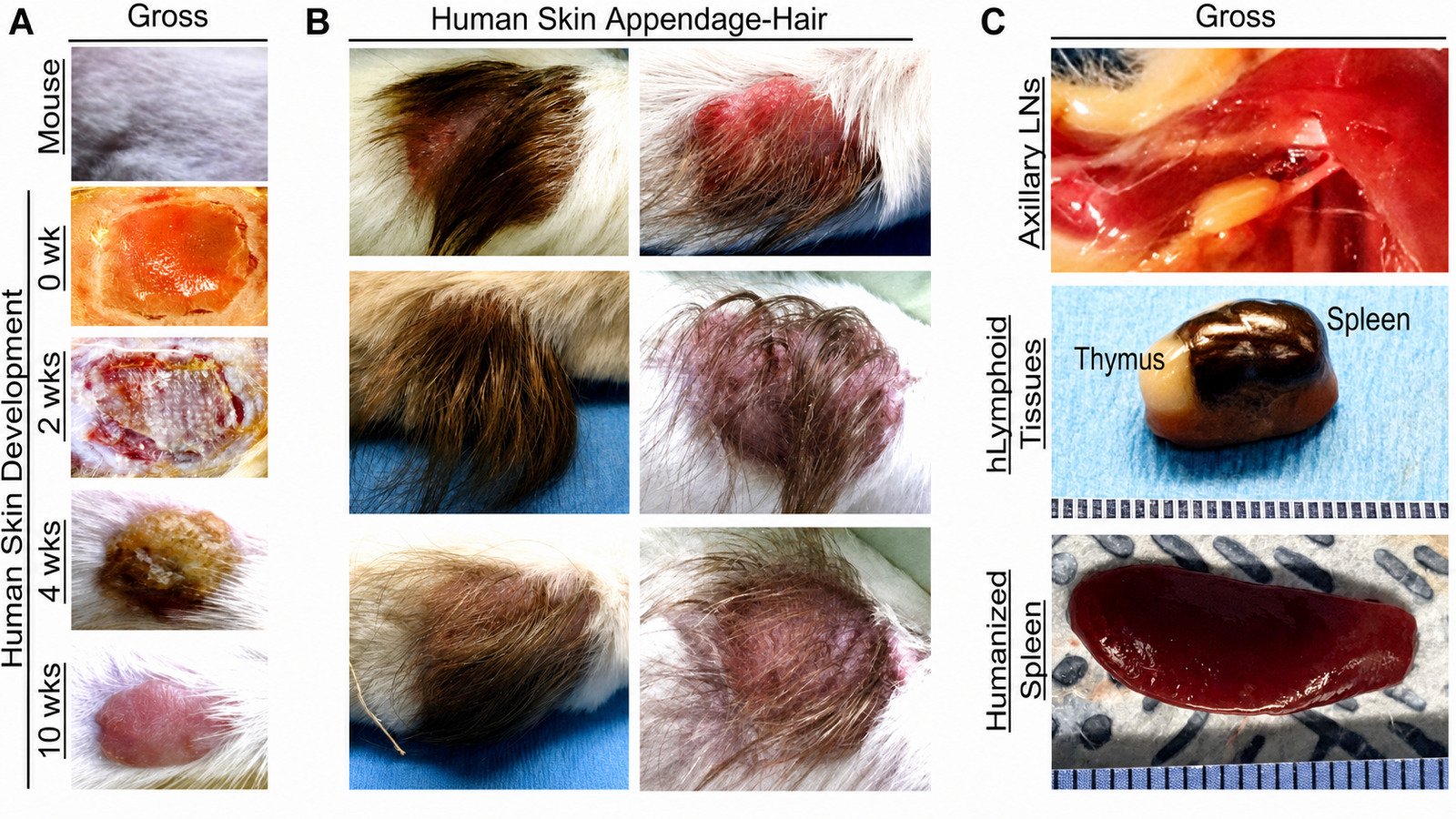
Within weeks, the human skin began to develop. By 12 weeks, fine human hair was growing from the backs of the mice.
The experiment was documented in a peer-reviewed, federally funded Scientific Reports study published in 2020. The researchers said they were building “humanized” mouse and rat models with human skin, immune cells, and lymphoid tissue so they could study infections that attack human skin.
The paper says the human fetal tissue came from pregnancies terminated at 18 to 20 weeks of gestation. It was obtained through Magee-Womens Hospital and the University of Pittsburgh’s Health Sciences Tissue Bank after medically indicated or elective terminations.
Researchers collected full-thickness skin from the fetal scalp and back. Scalp skin was chosen specifically for grafts with hair, while skin from the back was used for grafts without hair.
They also processed fetal liver, thymus, and spleen into small pieces. Those tissues were transplanted into irradiated mice to help build human lymphoid structures and immune systems inside the animals.
The paper’s photographs show the graft sites changing over time. Human hair is plainly visible growing from the fetal scalp tissue attached to the mice.
The study lists grant R21AI135412 from the National Institute of Allergy and Infectious Diseases among its sources of support. Dr. Anthony Fauci was running NIAID at the time.
That is the experiment now exploding back into public view:
This is just horrific… My God… they all need to pay dearly.
Dr. Fauci sowed the fingers and scalps of aborted babies into the backs of research mice, which the scalps grew fine baby hair.
— MJTruthUltra (@MJTruthUltra) July 29, 2026
The viral post gets one important detail wrong.
There is no evidence that Fauci personally cut the mice, handled the fetal tissue, or performed the grafting. The published record ties the experiment to the agency he led through NIAID funding.
The truth is already horrifying without putting a scalpel in Fauci’s hand.
Human fetal scalp tissue was attached to research mice. Human hair grew from it.
Federal money helped pay for the work.
And this week, a United States senator forced Fauci to face that record in public.
The Senate Homeland Security and Governmental Affairs Committee held a full committee hearing Wednesday titled “Testimony of Anthony Fauci.” Fauci appeared under subpoena as the sole witness listed for the proceeding.
Sen. Joni Ernst used part of her allotted time to describe federally funded experiments involving body parts from aborted babies. She specifically raised the research in which fetal scalp tissue was grafted onto rodents and later grew human hair.
Then she asked Fauci a direct moral question: Did he believe body parts from aborted babies should be put into mice for coronavirus research?
Fauci declined to answer. He invoked his Fifth Amendment protection against self-incrimination, and the next senator took over without the committee receiving a yes or a no.
Ernst posted her reaction after the hearing:
How does Dr. Fauci sleep at night knowing his labs were using aborted baby body parts? Sickening.
— Joni Ernst (@SenJoniErnst) July 29, 2026
Invoking the Fifth is a constitutional right and does not prove guilt. The amendment protects a witness from being compelled to give testimony that could later be used against him.
The Associated Press reported that Fauci feared his answers could expose him to a new investigation or a perjury allegation. His attorneys maintained that President Joe Biden’s preemptive pardon did not eliminate every possible avenue of legal jeopardy.
Committee Chairman Rand Paul disputed that reasoning for conduct covered by the pardon. After Fauci refused to answer substantive questions throughout the hearing, Paul announced that the committee would vote next week on a contempt resolution.
A committee vote would begin the contempt process. It would not itself convict or jail Fauci.
The report described a sharp partisan divide inside the room. Republicans accused Fauci of deception and stonewalling, while Democrats called the hearing political retaliation against a former public-health official.

None of that partisan combat changes what the researchers published.
The mice were real.
The fetal scalp grafts were real.
The human hair was real.
The federal funding was real.
Federal policy has since moved in the opposite direction.
A January 2026 National Institutes of Health notice says NIH funds may no longer support research using human fetal tissue obtained from elective abortions. The policy took effect immediately and replaced the agency’s earlier requirements governing fetal-tissue research.
The restriction covers research conducted inside NIH as well as outside grants, cooperative agreements, other transaction awards, and research-and-development contract proposals issued after the effective date. Currently funded organizations may redirect released money toward work permitted under the new rule.
Tissue obtained after miscarriages and stillbirths may still be used under existing legal and consent requirements. NIH also disclosed that federally supported fetal-tissue research had already fallen to 77 projects in fiscal year 2024.
The government will no longer fund this category of research.
But the photographs remain in the scientific record: patches of human fetal scalp tissue growing human hair from the bodies of laboratory mice.

Join the conversation!
Please share your thoughts about this article below. We value your opinions, and would love to see you add to the discussion!