

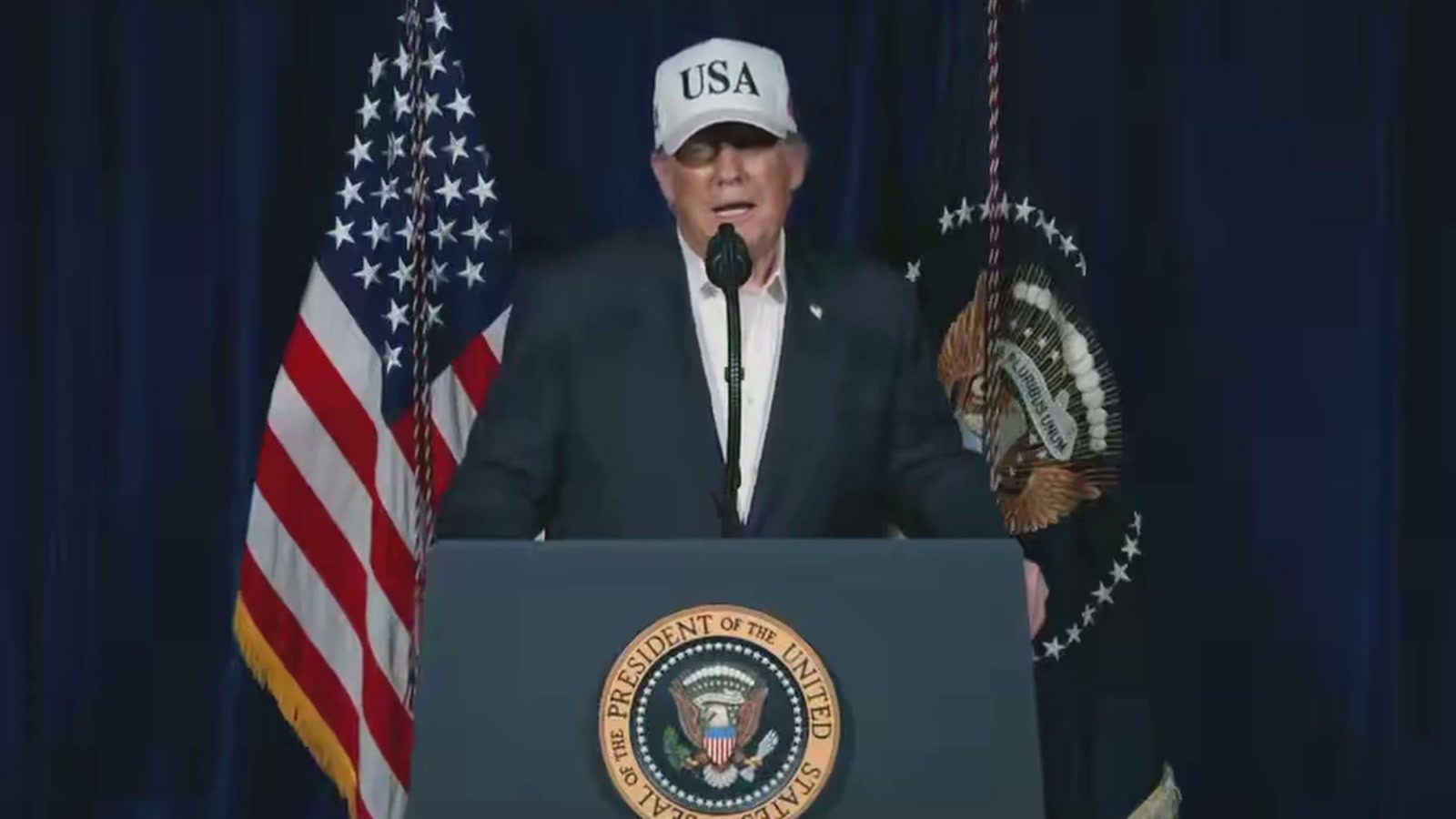
The ceasefire is no longer fraying.
Washington has now put in writing that American military action against Iran is underway again.
President Trump sent Congress a formal two-page notice dated July 10 stating that U.S. forces began new strikes inside Iran on July 7.
And the letter does not describe a single retaliatory shot that is already over.
It says American forces remain positioned to take further action against threats to the United States, its allies and its partners.
There is one important legal distinction here.
This was not a declaration of war passed by Congress. It was a formal War Powers report informing lawmakers that the President had ordered military action under his constitutional authority as Commander in Chief and Chief Executive.
In plain English: the bombs were already falling when Congress received the paperwork.
The letter surfaced publicly Monday:
BREAKING: Trump has formally restarted the war with Iran, in a letter sent to congress on Friday July 10th.
Trump said minutes ago the US will hit Iran "hard" tonight and tomorrow, adding "the MOU was only a test for Iran."
Trump also announced he will address the nation on… pic.twitter.com/QwcGhUwuhf
— The Hormuz Letter (@HormuzLetter) July 13, 2026
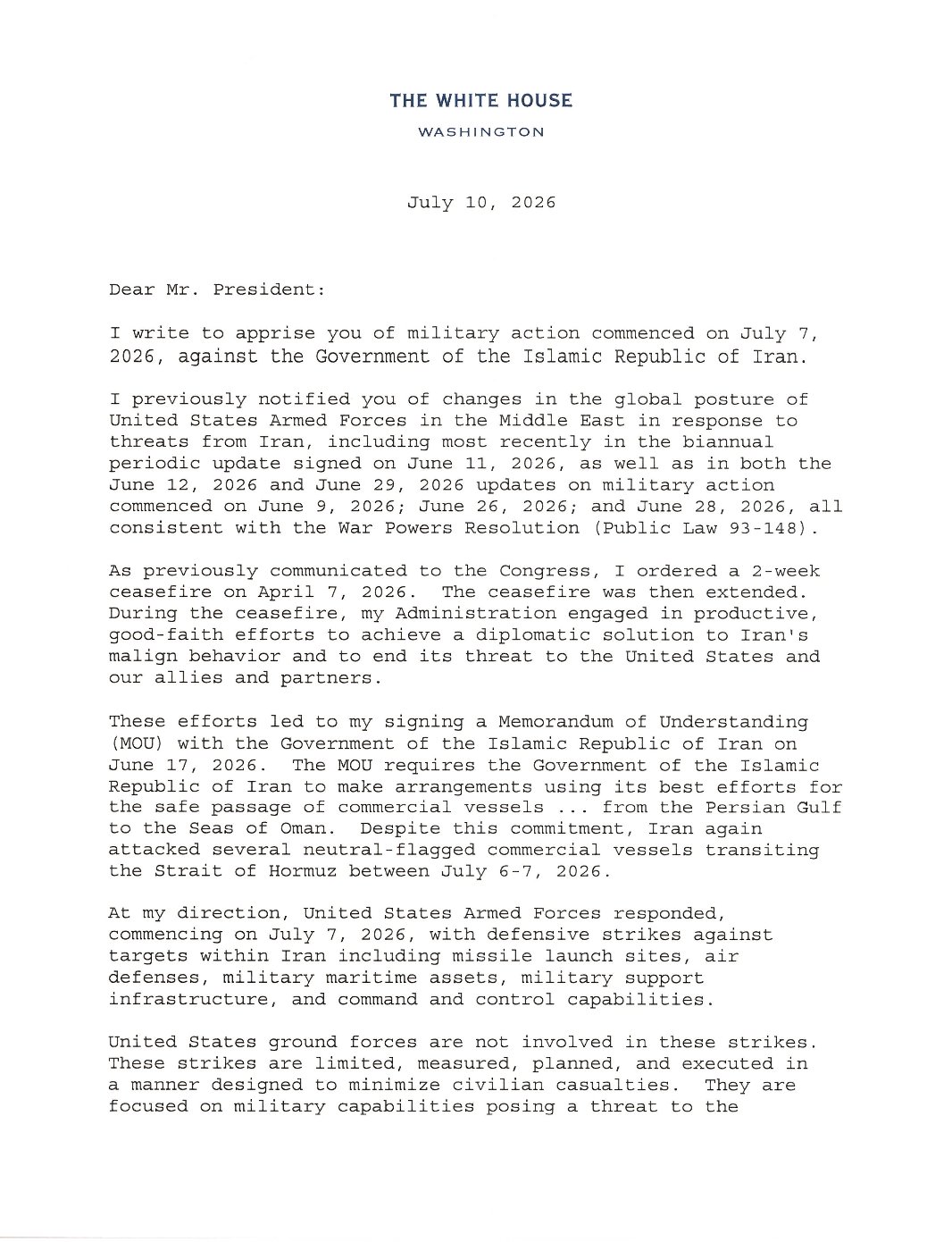
FULL TEXT TRANSCRIPT:
THE WHITE HOUSE
WASHINGTONJuly 10, 2026
Dear Mr. President:
ADVERTISEMENTI write to apprise you of military action commenced on July 7, 2026, against the Government of the Islamic Republic of Iran.
I previously notified you of changes in the global posture of United States Armed Forces in the Middle East in response to threats from Iran, including most recently in the biannual periodic update signed on June 11, 2026, as well as in both the June 12, 2026 and June 29, 2026 updates on military action commenced on June 9, 2026; June 26, 2026; and June 28, 2026, all consistent with the War Powers Resolution (Public Law 93-148).
As previously communicated to the Congress, I ordered a 2-week ceasefire on April 7, 2026. The ceasefire was then extended.
During the ceasefire, my Administration engaged in productive, good-faith efforts to achieve a diplomatic solution to Iran’s malign behavior and to end its threat to the United States and our allies and partners.
These efforts led to my signing a Memorandum of Understanding (MOU) with the Government of the Islamic Republic of Iran on June 17, 2026.
The MOU requires the Government of the Islamic Republic of Iran to make arrangements using its best efforts for the safe passage of commercial vessels … from the Persian Gulf to the Seas of Oman. Despite this commitment, Iran again attacked several neutral-flagged commercial vessels transiting the Strait of Hormuz between July 6-7, 2026.
At my direction, United States Armed Forces responded, commencing on July 7, 2026, with defensive strikes against targets within Iran including missile launch sites, air defenses, military maritime assets, military support infrastructure, and command and control capabilities.
United States ground forces are not involved in these strikes. These strikes are limited, measured, planned, and executed in a manner designed to minimize civilian casualties.
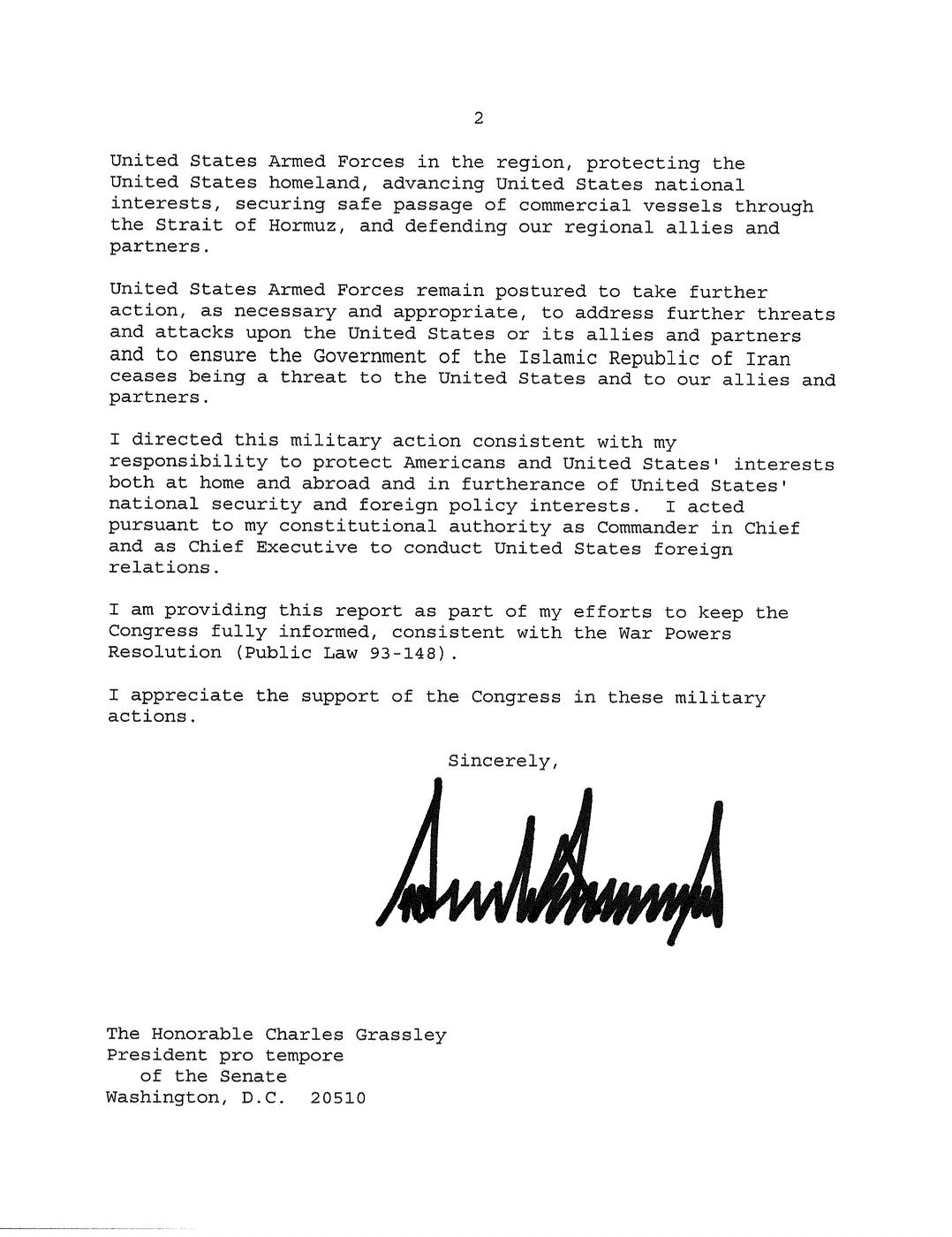
ADVERTISEMENTThey are focused on military capabilities posing a threat to the United States Armed Forces in the region, protecting the United States homeland, advancing United States national interests, securing safe passage of commercial vessels through the Strait of Hormuz, and defending our regional allies and partners.
United States Armed Forces remain postured to take further action, as necessary and appropriate, to address further threats and attacks upon the United States or its allies and partners and to ensure the Government of the Islamic Republic of Iran ceases being a threat to the United States and to our allies and partners.
I directed this military action consistent with my responsibility to protect Americans and United States’ interests both at home and abroad and in furtherance of United States’ national security and foreign policy interests. I acted pursuant to my constitutional authority as Commander in Chief and as Chief Executive to conduct United States foreign relations.
I am providing this report as part of my efforts to keep the Congress fully informed, consistent with the War Powers Resolution (Public Law 93-148).
ADVERTISEMENTI appreciate the support of the Congress in these military actions.
Sincerely,
[Signed]
Donald J. TrumpThe Honorable Charles Grassley
President pro tempore
of the Senate
Washington, D.C. 20510

The most consequential sentence may be the one on the second page.
American forces, the President wrote, remain postured for more action.
The wording goes beyond a completed reprisal.
It is the language of an open military campaign whose next round can be ordered as the administration decides it is necessary.
The targets listed in the document are also broad: missile launch sites, air defenses, maritime assets, military support infrastructure, and command-and-control capabilities.
Those categories cover much more than the vessels blamed for the latest attacks in the Strait of Hormuz.
CBS News independently obtained the July 10 letter and confirmed that it was President Trump’s formal notification to Congress that military action had resumed three days earlier.
The network reported that the notice followed Iranian attacks on commercial vessels in the Strait of Hormuz and several rounds of U.S. strikes on Iranian targets. Iran then responded with missiles and drones aimed at U.S.-allied Gulf states.
The report also confirmed that the administration is describing the new strikes as limited and designed to minimize civilian casualties. Their stated purpose is to hit Iranian military capabilities that threaten American forces and commercial shipping, not to deploy U.S. ground troops into Iran.
The legal timing is where the next political fight will begin. The War Powers Resolution requires the President to notify Congress after introducing U.S. forces into hostilities, and the administration had argued that the earlier round of hostilities ended when the April ceasefire took effect.
This new notice creates a fresh, formal record that military action began again on July 7. Whether lawmakers treat that as a reset of the War Powers clock is certain to become part of the battle on Capitol Hill.
The written notice was followed by an unmistakable verbal warning.
The White House posted President Trump’s exact words:
What are your thoughts?

.@POTUS: "We're going to hit them very hard tonight and we're going to hit them hard tomorrow — and there's not a damn thing they can do about it. They have nothing. They have nothing going other than they have big mouths… I got to know them, and they're stone cold crazy." https://t.co/vKSOZN3EaI pic.twitter.com/UH8lBL5An3
— Rapid Response 47 (@RapidResponse47) July 13, 2026
That was not a hypothetical warning about what might happen someday.
It was a public promise of strikes tonight and tomorrow.
President Trump also said the memorandum of understanding had effectively served as a test of whether Iran could be trusted.
His conclusion was blunt: Iran failed it.
Axios reported that the military pressure is expanding beyond airstrikes. The United States is scheduled to resume its blockade of Iranian ports at 4 p.m. ET on July 14.
The order applies to maritime traffic entering or leaving Iranian ports and coastal areas while allowing vessels bound for non-Iranian destinations to continue through regional waters. Humanitarian shipments can still reach Iran, but only after inspection.
A U.S. defense official told the outlet that the military had plans for several more days of strikes around the Strait of Hormuz and along Iran’s southern coastline. The stated aim is to reduce the Islamic Revolutionary Guard Corps’ ability to attack commercial shipping.
The blockade raises the stakes far beyond Washington and Tehran. The Strait is one of the most important energy corridors on Earth, and even a limited disruption can hit oil prices, shipping costs, insurance rates, fertilizer prices and household budgets across the world.
That makes the administration’s message a two-part one: Iranian shipping will be constrained, while other nations will be promised safe passage under American protection.
Then came the military confirmation.
U.S. Central Command announced that the next wave was already moving:
At 4:45 p.m. ET today, U.S. Central Command began launching the third consecutive night of strikes against Iran, at the Commander in Chief's direction. These strikes will continue imposing a heavy cost on Iranian forces and degrade their ability to attack innocent civilians and…
— U.S. Central Command (@CENTCOM) July 13, 2026
CENTCOM said the strikes are intended to impose a heavy cost on Iranian forces and reduce their ability to attack civilians and commercial shipping in the Strait of Hormuz.
The sequence leaves little room for ambiguity.
First came the formal notice that military action had resumed.
Then came President Trump’s warning that Iran would be hit hard tonight and tomorrow.
Then CENTCOM confirmed that the third consecutive night of strikes had begun.
Diplomatic talks may still continue, but the ceasefire itself is over.
The administration has now paired the paperwork of war with the machinery of war: a notice to Congress, renewed strikes, a returning naval blockade and an explicit promise that more force is coming.
Iran had its test.
President Trump says it failed.

Join the conversation!
Please share your thoughts about this article below. We value your opinions, and would love to see you add to the discussion!