

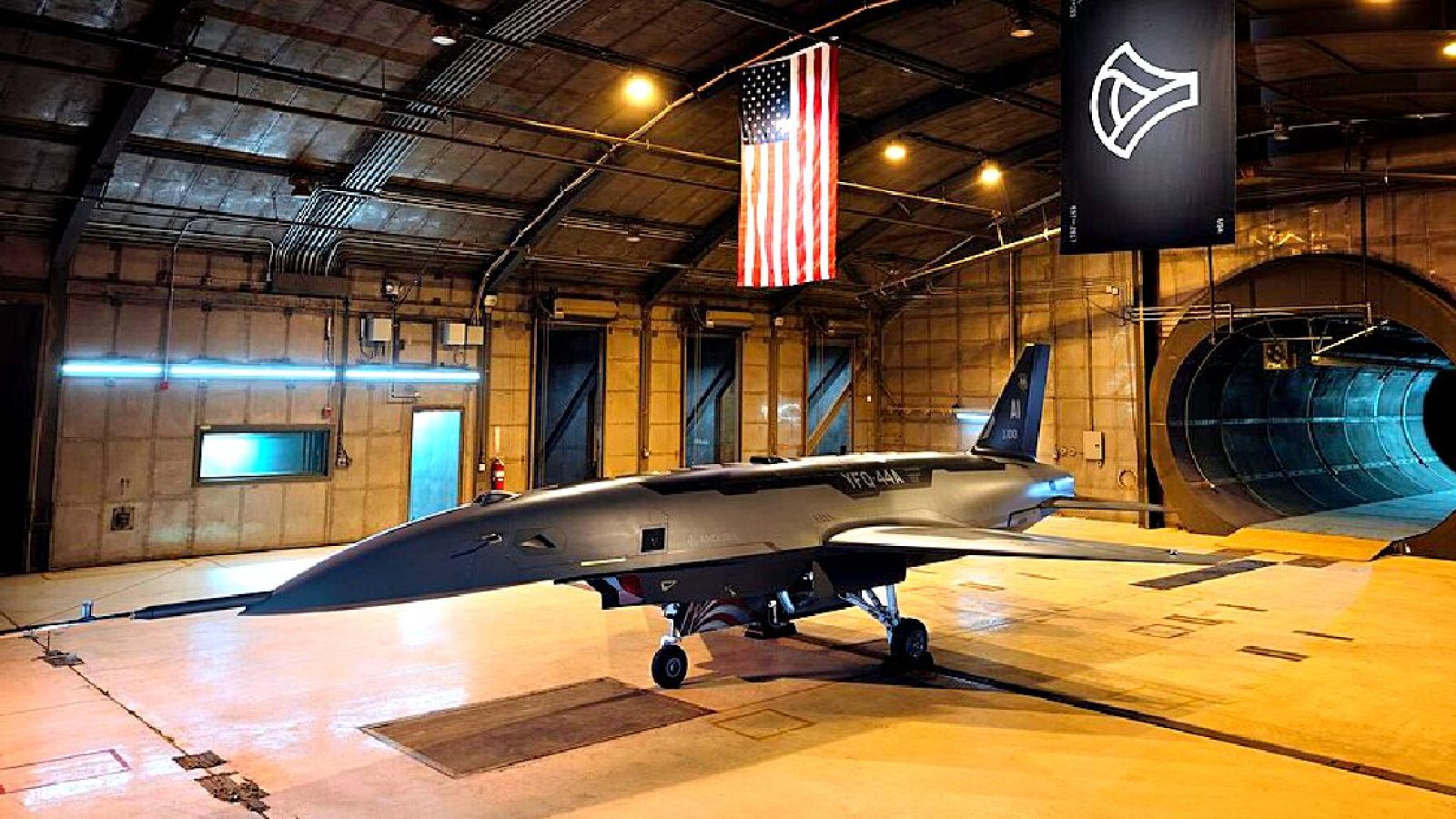
About a year ago, I started telling you about Palmer Luckey and the incredible work he is doing at Anduril.
Today, I’m going to SHOW you.
Unmanned strike drones—often described as kamikaze systems—have rapidly emerged as one of the most influential tools shaping modern warfare. Their presence is now nearly impossible to ignore across active conflict zones.
From the outset of his second term in office, Donald J. Trump pressed defense contractors to produce drones that were both cost-effective and highly lethal. Those efforts are now materializing.
With the United States currently engaged in military actions involving Iran and its affiliated groups, the Lucas drone—reportedly derived from the Iranian Shaheed platform—has seen extensive deployment. A next-generation version is also said to be on the horizon.
Meanwhile, Anduril Industries has revealed plans to begin production shortly on its advanced high-speed combat drone known as FURY. This system is designed to operate as a “loyal wingman,” supporting other aircraft in coordinated missions.
Production of the Fury drone will take place at a newly established manufacturing site in the U.S. state of Ohio.
Defense-tech company Anduril built “Fury,” an unmanned jet powered by artificial intelligence and designed to engage the enemy before a manned fighter jet arrives. Founder Palmer Luckey says the U.S. is in a race with China to develop similar technology.
"We have a pretty good… pic.twitter.com/3wETXCwYAQ
— 60 Minutes (@60Minutes) November 11, 2025
FURY: "We [were] competing against Boeing, Northrop Grumman, Lockheed Martin, & in the end Anduril beat all of them."
Palmer Luckey (@PalmerLuckey), Anduril
"This is the first autonomous fighter that the United States Air Force has ever procured.
We recently just flew it for… https://t.co/c0XYbwuogH pic.twitter.com/kBsSBolk3q
— Molly O’Shea (@MollySOShea) December 15, 2025
As reported by Reuters:
“Amid cornfields and horse farms 20 miles (32 km) south of Columbus, Ohio, the defense tech start-up is expecting its $1 billion Arsenal-1 autonomous systems manufacturing campus to employ more than 4,000 people over the next decade, starting with roughly 250 by the end of this year, officials said on Thursday.”
The fighter for fighters.
On 10.31.25, Anduril's YFQ-44A flew at the press of a button.
A new era of airpower. pic.twitter.com/Ot7gg21toz
— Anduril Industries (@anduriltech) November 4, 2025
MORE HERE:
I've covered Palmer Luckey before, but I'm guessing there are still many of you who have no idea who he is.
He's one of the few Silicon Valley tech leaders who is not a Far Left lunatic.
In fact, he's very based and after creating the Oculus headset as a teenager and then selling that company to Facebook for over $2 billion, he then worked at Facebook for a while after the sale until he was fired for donating $9,000 to Donald Trump in the 2016 election.
After that, he founded a new company called Anduril which makes next-generation military equipment for the USA -- and does it at a fraction of the price of the current stuff.
In other words, it's extremely likely that most or all of the next-gen tech that we used in the Maduro raid in Venezuela was created by Palmer Luckey and Anduril.
Here is one short example:
And that's just one thing....he has countless others!
Also, you can be sure that if he's showing something on Joe Rogan's podcast there is probably 10 times that behind the scenes that he's not going to reveal.
In other words, even as cool as that is, he's showing you the most basic stuff. The real stuff he's not going to reveal and it's probably light years ahead of even this.

He was on Mike Rowe's podcast this week and I think you're going to really enjoy this.
Check this out and then scroll down for more on the weapons created by Anduril that were likely used in the Maduro raid:
And now for more on the weapons developed by Anduril that were likely used in the Maduro raid....
I think this is going to blow your mind:
Palmer Luckey Is Simply Operating On A Completely Different Level Than Everyone Else
Palmer Luckey is anything but "Lucky".
After selling his first company, Occulus, to Facebook for $2+ Billion, many wrote him off as a kooky one-hit wonder.
But he's fast proving that's far from true.
In fact, I haven't seen a brain + talent + work ethic like this in a long time. I actually can only think of two other people in the last 50 years who I would put into this same category of maxing out on all three of those things (brain + talent + work ethic) and that would be Steve Jobs and Elon Musk.
He's also one of these guys who you can't adequately summarize or paraphrase, you really just need to hear him from the source. You need to hear him speak, take in how his brain is running at levels far above the rest of us.
I like to think I'm a pretty high-functioning person, but then I come across someone like Palmer Luckey, Steve Jobs or Elon Musk and I'm just completely blown away.
So I'm going to give you a video to watch below and trust me it will be well worth your time. I'll also include a full transcript below if that is easier for you to follow along with, but just like there always was with Steve Jobs and now Elon Musk, there's a magic in listening to this guy speak firsthand.
So without further adieu, please enjoy:
FULL TRANSCRIPT:
Introduction to Palmer Luckey and His Vision
Palmer Luckey: Hi, my name is Palmer Luckey and I build killer robots. Palmer Luckey, tech prodigy and defense disruptor, shaping the future of AI and military tech.
You must have a thousand different ideas. What’s your calculus for filtering these?We don’t have time for business as usual. We don’t have money for business as usual. We have to try something.
I think you’re going to see humanoid robots in defense applications pretty soon, but they’re not going to be for what people expect.We need to avoid outsourcing responsibility for violence to machines, to robotics. If we are going to kill people, we need to kill people, and it needs to weigh on us.
Now that’s a moonshot, ladies and gentlemen. I do appreciate you, you know, showing us your advanced designs here.
Uh, when I asked Palmer backstage, like, you know, do you have this under development? He goes, yeah, kind of something like this.
Palmer Luckey: Yeah, I mean, this is a long discussion, but I think you’re going to see humanoid robots in defense applications pretty soon.
But they’re not going to be for what people expect. The first use is not going to be like humanoid Special Forces door kickers.It’s going to be robots who walk around with about the physical ability of maybe an 85-year-old man, and they operate a lot of the existing systems we have.
So think about things we have that are manned systems today, like a surface-to-air missile defense system or missile silos.
Exactly, where right now they’re fully manned. If you could build robots that, you know, an 85-year-old man can shuffle around, push a few buttons—
Having humans being bored in there day after day—yeah, and there’s a lot of jobs like that in the military.
Same thing for, you know, potentially rather than automating old vehicle platforms, you could use humanoid robots that are able to just walk into it, close the door, and then operate it.So is that going to be the ultimate future of robotics? Of course not, but there’s a near-term future for even the limited humanoid robotic systems that exist today.
And I’m excited about that. Yeah, me too. But tell me the truth—Iron Man suit coming soon?
This is another one of those problems. It’s the classic—you are the closest thing we have. The United States should have invested—
I mean, look, Walt Disney was a huge fan of exoskeleton technology, and he was part of the Man Amplifier Project.
And a lot of the animatronics that are in Disneyland were actually a result of work that he did envisioning in that space.
Uh, that said, we probably should have invested in exoskeletons a long time ago. Too much time has passed.
And at this point, you’re probably just going to have fully remotely piloted robots or autonomous robots.
Building a robot that is capable of doing superhuman things while also wrapping it around a human made of meat—it’s very dangerous.It’s much harder to do those two things at the same time, and you have to answer the question, why am I doing this?
The Future of Humanoid Robots in Defense
What is the point? Am I trying to reenact my sci-fi fantasies, or am I trying to solve the problem?
And so, if I had to guess, you’re going to see exoskeletons more in the consumer and civilian sector.
We had one here—people just want to do cool stuff—than people who are actually out to do a job.ADVERTISEMENTWe had that here in our Tech Hub this year, for kids who need help walking and for elderly adults.
I mean, kids who want to walk good and do other stuff good too. Yeah.
Um, you have taken on industries that others have considered untouchable.
I mean, first of all, the naivety and insanity of the VR industry, and then, of course—
I mean, did people ask you whether, you know, you need to go have your head examined to take on the DoD?Uh, I mean, at this point, I’ve been doing it for eight years, so—
And I think they asked me a lot more at the beginning. Eight years ago, starting Anduril was very controversial.
You might remember—we were on, uh, let’s see, we’re on Bloomberg’s, uh, most—they called us the most controversial company in tech.
This was as Uber was going through their outing disaster, this was as WeWork execs were being indicted.
No, it was Anduril that was the most controversial company. Somehow, little old me with my two dozen people—
For the crime of daring to work with the US military—uh, I was on Wired Magazine.
Named me the most evil person in Silicon Valley. So, I mean, it’s just—it’s been a really interesting but an honor.
Oh, believe me, yeah, it is. That’s extraordinary. So why do you do this?
Why do you take on these seemingly impossible goals? I mean, what drove you to build Anduril?
So, I’ve actually been reflecting on what you’ve been asking people to do in terms of coming up with, you know, how they are going to do their moonshot.How do you think about impacting the world? The first time that I did it was nothing like that process you’re asking people to do.
I did not start working on virtual reality because I said, oh my God, I want to impact the world, how can I best do it? Ah, this is how I will do it.
It was much more simple than that. I was a gamer. I liked gaming.
I had been asking a question of myself for a long time: What’s the next step in games?
And then one day I woke up and asked, well, what’s the final step in games? Clearly, it’s virtual reality.
And that’s a passion-driven purpose. But what I’m saying is, it was just passion-driven, yeah.
When I was raising money for Oculus, I was not at all certain that any of my investors were going to make any of their money back.I felt like I had conned a bunch of people into paying me to work on my hobby full-time all day.
And I mean, that’s how a lot of the best companies start, right? It’s, uh—
I mean, arguably, that’s what the guys at Apple were doing. There were a lot of people who—
Computer Club, and they conned some people into paying them to play Computer Club all day and do what they were doing in the Computer Club, but as a business.
The Journey of Oculus and VR Technology
And so I was really no different than that. Oculus turned out to be exactly the right thing at the right time.
And I sold that company for billions of dollars after figuring out how to make VR headsets better.What was key was you said no to a billion dollars. How old was the company at that point when you said no to a billion dollars?
13 months. Holy—and then Zuck came back with 2.2 quite a bit later?
And we were 18 months at that point. But the thing to remember is—
The thing that convinced us—it wasn’t at some point like, if you sell your company for a billion dollars or 2.3 billion dollars, it’s the same in terms of quality of life.
It wasn’t the bump that made the difference. It was that Mark Zuckerberg committed that he was going to put at least a billion dollars a year—
Into research and development of VR technology, which was my passion, for at least the next 10 years.
So that’s what I was weighing. What is it going to take for me, as Palmer Luckey, to raise $10 billion in R&D cash?
Well, to do that, I’m going to need to make some number of billions in revenue. I’m going to need to dilute myself by some certain amount.I’m going to need to do some number of raises, and you start to do the math and you realize—simple math, yeah.
You say, I’m not going to be in control. It’s going to be almost impossible to do this.
And here is a surefire way to, you know, maybe not be as in charge of my destiny—
Um, and of course, I ended up getting fired a few years later, so that really manifested fully the risk.
But the positive side, and what did happen, is $10 billion—I mean, that was the commitment.The commitment from Mark was $10 billion—a billion dollars a year for 10 years—but the actual number has been $60 billion.
Wow. And so, I mean, you got—and they changed their name, in fact.
Well, then, actually, the day that they changed their name to Meta, I actually put all of my liquid assets back into Meta stock.
So, I mean, I’m a total nut. I really fully believe in the metaverse future.
Whether people think it’s a fad or not, I’ve been with it long enough that at least you can’t accuse me of chasing the fad.
You can only accuse me of being naive or stupid, but I’m a stupid person who really believes it. I believe you.
Anduril’s core mission—so how do you define, you know, why you built it, and is that still the same mission that you have today?
So, the first page of our pitch deck to our investors said—and I wish you had come and pitched me, but you didn’t.
Okay, sorry, I’m sorry. Never too late. I mean, I’ll tell you who I—I only ended up raising money in that first round from one fund. It was Founders Fund, and there’s a lot of reasons for that.
Uh, one of them is Founders Fund was the first institutional investor in Oculus.
After meeting with them and them beating up on me and saying, well, we don’t think this is really going to work.
If this works, you’re not just going to be a successful VR company—you’d be the first successful VR company in history, ever.
Um, and so they said, we don’t really believe this is going to work, but we’ll give you a million dollars.And that is something I’ll never forget. So I have a lot of loyalty to them for that.
Anduril’s Mission and the Defense Industry
And then also, uh, the guys at Founders Fund were some of the only people who were still willing to talk to me after I was fired by Facebook and ripped out of Oculus.
And I know it seems hard to imagine today because I’ve clawed my way back to a level of some relevance, at least.
Uh, but at the time, people literally would not answer my texts, would stay far away from me.And it came back to me through other people—like, they would explicitly tell other people, I’m staying away from Palmer.
That guy’s done. He’s a one-hit wonder. He got it good that one time, but he’s toast.
I’m not stupid enough to tie myself to a millstone like Palmer Luckey.
And, uh, that was a big part of why I started Anduril. I mean, you ask what our mission is—
Our mission is to revolutionize defense, save taxpayers hundreds of billions of dollars by making tens of billions of dollars.
But there’s also an element—I’m going to prove those guys wrong. I’m going to show that I’m still somebody.
That I’m not a one-hit wonder. And then I’m going to ask for them to come and pitch us on why I should let them invest in my company.
And at the end, I’m going to say, I don’t really want to tie myself to that millstone.
I love it, love it, love it. There is one investor who is in that category that I let invest—
Uh, just $100,000, who I won’t say who it was—just enough to get information, right?
So I can remind them how well we’re doing. I love you, buddy, you’re amazing.No, I’m a vengeful, bitter, cynical person. I appreciate that you appreciate—
I’ve seen some of the back-and-forth salvos. I would not want to be on the other side.
I’m very kind about most things. People imagine that I have this vengeful streak in general.
But if you look, the only thing that I’m vengeful about is the people who ripped me out of my own company that I started as a teenager—
And then celebrated it, and then especially the ones who made hundreds of millions of dollars in the process.
Like, the things I’m most bitter about—it’s just that. You can actually slight me today, and I’m actually pretty forgiving.
It’s just that one event in my life—I will never forgive any of the people who are responsible.
All right, very crystal clear. So there was an event that took place recently that is epic.
Um, you took over the Integrated Visual Augmentation System contract—$22 billion contract—from Microsoft, was handed over to Anduril.
That’s extraordinary. It is. I mean, so, from my—yeah, so talk, tell us that story.The IVAS Contract and Microsoft's Transition
I mean, it’s a long story, but, you know, shortly—the short version is, uh—
This idea of putting a heads-up display and a computer and a radio and an AI on every soldier has been around for a long time.
It goes back to at least the 1959 Robert Heinlein novel Starship Troopers.
I mean, what’s actually fascinating about Starship Troopers is it then achieves so much cultural relevance as a film—
But the film doesn’t actually have the mechanized infantry wearing heads-up displays or mech suits.
It’s very strange. The thing that I most liked about Starship Troopers did not make it to the film.Although there’s a new film being made, so the question is—love Heinlein stories, should all be made into film.
Oh, he has—he has a lot of incredible stuff. If you haven’t read his incredible number of things he’s written—
Then one of the things I’m proudest of was getting the Heinlein Award years ago.
Um, but so—so this idea is an old one, but nobody’s ever been able to pull it off.
There’s been many efforts—between Land Warrior, Future Warrior, Connected Soldier, Net Warrior.
But what you really lacked is a backend that could feed such a device with useful information feeds.
It’s easy to make a thing that can show a 2D map floating in front of you.
It’s hard to build something that can understand the world around you, augment your environment, show threats, show friendlies, tell you what to do.
That’s something that’s only recently become possible. Now, Anduril actually tried to go after the Army’s last attempt at doing this, which was IVAS.
Yes, almost eight years ago—almost eight years ago. But at the time, Anduril was less than two dozen people, the whole company.
And so it was pretty clear we were not going to win, and we didn’t.Uh, and the whole time since, I’ve been wondering, you know, when I was going to get to tackle this problem.
And, uh, through the—the story then gets very long, very bound by NDAs—
But then it ends with Microsoft saying, okay, we will hand over the entire contract to you.
And the United States Army said, yep, that’s fine with us. We’ll assign all responsibility to Anduril for continuing this work, rather than Microsoft.
And, uh, the good news for me is that I’ve been putting enormous amounts of my company’s money into building exactly the system you would actually want to get onto every infantryman.
And, uh, I’m going to be able to get done in about six months what other companies would take eight years to do.
So, amazing. Thank my investors for giving me all my money that I could use to invest in that.
Did Microsoft shut down HoloLens completely? Uh, depends on the way you look at it.Um, so actually, I didn’t just get the IVAS contract—I actually bought Microsoft’s entire mixed reality business.
The only part remaining of any substance was IVAS. Okay.
Um, yeah, the original pitch of IVAS was it was a militarized variant of HoloLens—
Which was going to be an AR/VR device for consumers and for enterprise. That got shut down.
They’re stripping Windows Mixed Reality out of Windows. Uh, it’s—
It’s not going to be a part of Microsoft’s near future, that’s for sure.
Innovations in Defense Technology and Cost Structures
Um, all right, let’s not go down that road, everybody. I hope you’re enjoying this episode.
Did you know that we’re likely to see as many as 10 billion humanoid robots by 2040?
And that Brett Adcock, the CEO of Figure, anticipates we’ll have robots in our homes in the next 2 to 3 years?
How about Max Hodak’s new form of BCI called biohybrid interfaces that could offer millions of connections between your neocortex and the cloud?
Then there’s Michael Andre, whose efforts at Eon is focusing on uploading the human connectome to the cloud by 2030.
These aren’t science fiction scenarios—there are serious efforts underway today.I’ve distilled the most powerful insights and roadmaps from this year’s Abundance 2025 Summit into a comprehensive report—
That will transform how you see the future. Get your free copy of the Abundance 2025 Summit summary at dm-andis.com/breakthroughs.
That’s dm-andis.com/breakthroughs. I’ve played in the aerospace industry, in the launch business, early on—
And it is one of the most entrenched industries on the planet. It absolutely is.
I mean, literally a self-licking ice cream cone of people flowing in and out of the government onto these industrial-military complex boards.
How in the world did you penetrate that? The way that we did it seems crazy in hindsight.
Uh, but we believed it would work, and somehow it did. We decided that we weren’t going to start a defense contractor.
We were going to start a defense product company. And the difference there is that you spend your own money to make something that works—
And then you sell that as a product, versus trying to get somebody else, usually the government, to pay you to do work, right?
And that makes all the difference. The incentives are different.
When you’re a product company, you make more money when you move faster, you make more money when you make affordable decisions.
You make more money when you do the right thing. And when you are paid on a cost-plus contract—
Where you’re paid time, materials, hourly, and a fixed percentage profit on time—
Yeah, you make more money when you spend more time working on something, when you buy the more expensive component—
When you don’t reuse things that you’ve done in the past, instead redoing them from scratch.
And so, by changing that incentive and by also bringing in a lot of our own money—
And by building products not on the taxpayer dime but on our dime, we were able to much more efficiently build things.
And, like, we’ve built autonomous fighter jets and autonomous submarines—
And now vision augmentation systems for the infantry, a lattice AI system called Lattice that kind of binds all of our stuff together.And we’ve done that all on our own dime. That’s the only reason that it works.
The Impact of Wildfires and Technological Solutions
I don’t think people realize that military cost-plus contracts are a thing of recent history, like post-World War II.
That’s right. Before, it was a complete opposite way of doing contracting.
Well, the United States has a long history of turning small technology companies into major defense companies.
The problem is that we’ve now forgotten how to do that. We haven’t done it for many decades.
And cost-plus contracting is a relatively recent artifact. Um, and the funny thing is—
It’s a contract structure that was intended to control graft and cost.The idea is, well, we don’t want to let them make too much of a profit margin, so we’ll just fix their profit margin—
And we’ll say we’re only going to pay them what it costs plus a fixed percentage.
What they forgot or didn’t understand is that it incentivizes you to make it cost as much as possible, which harms everybody.
Nobody wins. Yeah, yeah. Um, last time I got to point out that also the only other real industry that is dominated by cost-plus, like the military—
Almost all major defense acquisition programs—MDAPs, meaning anything that is of substance—
About 80% of MDAPs go to just five companies. 30% of MDAPs have a single bidder, meaning there’s zero competition.
And almost all of them are cost-plus contracting. The only other industry with the same density of cost-plus work—
Is residential renovation construction. And has anyone ever renovated their home and at the end said—
That cost exactly as much as I thought it was going to cost, and I really feel like I got value for my money?No, that is not a coincidence—that two industries so different, so far apart, would come to the same end.
Last time we spent a bunch of time together was the launch of our XPRIZE Wildfire XPRIZE.
Yeah, um, that was in Washington, DC. Had a bunch of people there—lieutenant governor was there.
A lot of Cal Fire officials. You announced you’d be the first team to register for that competition.
And then, uh, Peter Hulen and I came and toured your facility, and you showed us the technology you were going to use for that.
Yep. I was like, holy—this is amazing. And it’s worth noting that all that tech you saw—
Without getting into the details—was stuff we developed entirely on our own dime.
Like, that wasn’t something where the government paid us to build it.
It’s because we believed it was the right thing and the right solution, and so we invested our own money.
And we’re betting that, you know, eventually we’ll be able to make it work.
I won’t always be right, but if I flip enough coins, enough of them will come up heads that it works out.And one of the things you said on stage then—you know, we’ve just gone through these hellacious wildfires.
My family and I are still out of our home. We’ll hopefully be back in the next couple weeks.
Uh, but we’re lucky—so many thousands lost their homes—in a quarter of a, you know, what is it, $250 billion or thereabouts in damage?
Probably not even accounted for fully. But one of the things you said—
Million in damage, and they can’t seem to find a few million dollars to do controlled burns. It’s really interesting.
Collaboration and Competition in Defense Tech
Yeah, anyway, sorry, continue. No, it’s insane. It’s a set of perverse incentives.
Uh, and the insurance industry is broken—don’t get me started on that.
If you want to start a third company, let’s talk about reinventing the insurance industry.
I mean, the insurance industry should be—we ensure to make sure your home never burns down.
We’re going to protect your home. Life insurance keeps you alive, health insurance keeps you healthy from getting sick, right?
That should be the reinvention of our insurance industry.
One of the things that you said on stage, uh, at that press conference in DC was that you felt—
At the end of this competition, or with the technology that you were creating, that this could be the end of wildfires.
Uh, I’m going to be a pedant here—a pedant of destructive wildfires, yeah, not—
Palisades were really insistent on this. I remember prepping for the speech—
You can’t say the end of wildfires because wildfires are a natural force that is healthy.And not in the Pacific Palisades, yeah. Not in Pacific Palisades, no.
At the end of destructive wildfires. My press training from years ago is coming back to me.
Um, I absolutely still do. I do still believe it. I mean, I think you’re not giving yourself quite enough credit here.
I mean, you were trying to make the Wildfire XPRIZE challenge happen for a long time before it actually happened.
And there was a lot of resistance, even from the governments that did end up involved—
In the government agencies—where there was just not an interest.
There was, I think, not a belief that technology could solve this problem.
It was easy to say, you’re just a bunch of techno boys with your techno heads and your techno keyboards—
And you just type on your computers and you do your techno stuff.
And they didn’t really believe that that could be part of the solution.
I think now people are finally figuring it out. You convinced a lot of people on that. Thank you.
It’s slow, and I think the impact wildfires make clear that we don’t have time for business as usual.We don’t have money for business as usual. We have to try something.
One of my dear friends and co-author, Stephen Kotler, showed me the data that in the next 20 years—
The northwestern United States is going to burn. Yep.
The amount of dry kindling in the forest has exceeded 50%, and there will be just continual burning for it.
Now, some of that needs to be controlled, burned, and taken care of, but you should have our towns and cities, uh, protected.
You have some tech to show us, uh, on video, I think. I think we have Roadrunner. What’s going to happen? Tell us what we’re about to see.
Well, we’re seeing—I think a few things. I mean, I recognize what this is.
This is the end-of-2024 Anduril sizzle reel from the Anduril holiday party that our team must have sent over your way.
Yes, this is a CCA—Collaborative Combat Aircraft—uh, aircraft.
Actually just got an official designation from the Air Force a few days ago. It’s, uh, FQ-44.
Uh, which is F for fighter, Q for unmanned. It’s the first unmanned fighter jet.
Um, that was our Ghost surveillance drone. There’s a bunch of those in Ukraine.
A lot of those with the US forces just won a major contract with the US Army for MRR.ADVERTISEMENTThis is Anvil. These are in service on US military bases all over the world, protecting bases from drone attacks.
These are some of our Anduril Sentry Towers. They’re on the border, on military bases—
On critical nuclear and other energy infrastructure all over the world.
We’re covering about 35% of the US southern border right now with those, actually.
Uh, this is Menace. It’s a mobile command and control. Names, by the way—thank you, they’re pretty good.
Half the names are good, and half of them are code names that the engineers always get to pick—
And then the customers get so attached to them that they never change them.
Um, one of those examples is Roadrunner, which was competing with a Raytheon project called Coyote. That’s great.And this is one of our Dive-LDs, one of our smaller submarines that we make.
Can do a lot of things that used to be exclusively the domain of a manned submarine—
And instead, you can do it with an autonomous system.
Uh, we have a much larger version of that called the Dive-XL, and unfortunately, I can’t show you that on a video yet.
Uh, but you’re going to be able to see in the next few months.
This is an Alula 600. It can be launched on the move. You can carry one on your back in a backpack and launch it.
We actually just sent another big plane full of these to Ukraine.
We sent a bunch of these to Taiwan, and that got me sanctioned by China.
So I’m going to go to prison if I go to Hong Kong or China now.
I am also sanctioned in Russia and Belarus, and so there’s all kinds of places—four countries down.
You know, four countries—I’m going for Iran next. Uh, I think—I think that’s pretty good.That’s beautiful, yeah. And there’s Roadrunner—what a beauty.
Twin turbo, twin-thrust Spectre turbojet, vertical takeoff, and micro fighter.
Now, is Roadrunner what you can use on the wildfire? You’ll have to wait and see.
Uh-huh, you’ll have to wait and see. I can’t—I can’t give away my secrets.
I want—I’m—we’re collaborating with some of the companies that are in the competition, but others—
We’re just going to destroy them. Yes! Give it up for that!
But by the way, uh, something you just said, which is important that I love about XPRIZE—
Is while we run this competition, we also create extraordinary collaboration between the teams.
Teams merge, teams partner, and Anduril is teaming with a bunch of other companies that are there.
I think I actually said this in DC when you were announcing it—
That I suspected the winning team was not going to be any one of these companies.
It was going to be a consortium or, you know, collaborative effort between companies.
I’m a huge believer in specialization of labor—like, not just at the company level, but even just the human level.
Trying—like, I am a generalist, and so maybe this is me fetishizing what I am not—
But there’s a lot of value in people becoming deep experts in exactly what they do.
And so we’re partnering with companies that have deep expertise in parts of this problem that we don’t have.
Collaborative Solutions in Defense Technology
And I have no intention of building—and then, vice versa, we’re doing things at Anduril that some of these other companies don’t want to do.
So I think that’s actually also the healthiest outcome.
The healthiest outcome is going to be a lot of different companies all working to solve this problem. Love it.
And then he said the companies he’s not partnering with, he’s going to crush.
Okay, only the bad ones, only the bad ones. The bad, yeah. I like efficient markets.
All right, I’m going to ask one more question before we have a lot—a lot of them—but one more.
‘Cause I want to get to your questions here. Um, how do you decide what to go after and what not to?
I mean, you must have, as a person or as Anduril—as an entrepreneur, let me put it that way.
As an entrepreneur—because you must have a thousand different ideas, lots of approaches to you. Sure.What’s your calculus for filtering these? I mean, personally, like, when I started Anduril—
It was—it was my—like my first round, like I said earlier, it was me doing my hobby.
The second time around, I wanted to prove—it was a combination of truly wanting to impact the world—
And, uh, wanting to prove to everybody that I could still impact the world.
How important—how important is that ego drive? Massive. Absolutely massive.
I need—I need everyone who wronged me to weep. You—what—what—
What was it, you know, Conan—what is best in life? To crush your enemies, to see them driven before you—
To hear the lamentations of their women. Like, it’s—I want—I want it all. I want it all.
Um, but—but—but—like, I was—in deciding what I was going to do that would be impactful—
I was deciding between either fixing the defense industry, solving obesity, or solving the prison crisis in America.
I decided on defense for a long list of reasons we could talk about some other time.When Anduril is trying to decide what problem we go after, it “
s a lot easier. Um, it’s a lot more rational and less emotional.
Um, we have kind of a four-part test for us before we work on something seriously.
First, it has to be something that the Pentagon deeply cares about.
That means that it can’t just be a thing that someone somewhere in the bureaucracy is technically tasked with doing.
You need to pick their top problems—what are the things that keep the Joint Chiefs awake at night—
Afraid that America is going to fall? Like, those are the problems that I want to work on.
Things like industrial capacity for rocket boosters, lack of manufacturing in the United States—
Things like our lack of long-range fighters that can actually project effects and sensors deep enough into enemy territory to matter.
So you want to work on things that are going to be a big part of solving big problems.
Because if you’re not, people aren’t going to help you cut red tape and push down boundaries.
You need to work on important stuff that they want to help you work on if you’re going to move fast enough.
So that’s one—the Pentagon has to care. Two—Congress has to care.
This might not be true for your business, but for me, I have to recognize that Congress has the power of the purse.
I can spend my own money developing things, but at the end of the day, Congress decides what gets money at scale.If you are working on solving a problem that they don’t believe in, you are never going to get significant money.
They’re not going to tell you that—they’re going to meet with you, and it’s like when there’s a girl who’s turning you down nicely—
And she says, oh, that’s very nice, very nice, very nice, uh, but then they never talk to you again.
You have to recognize that the nice words are not a reflection of reality—it’s just them being nice.
And so, uh, I’ll give you an example—if you’re working on stuff for counterterrorism right now—
It’s just not what Congress cares about. They are worried about a great power conflict against Russia, China, or Iran.
They are trying to figure out how we’re going to fight a war in the Pacific on the other side of the world and win.And stuff that looks a lot like the wars we’ve already fought and already won or lost—it’s just not of interest to them.
And then the last two things that we have to answer are—is it something we can do well?
That sounds obvious—you should only do things you can do well—but that’s really a call for Anduril to do more.
There’s things that we can do today that we never would have been able to do well 5 years ago, 6 years ago, 7 years ago.
You always want to be growing as a company so you can do more things—
And go after things that fit in those previous two categories.
Like, we couldn’t have built an autonomous fighter jet eight years ago when we started the company.
And now we’re beating Boeing and Lockheed and Northrop Grumman doing the same.
And then the last one is—are other people already doing a good enough job?
I don’t want to be in the business of using my investor money to crush other companies that are doing a quite competent job—
Even if I could do better. Why would I spend my life achieving marginal gain over other American companies—
That are going to get the job done reasonably well? I want to build things that wouldn’t exist otherwise—
Or kill companies that deserve to die. And so that’s what it is.The Pentagon has to care, Congress has to care, we have to be able to do a good job, other people are doing a bad job.
If it fits all four of those categories, then you’re going to see it in the Anduril showroom within a year or two.
That’s awesome, dude. It was about 13 years ago I had my two kids, my two boys—
And I remember at that moment in time, I made a decision to double down on my health.
Health and Wellness Innovations
Uh, without question, I wanted to see their kids, their grandkids, and really, you know—
During this extraordinary time where the space frontier and AI and crypto is all exploding—
It was like the most exciting time ever to be alive, and I made a decision to double down on my health.
And I’ve done that in three key areas. The first is going every year for a Fountain upload.You know, Fountain is one of the most advanced diagnostics and therapeutics companies.
I go there, upload myself, digitize myself—about 200 gigabytes of data that the AI system is able to look at—
To catch disease at inception, you know, look for any cardiovascular, any cancer—
Any neurodegenerative disease, any metabolic disease—these things are all going on all the time.
And you can prevent them if you can find them at inception. So, super important.
So Fountain is one of my keys—I make that available to the CEOs of all my companies, my family members—
‘Cause, you know, health is the new wealth. Uh, but beyond that—
We are a collection of 40 trillion human cells and about another 100 trillion bacterial cells, fungi, viruses—
And we don’t understand how that impacts us. And so I use a company and a product called Viome.
And Viome, uh, has a technology called metatranscriptomics—it was actually developed, uh, in New Mexico—
The same place where the nuclear bomb was developed, as a biodefense weapon.
And their technology is able to help you understand what’s going on in your body—
To understand which bacteria are producing which proteins, and as a consequence of that—
What foods are your superfoods that are best for you to eat, or what foods should you avoid, right?
What’s going on in your oral microbiome? So I use their testing to understand my foods—
Understand my medicines, understand my supplements—and Viome really helps me understand—
From a biological and data standpoint, what’s best for me.
And then, finally, you know, feeling good, being intelligent, moving well is critical—
But looking good, when you look yourself in the mirror and say, you know, I feel great about life—is so important, right?And so a product I use every day, twice a day, is called OneSkin—
Developed by four incredible PhD women that found this 10-amino-acid peptide—
That’s able to zap senescent cells in your skin and really help you stay youthful in your look and appearance.
So, for me, these are three technologies I love and I use all the time.
Uh, I’ll have my team link to those in the show notes down below—please check them out.
Anyway, hope you enjoyed that. Now, back to the episode.
All right, let’s get to the microphones—and as you do, I’ll note that less than half the products we make are even on our website right now.
So, you know, like, the things we’re doing—it’s beyond even what’s necessarily public.
Uh, I’m going to ask one question—what piece of conventional wisdom in defense or tech do you think is completely wrong?
Challenging Conventional Wisdom
Follow your dreams—it’s the dumbest I’ve ever heard. Yeah, I know it worked for me, but the reality is—
That most people are going to do better off following where they can have the biggest impact.
It’s following your skills, following your talents, not your dreams.
A lot of kids have stupid dreams, and a lot of people have dreams that aren’t going to impact the world.
And so, like, when people say, oh, tell people to follow—I’m going to tell my kids to follow their dreams—
Like, my kids probably have stupid dreams, at least at some point in their life. I’m not going to tell them to follow that.
You crazy YouTuber video game—yeah, I mean, like, in 1969, you know, the number one job that kids wanted was—
You probably guess—astronaut. Astronaut—fantastic. They’re like Superman, fighter pilot, PhD, public speaker—heroes, okay?
And what’s the number one job today? It goes back and forth between YouTuber and professional gamer and streamer.It goes back and forth. And so, I would say, like, conventional wisdom that people say—like, follow your dreams—
I think it is dangerous. It is bad. It would lead to a nation full of people not having and not taking care of their families.
There’s even people who say, I’m just going to do this—I’m going to do something I hate—at least, like—
You might—if everyone followed their dreams, on average, people will not make enough money to get by—
And they will not be impactful. That’s a bad thing.
And if you are not passionate about any of the things that you’re talented in doing—
You need to get better at doing stuff—like, go find something to be good at or find something to be passionate about.
You need to change yourself, not just follow whatever path you’ve randomly—
You don’t just fall out of a coconut tree and then go and do whatever you feel like.
It’s good to—yes, hi! Hey, Peter, thanks for having us.
Thank you so much for coming back. I was a huge fan two years ago—still a fan. Thank you.
Political Landscape and Defense
Um, my question for you is—I really admired at that time what you were doing for Ukraine—
And I’m curious about what the new administration means for your company.
So, the new administration—in regards to Ukraine or generally?ADVERTISEMENTGenerally is fine, but however you feel comfortable. All right, generally—
The ceiling for positive change is much higher. And the point that I try to make with some of my friends who are more left-leaning—
And, you know, I was fired because I gave $9,000 to an anti-Clinton group, so you can guess where I fall—
But I argue with some of my well-meaning but more liberal colleagues, as Reagan would say—
And I say, look, whether or not you agree with individual decisions, the variance day-to-day—
The ceiling for positive change is certainly much higher. I’m actually quite optimistic.
I think that things are going to happen that never would have happened previously.
I think we will be able to cut spending in a very big way. I think that that will force people to tighten their belts—
And think hard about where we’re spending money and develop more effective techniques.
Necessity is the mother of invention. If there are things that our government needs to be doing—
And they find themselves with less money, given competent people in the role—
They will figure out how to innovate and do better. We’ve always done that as a country.
There’s really—there’s never been catastrophic failures in our country that were because we couldn’t figure out how to be more technologically savvy.
It just hasn’t—anything that we’ve actually set our minds to, we’ve done—
Whether it’s going to the moon or trying to build better databases.
So I think we can do that. With Ukraine specifically—I hate to—I hate to abdicate responsibility for this, you know—
I—we’ve had stuff as Anduril in Ukraine since the second week of the war.
I met with Zelensky before the war, and I met with him again in Kyiv during the war.I’ve been to Ukraine to help train operatives in how to use Anduril’s weapon systems.
So, again, you could probably guess where I fall. But it is not appropriate for me, in my opinion—
People ask why I’m not tweeting about this—why are you not tweeting?
I tweeted about us sending them more weapons, but why aren’t you tweeting more about what should be done politically?
My answer is simple—because I’m the executive of a weapons company making money selling weapons to Ukraine—
To the United States for Ukraine, to the United Kingdom for Ukraine.
Aren’t we supposed to hate it when the military-industrial complex advocates for longer, more extended wars—
In a way that clearly benefits their pocketbooks? My point is, whatever my opinion is—
I’m not the right guy to be telling the message. I don’t think it’s the place of weapons companies—
To be weighing in on what conflicts are appropriate, how long they should go on, what quantity of weapons we should—
I just don’t. And so I think people—people see this too—are like, Palmer, would you work with this country?
Would you work with that country? Would you enter this war?
And my point is—you better hope that that decision is not made by me.You better hope we’re not moving into a dystopian future where corporate executives de facto control US foreign policy and military policy.
Because if you believe in democracy at all, then those decisions need to be made by civilian leadership—
That is accountable to the body politic—not me. I’m not accountable to anyone.
My board is three people, and I control all of them. It’s not—it’s—
It’s—so that—that’d be my—look, big picture and little picture. Good question. Thanks.
All right, Thomas, what do you got? Thank you, uh, thank you. Um, very enjoyable.
I know, exoskeleton aside, I kept thinking of Tony Stark when I saw that video, so you remind me of him.
Um, private question I’ll try to ask you later, but in your bio that I read—
You talked about your inspiration when you first started out to form Anduril—
You were like helping veterans with PTSD. Could you share a little bit about that, um, and how that happened?
Because I’m a huge believer we’ve got a big problem there, and psychedelics can help a lot—can help, yeah.
Technology’s Role in Mental Health
So, for about eight months prior to me ever starting Oculus—I was still—
I started building virtual reality headsets when I was 15 years old. Um, I started Oculus when I was 19.
But in between there, somewhere, I, uh, worked for about eight months at the ICT Mixed Reality Lab—
Which is an Army-affiliated research center, working on an Army program called Brave Mind.
And Brave Mind was doing a lot of different things. The conspiracy theorists say it was a brainwashing program—it wasn’t.It was a program to treat veterans suffering from extreme PTSD using virtual reality exposure therapy.
So, by exposing them to things that trigger them, you could train them, uh, to engage in coping techniques—
Thinking techniques, biofeedback techniques—they would mitigate their physiological responses.
And in doing so, you could reduce their dependence on medication, improve their quality of life.
And, uh, it was—it was—I can’t take any credit for the success of the program.
I was a lab technician. I was a cable monkey, uh, you know, a monitor minder—
Uh, all kinds of names they came up with for us. Um, but, uh, you know—
The people who were doing the real work on that, they successfully shepherded that from, uh, one VA hospital clinical trial—
To 40 VA hospitals across the country. It’s a great example of how technology can help people—
If you apply it in ways that, to a normal person, might—like, people thought it was crazy—
But it ended up having better impact and better results than any of the medical interventions—
Any of the pharmaceutical interventions. It was fantastic.
There’s so many areas across the government like that. And you mentioned, like, psychedelics and novel substances—
I’d say the thing in common between these is, sometimes things that seem crazy to the existing bureaucracy—
Are, in fact, the right solution. And the problem is that no bureaucrat ever got fired for doing the same thing his predecessor did, right?
And the number one job of most bureaucrats is to not get fired.
And so we need to normalize doing crazier things. We can do them somewhat responsibly—
But I think we can afford to borrow from science fiction and at least give it a shot.Thank you. Let’s go to Craig in the back here.
Innovation in Defense Contractors
So, during the last eight years, have you seen any of the major defense contractors actually be able to make change—
Or are you seeing them continue to do what they’ve always done?
Some of them are definitely engaging in change. Um, but it’s a matter of speed and extent, right?
Like, they’re not totally static—they are somewhat changing.
I don’t think they’re changing fast enough. And if you look at their revenue streams—
It’s not actually dominated by new procurement. If you’re a company that’s been around for many decades—
And you’re supporting platforms that the United States has spent tens of billions or hundreds of billions of dollars procuring—
You’re actually making more money off the things that you’ve done for the last 20 or 30 years—
Than anything that you’re doing in the next 10. And so that drives incentives.
That drives how they think and how fast they can move and react.And you’ve got to remember that, at the end of the day, companies are the product of their shareholders.
And shareholders—you can define that in a lot of ways. Like, some people literally, you know, hold physical shares—
Some people, you know, they just—they’re the employees, they have a stake in the company, whether they own shares or not.
In the case of these major defense companies, their investors don’t want them to be like Anduril.
Their investors want them to be an ultra-low-risk extension of the United States government—
Akin to a bond in terms of risk—that will continue to exist even if, let’s say, COVID Lambda variant comes along—
And wipes out consumer spending for a couple years. That is the asset category they fit into.
And so, suppose I were the CEO of a major defense company, and I were to announce that we’re going to be like Anduril—
We’ve seen the light, we’ve seen the way, we’re going to be a defense product company—
Instead of putting 1% of our revenue back into internal research and development, we’re going to put 100% of our revenue back into IRAD.
You know what’s going to happen? You know what that CEO is going to say the next day? Nothing—he’s already been fired by the board.
It’s—that’s not what his investors hired him to be. And so that, I think, is actually the biggest challenge.
Before we go to the mic—should I just run through some of the ones that are on the screen real fast?
All right, we’ve got number one—are we militarily ready enough? No.What is next for Mod Retro and Chromatic? For people who don’t know—oh, hell yeah, you have—
You have, uh, my second favorite color. Um, for people who don’t know—
I have a side company called Mod Retro. It was a forum that I started when I was 14 years old.
We started a project—we were modifying vintage game consoles with modern technology—
For me and some of my buddies who’ve been working on a project for 15 years to build a clone of the Nintendo Game Boy Color.
And we finally finished last year, and we started selling them to people—an open-source tip.
So, if you want an open-source clone of the Nintendo Game Boy Color with a sapphire screen lens—
And magnesium-aluminum alloy chassis, there’s what you—look, it’s beautiful.
Would you like one? You can’t order it—it’s not for sale. They’re completely sold out.
Um, so I’m glad you got—what is next? We’re going to be doing a Nintendo 64. Oh, wow, yeah.
How important is the human in your future work? Very, very important—we can’t automate people entirely.
Will you need employees? I think so. How do you differentiate yourself from competition?
I think we’re just very differentiated—mostly we struggle to convince people that we’re not too crazy.
We are very different. We’re so fundamentally different at a product level—
I don’t have customers coming in saying, so what makes you different? It’s not my problem.
Creative Processes and Inspirations
It says they can hire the same talent in tech now, but your end products out-innovate them?
Yeah, I think this is what I got to before with that last question.Yeah, they could, in theory, hire the same talent and tech now, but people don’t want to work for companies—
That don’t put their own money into things, that try to drag things out.
They don’t want to work for low-risk companies like that—it’s a different type of person for a different type of role.
Anyway, let’s go to John Batal on Zoom. Hey, John!
Hey, great information—wow, unbelievable. So, my question is about your creative process.
How, when do your big ideas come to you? Are they in a dream state? Are they when you’re in the shower?
Is it a consistent way they come to you, and if so, how do you get yourself in that state?
I steal all of my ideas from science fiction from the ‘60s and ‘70s—that’s most what I do.
Um, in fact, I had a friend of mine, Ulla, who used to literally read all of Heinlein’s stuff.
I’ve read every novel he’s ever put out, and I steal everything. He can’t do anything about it—he’s dead.
Yes, he is—but amazing stuff, brilliant designer.
Well, and I mean, you read about stuff like—he published a piece in, I think, a 1945 issue of a serial called Astounding Science Fiction—
And it was a short story about fighter jets and space fighters piloted by intelligent AI—
That flies alongside human pilots. And, like, now—that is what we are building today.And there—I kid you not—there are ideas that he lays out for how he believes you should communicate with—
And personify AI in piloting ships that we have copied into our products.
Like, there—and it’s not just him. My job is—look at problems in the world and then find the best solutions—
But I need to first come prepared by knowing what the solutions that people in the past—
Who have thought about things very deeply and thought about the future deeply—have already come to the conclusion to.
I’m not going to be able to do as well sitting on my own in a room thinking about what the future could be—
As the combined works of the top, let’s say, thousand sci-fi authors over the last century, right?
They’ve had a lot more time to think about it. They’ve constrained time—
And they’ve been able to think about the first-order effects, second-order effects, tertiary effects.
And so I could just rip off all their thinking. And of course, they get it wrong because some of them are trying to tell stories.This is also, by the way—I like to rip off sci-fi that’s old because new sci-fi, uh, is largely not as concept-driven.
Uh, like, books were this way for a while—there was a period in the ‘70s and ‘80s, like the “take a piece of technology and that is the show” genre.
Like Knight Rider and Airwolf, the Six Million Dollar Man—even RoboCop—
Like, it’s—there’s this thing, right? And it’s a tech thing. All right, so here—that’s the story.
Um, that genre has gone away, which is unfortunate—I want it to come back.
Where, like—so what’s the pitch? What’s this movie about? Oh, it’s a car, and it’s really fast because of this new technology.
You’re like, oh, let’s go—to one of our faculty members, Gil Bdon. Hey, Gil, welcome back!
Speed Racer! Speed Racer—I love Speed Racer. Cars—fast—that’s the story.
Gil, a.k.a. Bef here—I think we follow each other on Twitter. Um, first of all, big fan.
I want to thank you, uh, for the vibe shift you started for all deep tech and defense tech founders.
I’m personally working on AI chips to win the chip war, and, uh—
I think your chip-on-the-shoulder energy definitely resonated with me as well—
Having—appreciate that—having gone through the media swarm attack, uh, myself.
And supposedly I’m building Skynet or something—I don’t know. Um, but you could believe it.
I was a journalism major before I dropped out—I could have been one of them.I’m kind of like one of those Terminators that turned good—you’re Schwarzenegger.
I know how to spin a story and tell a narrative and twist the truth—
But this time I’m back for good. I’ll be back—awesome, awesome, yeah.
Advice for New Founders in Deep Tech
You know, a lot of the vibe has shifted for this new generation of founders—
But there’s still sort of inertia from the media, inertia from the venture capital community—
To invest in deep tech and have some actual courage. Um, so what sort of advice would you have—
For this new generation of founders in deep tech and defense tech—and El Segundo and beyond?
Control your narrative. You don’t need to work with the press. I think, uh—
Maybe I’m going to be wrong, so I’m—this is probably the thing I have least conviction in—
So it’s like a crazy opinion that I have, like, 60% conviction in.
Um, all of the media companies—every single one—is running on either fumes—
Or, in some cases, a half-full tank of gas left over from when interest rates were near zero.
There was a lot of money put into tech companies and media companies and everything that made no sense at all.
And they are all trying to figure out what they are going to do about the fact that their businesses are terrible—
Nobody likes them, and they’re irrelevant in modern society—that is what is driving—
That is what is driving a lot of the vitriol. I think they—like, they know the numbers.
They’re not putting the numbers out publicly in most cases, but they know the numbers.And, uh, when they see more and more people getting sources from citizen news sources—
You know, when I’m not just talking about an X—I’m talking about, like, you know, uh—
I subscribe to a Patreon called Inner City Press, and he’s a fantastic independent journalist—
Who covers mostly things in New York City courtrooms—way better than any mainstream press outlet.
There’s a lot of Substacks that are the same. There’s a lot of YouTubers who are doing a great job.
And so they’re seeing this all happening and realizing that things are coming to an end.
So I would say—just don’t worry about it. Wait them out—you’ll be here when they are gone.
Yeah, I love it. There was a question—given that so much innovation comes from defense—oh, no, it disappeared.
It was—given how much there’s so much innovation in defense, are you going to sprinkle some of that in the civilian world?
The answer is no—not really. Uh, I set out to start a company that would solve our national security problems.
And, in fact, I’ve purposely avoided doing things that I knew were going to do better on the civilian side than the military side.
I have nothing—there’s nothing wrong with civilian applications, but it’s not what I set out to do.
And when you run a company, you need to be focused. And, like, I—and to be clear—
I think I could make more money if I just focused on where I need to make money—
But I make enough money and control my company sufficiently well enough that I can afford to leave money on the table—
And do things that I want to do. I want to work on national security problems, and so I will.
Are me and Jake C. on good terms now? Absolutely not—he’s a horrible person.
Everyone laughs—haha—no, he—he’s a really bad guy, and it’s really terrible how he’s still out there.
He’s on a podcast where he says, oh—oh, no, nobody agrees with Palmer, I know all his board members—
And I have a good relationship with—no, he doesn’t. I think he couldn’t even name a single one of our board members.
He’s literally just lying to people because he can get away with it—
And he’s surrounded by sycophants who won’t call him on it and say, but Jason, you’re just lying—that’s not true.
They—they—they all—they are all condemnable. Anyway—
All right, Rickard. Hey, Palmer! Hi! Thank you for all the great work that you’re doing.Two years ago, we brought the dream of flying cars here to A360, and, um—
I think you met Thomas Patan, the founder, and we got some of the community here to invest.
Last week, we had the first serial production. But as we continue dreaming—
Do you think that the consumer dream of the personal aerial mobility sports car of the sky is the future—
Or, now that you have seen the other side, is it more government—first responder, police, ambulance—
Or potentially military logistics? It’s all of it. I mean, I’m—look, I’m a rotary-wing pilot.
I own seven helicopters, including a UH-60 Blackhawk. I really love vertical takeoff and landing aircraft.
And I believe that eVTOL stuff is going to come to pass—it’s taking longer than I want.
I think that we wasted a lot of energy on purely electric systems when we should have been focused on hybrids—
Because eVTOLs—they’re not actually designed to haul people around, they’re designed to haul batteries around—
Over and over and over again, and then a person gets to hitch a ride. That’s where all your mass is.
So, anyway—that—I’m glad we’ve stopped wasting time on that. Uh, I still believe that that is going to happen.
Now, there’s obstacles in the way. I was at CES a couple years back, and the head of the Los Angeles Department of Transportation said—
That the city of Los Angeles will not allow any vertiports—new vertiports—to be installed—
Until eVTOL transport is as cheap as public transportation—
Because she refuses to allow the billionaires to come in and compete and subsidize and destroy public transportation.
And, you know, some of the guys from Bell Helicopter were on the same panel, and they’re saying—
Yo, that’s a beautiful vision for the future—it’ll start expensive, get cheaper. She said, no, I want to be clear—
No vertiport till it’s as cheap as the city bus. And so, unfortunately, there’s a lot of dumb people in the world—
And that is actually going to be our biggest obstacle for eVTOL.
It’s going to come to places where, like, I think Dallas is going to be a place that turns into a hub pretty early.
Uh, I think New York, obviously, because they already have heliport infrastructure—
No, I totally believe in it. That said—you might have seen we partnered with Archer a few weeks ago—that was announced.
I think that a lot of the tech that’s developed by the civilian eVTOL sector will have huge military applications.
And this is one of those things where—if people are going to design FAA-certified drivetrain, powertrain components—
That can go 15,000 flight hours without a single maintenance interval—I absolutely want to use that in my military aircraft.
I don’t think I need to rebuild it. So it’s essentially a platform where you don’t choose—you go both ways.
If I were you guys, I would probably—if I’m just making up—if I were you guys—
I would probably realize that search and rescue, fire, police—that is the now.
And the future is still eVTOL—because, remember, government and public works applications have waivers to everything.
You don’t even need to be FAA-certified if you can find a public agency.
You don’t even need a pilot’s license to fly for a fire department—do you know that? No.
Or for a police department—they can put you in a helicopter that they build themselves with a pilot that’s got no training.
And, of course, they don’t actually do this in practice—they buy surplus military helicopters, civil helicopters—
And they’re mostly private pilots or people that they put through their own training programs.
But the point is—the waivers are there. That is the now.
You need to hope that the FAA gets their act together before you run out of money—
If you’re going to make money on the civilian side. That’s the—I mean, that’s the MOSAIC, right?
The brand-new everything modernization program in the FAA—they’ve pushed it back for what, five or six years now?
You need to last long enough for MOSAIC to get through. Um, and if you don’t, then you’re gone.
Thank you. Love your chill outfit—what do you wear when you show up for government meetings?
I wear a suit. Um, and that is because—does it have Hawaiian patterns on the suit?
Not when I meet with the government, okay. Um, no—suits are for funerals, weddings, Pentagon meetings, Capitol Hill meetings—that’s it.
Um, it’s simple—it’s just a matter of respect.
Hi, hello there—I’m Australian, been in London. Hi, Palmer—really respect what you’re doing.
And I remember getting the Wired magazine of Oculus in 2014—
And that got me into the whole metaverse and Crash and Neal Stephenson.
So I bond over the science fiction, and I love what you’re doing with autonomous vehicles and defense.
My question for you is—in the perspective of moonshots, as our conversation—
And how that changes over time based on cultural context and all these different factors—
Do you foresee a moment in your lifetime, and your kids’ lifetime, when we’re no longer at war as a human species?
I believe collaboration is more important than competition.
My science fiction book’s going to the moon at the end of the year, and I got Frank White to write the foreword for it—
Which is the overview effect—and the whole idea is that we’re one human family on spaceship Earth—
And we should start viewing it like that. I would love to see, personally, in my lifetime—
Where we’re at a time where we don’t even have to talk about war as an industry.
I think that there will be a time without war—and then that time will come to an end.
Like, I—I’m—I’m not—human history, we’ve been fighting for way too long for me to sit on this stage and say—
Yeah, I think we’re just going to get over that. Uh, and it’s one of those interesting problems where—
The more, let’s say, you totally get away with it—like, war stops—the longer you spend away from it—
The less that people believe it’s possible, and the less you do to prevent it.
This is the theory of the end of history that existed pre-World War I, then pre-World War II—
Then before the war in Vietnam, and then before the war on terror—like, there’s—
The globalized financial elites, every time, come to this conclusion where they say—
Well, we’re the most important people in the world, and so sternly worded letters from us—
And entanglement between our companies economically mean that large-scale conflict is impossible.
I encourage you to go back and read people who wrote about the end of history right after World War I.
They said World War I was so horrible, and now we are so unified—Europe is so unified—
That never again is war even possible. It’s not even possible to imagine.
And then they said also, all the territorial disputes—they’re so settled that nobody’s ever going to try to undo the borders.
I mean, like, it’s—it happens over and over again. And I’m—I refuse to be the guy who’s quoted like that—
A hundred years from now, where they say, and here’s this idiot Palmer who said—
I believe that someday war will be over. So I—yes, I think there will be a period where war ends.
I think it will go on for a long period of time. I think we can build tools of deterrence that make—
You—wars start when one or both sides disagree as to the outcome—
When they disagree as to who will win and who will lose. When the outcome is relatively known, wars don’t start.
And so I’m a big believer in either unipolar or maybe, you know, a bi- or multi-polar power—
But, like, if you have a few powers in the world that are relatively at stalemate with each other—
And your interests don’t diverge too much—you can get away with no war for a long time.
But who’s to say that someone’s not going to come up with an asymmetrical advantage—
A programmable virus that wipes out all of his enemies, and he decides that he’s going to launch an asymmetrical war—
And he’s going to get a bunch of crazy people on his side?
The last thing I’ll end this with is—war can come in a lot of forms.
You can have nation-states, or you can have radical extremist groups—
You have radical violent religious groups—and it would be very hard for me to imagine—
That never again will there come a group that is willing to die, lose, and consider that victory—
In pursuit of their extreme goals. How do you deter someone like that who’s like—
Oh, I’m going to lose so hard, I’m going to die and go to heaven—so good?
It’s just—it’s—how do you deter that? It’s very difficult.
All right, we’re running short—I’ll be efficient with my time—so, Carrie, short questions.
Oh, yeah, okay—Abby, okay, go. This is controversial—I work in prosthetics.
Um, I work with a lot of active warriors—they suffer a traumatic amputation—
And the first thing they want to do is go back. Have you ever thought of militarizing prosthetics?
It’s—ooh, immigration—as I—I actually collect high-end prosthetics. Um—
So, yes. Um, I have—so, the thing is, there’s a lot of interesting—
There’s a few disciplines in the world that attract extremely competent people who really fight for every last bit—
Of weight savings, power density, materials science advantage—one of them is F1 racing.
Another one of maybe a half dozen in the world that is the best at attracting these people—is high-end prosthetics.
I mean, there are very advanced prosthetics that have the most power-dense actuators in the world—
The best materials science in the world—there’s—they’re not too cost-sensitive.
Small improvements in performance make a huge difference on the quality of life for these people.
Um, so—have I considered getting into that industry? Of course—I’m daydreaming of—
I look at some of these, you know, cool multi-composite, metallic-ceramic-carbon wonders—
And I say, man, I would love to be doing something better. But this is actually one of those areas—
Where my conclusion was—there are already people doing a quite good job.
I think that the best that I could do would be to somewhat make it a little better for a while—
But then the other people would leapfrog me. And so, I—it would be a continuous fight to be a tiny bit better.
Uh, I’m very interested in this space, and it continues to advance rapidly—
But I think it’s probably not going to be one, for that reason, that Anduril gets into. Thank you.
All right, last question—Jacob. Hello, Palmer—I hope this is a short question, but it’s a big one.
Um, based on your experience in DoD, do you believe that there will ever be a time—
Where the United States employs employs a fully autonomous global warfare system—
Where we no longer fight wars with our men, but with our technology and our machines ?
If so, when do you think this will be, and what do you think are the technologies that will be within these future wars?
I don’t think it’ll ever be fully autonomous—because the gains aren’t there, and the negatives are.
It’s one of those things where—going from, let’s say, a million people doing some task to 100,000 people through automation—
That’s a huge gain in cost. You can often do a much better job.
Going from 100,000 to, let’s say, a thousand people—maybe there’s even gains there.
If you look at the United Kingdom—a smaller country than ours—they’re looking at reducing the size of their navy—
Over the next 10 years by 30%, and that’s still significant for them.
Going from a thousand people to zero people—I don’t see the gains.
It’s just—you—if people are going to be responsible for violence, and if we are going to be responsible—
For use of force against other nations, against other people—
There has to be a level of attention and responsibility measured with the consequence, exactly.
Like, if you imagine if you had one person—not nobody, but one guy—who runs the whole war—
You can’t actually hold him accountable for anything because you can say—
Oh my God, this thing happened—that’s absolutely unthinkable—
And he’s going to say, well, of course, I had to do a thousand actions over the course of an hour—
I had to take out a million targets—of course I couldn’t actually ever possibly dedicate any meaningful amount of attention to anything.
And that is what we need to avoid. We need to avoid outsourcing responsibility for violence to machines, to robotics.
If we are going to kill people, we need to kill people, and it needs to weigh on us.
I never thought I’d be clapping for “we need to keep killing people.”
My name is Palmer Luckey, and I build killer robots. Ladies and gentlemen, on that note—
Give it up for Palmer Luckey, everybody!
I hope you’re enjoying this episode. You know, at this year’s Abundance Summit—
Raul Pal and Bill Barhydt predicted that the tokenization of assets will create an unprecedented amount of wealth—
Growing from 3 trillion today to 100 trillion by 2034.
You know, that’s more wealth than all the Silicon Valley billionaires, Russian oligarchs, Chinese tycoons, and Wall Street bankers combined.
Meanwhile, Vinod Khosla explained how AI will multiply our scientific capacity by 10x to 100x within 5 years.
These opportunities are way too big to miss. I’ve compiled all the game-changing insights—
From this year’s Abundance Summit into a comprehensive report.
You can download that free report at dm-andis.com/breakthroughs—
And position yourself at the forefront of this wealth creation wave. [Music]
RELATED REPORT:
BIG TECH ANTI-HERO: Introducing Palmer Luckey
Some of you may be familiar with Palmer Luckey, but I'm guessing many of you will have no idea who he is.
It's not often that I'm so blown away by someone that I devote a whole article to it, but that's what I'm doing right here....because I watched his interview with Shawn Ryan and I was absolutely BLOWN AWAY.
Look, I'm not here to put him up on a pedestal and anoint him as God, but I was very impressed. Pleasantly surprised.
I was vaguely familiar with him as the founder of the Oculus Headset which he famously sold to Facebook for $2.3 billion, but other than that I didn't really know much about him.
In fact, I kind of figured he'd be like most of the rest of Silicon Valley. Weird. Creepy. Far Left. Anti-human. Basically like Sam Altman -- boy does that guy creep me out!
But Palmer's not like that.
He's actually more like the exact opposite of Silicon Valley, similar in a way to how Steve Jobs did not fully fit in with the Far-Left tech world.
An outsider.
A free thinker.
Self made from literally nothing.
And quite clearly a genius.
Not only that, but a $9,000 donation to a pro-Trump PAC back in 2015 ultimately got him FIRED from Facebook!
The more you dig, the more it's impossible to not like this guy and not be impressed by him.
I write this article not to go all "fan boy" on him, but to say we need more people like this in America.
Free thinkers who will not conform to what Far Left Big Tech tells us we have to think....
People who want to radically transform our Country for the better!
Oh, I didn't mention that part, did I?
After selling Oculus to Facebook, collecting $2.3 Billion, and then getting FIRED from Facebook for his Trump support, most people would probably just sail off into living a very easy life.
But similar to Elon Musk, that's not what Palmer did.
No, he started a new company designed to compete with all the weapons companies like Northrop Grumman, Lockheed Martin, Boeing, etc.
Why?
Because he saw that they were ripping off America and he wanted to put a stop to it.
He also saw they were provided sub-standard weapons for America and he wanted to make sure we had the absolute best of the best to secure America's future.
But he's not a war hawk....
In fact, he's very similar to President Trump. He wants peace through strength. He wants to bring our troops home, but also have the strongest military in the world, by such a large degree that no one dares challenge us.
Sounds just like Trump, doesn't it?
But he saw there was no path for that to happen in the corrupt Military Industrial Complex system we've been living in since Eisenhower, so he basically set out to become DOGE himself for an entire industry!
And that's what he's been doing, with remarkable and mind-blowing levels of success!
Ok enough of me talking, let me SHOW you.
I have the full interview down below, which I encourage you watch -- you will not be disappointed, I promise you that!
But first let me give you some shorter clips to get you warmed up and show you what I mean:
Starting here:
WATCH: Palmer Luckey reveals the truth about why he was FIRED by Facebook.
This guy is based! Patriot! pic.twitter.com/PMCKqu5xWQ
— Noah Christopher (@DailyNoahNews) February 21, 2025
FULL TRANSCRIPT:
Then here:
Palmer Luckey explains how a small donation to MAGA got him fired from Facebook pic.twitter.com/UjtOqClAiY
— Noah Christopher (@DailyNoahNews) February 21, 2025
FULL TRANSCRIPT:
Then here:
From VR to politics: Why Palmer Luckey supported President Trump while surrounded by Silicon Valley liberals pic.twitter.com/gmrwhDeJTN
— Noah Christopher (@DailyNoahNews) February 21, 2025
FULL TRANSCRIPT:
I'll say like I've long been a libertarian-minded person.
Politics were always something I had thought about but really didn't do anything about.
Like, I had given 40 dollars to Gary Johnson, right?
Like, I don't want to say politics weren't important to me, but they just weren't that important to me.I cared about VR—I was the VR guy, right?
And so here I am—I’ve sold my company for billions of dollars.
A few years pass and all of a sudden Donald Trump's running for president.
Now, Donald Trump is somebody who I had long had respect for.I actually wrote a letter to him when I was in college and 15 years old, telling him that he should run for president.
You might not remember this, but he had been on TV and they were asking if he was going to run against Barack Obama.
And he said, he said, "Well, I might have no choice—I might have to run. I don't want to run. No, nobody wants me to run."
It feels like, but if I have to do it, then I have to do it.You know, if people tell me that I have to run, then maybe I have to do it.
And so I wrote him a letter—I said, "You have to run. We need someone who's signed both sides of a check.
We need someone who is not a part of this giant government bureaucracy.
We need someone who understands what it's like to build a business, not to be a community organizer."I wrote that letter—I don't even want to say I thought too much of it.
I did it on an impulse because I saw him say, "If enough people tell me I have to run, then maybe I'll do it."
Years pass—Trump's running for president—and I said, "This is fantastic.
I'm so stoked that Donald Trump is finally running for president."Hold on—was there any, did you get a response?
No, I never got a response, which is fine.
I don't want to act like I was put off by it—I’m so glad I did this.
I posted on Facebook about it too—I said, "It looks like Donald Trump might run for president.
We can convince him."This would be awesome.
I'm so glad I did that because now I have proof that I supported him when I was 15 years old—all those years ago.
Because otherwise, this would be a ridiculous story—you'd never be able to prove it.
When I had Trump at my house years later for a fundraiser—which, by the way, was the biggest presidential fundraiser for a Republican that had ever been held—I put that little Facebook post up on the screen before he came up.Anyways, look—Trump's running for president.
Everyone in Silicon Valley was losing their mind, right?
I mean, it's like—I know you probably remember, but there's probably people listening who don't remember or they're too young to remember—twenty fifteen and twenty sixteen was insane.
The media hated Trump—everything was being twisted in these absurd ways.You remember when he said, "They're sending us their drugs, they're criminals, they're rapists."
And they said, "Trump says that Mexicans are rapists."
And their quote is, "They are rapists."
You can literally just watch what he says and it doesn't even make grammatical sense for that construct.Also, he's literally talking about the criminals and the drugs and the murderers and the rapists.
And, I mean, it was insane.
There was no ethics being used—it was a pure attack blitzkrieg by the media against Trump, and a lot of people fell for it.
And so I ended up giving nine thousand dollars to a pro-Trump, anti-Clinton group.And it's so funny because this started a media shitstorm that I'll get into in a moment, but I have to tell you what they actually did.
I gave them nine thousand dollars—they ran one single billboard in Ohio—I think in Columbus, Ohio—that was a picture of Hillary Clinton and it said, "Too big to jail."
And this was after she got away with mishandling classified information.
You might remember at exactly the same time you had U.S. submariners being put in prison for decades for much less expansive mishandling of classified information.It was an obvious double standard.
You have the deep state, the State Department apparatus protecting Hillary.
And on the other side, you have a serviceman going to prison for something that was not nearly as bad as anything.
So, "Too big to jail."So would you agree—like, that's pretty reasonable political discourse, right?
That's not crazy—I'm not saying Hillary's a bitch, like, you know, it's very reasonable.
So, two things happened: first, the media found out about my contribution.
And a few media outlets reported on it somewhat accurately, like, "Palmer Luckey—the guy who started Oculus—this Facebook executive has given nine thousand dollars to this pro-Trump, anti-Clinton group that's running a billboard."Then, a handful of people on Twitter—literally, it was a completely made-up story—said, "Palmer is funding white supremacist internet trolls to attack Clinton supporters on the internet."
It expanded from there: "Palmer is funding anti-Semitic memes.
Palmer is funding misogynist troll squads.
Palmer is funding— I believe Ars Technica called it—a tidal wave of racist memes on Reddit, Facebook, and beyond."It was literally fabricated—none of it ever happened.
It was a completely false story.
Then here:
Palmer Luckey reveals EXACTLY how the MSM spins their lies and how defamed him
"Radical Zionist" pic.twitter.com/94ne7nRigu
— Noah Christopher (@DailyNoahNews) February 21, 2025
FULL TRANSCRIPT:
And it was reported by dozens of outlets—CNN, Bloomberg, CNBC, Ars Technica, Wired Magazine, Gizmodo, Boing Boing, The Washington Post.
Taylor Lorenz reported on it—I mean, it was everywhere.
And they all just had this lockstep narrative: Palmer Luckey is a racist, misogynist, anti‑[something].
Which is so funny—I'm actually a radical Zionist.It was even in the moment—it was funny.
What is a radical Zionist?
I strongly believe in the right of Israel to exist as a Jewish state.
People are like, "That's so problematic, though. It's so ethnostate-adjacent."I say, "I don't care. After what happened to them in World War II, they deserve a place where they can do their own thing and protect their own people without getting wrecked by everybody else who hates them."
And you know what? Maybe someday everyone who hates Jews is going to be gone.
We are not living in that world today.
And people—it's a slippery slope, though.If they can have it, why can't the KKK have their own state?
I say, "That's not going to happen."
It's absurd for us to even have this discussion.
It is very reasonable for the Jews to have a place that is theirs.And they say, "Oh, but what about the Palestinians?"
You know what? That's a separate political issue.
Like, the existence of a Jewish state—which is what Zionism is: the belief that they have the right to a Jewish state—is separate from the issue of what do you do with refugees from some political, you know, from some physical area.
So it was so funny to me when, like, Palmer's this anti-Semitic guy, because it was literally made up.Like, it's not even like there were screenshots or made-up screenshots—journalists just said it was true with zero evidence, and they just repeated what each other said.
And I know people are going to hear this and say, "I must be mistaken—Palmer's ignoring, he's glossing over something. He must have said something about Jews on Twitter."
"Are you Jewish?"
"No, I'm not Jewish. I just believe in the existence of a Jewish state."And I bet even some of your listeners probably won't agree with me on that, and that's fine—we don't have to all agree on everything.
But I will say, it was pretty ridiculous in the moment when Palmer's an anti-Semite—I'm like, "No, I love the Jews more than anybody."
You Democrats would probably hate me for how much I love the Jews.
Anyway, it was—what happened was, as a result of this reporting, looking back, I should have pushed back.What happened is I wrote a statement saying, "Hey, this is all false. None of this is true. Here's what actually happened: I gave nine thousand dollars to this pro-Trump group.
They ran a single billboard.
Everyone is lying.
This is literally fake news."And that was when "fake news" was like a new phrase.
Facebook told me I couldn't publish it.
They said, "We won't let you make this statement. You cannot make this statement because it frames the media as the bad guy."
And in a world where Donald Trump is attacking the Fourth Estate, we can't appear to be aligned with him.ADVERTISEMENTI said, "Well, you guys don't have to appear to be aligned, but I will be.
I'm fine if people think that I'm being unfair because this is literally character assassination.
They are trying to destroy—"
They kept reporting, as of Thursday at 3:58 p.m. when read for comment, "Palmer Luckey is still employed by Facebook."That's how they ended the article—it was explicitly a scalp-taking operation from the very beginning.
All the articles were ending with, "Palmer's still employed ..."
According to Facebook, Palmer is currently still employed.
And they just couldn't wait for the follow-up where they could take my scalp.So Facebook tried to get me to resign, and I refused.
They tried to get me to not say anything.
Eventually, they wrote their own statement for me that basically just said, "I'm sorry for the negative impact this is having on Facebook's reputation, and I want to—I'm going to be taking a voluntary leave of absence."
In reality, they told me I couldn't come into the office until after the election—it was that explicit: "You can't come in until after the election."Their thinking was, "Okay, Palmer is like the leader of our virtual reality organization."
They knew they actually needed me; getting rid of me was not a thing that they could easily do.
And their thought was, "Okay, we know that Palmer didn't post these racist memes."
Like, Facebook did not know—Facebook knew none of this was true, right?So they knew that this was just a media invention, but they didn't want to push back.
They didn't want to say anything—kind of like when you see Mark now coming out and finally saying, "Okay, the Hunter Biden laptop thing—maybe, you know, that wasn't good; this was... it was a different universe."
So they were hoping that I would take this leave of absence, disappear until after the election.
They believed Hillary would win.And then, if Hillary won, they thought all their employees and the press would kind of forget about this whole thing, because it would just be this crazy time that Palmer supported that fringe candidate who lost in a landslide to Hillary Clinton.
Remember, she had a 95 percent chance of winning.
So now I told them this was a bad strategy—I said, "Guys, what you don't understand is Donald Trump is going to win."
And finally here:
Palmer Luckey explains how Donald Trump is one of the only people who understands the massive threat of manufacturing overseas.
Xi could cripple us overnight! pic.twitter.com/NVdlsyXxc6
— Noah Christopher (@DailyNoahNews) February 21, 2025
FULL TRANSCRIPT:
You are one of like the puzzle pieces that keeps everything held together for, you know, their missile program.
Come over to the United States—we'll give you a job at NASA and we'll give you a visa.
You can come over, you can get an American life, an American wife—it'll be fantastic.
You're going to love it.I think we need to start doing that again.
I think that that's one of the ways that we can beat China, because there's a lot of people in China—they're there, but they don't really want to be.
There's a lot of people who hate what China has become.
I would love it if we could say, you know what—we need a lot more people in America who know how to manufacture.I want American jobs, right?
To be clear, I'm not saying we need to import people because we can't survive without immigration—I'm not one of those people.
But if we can steal their very best manufacturing engineers, deprive China of those people, and then put them to work here helping us catch up with China on manufacturing, I mean, that's a great trade.
Let's haul over their best plant managers and then let's have a thousand jobs created by each of those guys here in America.I think we need to bring back defector visas.
We need to own it.
And it seems like a type of immigration that even the really anti-immigration people can get behind, because the point is, like, look—we're not trying to bring in millions of fruit pickers.
We're trying to steal the very best people from our greatest foe.Surely we can agree that that's usually worth doing.
It's better for us to have those people than for them to be running the missile factory that's going to blow up our nation.
There was a little bit of a debate on that not too long ago, correct?
You know, like, the skilled immigration versus not.So that's true.
The difference there is that H-Bs are about whether or not they're, like, it's on theory.
Of course, there's so much H-B abuse—you would not believe what I saw when I was in Silicon Valley.
It is insane.It's obviously a program to try and replace U.S. workers with basically slave labor that can't ever escape H-B abuse—it's crazy.
But in theory, H-Bs are to create a job for an immigrant if there is not a person who can be hired to do that job in the United States.
A defector visa adds an additional requirement: it has to be something that they care about that you're ripping away.
So, like, it's not just that there's a need for them here—it's that it's going to hurt China by taking them.If China has a million people that do something like, let's say...
Like, let's say that we need more rice pickers here and China's got more rice pickers—China's got plenty of rice pickers.
Taking a rice picker is not going to hurt.
Taking the head of an advanced silicon manufacturing facility that can make cutting-edge computer graphics chips—that is going to really, really hurt them.So I say that was the part of the debate that I didn't see present: using immigration not just as a tool to help the United States but to harm our adversaries.
I want to stop focusing on the plow and start turning it into a sword—to double win.
Exactly—because there's a lot of people around the world who would rather be here, who will cause catastrophic consequences for their home country if they leave.
Here's a fun one: think about the guys who are running the—what would it be like if China plucked you?Yes, that's a great example.
Imagine if I had no national allegiance and they made an offer over there and I really wanted to live in China, and they just—yeah, they got rid of me.
That would cause so much downstream damage.
And the best—like, I don't want to go to China.In fact, my company is sanctioned by China on account of our sales to Taiwan.
And so if I go to China or Hong Kong, I'll be arrested—it's fantastic.
Also Russia or Belarus—if I go to Belarus, I'll be arrested, I would imagine.
How do you know that? Oh, they put it out publicly.Russia has the so-called poison list where they say, "Here are the individuals that are under extreme sanctions," personally, individually, as individuals.
And Belarus also recognizes—the, I think, Belarus had maybe one other, one other weirdo Baltic break-off—I can't remember what it was, but there's a handful of countries in the world where I literally can't go.
But think about not even just China—is that public?
Oh yeah, it's public.I even tweeted about it.
I actually have the notice framed in my office.
I was just going to say, "I want to get that, have you sign it, and I'm going to frame it."
I will definitely send one to you—I have one in my office.Perfect.
My dream is to get it signed by Vladimir Putin somehow.
I just want to get it on his desk somehow, or at a signing or something.
By the way, he deserves a bit of credit on this AI stuff.He was saying, before I even started Anduril, "The country that wins in the sphere of artificial intelligence will become the ruler of the entire world."
I know that today that sounds not that interesting, but this was 9 years ago when everyone thought AI was crazy.
Xi Jinping said that too, right?
And you have all these world leaders who are saying things.Could you imagine, let's say—could you imagine Hillary Clinton having an opinion on something like that 8 or 9 years ago?
Absolutely not.
Could you imagine Joe Biden putting a stake in the ground?
Of course not.Anyway, even in growing China, look at Venezuela.
Let's take whoever's running their oil and gas machinery over there—imagine what would happen if we identified their top ten most competent people who are running their oil and gas organizations, and we gave them all defector visas and said, "Come to America and you can work at ExxonMobil on industrial refinement systems, and we're going to pay you twice as much as you make in..."
One other observation....
As I was watching this interview, I couldn't help but think this guy is almost EXACTLY the Donnie Douglas character from Frasier.
Remember him?
One of the best guest stars they ever had on the show, and that was a high bar.
But if the timeline wasn't completely impossible, I would say the Donnie Douglas character was simply inspired by Palmer Luckey, and a pretty obvious rip off at that!
Tell me I'm wrong:
https://www.youtube.com/watch?v=0ejBatH1jRk
Crazy, right?
Ok, here's the full interview if you'd like to watch the whole thing.
Please enjoy:
Share!
Any ideas?

Join the conversation!
Please share your thoughts about this article below. We value your opinions, and would love to see you add to the discussion!