

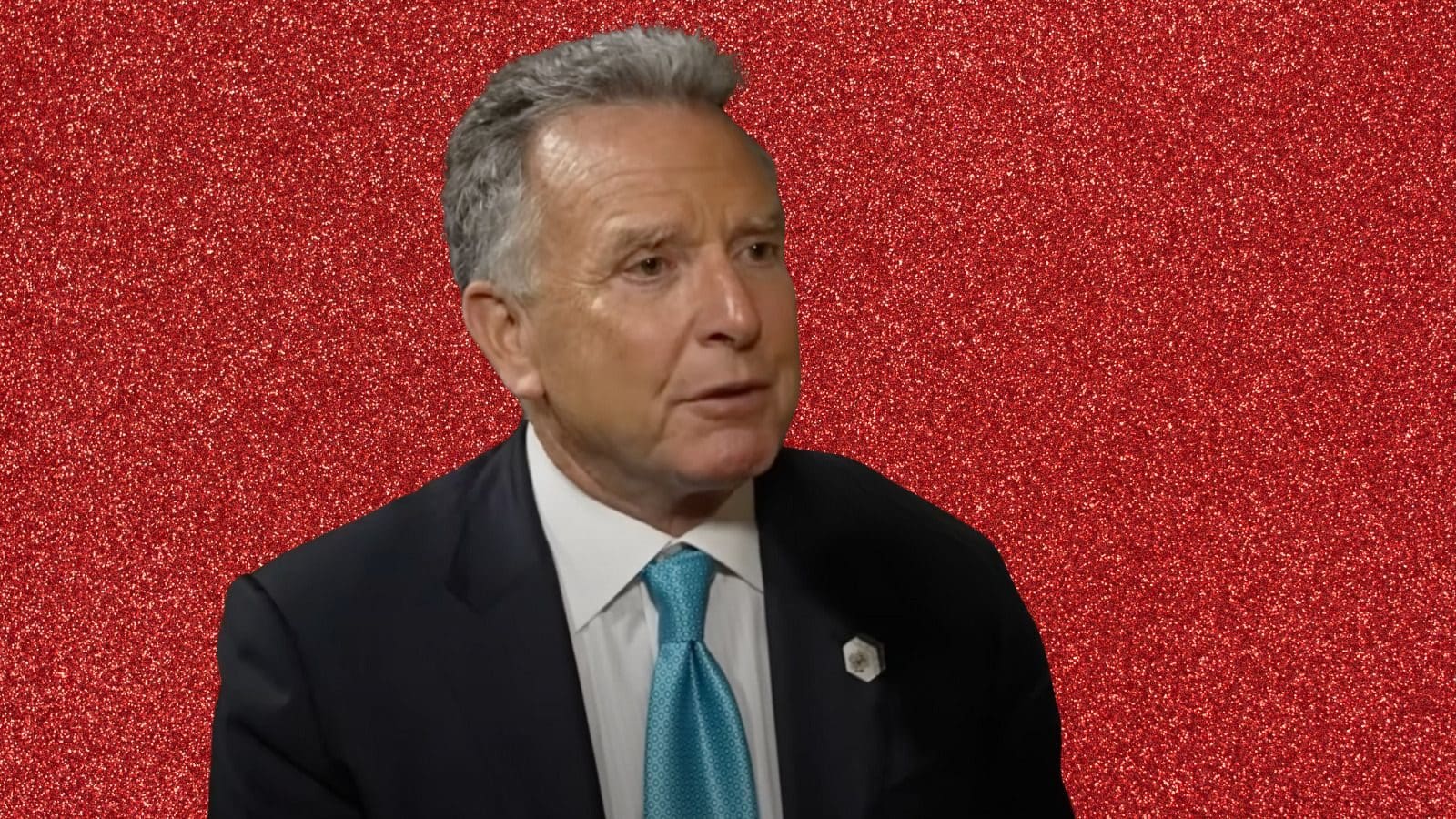
This is Part 3 in my series where we sneak behind the curtain to see how the Trump Administration is operating — and has been operating long before the 2024 election.
Because the organization, efficiency and cooperation within this team is unlike anything we’ve ever seen!
And it’s going to give you incredible confidence in what they will accomplish going forward.
If you missed Parts 1 and 2, start with those first before doing this one:
Part 1:
If You Have ANY Doubt About ANYTHING In The Trump Administration, Watch This Right Now…
Part 2:
If You Have ANY Doubt About ANYTHING In The Trump Administration, Watch This Right Now (Part 2)…
And now here is Part 3 with lead negotiator Steve Witkoff.
One common thing I'm hearing from all of these people is the incredible respect and admiration they have for President Trump.
None of them wants the credit, they all defer strongly to President Trump's leadership, each one noting he is the one who got elected so they are following his lead.
They're all wildly capable people and very strong on their own, which is why it's fascinating to see them balance their own personal skills (which are abundant) with deference to President Trump's leadership and agenda.
They also all mention that while they have their own styles and strategies, they also all realize President Trump's mandate and vision is what got us here, and so they're very mindful to place that first and foremost.
I learned so much more in this one about how things work behind the scenes and how President Trump leads and makes decisions but also how he takes guidance and recommendations from his Cabinet. It's an incredible mix of those two things.
President Trump is NOT leading by committee, he's very clearly the President and very clearly in control, but it's also not his way or the highway. He listens and he wants input from all of the highly skilled and brilliant people he has placed around him.
That's the best of both worlds -- the buck most definitely stops with President Trump and when he makes his final decision the team gets on board and backs him up 100% (unlike in the first term) but it's not Trump's opinion from the jump. He wants an abundance of ideas from an extremely smart and skilled team, and then he makes his decision.
This one was really great....please enjoy Steve Witkoff chatting with Tucker Carlson:
Backup here if needed:
Steve Witkoff has no background in diplomacy but has turned out to be the most effective American diplomat in a generation. Here’s how he’s trying to resolve the conflicts in Gaza and Ukraine.
(0:00) What Witkoff Has Learned as Trump’s Global Negotiator
(4:10) Negotiating With… pic.twitter.com/7AUh4gvwke— Tucker Carlson (@TuckerCarlson) March 21, 2025
FULL TRANSCRIPT:
What Witkoff Has Learned as Trump’s Global Negotiator
Tucker: Steve, thank you so much for coming. So I think you've had one of the most, maybe the most remarkable life trajectories of anyone I've ever met. Um, and you wind up, you know, close to Trump, you campaigned with Trump. You've done, I mean, you're an intimate friend of the presidents and you could have had any job you don't want any job, um, cause you're doing your own thing and then he taps you as a, as a, as a diplomat, as a negotiator on behalf of him and you wind up becoming probably the most effective negotiator in my lifetime.And you speak for the president, I think everyone acknowledges that you're honest and people like you personally. So those are obviously the foundations of effective diplomacy. But what have you learned negotiating on behalf of a country in the last couple of months?
Steve: Well, first of all, I think President Trump sets the table for all of us. He really does. This whole peace through strength thing, it's not just a slogan, it actually works.
And so when he dispatches you to go to the Middle East, people are almost a little bit intimidated before you get there. And this goes for me and other people who are doing a similar job. So he sets the table in a pretty powerful way.ADVERTISEMENTBut negotiating is being outcome oriented. I talk about this a lot. It's figuring out where you want to get to. That's Trump's game plan all the time. I sit with the president and we talk often about what the end game is. Where does he want to get to?
And once you decide where you want to get to, then it's all about tactically figuring out what that pathway is. With the Middle Eastern, you know, Tucker, when I first got in, and I was talking to Brett McGurk, who was the envoy on behalf of Biden. He was a smart guy. Yes.
He just didn't have a great boss giving him direction. So he couldn't really speak on behalf of Biden. I was able to speak on behalf of Trump because we talked about it. We had a great conversation about it. He said to me, this is where I want to get to, Steve.And so when I went in there, I went in with the imprimatur of the president and it became a, you know, that's the difference maker. But I mean, clearly, and no one doubts that you speak for the president, that you know what the president wants because you know the president. You actually talk to him. You're not some guy he just hired.
And that makes a huge difference. But it also seems like you think through where whoever you're negotiating with is coming from. Like, what do they want?
Well, there's no doubt I'm always trying to put myself in the shoes of the other person because a good deal has to work for everybody. But I want to just say this, when I say I speak for the president, it's not because I presume what he's thinking. It's because I ask what he's thinking.
He is the president. I'm in my job only because of him. And to me, I give him the respect of always asking the question, where do you want to get to, Mr. President? And so... That's critical.
So now I know where he stands and now it's about tactics. From the, as you talk about from the other side standpoint, it's important for me to know or to have a feeling of where the Israelis want to get to. What about the Qataris? They're the mediators at the table.What do they want to accomplish here? What about Hamas? Where are they? Will they really demilitarize? Is that something they'll do? Will they take the golden bridge out of Gaza? All of these are considerations. But first, I have to find out where the boss wants to end up, and the boss is President Trump.
Tucker: Feels forbidden for you to say what you just said. So what does Israel want?
Negotiating With Israel, Hamas, and Qatar
Obviously a critical, the key question, but there are other players and what do they want? And I don't know that I've heard anybody say that out loud ever, any American say that out loud. And I think you've been criticized for saying that out loud.
Steve: Well, I think it's important to recognize that everybody may want something. I think in the case of the Qataris, they're criticized for not being well-motivated. It's preposterous. They are well-motivated. They're good, decent people.What they want is a mediation that's effective that gets to a peace goal. And why? Because they're a small nation, and they want to be acknowledged as a peacemaker. And I think the president realizes that, and I realize that today.
But we have to know that if they had a different agenda, it would be important for us to know that different agenda. I think if they had a different agenda, it would be fine as long as we weren't operating blind. And operating blind is really the problem in a negotiation like this. You have to know where everybody stands.
Tucker: Just laughing because what you're saying is so obviously true. It's a prerequisite to getting a deal. And yet it is so different from the posture that the last couple of generations of diplomats have taken, which is like, here's what we want, shut up and do it.ADVERTISEMENTAnd I just don't think, leaving aside like moral considerations, I don't think it's been very effective.
Steve: Well, you know, here's an example, Gaza and what the president set forth is what he wanted to do with Gaza. I came back from my first trip. This is before he was inaugurated, where we had permission from the Biden administration to collaborate with them. Yes.
And the president said, when do you think Gaza can be reconstructed? 15 years was my answer, maybe 20. And he said, why? I said, I gave him the battlefield conditions. I was in Gaza, actually, that it's been decimated, it's been destroyed.There are tunnels underneath, so think Swiss cheese underneath, and then they got hit with bunker buster bombs. So there's no rock there anymore. There's no place to put footings if you're gonna build buildings. And yet the whole world thought that this was a five-year reconstruction plan, and why?
Because the Biden May 27th Protocol, which is the operating agreement pursuant to which the negotiation between Hamas and the U.S. government and Israel happen, talks about a five-year plan, but it's those, that's a false set of facts. Level setting the facts, you have to acknowledge that it's a 15 to 20 year plan.
When we first started talking 15 to 20 years, everyone said that we didn't know what we were talking about until the journal wrote an article and said 15 to 20 years. Yes, so the president's plan about Gaza was all about how do we, how do we put people back in a battle zone where there are munitions all over the field?Or where there are these latent conditions so that a kid could fall into a hole and go 40, 50, 60 feet down and you'd never know that he was there. Who would do such a thing? If we had buildings in those conditions in New York, there would be yellow tape all around and no one would be allowed in.
So, and then of course he got criticized for that as if he was looking to create a beachside community, gleaming towers and casinos. It was preposterous, he was being realistic about how you needed to consider Gaza.
I think it's really important that when you're making these decisions that you level set the facts. And that was my instructions from President Trump. Go out there, level set the facts, figure out what it is, and then we'll make decisions about where we wanna see Gaza going to.
And I think we've got a better, that's a better program. Definitely a better program. I mean, operating on the basis of honesty works.Tucker: So, okay, I think the president's goal is pretty clear, he said it many times, he campaigned on it, he was elected on it, which is we want stability and peace in the world. It's not good for anybody when we don't have that.
But to the extent that you understand it, and since you're one of the few people who seems willing to say it out loud, can you just describe the three players in the current conflict, the Middle East, the big ones. Can you go through and tell us what you think each one wants? What's their goal? So Israel, Hamas, and Qatar.
Steve: So I think Qatar is a small nation, probably has the highest GDP per capita, per person, of anyone in the world, huge, huge reserves. I think they want stability. I think they want a peace treaty from the United States. Why?Because, and all the Middle East, all the GCC countries want that, by the way. This is an interesting point. Everybody thinks the peace treaty is about physical defense, what it's really about is the United States providing a security wrapper so that they're all financeable.
Today, you can't borrow money in those countries. So if you want to go do a deal in Saudi Arabia, in the UAE, JP Morgan, if they are the hypothetical bank, has to underwrite war risk. They have to underwrite, will the Houthis in Saudi Arabia fire a hypersonic missile and destroy that AI data center that you just bought for $200 billion?That's a real problem. So a lot of these countries want defense treaties so that they're not just building out of their pocket, they're taking their oil money and they're actually leveraging it and creating a better economy long-term. So I think the Qataris want stability and they don't get enough credit for that motivation.
It's a good motivation for their people. Amen. But they're often accused, almost universally accused in the US media of being agents of Iran. It's preposterous. Look, they're a Muslim nation.In the past, they've had some views that are a little bit more radical from an Islamist standpoint than they are today, but it's moderated quite a bit. There's no doubt that they're an ally of the United States. There's no doubt about that.
Tucker: Thank you. Maybe a huge airbase there.
Steve: By the way, and they pay for every dollar of it. They don't have their hand out for a thing. There is nothing that the United States has to fund with regard to that air base. That's pretty unusual. That's amazing.
So they fund everything. They don't ask for much. I think I had a conversation with General Carrillo, Eric Carrillo, who runs CENTCOM, an amazing man. And I said to him, what do you think of the Qataris? He says, they're special people.So the people in the know know that they're good, decent people. What does Hamas want? I think they want to stay there till the end of time and they want to rule Gaza. Yes. And that's unacceptable.
So we have to know that. We had to know what they wanted. What they want is unacceptable. What's acceptable to us is they need to demilitarize. Then maybe they could stay there a little bit, right?ADVERTISEMENTBe involved politically, but they can't be involved. We can't have a terrorist organization running Gaza because that won't be acceptable to Israel. Then we'll just have the same exact experiences of every five, 10, 15 years, we're gonna have an October 7th. October 7th, pardon me.
So that's what Hamas wants. That's not possible. What do they like to deal with? I've never really, I've never been in the same room as them, which is a little bit weird, wouldn't you say? Like a negotiation where you don't have the other party?Like you don't even know if the guy behind the wall is the Wizard of Oz or he's not the Wizard of Oz, right? So.
Tucker: So how do you keep, I mean, without, you know, giving away anything you can.
Steve: I think we trust the Qataris. If I didn't trust the Qataris, then that would be really problematic, not meeting with Hamas. And of course, you know, we read— So you can communicate with Hamas through the Qataris.
Right, and Sheikh Mohammed, the prime minister of Qatar, is a good man. He's really— He certainly is a good man. He's a special guy. He really is, and he cares, and I've spent a lot of time with him, and broken bread with him, and he's just a good, decent human being who wants what's best for his people.But also like what you were alluding to before, he's able to put himself in the shoes of the Israelis, of the United States, and I think explain to the Qataris, excuse me, explain to Hamas where they're gonna have to get to to make a deal.
Tucker: And do, I mean, from an American perspective, like it's just hard to even understand what Hamas is thinking, or do you, but it's essential to understand. I mean, just as a procedural matter, we need to know. Correct. So is it hard for you to understand?Will We Achieve Peace Between Israel and Hamas?
Like, do you feel like you can effectively communicate with them, even through proxy, and understand what they want and what their, you know, what their red lines are or whatever? Can you negotiate with them?
Steve: Well, it's hard, you know, I'll give you an example of what makes it hard. I went to Gaza, and then I had this fabulous lunch with CENTCOM people, you know, military guys. I shook hands with everybody I met, because who doesn't want to shake the hand of these guys who are out in the field, you know, they protect our country.I'm talking about our military guys. And then they showed me, this is Southern Command of Israel, then showed me a film of what happened on October 7th. And the film is horrific. It is about mass rapes.
There's pictures of Hamas people cutting the head off of an Israeli soldier. I watched them saw the head off. I mean, it's really terrible stuff and it's beyond what I've ever seen. And it can taint you, right?It can taint the way you're going to, you know, the way you're going to feel about these people. And I think sometimes as a negotiator, you have to be dispassionate. It's not easy to make decisions if you're going to, but I had to see that film, Tucker.
I mean, that film is a reality. I mean, we can't ignore the reality of what happened on October 7th. Now, they would tell you that they've got justification, but there's no justification for what happened that day. There just isn't.
And unfortunately, there were security lapses that day that shouldn't have happened, that accentuated what happened that day, which shouldn't have happened. But... Do we understand that?
I think we understand that there were security lapses, that there were some mistakes that were made. But we're humans, we're not robots, right? We're not completely overwhelmed by AI right now. So people will make mistakes.There were intelligence mistakes, but there's some really good people who were involved. Here, you know, I met some exceptional people in Israel. I mean, really some exceptional people who, yes, and it's a difficult situation, but I think you have to know what Hamas wants just to go back to your question.
Yes, and then you've got to figure out what you can give them that allows them to walk out because that's what's needed here. You know what we heard in the beginning of this conflict is Hamas is ideological. They're prepared to die for a whole variety of reasons.
I personally, and I talk to the president about this, there's nothing I don't talk to the president about before we're gonna make a decision. Because he is the guy. He was elected, I was not, none of the other people were, he was elected.And I think that's how we have to function. With that said, I said to him, I don't think that they are as ideologically locked in, they're not ideologically intractable. I never believe that, by the way. I believe they strap on the suicide vest onto young kids who don't know what they're doing, right?
And they tell them a story. And once you understand that, once you understand that they wanted to live, then you were able to talk to them in a more effective way. That is smart, but it's how hard was it to come to that conclusion.
You know what, I get a lot of intelligence reports so I'm able to read things. And it just felt to me that the rhythm and the cadence of the negotiation, that's part of it too, right? If I'm not there all the time, I'm getting secondhand information.
I had to feel it for myself. I had to be able to sort of live it in real time. And that's when I sort of came to the conclusion that they wanted alternatives. We're in a negotiation right now to maybe stop some of these Israeli strikes and maybe finish this conflict with dialog.And if I don't have a feeling that we can accomplish that, why would I waste my time? Or the United States' time? Or, and worse yet, why would I put the, why would I come to the president, recommend to him that we could finish something with dialog?
And then effectively, and then we can't be that effective. That's a bad policy prescription if I'm not in this thing, making those sort of assessments and being able to come back to the president and say, I think we can finish it with dialog, or not.
And those, by the way, those calculations are going to be the same with the Iranians, and they're going to be the same with the Russians and the Ukrainians, and they're going to be the same with Azerbaijan and Armenia. So those principles apply to all of these conflicts that we're gonna maybe talk about today.So it's not a conspiracy theory, it turns out, to say there's fraud in the government, whether it's mysterious 150-year-olds cashing checks or dead people in the voter rolls, the system is filled with fraud and its perpetrators are slipping through the cracks. Who's protecting you exactly?
Unless you're actively monitoring your personal data, you're leaving yourself and your family exposed. Data hawks are constantly looking for ways to exploit your information, which is why we recommend Identity Guard. Identity Guard's real-time alerts let you know if your information, whether it's your social security number, your phone number, anything, is under attack.
Someone's trying to grab it on the internet so you know before they can. And when you need help, you'll not be stuck with frustrating inhuman phone bots. Hello, may I help you? Says a computer. Identity Guard's US-based customer care team is available at all times, 24-7, real people who will help you.With Identity Guard, you get $1 million in identity theft insurance, you get monitoring for your social security number, bank and investment accounts, home and auto titles, and more, and it's cheap. Identity Guard is offering a 30-day free trial plus over 60% off to this show's listeners.
Go to identityguard.com slash Tucker to claim this deal. Sign up before your identity is stolen and the damage is done. Identityguard.com slash Tucker.
Tucker: I'm just going to say this for a third time, I won't keep repeating myself, but that's just such a different way of looking at the conflict, not just in Gaza, but in all the places you just mentioned, acknowledging that, you know, we're on, we're sympathetic to one side, but both sides have an interest and like the reason can still play a role in this.Negotiation can play a role, dialog can play a role. I just, I haven't heard anybody say that in so long, and you've taken an enormous amount of abuse. I don't even know if you're aware of it because you're always on an airplane, but like in U.S. media and social media, attacking you is like an agent of all kinds of different foreign powers.
He's working for Hamas, he's working for the Qataris. Does that penetrate at all?
Why Corporate Media Hates Witkoff
Steve: You know, in the beginning I didn't like it. Yeah, I bet! But one night I was reflecting on what someone told me after my son, Andrew, died, and they said to me, you're never gonna have a bigger hit than that in your life, losing a child.
It's a bad club to be a member of. Oh, there's nothing, nothing worse. Nothing worse. And then I began to get like President Trump, not caring what people said.
I'd wake up in the morning, read the paper, I'd read some sort of explanation about why I said something or did something. And it was preposterous, Tucker, just preposterous. So one day, what's that movie, there was some movie where they kept, it won the Academy, I can't remember the name, I Just Stop Caring?
Yes. I just stop caring about what the news media said about me. So I've experienced a little bit of this myself, nothing compared to what you've just experienced, but it does seem like some of these criticisms of you are not actually sincere, nobody really thinks you're like, pro Hamas or working for the Qataris.ADVERTISEMENTBut the point is to throw you off balance and to sort of put a leash around your neck and control you. No doubt. Right? That's the agenda. That's the agenda. No doubt.
And it seems to have had no effect. From all sides, of course! Oh, absolutely! I've had a couple of experiences where first I was attacked as being pro-Qatari sympathizer. By the way, Qatar is a mediator here.
They're not a party to the conflict. They're a mediator. And by the way, they've mediated all over the world. No different than the Swiss and the Norwegians. They've mediated in Russia.
They've mediated in Afghanistan. And God bless them. I know, and they've done an effective job. They're good at it. So I am.
How could I not collaborate with the mediator and be, if I'm not collaborating with the mediator, I'm bound to be ineffective. It's not even possible that I could do the job. I had to know everything that they knew. So that means collaboration.
And that's how President Trump operates too. I learned the business from him. I went into the business because of him, the real estate business. And this is his ethos. This is how he operates.
And so I'm really following him in a certain respect. I didn't realize you went into that so I didn't know I knew you'd known him forever. I didn't know that.Oh no, I wanted to be him. By the way, everybody wanted to be him. He'd come to 101 Park Avenue where I was a lawyer. He had this swashbuckling style. I used to see him come in and I used to say, well, God, I want to be him.
I don't want to be the lawyer. I don't want to be the scrivener. I want to be that man. Yeah, I can remember saying that. Yeah, he was like the Michael Jordan to me, you know, of the real estate business.
How the Loss of His Son Changed the Way Witkoff Negotiates Hostage Situations
Tucker: It's incredible the turns your life has taken, it's just incredible. Well, when you have a chance to sort it out when all this is over, I think you're gonna look at your own life and say, well, that was amazing.
Steve: Well, I've been blessed. I mean, it used to be that I couldn't use the word blessing because of my boy, of his death. But now I can say I was blessed but for this overwhelming tragedy. And I think my son, Tucker, allows me to be, to have this sense of, I relate to a lot of the hostage families.
Many of these families are never gonna get their children back. The children have either been killed or may in fact get killed if we don't successfully get to a peace program in Gaza. So I think that this sense of sensitivity or empathy that I have, I can relate to them.
They all have my telephone numbers. I talk to them on a daily basis. And I think that's been a big, it's been a big help for them. But interestingly enough, it's been a big help for me. I believe that.
And I talked to the president about this. I had hostage families in the Oval Office the other day. The president was tired. And he said to me, he knew they were at my office and he said, bring them up, let me at least say hello to them and get connected to them, but let them know I only have a couple of minutes, because it was a hectic day.
He spent an hour and a half with them, talked to every one of them, gave them his challenge coin, every one of them, listened to their stories. People who talked about children who might not come home, many of these people were captives themselves, hostages.
You know, it's a very real experience when you sit there and you listen to what it was like. Some of these people who lived in cages were chained 24 hours a day. Had, you know, we talked about what it was like to find a bathroom, right, or what it was like to live in the dark, or to be starving to death, you know, as some of them were, or to watch people be murdered.And the president, as a president, he doesn't have to do that if he doesn't want to. He could sort of get the information just from me. But he's, it's up close and personal for him. And that way of doing things guides people like me who work for him.
Now I want to get up close and personal. That's why I went to Gaza. I was the first US official to go to Gaza in 22 years. But how would you implement a peace deal if you didn't go to the place where the peace deal was being implemented?
I mean, it's curious, right? Like who would not, who would try to get, who would try to get a peace deal done? And then it's all in the implementation. So what the contract says, what the writing says, now we have to figure out the battlefield conditions. Nobody had been there.
Tucker: It's kind of crazy. Well, it is crazy. And it's connected to what you've been saying for the last 20 minutes, which is you have to understand all sides if you want to affect the outcome that you've decided you want. Correct. Yes.
Again, that's a revolutionary development in American diplomacy. And I just am thrilled to see it. So finally, the biggest player in all of this, of course, is the government of Israel. What is the government of Israel, leaving aside the population of Israel, I have no idea, but what is the government making these decisions?
Steve: Well, I think that's complicated. I think they're well motivated. I think there are things that they're trying to get done. You know, as an example, we would not be as effective in what we're doing there if Bibi did not get Nasrallah out of the picture in Lebanon. Right.
If he did not decapitate, because he's effectively decapitated Hezbollah. If he did not do what he did with Hamas, he's decapitated Hamas to masses, nowhere close to the terrorist organization that they were beforehand. Both of those events inform on his relationship with Iran and Iran continuing to use proxies and so forth.
They are less prone to do those sorts of things today, right? And so that sort of Iranian crescent or that Islamist crescent that everybody thought was going to be effective, it's been largely eliminated. So he's done an exceptional job with that, but of course the rap he gets is that he's more concerned about the fight than he is about the hostages.
I think in some respects, I understand how people make that assessment, but I don't necessarily agree with it. I think that he does wanna get hostages home, if he can, but he believes that pressuring Hamas is the only way to do it. I think in some respects, the nuances here, the changes that happen there on a day-to-day basis.We were at the Arab summit a week and a half ago, we made a proposal to Hamas. They considered it, they rejected it the next day. We thought it was unacceptable that they rejected it. Three days later, the Israelis went in, guess what, they're talking again.
Stuff changes there, Tucker. Hour to hour. You really have to stay on top of it. I think Bibi feels that he's doing the right thing. I think he goes up against public opinion because public opinion there wants those hostages home.
Public opinion in Israel. In Israel. Yeah, you don't get that sense, I don't think from American media, but Israel has always been, you know, there's been a robust debate since, you know, I started going to Israel, that, you know, they have a very vigorous debate internally about their government.
Like it's, you know, people feel free to say. I went to Hostage Square, and I went with a detail. And my guys were afraid for me to get out. There were, I don't know, four or 5,000 people there.
And we were passing by, and I said, let's stop. There was no plan to go there, let's stop. We didn't have a lot of security with us. I knew it was gonna be fine. I came in there, I spent almost an hour there.
It was spiritual. All the families were there. Hostages who had been released were there. People were crying. Look, getting, this has infected Israel.
It's fractured Israel. It's like a seam cutting right through the soul of the country. We've gotta get these people back. I talked to, by the way, I talked to Bibi about it. I talked to Dermer about it, but.
You know, they also have a view strategically about Hamas, how they have to be dealt with. I'm not sure, in some respects, there are times that we agree with each other, there are times we slightly disagree, but I think they're well motivated, is my point.
And our policy is that Hamas cannot continue to exist here. That's the president's policy. And I'm a, you know, I'm someone who follows the president, because he's the one who got elected, and I—
Israel’s Goals
—believe in his policy. And he got elected on, I think, a pretty clear vision of how he wanted to manage the world to the extent that we can. And again, it was, you know, no more chaos. And to the extent you can avoid it, no more wars.
And Americans really responded to that. And the world understands that. Like everyone kind of knows that's the agenda. And you've said many times, we talk through what we want the outcome to be before we begin the tactical considerations.I just in my traveling, there are a lot of Gulf countries that are, you know, have extensive, very, much more than people understand, relations with Israel. Some have signed the accord, others haven't, but they all deal with the Israelis all the time. They're not hostile to the Israelis.
But not one person I've spoken to understands what the long-term vision is. Like, what's the plan here? What are we, you know, if you get everything you want, what does it look like? Do you understand it?
Well, I understand we have to have that notion. I understand that we have to be outcome-oriented. What would be how we're operating myopically if we're not outcome-oriented. If we don't, I mean, peace, stability, the Gulf Coast could be one of the most undervalued opportunities if we get peace and stability throughout the region.
If we solve Iran and you can finance in that market, the Israelis are brilliant from a technological standpoint, they've got a huge technological base there, they're in AI, robotics, blockchain, that's where the UAE is today. That's where Saudi Arabia is today, that's where Qatar is today.
Can you imagine all these countries working collaboratively together and creating that type of market? It could be much bigger than Europe. Europe is dysfunctional today. Imagine if they became functional and everybody's a business guy there.
Tucker: I completely agree. I think the core question is the map. You know, for thousands of years it's been about the land. What does the map look like? Who controls what?
And it's clearly had a destabilizing effect on some of the poor, more populated countries in there. No doubt. Specifically Jordan and Egypt, a hundred million people in Egypt. I think it might be helpful for everybody if there was just a clear picture of when this is all done, here's what we want the map to be and then we can debate that.
Do you have any sense of what the map would look like from Israel's perspective? When you say the map, you mean what? What countries?Well, what, okay, so Israel's moved into Lebanon and Syria, they're not part of Israel, but they control them. So when all this is over, what does the Israeli government hope to control? And then if that were clear, then I think people would say, you know, they can either live with it or they can't, but it would have a calming effect if people knew what the goal was.
Steve: I would say the goal begins with, how do we deal with Iran? That's the biggie. Yeah. So the first is nuclear. Yeah. We cannot have that. Right.
And we can talk about it in this session, how bold it was for the president to send that letter, because many would not, and that's an important thing, but I'll leave it to the end. So it begins with Iranian nuclear, but most importantly, because Iranian nuclear, if they were to have a bomb, that would create North Korea in the GCC.
We cannot have that. North Korea, where they are, has outsized influence as a very small nation. We can never allow someone to have a nuclear weapon and have outsized influence. That doesn't work.
So if we can solve for that, which I'm hopeful that we can, and we can talk about that too, the next thing we need to deal with Iran is that they're being a benefactor of these proxy armies. We've proven that that's not existential. We've, for all intents and purposes, destroyed Hezbollah.
So they're not really an existential risk. Hamas, same thing. The Houthis, we're having, you know, we're in a conflict with them today. I think we'll prove that they won't be an existential risk either.
But if we can get these terrorist organizations eliminated as risks, not existential, but still risks, they're destabilizing risks, will normalize everywhere. I think Lebanon could normalize with Israel, literally. Normalize meaning a peace treaty with the two countries. That's really possible.
Syria too. The indications are that Jalani is a different person than he once was and people do change. You at 55 are completely different than how you were at 35. That's for sure.
And I say to myself, I'm a different person today at 68 years old. I'm not the person I knew 30 years ago. So maybe Jalani in Syria is a different guy. They've driven Iran out.Imagine if Lebanon normalizes, Syria normalizes, and the Saudis sign a normalization treaty with Israel because there's a peace in Gaza. They must have that as a prerequisite. That's a condition precedent to Saudi normalizing. But now you'd begin to have a GCC that all work together.
It would be epic. It would be, and I think it'd be good for the world. For sure, it would be good for the world because Europe is dying, unfortunately. And so the United States needs allies abroad.
And those are all potential allies. Well, they are allies already. I couldn't agree with you more. And remember, Tucker, one more thing as a condition in that region. You have young leadership.
You have young leadership in MBS. You have relatively young leadership in the UAE. You have relatively young leadership, new leadership in Qatar, people who don't have the old sensibilities, people who want to have, want to do business, who realize like Trump's way is people vote their pocketbook, right?
So he wants to bring the bacon home to the United States. I think everybody's bought into that over in the GCC. I agree. I mean, we're reverting to like human nature. People want stability and prosperity for sure.
Correct. But looming over all of these countries and their remarkable success, both economically and socially, they're just like great countries, in my opinion, is this, is, you know, is the conflict in Gaza and not just Gaza, but the idea that, wow, this could all blow up tomorrow because we don't know what the Israeli plan is.
And even people who should know don't seem to know. Do you think at some point they will articulate like, here's our plan?
Trump’s Plan for Gaza
Steve: I think so. First of all, I think that the president, President Trump's approach to Gaza has engendered a lot of lively discussion about different ways to deal with Gaza. We're now seeing an Egyptian plan. We're seeing the Saudis put together a white paper.
So I think what we're going to do with Gaza is going to become much more apparent over the next six to 12 months. But Gaza is a flash point and we've got to figure that out. And I agree with the president when he said, the old plans don't work.The old plans, the last 40, 50 years of policy prescription in Gaza. Rebuild, more war, more rebuilding. It's just, that's not something that made any, that made any sense. It was why the president began to say maybe we need to think about it in a different way.
Now we got criticized for it because that's what happens when you begin to go up against, you know, the old way of thinking and you, you want to sort of introduce a new way of thinking. Well, a new way of thinking is definitely needed. I think everybody realizes that.
So we're not positive that cryptocurrency is the future of finance, but we do know that what we have now is broken and dangerous. Debt has never been higher in this country. Many of our so-called leaders are getting rich, serving you. It's a scam.
So where does it go? Well, thankfully there are options. Donald Trump has said repeatedly he wants the United States to be the crypto capital of the world. He's already created the Crypto Advisory Council and recently signed an executive order to establish a Bitcoin strategic reserve.
This could give normal people an alternative to the government's failing system, and frankly, to the US dollar. I'm not saying put all your money outside the US dollar, but like, don't be crazy, don't be stupid here. You can see where it's going.
So the people that I trust capital can help you get in to this. It's complicated for people who aren't following it. They make it easy. They're based 100% in the United States of America.
We looked into this. They service only American investors and they operate the only platform that allows you to buy and sell crypto 24 seven, both inside and outside of your tax advantage to IRA. And it all happens on one easy to use dashboard.
They also operate a closed loop system, meaning that bad actors can't access your account and steal your money. So if you're considering adding Bitcoin, if you want to, or some other cryptocurrency portfolio, I trust can be trusted and it's easy to understand. ITrustCapital.com or click the link below.
Tucker: One question, I don't know if it's answerable, I've just noticed it. I was talking to some Israeli government people yesterday. And so here you have, October 7th, obviously traumatic to Israel, but you get the destruction of leadership of Hamas, you expelled, you broke Hezbollah, Nasrallah's dead.
No one ever, I was there for the 2006 war. No one ever thought that was gonna happen. I didn't anyway. That happened. And Bashar al-Assad's gone from Syria and there's a more kind of pro-Israel, a Jalani leader in Syria.
So that seems, like from an Israeli perspective, those seem like massive wins that nobody thought were possible. And yet I detect in the people I know in Israel a feeling like they feel more under threat almost. Do you feel that?
Steve: Well, I think, you know, I go to Israel quite often. Yeah. And I think there's a feeling of, with some, when does the violence end? At what point have we had enough of it?
And I think that's the issue. And, you know, maybe the Israeli government needs to do. Look, I understand where they're coming from. Their central premise or thesis is that Hamas cannot be allowed to live on and I think we're talking about now demilitarizing.That's the big thing. I don't think anyone has a feeling that you can just sort of kill off a Hamas. It's an idea, right? That's what Hamas is about. It's an ideological.
They can't be allowed to ever again foment alongside of the Muslim Brotherhood, alongside of Islamic Jihad. These are all groups that are operating in Gaza today. We just can't have an October 7th ever again. Now October 7th was like 9-11.
What 9-11 was in the United States, October 7th was the Israelis' version of. But what's interesting is it happened at exactly the moment that it felt like things were on track to get better. I mean, Abraham Accords had been signed, Saudi didn't sign.
But there was some thought that they might, I think. I mean, it was. And so, like, the trajectory was like that. And all of a sudden, it just went in the opposite direction. And so then the question becomes, well, like, how do you ensure, how do you build a framework where there's like enduring peace and everyone can just go on with living their lives and building their businesses and all that.
Well, we're going to need a very good plan on Gaza. It's going to begin with that. We're going to need stability on Gaza. Stability on Gaza could mean some people come back. It could mean some people don't come back.
But I believe we have to get to a place where people can live a better life in Gaza, and we have to have a plan for that. That involves housing. But it also involves these people's aspirations. What is going to happen for their children?
Are their children like our children? You want better for your kids, I want better for my kids. I want them to have, to go and get an education, to be self-sufficient. I don't think Gazan people have ever really felt that way about, we have, felt that way. No.
They don't have that opportunity for their families. We have to give them that opportunity or find pathways for them to pursue those opportunities. That's what President Trump was talking about when he talked about a new way of thinking about Gaza.
So, and we're going to, we're going to attempt to, um, you know, to ascertain different development plans for Gaza could involve the word two-state, could not involve the word two-state. What about that? You don't hear that anymore.
Tucker: I mean, for my whole life, the stated aspiration was a Palestinian state, like an actual state, and then the debate was over what it would look like and who controls the utilities and airports and all that stuff, but lots of details to hammer out. But man, I haven't in the past five or six, 10 years heard anybody in authority even mention it.
Steve: Because when you use those words, it's like a flash point. So I use the word, I can be attacked for it. To me, it's just a word. What two-state to me means is, how do we have a better living prescription for Palestinians who are living in Gaza?
Let's get to that place. But it's not just about housing. Maybe it's about AI coming there. Maybe it's about hyperscale data centers being seeded into that area, because we need to have that.
And these people can now take advantage and we can create jobs for them there. Maybe it's about blockchain and robotics coming there. Maybe it's about pharmaceutical manufacturing coming there. We need, we can't rebuild Gaza and it be based on a welfare system.
We have to give people prospects, economic and financial prospects.Tucker: That's exactly right. Treat them like human beings, adults, where they have nothing. Interesting. Um, so you think by saying two-state, I mean, that's a controversial thing to say now.
How Witkoff Negotiated the Ceasefire
Um, but obviously you don't care. Um, so do you think the ceasefire that you on the president's behalf got the ceasefire? I mean, that was my read. Anyway, you went to Israel and said the president wants us and you got it. Um, but then it ended. What are the prospects now?
What do you think happens next?
Steve: Well, let me say this, we got it because they didn't want to defy him. He's a bad guy to defy. The Israelis. No, President Trump. No, but the Israelis did not want to defy Trump.
But not just the Israelis, it was the Israelis, it was Hamas, it was Qatar wanting, you know, everybody had to know that we needed to pull in the same, right, to pull in the same way. And we got, there was a lot of miscommunication in that deal, lots. We cleaned up the miscommunication, that was the game plan.
And, but it was the president's, his sort of overarching personality, and letting everybody know that that success was not an option, it had to be. It was a mandate. And that's how we got to that place.
I mean, it would take me a 10-hour interview to explain to you the ins and outs of how we actually got there. I can't even imagine. But the story was that you just kind of rolled in and said, here's what we're doing. This is what the president wants.
Well, that's what he would do. So that's what I did because that's what he would do. He would roll in and say, this is unacceptable. This is what we need to have happen. And that's effectively what I did.
By the way, why reinvent the wheel? Why not copy the master? He's the master. So why not copy the strategy? It's worked.
Tucker: When I saw you do that on his behalf, my first thought was, why didn't the Biden people do this? I mean, they lost for a lot of reasons, but one of the reasons they lost was the ongoing Gaza conflict, and that alienated a ton of their voters.
I mean, that was a crisis for them. Muslims in Southeast Michigan voted for Trump in part because of that, and like a lot of them did. Never thought I'd live to see that. And Orthodox Jews voted for him too, which was like amazing.
So why didn't, and they knew it was hurting them, why didn't they do that?
Steve: Because Joe Biden is not Donald Trump. It's as simple as that. So you think about it when his policymakers walked into the Oval Office, were they going to get that sort of direct mandate from him? And I was not there, so this is just a thesis.
My bet is not. I walk into the Oval Office, Tucker, it's purposeful. That's what it feels like. We're there to get solutions, to agree on solutions, and then to decide on how tactically we're going to get to that place.That's what we do. We sit in the Oval Office. I could be sitting there with Susie Wiles, John Ratcliffe, Mike Waltz, the Secretary of State Marco Rubio, I mean, exceptional human beings, Tulsi Gabbard, and yeah, we have some fun together because it's a very tight-knit team.
He's got, he's got a great team this year, you know, that he's put into place this year, and hopefully they'll all be there for the entire term. But we're there to be solution-based, and it's a collaborative conversation with the president leading the conversation.
He's interested in a lot of different opinions, which I think underscores what a great leader he is. He's not stuck on a view. He's prepared to consider different things. I think that makes him a great leader.
I think people have that misconception about him that, you know, he wakes up in the morning and you know, this is the way it's going to be. No, he listens. He's intent on understanding different viewpoints. That's for sure.
He's prepared to be flexible in his thinking. I think that's what comes from a lifetime of experience. And I think it's a great example to all of us who work for him because we go out with that way of thinking too, for the most part.
Tucker: Do you think there's a hope for a cessation of violence in Gaza like soon?
Steve: I mean, I'm not at liberty at this moment to talk about... I bet you're not! But I think there have been signs. I think the Israelis going in is in some respects unfortunate and in some respects falls into the had-to-be bucket.
It kind of had to be. Hamas was not responding. They were not and what then their responses were unreasonable. And look, I warned everybody at the Arab summit.
We presented a proposal at the Arab summit 10 days ago or two weeks ago that was reasonable, that was a bridge to get to a peace deal, a bridge to get to demilitarization of Hamas and a discussion about an enduring truce. That's what I was presenting 10 days ago.
And Hamas, their reaction was completely inappropriate. That's inappropriate is probably a light word, but I warned everybody that this was going to result in some sort of military action. Not because I know, I did not know before the Israelis went in.
I just sensed that that was going to be the only alternative based on Hamas's reaction. Now that may not, we may be able to reverse things, or we may use this. We may be able to use this to get Hamas to be a whole lot more reasonable, because they have a lot of sway there.
And they impose that sway at the point of a gun, which is why we have to demilitarize them. We need real elections in Gaza. There has to be a whole new way of thinking. We need a real security force there to ensure to Israel that they're not gonna have a problem with them long-term.
If Israel thinks they're gonna have a problem in Gaza, because Hamas is gonna be there long-term, this is never gonna end. So the only way to deal with this conflict is to make sure that we satisfy everybody, that we're never going to have an October 7th ever again.
Should We Be Concerned About Jordan, Egypt, and Turkey?
Tucker: There is huge concern, as I know you know, from a lot of the neighboring countries that the conflict in Gaza, which is, of course, streamed into everyone's iPhone, a lot of people have been killed in Gaza, a lot of kids, and that's inflaming the populations of some of these countries, again, specifically Egypt and Jordan, to such a point that those governments could fall and cause massive chaos, including in Europe. Is that a factor, is that worry a factor?
Steve: Huge factor. It's a huge factor. I think King Abdullah in Jordan has done an amazing job, amazing job of figuring out how to deal with that instability. But, you know, in some respects, he's been lucky.
I think Egypt is a flash point. All the good that happened in the election because of Nasrallah and Sinwar being eliminated. That could all be reversed if we lose Egypt. What happened in Syria was a huge data point for the region.
I mean, getting him out, Assad, was a big deal. And no one ever expected it. But Egypt has a very restive, I want to say the stats in Egypt are huge unemployment among under 25%, like 45% unemployment. Yeah, a country can't exist like that.They're largely broke. They need a lot of help. If we have a bad event in Egypt, it could take us back. And Saudi Arabia also, large, you know, I mean, he's an amazing leader, MBS, but people are worried about his young population and how they're looking at this whole thing.
Which is why we've got to solve Gaza, because if we solve Gaza, which is the condition precedent to Saudi normalizing, then Saudi can normalize. And if they normalize, we're building on the framework of the Abraham Peace Accords, which, of course, is the president's creation.
He wants the Abraham Peace Accords to be augmented, and we're in the process of doing it. We think we're gonna be announcing several new countries who are joining. So— would—
Tucker: It feels like, I don't know, I'm not there, but it feels like there's some significant unrest in Turkey. Yeah. And this being driven by this, being driven by what's happening in Syria, which of course Turkey participated in, that Erdogan is seen by some in his country as a tool of Israel or what, I mean, if you had like real problems in Turkey, that would be like a global disaster, of course, because they've got this massive military. Is there a lot of concern about that?
Steve: Well, I think there was, but I think the president had a great conversation with Erdogan a couple of days ago. Really transformational, I would describe it. I mean, I think it's gone, I think it's been under-reported, to tell you the truth.
And I think it's under-reported because of the Houthis, because of what happened with Israel, and because of what's going on with Russia, Ukraine. It's not really, you know, a headline, but I think Tom Barak, who's the ambassador there, has done and will do an exceptional job.
I think the president has a relationship with Erdogan, and that's going to be important. And I think that there's some good coming. There's just a lot of good positive news coming out of Turkey right now as a result of that conversation.
So I think you'll see that in the reporting in the coming days.
Negotiating With Russia and Ukraine
Tucker: So if you don't mind, I'd love to, so here's the timeline as I understand it as an observer. So you go over, you deliver the president's message. There is a ceasefire in Gaza, which as you've said five times is a prerequisite to a lot of other things. Like it's hard to do anything with this open wound.
So you do that and the president says, wow, Steve Witkoff, my friend from the real estate business, like you're really good at this, sends you to Russia. Is that fair?
Steve: It's not so far from the truth. Right, so it's like, I'm watching this because I knew you before and I was like, this is the most amazing thing I've ever seen. I'm cheering you by the way. Where are we there? That conflict, would you say?
I think we've made more progress. Again, by the way, look, Tucker, I'm not just saying it. Every solution comes as a result of President Trump. And I don't get paid to say that.
I say it because it is the absolute truth. Putin's got a huge respect for the president. And you saw what happened in the Oval Office with Zelensky and the president, right? I mean this disrespecting him is not a healthy way to have a good relationship.
Arrogance of small countries. That's like get some perspective. I mean, come on. How can you imagine? And they're dependent on us. Oh, I know.And we've been so good to them. I know. And I think that's, but look, that's been corrected and that's a really good thing. It got corrected and hopefully we'll chalk it up to a misunderstanding and we'll get to a peace solution here.
But I believe that we have made more progress in Russia, in this Russian-Ukraine conflict, in the last eight weeks than anyone thought we would ever. I hear people describe this last conversation that the president had with President Putin as, you know, unsuccessful.
It's preposterous, by the way. We talked throughout a two-hour conversation about an ultimate ceasefire, and there are conditions that the Russians will need for an ultimate ceasefire, because an ultimate ceasefire is complicated. A, there's Kursk, where Ukrainian troops are surrounded.
And the Russians, within Russia. Kursk is within Russia, the Russians have taken it back. And they've got people trapped there and the president doesn't wanna see everybody getting killed. That's a significant battlefield condition that has to be dealt with.
But on top of that— Is that acknowledged? I don't know if the New York Times that story right now. I think it gets lost a little bit. First of all, I think a lot of these newspaper stories are, they're agenda driven.
Yes. People start out saying, I support the Ukrainians, so I'm going to write the article in a certain way. Look, we want to, I want to see Ukraine come out of this, okay? I want to see Russia come out of it, okay?
Again, outcome oriented in this circumstance means that we need a deal that the Ukrainian people can live with. We have to sell it. There's going to be various Senate approvals that we may need here. And that's the political system we're in, that we're gonna want everybody to be in some respect satisfied.
So we're gonna want the Russians to be satisfied in some respect. We're gonna want the Ukrainians to be satisfied in some respect. We're talking to the Europeans. When I say satisfied, feeling that we came out of this thing, okay, with a deal that everybody can live with.
I think that we have moved Russia in ways that no one thought was possible. So in the last conversation, they agreed to an energy infrastructure ceasefire, which means Russia is not going to target Ukraine's energy infrastructure, and Ukraine will not target Russia's energy infrastructure.
They've never talked about that before. Here we are talking about that. They've never talked about reinstituting the Black Sea moratorium on maritime hits. Ukraine firing on Russian ships, Russia firing on Ukrainian ships.
Now, we're down to, and that's going to be implemented over the next week or so. There's some details that need to be discussed, but that became a part of that conversation. That's big stuff, really big stuff. What's the ultimate goal?
The ultimate goal is a 30-day ceasefire during which time we discuss a permanent ceasefire. We're not far away from that, but a 30-day ceasefire is something where we have to figure out what all the battlefield conditions are, which is why I began with Kursk. But Kursk is just the beginning of it.
Because there's this 2,000 kilometer, that's 1,200 miles, this 2,000 kilometer border between Ukraine and Russia, where the Russian and Ukrainian troops are involved in, I don't know, 50, 60, 70, maybe 80 firefights throughout this border with all kinds of different conditions.
Putin asked me in the meeting, what should I do in a particular area where we have people surrounded and they don't want to give up. Do I kill them? How do I get them to give up? I'm happy not to kill everybody.
I'm happy to get people to wave the white flag if I can get them to wave the white flag. And that one situation, Steve, this is him talking, Putin talking to me, is just one example of 70, 80, 90 different situations out there along this border, each one having different battlefield conditions.
Each one needing a separate conversation. That's what has to happen for a ceasefire. And yet, we're talking about it. That's a big, big deal. Our technical teams are going to be meeting in Jeddah beginning Monday.
That's a big deal. There's all kinds of good positive talk coming out of Russia about their willingness to consider all of these different things. And Zelensky had a wonderful conversation with the president after the President Putin's conversation the next day.
And I think that indicates that they've got some degree of flexibility in the way that they've been thinking about finishing up this conflict. So I am not to sound like a forever optimist, but I am very, very optimistic that we're going to be able to bring the two sides together.We have narrowed the issues so considerably, so I'm optimistic. Time for another True Life Alp story. I got a call from a friend of mine yesterday, honestly, true story, who said his girlfriend had just broken up with him over Alp.
He wouldn't stop. And I thought to myself, that's kind of sad. And he said, no, it's not sad. Imagine if I'd married her. Now I know, I was saved.
Then the next day, this same friend is driving at twice the speed limit through a major American city, pulled over by a cop in a speed trap. Cop takes his license registration, goes back to the patrol car, runs him, comes back, looks in the window and sees a tin of Alp on the dashboard.
Pauses. Stunned, says to my friend, you use Alp? Yeah, I do, says my friend. So do I, says the cop. We all do.
He looks at my friend thoughtfully and goes, drive safely, sir, and hands back his license and registration. No ticket. So in two days, he's saved from a tragic marriage to a girl who doesn't like Alp and a speeding ticket. All true.
It's more than a name. In a nation of 350 million, people are guessing there are about 350 million Alp stories. Email us yours. We want to know and read it on the air. Email tellall at alppouch.com.
Tellall at alppouch.com. Give us your Alp story.
Tucker: So Russia, Putin, who's been in power 25 years, has been consistent for the whole duration of his presidency in one demand, which is that NATO stop encroaching on its borders, and specifically that Ukraine, which is the largest country with the borders, Russia not be in NATO.
And that is my understanding, my certainty is that that still remains the central demand, period. No Ukraine and NATO can't have peace without that, in the same way that Israel doesn't want Hamas in its border. They don't want that. Can the U.S. deliver that?
Steve: First of all, I think the largest issue in that conflict are these so-called four regions, Donbass, Crimea. You know, the names, Lugansk, and there's two others. They're Russian-speaking, there have been referendums where the overwhelming majority of the people have indicated that they want to be under Russian rule.
I think that's the key issue in the conflict. So that's the first thing. When that gets settled, and we're having very, very positive conversations. And Russia controls that.
In fact, some of those territories are now, from the Russian perspective, part of Russia. That's correct, but this has always been the issue. And it's sort of no one wants to talk about it. That's the elephant in the room.
The elephant in the room is, there are constitutional issues within Ukraine as to what they can concede to with regard to giving up territory. The Russians are de facto in control of these territories. Yes. The question is, will the world acknowledge that those are Russian territories?
Will it end up? Can Zelensky survive politically if he acknowledges this? This is the central issue in the conflict. Absolutely that. On NATO, I think that Zelensky, and he's got a right-hand guy, Yermak, I think that they've largely conceded that they are not going to be a member of NATO.
There's been all kinds of talk about whether they could still have, quote unquote, what is called Article V protection, right, which gives— every NATO country has this Article 5 protection, whether Ukraine could have that in some respect from the United States or European nations without being a member of NATO.
And I think that's open for discussion. But I think it's accepted that Ukraine, and Russia, if there's going to be a peace deal, Ukraine cannot be a member of NATO. I think that's largely accepted.
Tucker: So you spent sort of an amazing story that got downplayed in the media, but you go to Moscow and then you wind up meeting directly with Putin for a long time. Long time. Which is kind of remarkable, I think, considering you're the president's envoy, but you're not. I'm not the president.
You're not the president, exactly right. So the Russians are very formal, as you know. In every regard, they're very formal. And so you can imagine a scenario where it's like, well, it's not the president, so our president's not gonna meet with him, but he did meet with you, for a long time. What did you think of him?
Steve: I liked him. I thought he was straight up with me. Of course, by the way, I've said that. And you can imagine, by the way, I say that I get pilloried. Oh my gosh, you're actually saying that you like him.
Every American president, until Biden, has said that. Every single one. Bill Clinton said that, George W. Bush said that, Barack Obama said that, every president around the world I've ever spoken to is like, they may disagree with what Russia's doing, whatever, but they're like, you know, Putin's a straightforward guy.First of all, I thought it was gracious of him to accept me. Yeah. To see me. Why would I interpret it any other way? But that was gracious.
Now, I'm an emissary of the president. And the president had a great relationship with Vladimir Putin in his first term. So I think Vladimir Putin knew that it was going to be hard for the president at this time to come over to Russia.
I think they're going to meet in the coming months. But I think it was enormously gracious for him to accept me, and I need to acknowledge that. This is safe. I know, but by the way, that's the same way that I said that Sheikh Mohammed is a good guy and, you know, because that he is a good guy.
Yeah, I mean if you don't, you know, in our country if you don't act like a lemming and just walk off the cliff like everybody else, then you know you get attacked. It's, by the way, how would we settle a conflict with a guy, with someone who is the head of a major nuclear power?
Unless we establish trust and, and, and good feelings with one another. I don't know how you would do such a thing. And, and, uh, President Putin said to me in the first meeting I had, he said, Steve, do you know that I didn't talk to Joe Biden for three and a half years?
It's craziness. How would you resolve that? Tucker, can you imagine me and you having a conflict? I don't know what it was with, you live in this house, I live in that house. Okay.
I think you've encroached on my land and we never have a conversation about it. I mean who—
Tucker: That's why I went over there last year, because I thought we're moving toward a nuclear war. And I just feel like if no one's talking to Putin, like someone should at least broadcast his views to the world because we could have a war otherwise. That was my thinking anyway.
Steve: When I came back, before the first meeting with President Putin, when President Trump said to me, go over and have that conversation, I think we're going to have a good, healthy conversation. Before that conversation, there was no talk about a Black Sea moratorium.
There was no conversation about an energy infrastructure moratorium on hits between the two countries. We were not talking about prisoner exchanges and all kinds of other stuff. After one meeting, and I am saying to you, not because of me, because this was President Trump sending a signal to President Putin.
That he wanted to resume his relationship together and that they were going to be two great leaders figuring out this conflict. That was the message. That was me coming there. That was my message to President Putin.
I was directed by President Trump to deliver that message, that we were here to begin a real discussion, a productive discussion, about how to end this conflict. And President Putin, to his credit, sent all kinds of signals back to the president that this is the path that he wanted to be on, including statements that he made.
Putin Praying for Trump After He Was Shot
In the second visit that I had, it got personal. The president, President Putin had commissioned a beautiful portrait of President Trump from the leading Russian artist and actually gave it to me and asked me to take it home to President Trump, which I brought home and delivered to him.
It's been reported in the paper, but it was such a gracious moment and told me a story, Tucker, about how when the president was shot, he went to his local church and met with his priest and prayed for the president, not because he was the president of the United, he could become the president of the United States, but because he had a friendship with him and he was praying for his friend.
It was, I mean, can you imagine sitting there and listening to these kinds of conversations? And I came home and delivered that message to our president and delivered the painting, and he was clearly touched by it.
So this is the kind of connection that we've been able to reestablish through, by the way, a simple word called communication, which many people would say, you know, I shouldn't have had because Putin is a bad guy. I don't regard Putin as a bad guy.That is a complicated situation, that war, and all the ingredients that led up to it. You know, it's never just one person, right? So we're gonna, I think we're gonna figure it out. It's like a marriage.
I mean, you know, you can blame the other person all you want, but you're implicated in it too. So that's just a fact. That's just— It's human nature.
Tucker: So it does raise the question, everything you've said. I don't think any fair person— Everything you've just said about Russia, Ukraine— Any fair person with knowledge? Yeah, that's true, but why there has to be some reason that none of this has been acknowledged for three and a half years?
Like why the effort to prevent Americans from hearing the other side, from understanding the conflict in its totality, not just parts of it, but the whole thing, like why, why the censorship designed to keep us from knowing what's actually happening?
Because that's what we've been enduring. Oh, I know. Censorship. Yes.
Steve: We've been enduring a media that, you know, they all march together. I mean, I told you this story. I give interviews about President Trump and I, guess what? All the nice things I have to say about him, because I believe in that, that sort of gets excised out of my interviews.
Not with you, I know, but because you're a fan too. I'm a great fan of his, you know, so you hear it. But guess what? Trump derangement syndrome still exists out there today. I don't, you know, he said it at the State of the Union.
If I came here, and he was looking at the Democrats, if I came here, I had the cure for cancer, and I had a magic pill that would cure all conflicts all over the world, nobody would cheer for me on your side. It really is true, by the way.
Look, look at how all the different things he's involved in now. I mean, we are out there curing and solving conflicts all over the world. It's unbelievable, and no one's ever seen this sort of progress before. And the Russians want to engage with us once again because we have a real decision maker.
Iran is now responding to the letter. Hopefully we can solve that. Gaza, Turkey, we've got real leadership. And the world needed leadership and we were bereft of that leadership. We didn't have it.
And the Trump administration is, is moving forward with a strong leadership.
Will There Be Elections in Ukraine Again?
Tucker: It's a big deal. Do you think, Zelensky, the question of Zelensky, I think there are good things to say about Zelensky. I think he's got a kind of bravery, which I admire. I think the Ukrainian military is legit brave, doomed, because they're just fighting a much bigger country.
You know, it's not gonna win. But I think they've behaved with valiance. The Russian position is he's not elected and so we can't sign any kind of treaty with him. Um, do you think there will be elections in Ukraine?
Steve: Yes. You do? There will be. Yeah. They've agreed to it. There will be elections in Ukraine.
And I agree with you. I think Zelensky is trying his best. I think he's in a very, very difficult position, but he's up against a nuclear nation. And he's also up against a nation that has four times the population that he has.
And so he's got to know that he's going to get ground down. Now was the best time for him to get a deal done. President Trump can deliver him the best possible deal he's ever going to get. Who's giving him like the, I mean, you know, I blame Zelensky, the man for his behavior in Washington a few weeks ago.
But I also blame whoever briefed him before he went into the Oval with the president and vice president, whoever told him to act that way and it's clear people did, whether it was Samantha Power or whoever it was. Those people, I mean, that was criminally bad advice.
Do you think he's speaking to realistic, clear-eyed people who can... You know, who have the welfare of Ukraine in mind?
So without getting into names, I've talked to multiple European leaders and I've said to them, the more you encourage him not to be proactive at the peace table, the more you suggest that aid will continue without any conditions attached to it.No one says that we shouldn't aid Ukraine today or in the reconstruction later on, but it's gotta come with certain conditions. If we're gonna give a lot of money to Ukraine, we wanna hear the business plan of how this is going to get resolved because it's an unsustainable business plan if they don't have a plan for how it gets resolved.
We just can't forever give money because they'll get ground down. And ultimately, and this is, we've discussed this in the administration, and ultimately, what you can have here is risk of any kind of nuclear action, even the tactical nuclear action.
I mean, even if it's not a big bomb explosion, just a tactical nuke would take stock markets down all over the world. Well, they haven't been used in 80 years, they've been used exactly twice in human history. You can't allow it to happen.
It's not a precedent you want, at all. And while I think we have to get a fair deal for Ukraine, we cannot allow that country to drag us into World War III. And that's not what I'm, that's not my policy, that's President Trump's policy.
Tucker: If I can just say, what the hell is going on with the European League? Keir Starmer saying we're going to send British troops? Their entire military is smaller than the U.S. Marine Corps. The country is dying economically. All those countries are dying economically. What are they thinking? What is that? Is it a posture, is it a pose?
Steve: Well, I think it's a combination of a posture and a pose and a combination of also being simplistic. I think there's this sort of notion of, we've all got to be like Winston Churchill. The Russians are going to march across Europe. I think that's preposterous, by the way.
We have something called NATO that we did not have in World War II. Do you think the Russians want to march across Europe? 100% not. I think. I think. Right? I feel like why would they want that?
I wouldn't want those countries, like why would they? First of all, why would they want to absorb Ukraine? For what purpose? Exactly. They don't need to absorb Ukraine.
That would be like occupying Gaza. Why do the Israelis really want to occupy Gaza for the rest of their lives? They don't. They want stability there. They don't want to deal with that.
But the Russians also have what they want. They've gotten, they've reclaimed these five regions. They have Crimea, and they've gotten what they want. So why do they need more? Putin is a very smart guy.
You know, someone said to me that um... I was talking to someone in the administration, and they said, well, you gotta watch it, because he's an ex-KGB guy. So I said, okay, what's the inference? Well, he's an ex-KGB guy, he could be looking to manipulate you.
Says the ex-CIA guy to you. This was not an ex-CIA guy, but effectively, and I said, look, here's how I see it. In the old days, the only people who went into the KGB were the smartest people in the nation. That's who went into the KGB.
He's a super smart guy, okay? You don't want to give him the credit for it. That's okay. I give him the credit for it. H Two for six! Stuff like that. But he is.
I know, I'm very aware. So should we ignore it? I mean, and this is what I talk about with level-setting the facts, like are we now, like Trump was elected, we're now allowed to speak freely. We were not, you know, we were muzzled, Tucker.
No one was allowed to say what they really wanted to say. I'm very aware. I mean, we just came out of a world where a judge who was not even an elected judge could tell a man that he was gonna spend 10 years in prison, you know, and he had 80 million votes in this country.
Guess what? That's gone, okay? So, you know, listen, we can breathe again.
And now if you missed them, I'll also put Parts 1 and 2 below:
If You Have ANY Doubt About ANYTHING In The Trump Administration, Watch This Right Now (Part 2)...
This is Part 2 of a series I first brought you yesterday.
If you missed that, please start here:
If You Have ANY Doubt About ANYTHING In The Trump Administration, Watch This Right Now…
And now for Part 2!
We started yesterday with Howard Lutnick, but Scott Bessent is equally compelling.
These two men, plus Elon Musk, plus a bunch more, have truly created the Dream Team of financial experts and plain old business "killers" who are setting everything aside to save this country!
As with Lutnick, I didn't know a lot about Scott Bessent before this appointment, but he truly has an incredible history....
While I don't necessarily love this, sometimes you have to keep your friends close and your enemies closer, so Bessent has a history of working with George Soros and Stanley Drunkenmiller (two icons in finance) and he learned from them with boots on the ground for decades, including the one time they "broke the Bank of England" with a trade.
Trust me folks, this is a guy you want on our side working for President Trump!
First, let's start with a couple shorter clips:
BESSENT: “With DOGE, I am completely aligned with what @elonmusk is doing … I said to Elon … you know, people are mad at you because you're moving their cheese. And he goes, it's not their cheese. It's the American people's cheese.” pic.twitter.com/6ekgot59Ku
— Chief Nerd (@TheChiefNerd) March 19, 2025
And:
President Trump's leadership speaks for itself. He cares deeply about serving all 330 million of his constituents. pic.twitter.com/76Nu6qtLCy
— Secretary of Treasury Scott Bessent (@SecScottBessent) March 19, 2025
Now the full interview....
You can watch right here, plus I'll post the full transcript below if that's better for you:
Backup here if needed:
🇺🇸 all-in takes dc!@chamath and @friedberg sat down with @USTreasury secretary @SecScottBessent for an incredible long-form interview
-- main street vs wall street
-- the trump admin's economic strategy
-- scott's involvement in the legendary trade that broke the bank of… pic.twitter.com/tm3jxqG38x
— The All-In Podcast (@theallinpod) March 19, 2025
FULL TRANSCRIPT:
Chamath: Okay, we are here in Washington DC in front of the White House, having spent the afternoon with our friend David Sacks, our friend Elon Musk, and others. We are here to learn about the debt, the deficit, what's going on in DC, and we have an incredible interview lined up with Scott Bessent, Treasury Secretary of the United States.
It was amazing, and it’s been an amazing afternoon, and we’re really looking forward to it. It was amazing. Well, this is the pre—the intro to the video—it will be amazing. It’s not the pre, let’s just—what the—we’re going to pretend it’s the pre. It was amazing. It will be incredible. It was incredible.But how cool is the White House? And here’s a bell. I’m pretty sure—I’m pretty sure the bell—I cannot even describe to you the day we had running around. It’s incredible, running around room to room in the White House. One of the best days of my life. It was one of the best days of my life. It was incredible, incredible.
I think this bell is probably pretty important. Can you guys get a shot of this bell? I don’t know what it is, but it’s really important. Yeah, the White House—the people, to a one, super kind, super open, super curious. I mean, did you feel it? I—you felt accepted. Yeah, I felt—but I got free soda.
They have a soda machine where you can make any Coca-Cola flavor you want in the White House. It was pretty cool. I took some, uh, hummus, I wrapped it on Creeper’s face, I punched him in—it was a cool afternoon. And, uh, this is—what is this, the East Wing of the White House? And we took a walk from the West Wing all the way over to the East Wing to the portico.
And then we—we snuck in—well, we didn’t sneak in, we walked in—and then we’re walking around the East Wing. We went to all of the private rooms. I got great photos—we’ll slice them into this video. And then some Secret Service dude comes up and he’s like, “What are you guys—what are you doing here? This is the residence of the president. You have to get the hell out.”He’s like, “You need to go downstairs now.” So we got kicked the hell out, but it was an incredible, um, incredible tour. Super great. Yeah, anyway, we’re excited for this interview with Scott Bessent and hope you enjoy it.
All right, besties, I think that was another epic discussion. People love the interviews. I could hear him talk for hours. Absolutely. We crush your questions in a minute. We are giving people ground truth data to underwrite your own opinion. What do you guys think? That was fun, pal. Well, today’s a really important day—Scott’s background, what drew him to equities, the role of macro investors.
Friedberg: We’re joined by the 79th Secretary of the Treasury, Scott Bessent, and this is an opportunity that we wanted to take as part of a longer-form way of explaining to people not just how the economy works, but in a little bit more detail—where are we in this moment in time? Where are we with deficits, tariffs, the budget, economic, monetary, fiscal policy?
How do we make sure that we all understand the plan to make America great again? So, Scott, thank you for joining us.
Scott Bessent: Good, thanks for having me. I actually want to start with—let’s go back in the way-back machine. So, South Carolina—your father was a real estate developer. Tell us where the passion for finance came from.
Uh, well, um, I don’t know where finance in particular came from. As you mentioned, my dad was a real estate developer, and he was kind of a boom-bust kind of guy. So I think that’s where my passion for risk management came from. But, uh, I was very fortunate—went to Yale, wasn’t sure what I wanted to do in 1980 when I got there.
Probably you all can imagine this, but there used to be these things called punch cards, and we had just—the Yale computer system had just gone from punch cards to screens. I was going to think of being a computer science major, maybe a journalist, because people actually used to read newspapers. So, punch cards and newspapers from the way-back machine.And, um, I got an internship at—just for an individual—and he taught me the investment business really well. And—who was that? His name is Jim Rogers. He’s famous. He was George Soros’s first partner. Uh, he had just completed an around-the-world motorcycle trip and written a book called Investment Biker. Fascinating guy.
And, um, I did the investment business, and I thought, this is really what I like because it’s quantitative—so I get to use my quantitative skills—but you’re also constructing a narrative. Um, and it’s also like human emotions. And you were trading equities, bonds, everything—currencies?
Uh, well, I started out with equities, and I did that for several years. And then I actually ended up at Soros Fund Management. I worked for a fellow who’s my mentor, Stan Druckenmiller, who’s incredible. I think he’s on—he’s more than 40 years now, never a down year. And, you know, when you’re sitting next to him, I think, what am I doing all day?
And notorious for going all-in several times in his career—all-in, all-in. And only when he’s right? Yes, well, I—but he is the best at changing his mind, that’s right, of anyone I’ve ever seen. So Druck has that famous adage, “Invest, then investigate.” Well, he has several, and I’m trying to get him to write a book because he has so many of these great things.Uh, maybe you will press him. Um, but “investigate”—“it takes courage to be a pig,” right? Right. So, uh, and then I was hooked on markets because, again, it was everything—it was quantitative, it was qualitative, and it’s real-time. You get real-time feedback all the time.
And you could have a long-term view, but then you’re trying to gauge the short term against that. And, you know, I loved it. And, uh, for 35 years, I got into—I did what’s called macro investing. So, uh, eventually I was trading currencies, bonds, commodities, the equities, uh, some credit.
And I got to travel around the world meeting leaders and trying to figure out what the next move was in policy. I think this is important because I’ve spoken with folks who, um, trade in macro, and a big part of the role of being a macro investor, macro trader, is really knowing where central bank action is going to be.
Really knowing how government bonds are going to move and spending time with economists—not just central, but around the world—and learning a little bit about how capital is flowing all over the world. Is that kind of the right way to describe that role of being a macro investor, just for folks?
Yeah, you know, it’s a lot of that. There’s another great macro investor called Bruce Kovner, and he had this saying that he said, you know, “I succeeded because I could imagine a different future and believe it could happen.” So the key is to believe it could happen and then manage the risk.
So, you know, could you imagine, like, what would happen if the Iron Curtain came down? What would happen? I mean, you all do it as venture capitalists, but, like, you know, how could the world live in a different state? Okay.
Chamath: Well, let’s hold that idea and double-click for us to ’92. It’s probably one of the most famous moments where the broader world at large met macro trading, and this is really where you and Druck and Soros basically broke the back of the Bank of England.
And it’s really an interesting window into assessing all of these things. So can you give us the conditions on the ground at that moment and what new reality you saw for England, and then it would be great from there—we’ll contrast and compare to America today.Scott Bessent: Good. So, uh, it’s a great historical example, and it also kind of brings in three dimensions. So I was the analyst, Stan was the portfolio manager, and then, in a way, George was the risk manager. Okay.
So I was running the UK office. I was on the ground in the UK, and I had this light bulb go off. And, you know, I thought—kind of the fulcrum thought, or like my differentiated view—was that the UK had just had a big housing boom.
And UK mortgages at that time—they didn’t have long-term mortgages, they were all floating rates. So if the Bank of England raised rates on a Wednesday, your mortgage went up on a Friday. Yeah. Uh, the UK had hooked into something called the Exchange Rate Mechanism.
They had to balance versus the Deutschmark. They had to stay within a band. Um, I noticed that if they raised—or I thought if they raised rates to try to stay in the band and protect the currency—it would be unsustainable because British homeowners would get bankrupted.
Stan’s great feat of analysis was figuring out that, gosh, these bands set up this incredible asymmetric bet because I can push them up against one side of the band, and their mandate is just to push me back to the other side. So we just lose two and a half percent.
And, um, you know, Stan tells this great story of, like, telling George Soros, “Oh, well, you know, here’s what I want to do.” And he says he told him, and George says, “Well, how much do you want to do?” And he said, “Probably 100% of the fund.” And he said Soros gave him this really sour look.And he thought that he had said something wrong. “Why wouldn’t you do three times that deal?” So, uh, but anyway, it was, um—we pushed them against the band. The Bank of England, the British government, uh, had to buy this unlimited amount of pounds.
And they started raising interest rates, and this was September of 1992. And, uh, you know, eventually they just weren’t able to sustain the pressure from the high rates and came out. And then the asymmetric risk-reward was—we made about twenty-something percent in a day. Yeah.
Right. And back to what was really Stan’s genius is—I don’t know if either of you play backgammon, but in backgammon, there’s the move after the move. And so Stan—we’d made all that money, and we were kind of euphoric. Okay, now what? Because there’s going to be the trade after the trade.
So we made that much in a day, but then it was actually the trade after the trade—and this isn’t well publicized—I think we made another 20% during the rest of the year. Wow. So, in that moment, what you’re really observing is that the real economy is somewhat dislocated—maybe meaningfully dislocated—from the financial economy you’re operating in.
And I think you’ve said this now many times, and you’ve basically used the terminology—the Main Street-Wall Street dichotomy. How do you observe the moment in 2025? Maybe what rhymes with the early ’90s or other periods where you’ve been trading actively?
Well, look, I think it goes back to—something that’s unsustainable is unsustainable. And, um, one of the reasons I’m sitting here now is, uh, about 18 months ago, I went to see President Trump. I’d known the Trump family for 30 years—I’d never known the president that well—but to tell him that I want to get involved in the campaign.
Because I was so alarmed with what the Biden administration was doing with the debt and deficit—endless stimulus, endless spending, endless spending. But endless spending when we were in, like, solid economic territory, or not in a war. First time—first time ever.And I thought it was very cynical because I actually thought, well, we’re going to spend, spend, spend, and then there’ll be no choice but to raise taxes. So you’d go into this equilibrium that you could just never get out of, and you become kind of a European-style social democracy—you know, the malaise.
And, you know, I also think that we’re very cynical on immigration, right? Because if you take kind of the stated number—12 million—the president’s number—22 million—I don’t know what the truth is, kind of lean toward the president. But it was, “Oh, we’re going to let all these people cross the border. You can’t ever make them—the problem’s too big to make them go home.”
But I like to stay in my finance lane. So the finance lane was—we’re going to just go to the point of no return and kind of inflict these progressive financial values on the country. There’ll be no way out. Very meaningful wage suppression in that period.
And you had an equity market that was incredibly well-bid just because the money supply was just always there. Well, it was always there, and you had these distributional aspects. Because, back to your question—Wall Street versus Main Street—that it was driving me crazy when Vice President Harris said, “I’m going to fight for the middle class.”
And she’d eviscerated the middle class—or these policies, inadvertent, intentional, had eviscerated the middle class and really the bottom 50%. So, you—we’re in this—because purchasing power goes down, inflation went up. Well, per—if you didn’t have assets, right?
So, uh, that’s really important. I think people don’t understand this—that if you had stocks, if you had assets, your assets inflated. But if you didn’t, the cost of everything inflated, but you didn’t have the ability to purchase because your wages don’t go up. Yeah, and they—not only did inflation go up, but if you look—uh, Jason Trennert has this thing.I think he calls it the Everyman Index. And, um, so CPI went up about 22% during the period, but the Everyman Index was up over 30—35%—because the bottom 25%, the bottom 50% of wage earners have a different basket than we do, and it inflated much faster. Used car prices, car insurance, car insurance, rent, groceries.
And you—like, not only is it unfair, but it’s just unstable. And great civil—civil issues, societal issues. And so—yes. But, sorry, as you guys got into looking at this—I, and I, remembering and talking about this in the summer of ’23, I think it was—or ’23—yeah.
And what was the point of view on what should have been done at that point in time, and then how much farther did it go, how much longer did it last? Well, I think what happened—the Democrats will tell you that the big spending bills were needed for rescue. Yeah.
And I would say in March of ’21, the economy didn’t need rescue—was already in recovery, right? So these were rescue-size packages. And even Larry Summers—I remember there was a great debate between Larry Summers and Paul Krugman—and Summers, I think, said, “Look, this is at least 900 billion, a trillion too much.”
And the Federal Reserve was—summer of ’23—’22—Federal Reserve was very slow off the mark. And, you know, we ended up—and you know, again—imagine top 10% has assets, stock market is flying. You’re in the bottom 50%, you have no assets, but you have debt. Yes.
So your credit cards are up—mortgages—impossible to buy a house. House prices had gone through the roof due to COVID. So it really did, like, end the American dream. And—but we’ve been suffering these distributional effects. Scott, what—what is the American dream today, do you think?Uh, look, I think the American dream is what it’s always been. But after World War II, I think 90% of American families—uh, the children made more than the parents. Now—now I think it’s 50/50. But, you know, it’s to own a home, it’s financial security, it’s to, uh, some level of comfort.
It’s purpose in your work, it’s to be able to support your family, uh, to be able to have choices, to not have to work two jobs. I made a remark at the Economic Club of New York last week—two weeks ago—and Mike Pence decided he was going to troll me.
Because I said the American dream is not built on cheap goods, right? And he said, “Well, yes, it is.” And, you know, I just say, “Vice President Pence, this ‘let them eat flat screens’ economic policy—that doesn’t—isn’t what people want.” They—we—they don’t want the baubles from China.
It’s like the old—they want progression. People want progression. I mean, I remember reading—um, there’s a—uh, I think Jonathan Haidt had some work on this a long time ago—where happiness is measured by your change in net worth or income per year.
It doesn’t matter what your absolute levels are—by all these socioeconomic kind of surveys that they do—that feeling like you’re having some progression in life is what folks are looking for. And I wonder whether—solving for that—we created a system. And I—I’d love your point—your read on this.
That we said everyone should own a home—that’s the American dream—and in order to do that, people put most of their net worth into a home. 60%, I think, of middle-class net worth is tied up in their—in a single asset. And then, in order to get them to feel like they’re progressing, we’ve created a system of loans.And a system of kind of economic and fiscal policy that ultimately drives the value of the home up every year. Now we’re kind of in an unsustainable housing bubble—most people can’t even afford to buy a home. What did we get wrong there, and how does that affect what the American dream should look like going forward?
Well, I think a lot of it is scarcity. Because what you’re talking about is, like, out in San Francisco—super tight zoning laws. So there’s scarcity for homes. If you think, like, Ivy League education—all of a sudden you gave all these people access to Ivy League educations.
You brought in international students, but the number of degrees awarded at Harvard, Yale, Princeton probably hasn’t changed very much since the 1950s. So you created just this demand for scarce things, which leads to this anxiety. Um, but you—you also created, I think, a sense of hopelessness.
Through—’cause if you’re—“I can’t access—I will never get—I will never be able to pay down my student loan. I will never be able to afford a home. I can never see my income growing to give me access there.” Yeah. And, um—so is that—is that a dereg solution? Is that the—well, I think the first—the first part of it is it’s a data problem.
Because in order for the government—I mean, the one thing that struck me about—I think this Trump 2.0 administration—is I think you have a better beat on the fact that this data is not as reliable as other administrations would say they were in order to do whatever it is they wanted to do anyway.
So it’s sort of like, “Let me just find the data that justifies what my action is.” Um, and part of why you can’t—I think—tell this story is, do you trust the GDP numbers? Do you trust non-farm payrolls? Do you think these are reliable enough for you to act on behalf of the United States?
No, look, they’re subject to big revisions over time. And I thought one of the big mistakes the Biden administration made—and thank goodness they made it—was they refused to—they went with the numbers, not what the American people were feeling.They said, “No, it’s a vibe session, and you really don’t understand how good you have it. This has happened, this has happened.” When—when in reality, I was on Meet the Press yesterday, and there’s something that said, “Well, the American people don’t believe Donald Trump’s doing enough on the economy.”
And I told the host, I said, “You know, the one thing I’m not going to answer is that they don’t know what they’re talking about. I have to have respect for how they feel, and then we need to go back and look at what is causing this anxiety.” So that’s what we’re going to do.
Friedberg: So let’s peel the onion back. What do you think is causing this anxiety? Where are the levers that maybe the federal government can control in releasing some of the pressure, and what are more market functions that just need to clear up some of these—
Scott Bessent: Well, look, I think there—we’re trying to do three things. And I think you may have talked about it last week—week before—the three legs on the stool. Three legs on the stool. And from the outside, you intuited that very well.
I would do just a little refinement on that—that’s what I was going to ask you—yeah, just tell me where I was right and wrong. But you were adjacent to everything, okay? So, uh, on one—uh, we are trying to bring down this massive federal debt, cut the spending—but in a controlled way, because you can’t do it all at once.
I don’t like to repeat private conversations with the president, but I’ll repeat this one because I think it’s very—it really illustrates where his head was at. First time I went to see him—saw him at Mar-a-Lago—and walk in the door, and he said, “Scott, how are we going to get these debt and deficits down without causing a recession?”
Fantastic. And that’s exactly where we are now—how are we going to get the debt and deficits down, not cause a recession? And I said, “Sir, um, when you win—you didn’t get us here—we’re going to set a goal. By 2028, we want to get back to the long-term average.”
We’re going to deflate it slowly, and long-term average being about 3% deficit to GDP—about three—three and a half percent deficit to GDP. And, you know, like I keep saying, the US—we don’t have a revenue problem, we have a spending problem.Because we are averaging right about 18% revenue—and I’m talking about federal government—federal government only—we’re at about 18%. And Biden administration blew it out—blew the spending out to 25%. Normally, it’s about 21—21 and a half.
We have 2% inflation, nominal GDP—it’d take real GDP—is 18%. So we get nominal GDP 3.8%, and it all works out. Yeah. And it was very—I had, uh, one of the heads of one of the Singapore sovereign wealth funds here last week. Guess what Singapore spends?
In terms of spending to GDP—deficit—3%. Uh, they have no deficit, but they spend 18%—18%—18%. And he said, you know, he said, “We have a lot in common with the Trump administration. We like small government, we don’t like immigration—illegal immigration—and we like personal safety.”
Which I thought was very interesting. Sorry, so let me just, um, understand—so deflating government spending is key. But the big challenge has been that we have now accumulated 30-some-odd trillion dollars—nearly—of debt. And the interest on that debt has started to grow.
We now have to pay $1.2 trillion in interest payments per year. So that starts to consume more of the spending budget that we have at the federal level, which means we can spend less on the rest of the federal government’s programs—meaning you have to cut a lot more than you otherwise would have.
Which is what makes it so difficult and so painful. Is it realistic that you can get Congress to act in the way that Congress needs to act to get to the level that we need to get to, given the high interest payments and the high debt level that we have?Yeah, and with this Republican Congress—uh, and look, I’m not sure what a deficit hawk is, but I think I would qualify as one. And, uh, a lot of the Republicans—I actually have to coax them—you can’t do this all at once.
I was with one of the congressional budget committees two weeks ago, and, you know, they really want to cut this fast. And I said, “You do realize every 300 billion we cut is about a percent of GDP? So you could—” So we are trying to land the plane, right?
Uh, well, and the plan—because that’s really what I’d like to talk about today—I think there are three plans here. But plan one—we’re going to delever the government via the spending. Uh, we are also going to shed excess labor from the government.
So on that side—and then on the other side, we’re going—we’re going to deregulate the financial system. The regulated financial system’s really been what I call a regulatory corset for a long time. And as we deregulate that, then the private sector can relever.
So government deleveraging, private sector releveraging—and the employment, or the folks who lost their government jobs, will be picked up by the more productive—but this—sorry, this is really important. And I think this is the most critical thing—I’m really glad we got the chance to talk today.
Because I hear so much about the conversation on any one of these topics independent of the others, and there’s a relationship between them that I think is critical to understand—on how this administration is aiming to drive an economic recovery that is not inflationary, is sustainable.
And also will allow people to have the American dream in a way that they can’t have access to today. Yeah. And the—so part of fixing the affordability crisis is—what can—and we come back and talk about it if you want—but where can we get prices down?
You know, like, eggs are easy—or—but the other side of getting prices down is getting real wages up. So on getting real wages for working people up—it goes back to the Main Street versus Wall Street. And the second plan is to reorder the international trading system and bring manufacturing jobs back to the US.
And you have—reinvigorate the middle class. Because—again—through tariffs? Well, to use tariffs where they’re needed to bring other countries into line and to create an economic incentive to onshore for some industries and some supply chains.
Well, so there’s tariffs—then I think there are three other things we can do, which are the centerpiece of the administration. We can have low and predictable taxes. We can substantially, uh, slash regulations—because regulations are the equivalent of—that’ll drive investment dollars—private investment dollars—and predictability in regulations.Uh, and then, uh, cheap energy, right? And—sorry—what is the relationship between the tax cuts and, um, the getting to 3%—three and a half percent deficit as a percent of GDP? Especially because the CR unfortunately gave folks a “get out of jail free” card because we kept the—you know—$2 trillion cap for the next—
Uh, yes. Uh, but you’ve got to have—we—I’ve been in this building, I think this is my seventh week. President Trump’s been back at the White House for eight weeks. So you actually do need time. So what—a lot of people who weren’t happy about the CR—but shutting down the government wouldn’t have been productive either—politically or economically.
So—sorry—does tax cuts get made up with tariffs, or does tax cuts get made up with cutting government spending? Well, tax cuts will—so tax cuts and deregulation will, uh, change the growth trajectory. If trend line has been 1.8—if you can move the growth to three or above, right?
Then you really change the trajectory. And if you can, um, keep expenses flat—or do the unthinkable and cut expenses—then you can really—so this is important. So—sorry—government revenue as a percent of GDP can go lower if you have lower expenses and a faster-growing economy?
Yes, I think that’s, like, really important for folks to understand—that relationship. And so, in isolation, tax cuts might reduce revenue, but when done with reduced government spending and deregulation and a reordered international trade model, you theoretically will accelerate economic growth in this country.
Increase government revenue overall, even with a lower tax rate—that’s kind of the theory, right? And, you know, I’ll tell you—shame on me—I was in the investment business 35 years. I talk very confidently that CBO scoring says this, and it turns out—I didn’t know—you know—what—about CBO scoring?
Like, when you’re on this side of the wall, you realize how crazy it is. It’s crazy. So—just quite a gameable system? It’s a—yeah, it’s very gameable. And one of the most gameable parts of it is—in normal CBO scoring—so we’re calling—we’re saying that we want to renew the tax cuts, right?
We’re actually just renewing the current tax regime, right? But somehow, after they expire, then they go back to the old rate. Spending never changes—like, spending never has to get renewed. And I think when I look and think about a mental model—and how do systems work, how do they break down?
One of the things that has caused this spending bulge is this idea that you never had to rescore spending. Oh, it’s nuts. And the incentive model is—when you have a constituency that you represent as an elected representative that’s earning from that spending—they’re telling you, “If you want to get reelected, make sure my earnings stay and get me more.”And then every year, you’ve got a set of elected representatives whose—you know—primary objective in a democratic system is to go in and get more money for their constituents. How do we solve that fundamental problem? How do you think about that?
Well, you’ve got to deal with a second—do you actually think that that’s true? Do you think that most politicians are here to just get money for their—good question. Yeah, yeah—I mean, it’s—it’s OPM—it’s other people’s money. But they—Danny DeVito had that movie—yeah.
But you would regard that as being a good politician—like, you brought home the bacon for your district—that—because the CR—a lot of people didn’t like it, but one of the things that a lot of people didn’t like—there were no earmarks in it. Like, how dare they?
Totally—the Christmas tree bill that kind of shows up at the 11th hour where everyone gets a little bit. Yeah. Can you talk about—so we talked about this deregulation as this one very important lever, right? So how do we add 50, 100 basis points of growth back in?
We’re going to do it through deregulation. How do you undo the financial corset, as you said? What are the—what are the sort of three or four big ideas that you’d like to affect? Yep. So, um, we are reexamining all—all the bank regulations.
And why—why are they there? Why do banks have to—I can’t remember—it’s five or 7%—to hold treasury bills? What are the regulations? Why do—I had a whole group of community bankers—or small banks—here last week. And why do they have to hold the same amount of capital that JPMorgan and Wells Fargo and Citi hold?
When they don’t have the complexity—they don’t have—why do the regulators—one of these small bankers said, “Well, you know, Bank of America does it this way.” Well, Bank of America has a trillion dollars in deposits. Yeah, this was $183 million.
But when you look at the regulatory overhang of some of these things—Basel I, Basel II—you have all of these frameworks. And then, as a result, all these organizations that are running around trying to help you administer this complexity—all it does is just lower economic activity in the end.
Well, and—but it’s—I know you all talk about incentives a lot—back to incentives—what’s a regulator’s incentive? Just to keep, like—keep tightening the corset. They don’t care about growth—they don’t care about the—uh—common sense. Turn off—turn off every risk—it’s their job.
If you had to create a metric, then, to say, okay, here’s how we’re going to measure this undoing of the financial corset—is it sort of the lending velocity by private lenders so that the private releveraging can occur? Is that a good way to think about it—or is rates a way to think about it?
Well, it doesn’t have to be rates—but if we do all the things I was just talking about—if we deregulate, if we have cheap energy—if we shed excess labor from the government, if we get government spending down—then rates—inflation should come down, rates should come down. Yeah.
Uh, but on the question of how are we going to measure it—I don’t have any problem with private credit. Yeah. Like, I actually think it’s exciting—the dynamic—it’s dynamic, it meets the business where it is. Yeah, I agree.
And the strength of the US financial system is the depth—and now the breadth—but you could see that what’s happened—that so much lending is being pushed outside the regulated banking system—that tells you it’s overregulated. Yeah, right.So now, um—once we—so one test will be—how has bank lending—especially small, regional, small banks, community banks—that come undone? And these small banks—the small banks and community banks—they’re 70% of loans—they’re 40% of small business loans.
And that’s one of the reasons Main Street’s been stifled. So can you talk about, then, how you will work with the Fed in sort of the change of all of this financial—you need to—and do you need to work with Congress, too, to make these changes? And also just generally—maybe your thoughts on just the Fed in this process—of helper, foe—like, where do they stand?
Well, the Fed—I 100% support the Fed’s autonomy in monetary policy. Yeah. I don’t agree with it all the time, but—right—that’s how it is. It’s how it is—it’s how it is. And, um, so—and I’ve said I won’t comment on prospective policy—I can talk about their mistakes in the past, which have been numerous.
But I think—like with any system—as it expands beyond sort of the core—uh, I actually think that some of the things they’ve done in regulation, some of the things they’ve done—kind of climate and DEI—some of the things—maybe even non-standard monetary policy—uh, threatens their independence.
And I want them to stay strong, robust, and independent on monetary policy. On regulation—I think that they have—they have been much too harsh on—especially the smaller—smaller banks, medium banks. Uh—so there are three main bank regulators.
There’s the Fed, Office of the Comptroller of the Currency—OCC—and the FDIC. And then there are other regulators—the SEC, CFTC—but the banking regulators at the federal level are those three. Here at Treasury, we have something called FSOC—and Financial Stability Oversight Council.
And, um, I chair that—and via that, the President’s Working Group—uh, which is another convening mechanism that I plan to just keep pushing for—you know—safe, sound, and smart deregulation. Like—why are we doing this? Why are we doing that?
And you—again—that there’s a capital charge to banks for buying treasury bills—totally. So I actually think there’s a chance that if we take—it’s called the supplementary leverage ratio—if we take that away—it becomes a binding constraint on banks.We might actually pull Treasury bill yields down by 30 to 70 basis points—every basis point is a billion dollars a year. Can we talk about that for a second? So I think—and I’ve said this for a year, probably—but one of the biggest mistakes that I think Janet Yellen affected was this continued issuance of money on the short end of the curve to finance these deficits.
Which gives you—you inherit an incredibly difficult challenge. I think over the next nine months, I think there’s like nine or ten trillion that has to get refinanced. Do you want to talk about that? Yeah, look, I thought that when rates were low, you’re supposed to term out rates—exactly.
And instead, the Treasury—for the past few years—has pulled rates in. And I think part of that was to keep rates lower—that they changed the issuance schedule. When rates moved back up towards 5%—I, um, have maintained that policy—but I’m maintaining it because—let’s go back to David’s question.
Of when—when are you going—when are we going to see the results from this—the getting the government spending under control? And I don’t think the markets recognize it yet—like, you know—again—if we do—they don’t—they’re not sure what to believe.
I mean, we hear this commentary a lot—like, what do you really—what—people—there’s just a lot of uncertainty—there’s a big spectrum of opinions there. Yeah—like the central value tendency—you’re right—the central value tendency—like, what’s the center of it?
Because the range of outcomes is so broad. And, you know—like, we know—we know there’s a problem there. We know there’s waste, fraud, and abuse—quantify it—quantify it. So I think as we are more able to quantify it, we will get credit for it.
So let me go back—so outside of waste, fraud, and abuse, as it’s termed—I want to go back to the question I asked earlier—how much does this administration need Congress to act to get to 3 to 3.5% deficit to GDP? And what’s your read on the Congress—and how willing and able they are to take the action that’s needed here?Yeah, I think there are a lot of headlines—especially after the CR—about the Democrats being in disarray. And media—like, media likes to write about disarray. I think the under—or untold—story here is Republicans have, for a change, actually been very disciplined.
That—and I think a lot of that—President Trump is kind of shepherding the party, shepherding the movement. Because imagine—he said, “Oh, that Mike Johnson will never get reconciliation instructions out of—he’s got such a slim majority.” Well, he did it—he did it.
Yeah—that he’ll never be able to pass a clean CR—he did it—he did it. So let’s see what happens with the budget. So we need Congress to be our partners on the budget—they’re very engaged—the House and the Senate—that everybody recognizes that if we don’t get this done—it’s going to be the biggest—it’s past fail.
It’s the biggest tax hike in history. Where does DOGE come in? Well, DOGE—that’s the cost-cutting. And it’s the first time we’ve really ever had businesspeople looking at it. This Clinton-Gore Commission that we hear a lot—like, or hear a lot about—I think it was a bunch of business school professors.
But here, you’ve got real CEOs—you got Lutnick, you got Bergquam, you got Elon—I mean, this cabinet is stocked full of experienced operators that can go in and identify where there’s an opportunity for saving the taxpayers money and still getting the results.
Well, it’s that—and we had this crypto council meeting the other day, and I was sitting—I was looking—it was myself, Secretary Lutnick, and Kelly Loeffler—everybody was a market person—like, forget business—like, we—and—but with DOGE—that—I am completely aligned with what Elon’s doing.
And everyone says, “Well, do you have to do it so fast? You have to do it.” I—like I said, I’ve only been in this business for seven weeks—I’ve only been in DC for eight weeks—but the thing I can tell you is—if you don’t move fast, the vested interests will weigh you down.
Like, the quicksand will come up—or the claws get—the claw—yeah. Everybody’s got lobbyists—everybody’s got—I mean, think about it—within a 10-mile radius of here, 25% of the GDP of the US pulsates through here—pulsates—every day.And everybody wants to just skim a little. I said to, uh, Elon—and we were in a meeting—and I said, “You know, people are mad at you ’cause you’re moving their cheese.” And he goes, “It’s not their cheese—it’s the American people’s cheese.”
100%. Every dollar spent goes into someone’s pocket—and that person’s going to fight tooth and nail to get that dollar to keep flowing into their pocket. And it’s a—it’s a very—like, there is no winning in Elon’s role. There’s—every single time he takes action, there are people that are going to come after him.
That are going to come after the administration—there’s no—and obviously gets recast, reclassified in the media as being something different—but there’s nothing but downside as you make these changes to individual organizations that participate.
And then it takes a while for the flow of that money to find its way—or those individuals to find their way—back into the productive private economy. That’s where I think there’s a big gap and a big challenge in the perception of the actions that are going on with the changes right now.
Is—everyone sees the cuts, but they don’t see the benefits—and that’s nine months, 12 months, 15 months down the road. And that’s a really hard thing to reconcile for most. Yeah. And I’d say there are a couple of things, too, is—one—like, everyone’s hearing “cuts,” and they think they’re government services—that’s right—that’s right.
And they’re not. I keep saying—it’s the Department of Government Efficiency—not government extinction—not government elimination. And—can we make it run much better with fewer people, with fewer costs? And—you—I don’t want to demonize any of these federal employees.
’Cause I tell you—in this building—I’ve been so impressed with the quality of the people. I would have hired them in my private firm—they are great public servants. “I need you to stay for the weekend, and I need a 25-page memo in 72 hours that’s super high quality.”
I actually think—what—when all this is done, there will have been two big savings. One will have been on these contractors—sure—which—totally—we were just talking about this—we were with Elon just now—with an incredible stat. He said—I’m not going to name the firm, so that I don’t want to—but he said this one organization gets 98% of their revenue from—
It was in the newspaper, so we can say it—it’s Booz Allen—we were talking about this. And then—but then we were going through the numbers on the other firms—and it’s just—the whole thing—what kind of risk management is that, by the way? Yeah, yeah—but it tells you that they didn’t manage the risk—that’s right.Tells you how entrenched they believe they were—and how good it is for them—and how good it is—you’re absolutely right. And the way the grift works—you can only have six-month contracts—but there are people who have had 40 six-month contracts—incredible—like, they’ve been in situ for 20 years—incredible.
And it’s this whole—I’m so happy there is transparency and visibility into this—if for nothing else—the administration providing this level of insight and data—I think is so important for taxpayers and individuals in this country to see—to recognize—and, importantly, to understand just how much of this grift is going on.
It’s frightening—and I’m glad that it’s, like, being addressed—and the American people can see if they want it. So this is what I was going to ask you—let’s just say that, somehow, the Borg slows this whole thing down—you know—what people say is that—the conventional wisdom—well, then the only place to look will be things like entitlements.
Good question—yeah. Do you—do you think that that’s true? Well, I think that—now that the cat’s out of the bag—that the American people are not going to stay with this—is that you may—maybe—again—here—maybe in the Northeast Corridor—um, there’s some pushback.
But when I’ve seen the polling data—and the rest of the country does not want this to stop—and this administration’s not gonna stop. Yeah. The courts—they’re trying to throw sand in the gears with the courts—and how some judge can say, “Oh, all these workers have to come back in.”
And—but I also think we’ve moved really quickly now. I think when we start putting out some of the anecdotes and the messages—and talk about what’s happening—like, I’ll talk about it—I’ll be talking about it soon—but there’s one very large department that everybody deals with on April 15th—that their help desk is fully staffed 24/7, 365 days a year.
They have the same number of people on Christmas Eve as they have on April 14th—wow. This is—this, by the way, is something that I’ve seen—being a lightning rod—theoretically—every dollar you spend on the IRS, you get $3 back—or whatever it is—that’s not necessarily true—like, I just want to be clear.
That there’s—you can still get all your tax revenue at the federal level, but you don’t need to waste—well, look, I mean—I’d be the ultimate chump if I said, “Oh, we’re going to cut spending.” Yeah—but I also cut revenues with the IRS—which Treasury controls.My three goals are very simple—revenue enhancement, privacy, and customer service—totally. You know, there’s a—there’s a body of knowledge that says—if we just fed in—and, by the way, four or five of these companies can do this now—if we just fed in this entire federal tax code into these AI models—
What you can give to Americans is a very guaranteed, resolute ability to file taxes—with the assurance that there is no waste, fraud, and abuse. And now, all of a sudden, you take this incredible weight off of people’s shoulders. Um, you know, sometimes it is said that you get audited for almost political reasons, it seems like—you know—uh, people that—not almost—
We have a—we had a big announcement on Tuesday—and we brought in the 200 Biden whistleblowers—who they, uh, have a lot to say about—who gets audited, who doesn’t—they’re going to be sitting in this building working on IRS matters—and understanding exactly how these audits get triggered—how these political witch hunts happen—
And trying to change the ethos of the building. And—again—99% of the people at the IRS are good people—it’s just, like, all these other agencies—where there’re bad folks—but to your point—this is where technology can create, um, very reliable guardrails for the American citizen—where it’s like, okay—well, if this model says I owe $1,000 in tax—this is it.
I’m not trying to change anything—I’ve fed it all the software first—and you just know. Let me go back to entitlements—um, I talked last week on our podcast about Social Security. Social Security has a $2.7 trillion balance—which is just basically a Treasury bond that’s owed—that they can’t trade out of.
Should Social Security have invested in the S&P—or invested in equities—and why don’t we turn Social Security into a sovereign wealth fund and invest it for the benefit of all Americans going forward? Yeah, I think there’s the optimal—then there’s the possible.
George W. Bush tried to privatize Social Security—and you—I saw your—your numbers—listened to your numbers—going way back—1971—1971—and with 15, 16 trillion that we’d have—I don’t know what the numbers are since W tried it—they’d be substantial—we wouldn’t be thinking about a problem in a few years.But I think now you’ve got to play the hand you’re dealt. I think we are dealt the Social Security hand—and I think—maybe we could re-engineer it—if we could create the sovereign wealth fund and have that on the other side—there are a lot of philanthropists who are looking at baby bonds.
So if you can create some kind of an investment account for newborns—then that would run on a parallel track to Social Security—so that would be compounding—the other thing would be a safety net—yeah—but it’s still sitting in Treasuries on the other side.
And that’s where there’s an opportunity—not just to drive up returns—but participate in the American economy—and give all Americans today the ability to know that they have some participation in the American economy—rather than having their retirement funds being sitting as a loan to the federal government for spending—which I think could be a big, dramatic change.
I don’t know if they need to be independent—but I—I think it’s a—it’s a real opportunity for us—are you—are you excited by the idea of the sovereign wealth fund? I am—and I’m excited by the idea—like, this is President Trump—everything he does isn’t in a straight line—but I guarantee he has a destination in mind.
And the idea that he’s going to be the first president in generations who is going to—he wants to create assets for the American people—not just debt—yeah—yeah—so he wants to take the debt down—and then this idea of assets—there was a lot of talk about this economic deal we’re going to do with Ukraine—that would have gone in the sovereign wealth fund—right—yeah—
Government has big stake in Fannie Mae and Freddie Mac—when it comes out of conservatorship—where does that go—where does that go? As you mentioned—Doug—Doug Bergquam did great work when he was governor of North Dakota—North Dakota has the equivalent of two state sovereign wealth funds—
And for—I don’t know—are they 7, 8, 900,000 people—I think they had $25 billion—right—and Alaska Permanent—the Alaska Permanent—but all—all that’s from the natural resource money going in—so to the extent we start—the other day—when the sovereign wealth fund was announced—
President Trump surprised me in the Oval and said, “Could you make a few remarks?” And I said, “Well, we’re—we’re going to—we’re going to mobilize the asset side of the balance sheet.” And all the gold bugs said, “He’s going to—he’s going to revalue the gold.”
I can say today—we’re not revaluing the gold—but what we are going to do is—Doug Bergquam at Interior—every other department head—is looking for the assets that we can mobilize—so if we have energy leases—federal government owns—back to the housing shortage—
Federal government owns a lot of land in downtown urban areas—can we—or in suburban-adjacent things—in Nevada and Utah—can we use that land—yeah—do you see a wave of privatizations as a way to sort of both pay down the deficits and debts—and also just—to that—that’s important to me—like—
Why put in a sovereign wealth fund versus pay down the debt—help—help kind of do the finance math for us on—oh, could you think you get a higher return—right—well—anything—anything that beats our current return—our current interest rate—yeah—I mean—not that I’m keeping score—not that I watch it closely—
But the 10-year Treasury today is 4.28—4.28—yeah—so, um—it’s responding well—can we—can we do better—yeah—than four—can we do better than 4.28—and I think with this group—and this cabinet—and if we can put in—right—right now, we’re working on the—the study group for the sovereign wealth fund—
And we want to do best practices—we’re talking to people around the world—we’re talking to investment people—uh—we’re talking to, uh, a lot of the other big sovereign funds—and we’re going to do best practices—and we want this to be a legacy event—totally—
Dan Loeb made this comment—that the Australian superannuation—they’ve got 30 managers—and they have as much in their—on their balance sheet today—in their fund—than Social Security does—about $3 trillion—and they have 7% of our population—yeah—no—it’s incredible—it’s incredible—it’s incredible—
And I was with one of the Middle Eastern funds—and, you know, I said something about oil revenue—“We haven’t had an injection into the fund in 20 years.” Why was this such a miss for America—what happened in the United States—was that we took every excess dollar we had—and we invested it in the future—
We bought—we built infrastructure—what happened that kept us out of this model—where others were so successful—and clearly have now gotten ahead of us—and their people have a greater kind of safety net than we do—yeah—I think it was just this idea of—it was supposed to be a safety net—not some kind of prosperity ramp—
The Old Age and Survivors Disability Insurance Fund—that’s what it’s called—right—under Social Security—you, uh—you’ve mentioned cheap energy as a critical part of this holistic program—I think three times now—where do we make mistakes in that path—where energy gets out of control—What do we need to do to make sure that energy—actually—the incremental cost of the electron—basically goes to zero—well, I think the biggest challenge we’re having right now is trying to get private sector to lock in for some things that might not have a payoff for 5, 10 years—
And how do we avoid student body left, student body right—with administrations coming and going—so we’re—we’re trying—we’re working on—well, this is an incredibly nuanced—and I think an important—point—because we have this very vibrant—as you know—tax equity and transferability market—
That allows a lot of these organizations to make these five- and ten-year investment cases—and you know—for all the issues with the IRA—of which there are many—I think the one narrow aspect that it did was—um—it calmed the markets about the future of those specific ITC credits—and transferability—
And it’s a critical thing—because there was a report—you probably saw it—but, you know—EIA said 90-plus percent of our incremental electrons—as of December—were from sources that were leveraging these ITC credits—and that transferability—so to your point—we have this very delicate balancing act—of making sure we—
But there’s the tax side—but then the regulatory side—with fossil—it’s tougher—because it crosses a lot of state lines—there’s a lot more permitting—right—a lot less permitting for solar farms—for wind—for geothermal—yeah—and nuclear—uh—nuclear is going to be a big part of it—
But it’s not going to happen tomorrow—we’ve got to fix the supply chain—and the regulatory—well—we’ve got to fix the supply chain—we’ve got to fix the regulatory—um—I—we’ve got to decide which model are we going to go with—and, you know—I’m told that you—you two probably know more about nuclear than I do—
But he loves it—I hate it—okay—well—no—I don’t hate it—I mean—I like—I like nuclear—I just think it’s 10 years away—he’s a loser—don’t listen to him—yeah—he doesn’t really—it’s just not an investable thing for the next—but it’s important—because the question is—when it becomes one—
That’s when we know we’ve fixed the problem—but—but to the point that it’s not investable—that’s where the government needs to step—absolutely—I 100% agree with you—like—we—that’s where we have to bridge to—to the technology—we have to do the time arbitrage—
And also—I’m told—especially with the smaller plants—that you need to cluster them—and you’ve got to find somebody who wants to cluster them—and all that—and, um—let me ask you one more question—as we kind of get to the end—but, uh—what’s been the most surprising thing for you in this role—Since you’ve—um—since you’ve been in office—uh—the national security aspect—that I would say 40, 50% of my day—uh—Treasury does a lot of national security work—whether it’s CFIUS—in terms of, uh—foreigners who want to buy US assets—whether it’s sanctions—
Whether it’s OFAC—anti-money laundering—we’ve just designated the Mexican cartels as foreign terrorist organizations—we—President Trump—over the weekend—launched a very aggressive strike—missile strike—on the Houthi assets—well—underneath that—
We had already been working for several weeks on their bank accounts—I see—so—or anyone who is adjacent to them—the Iranians supply the Houthis with their ecosystem—previous to my getting here—uh—Treasury had disrupted the ecosystem so much—
That, uh—the Iranians used to hand them cash—now they’re just handing them—“Here, take—take this oil tanker and try to sell it”—right—so—like—there is the ability to break that down—when you go home—and you’re talking to your kids—you’re talking to your husband—
And you’re like—“This was so cool”—there must be these moments where you’re like—“This was so cool”—do you have any anecdotes that you’re comfortable sharing—where you’re just like—this is like—I can’t believe I’m doing this job—uh—well—uh—there have been several—
But a good example—my family was actually there—because after the inauguration—I asked President Trump—“May I bring my family in—say hello—get a photo”—and we’re sitting in the Oval—so it’s myself—my 11-year-old daughter—uh—my spouse—15-year-old son—
And President Trump’s having a great conversation with them—and then he said—“Oh, Scott—while you’re here—let me call in these other two people—and we need to discuss this”—so they actually got to see government being done live—so you—there’s that—um—I—you know—I have to say—
I think the moment with—um—President Trump—Vice President Vance—President Zelensky—was kind of a once-in-a-lifetime thing—in the Oval Office—I hope it’s once-in-a-lifetime—and they—um—but, you know—I was sitting there—kind of in the front row of history—
I—Vice President—Secretary Rubio—myself—on the sofa—and watching President Zelensky do what I thought was the biggest diplomatic own-goal in history—yeah—yeah—I think you said it very well—in TV afterwards—it really, really was—
Based on—and you said—because you were there—you tried to negotiate with him—in Kyiv—it was a very escalated—I think you used the word escalated—or high—high-decibel conversation—high-decibel—yes—yeah—so—but it kind of—my job for 35 years was to be outside the room—Try to put my ear to the door—maybe lift myself over the transom—figure out what the leaders needed to do—were going to do—and then how it would affect the markets—and now—it’s fantastic—and amazing—and stimulating—and a little scary—being the person in the room—
Who has to—what should we do—what can we do—how’s it going to affect the markets—how’s it going to affect the real economy—what’s it going to do to working people in America—so—how do we fix affordability—um—we’re just going to have to go through and—where’s the problem—what’s the solution—
In terms of—like—are the insurance markets broken—right—what can we do there—there’s been no—in—I’ve been involved in the house-building business—there’s been no technological change in house building in 50 years—maybe 60—some of the building codes go all the way back to the Chicago Fire—right—
So what can we do—that—the way we categorize housing—it’s stick-built or modular—mhm—is there something in the middle—prefab—because the more that comes out of a factory—the more that is standardized—that neighborhoods—from DC—from DC to Bethesda—to Potomac—to—like—
You could be in contiguous neighborhoods—and if they’re different municipalities—they’d all have different building codes—not zoning—building—yeah—and why is that—like—it—they’re adjacent—why do the houses have to be—so—is there some kind of window guidance—
That the federal government can give—in terms of—the more that comes out of the factory—the cheaper it’ll be—the faster we can make it—things like that—is there pressure that you could apply—or influence you can apply—one of the things you mentioned earlier was just—you know—take San Francisco—
There’s an artificial constraint that’s created by the zoning paradigm—and it’s not clear how you unlock that—you know—maybe is it up to private citizens to sort of, like—have regime change at the local level—um—but how do we sort of unclog that part of it—
To marry up with this kind of stuff—because it would be great if you could just build up in many places—yeah—well—I think there are a lot of things—where you can look around and find—what’s interesting—that some—what’s something that’s interesting—that’s being done somewhere—
So I lived in Greenwich, Connecticut, for a while—maybe the richest suburb in America—there’s a ton of multifamily there—very expensive—very nice multifamily—there’s some affordable housing—but Greenwich is not all 10 acres and a horse farm—
The state of Connecticut has put in a—I guess it’s a law—that every municipality has to allocate 10% of vacant land to multifamily—and if the zoning board won’t give you a hearing—you—as a developer—you—as a nonprofit for housing—can go over the top—
And go to Hartford—and then Hartford will give you the authority—well—no town wants the state doing it on their behalf—so now the towns negotiate—yeah—so—like—I think that there are a lot of things that can be done—again—on insurance—
Is there something that—I’ve been thinking about—is there something the federal government could do—for California—where we come in—everyone’s paying homeowners insurance—then there’s reinsurance on top of that—then I think the California reinsurance—companies—called FAIR—on top of that—
So it’s a—well—it’s a separate plan—but—yeah—yeah—but—it’s—you’re stacking—you’re stacking it—so—is there something we could do—where you put another layer of private money in there—and then the federal government is the fifth risk tranche—right—But if the federal government comes in—can we mandate—down here—proper hygiene—changes in the building code—well—changes in the building code—changes in brush cutting—right—and material choices—yeah—right—right—yeah—makes sense—
Great—so I think there’s a lot—if we—and—obviously—energy—I mean—just getting back to affordability—right—energy costs come down—I took the words out of my mouth—no—no—no—no—but I mean—energy costs are energy costs—but then there’s also the—for food—
The transportation cost of getting it to the grocery store—everything that’s made out of petroleum products—so I think we can do that—and, um—you know—I think there’s a lot to do—and it shouldn’t be too hard—so we’re actually—we should probably be announcing it in about 10 days—
We’re going to have an affordability czar—but it’s going to be someone with a lot of experience in supply chains—figuring out—what are a lot of the quick fixes we can do—because—back to the question—what really has people anxious—inflation—for now—is actually pretty quiet—
And—but the affordability has gotten so away from everyone—that—how can we bring that down—yeah—good—for all our friends at home—who talk a lot about the conversation about climate change—and carbon-free—I think one of the things that I always point out to people—
Is—the cheapest way of driving energy production in this country—is that there’s a low-carbon—or carbon-free—alternative—that’s out there—that’s actually cheaper than standing up new plants—um—and there’s an acceleration—I don’t know how much this administration thinks about that relationship—
But it seems to me like—if we can unlock energy production—costs come down—and this economy transitions—well—it transitions—and I think it’s also—not being dogmatic—like—I saw what the Biden administration did with EVs—I have an EV—I can’t wait for it to come off lease—
And—but I also have a hybrid—and I think I fill it up maybe three times a year—totally—but this administration had a jihad on hybrids—because there—it—they didn’t pass the purity test—so they were picking winners and losers—in a way that a lot of us were left scratching our heads—yep—
And—cheap—I think cheap energy solves a lot of problems—I think it’ll—and, uh—cheap energy is energy security, too—100%—’cause that’s why Europe’s kind of over a barrel—literally—and it’s why the Russian war machine hasn’t—again—literally—run out of gas—
And—to the extent that we believe we’re in an existential arms race—for technical supremacy—it’s really on one dimension—which is AI—and that is so needy of energy—so—if we don’t pull all of these issues together—and realize that we need to basically take the incremental cost to zero—
Whatever we do—we need to create the incentives—and package it all together—I mean—we can’t—we can’t compete—manufacturing—without energy—without—we certainly can’t compete without energy—yep—yeah—I mean—we’re not going to crush labor—like China—and some other countries have done—
So we’ve got to crush the energy price—right—exactly right—and—when you’re in the Oval—what are the truths and misconceptions of the president—meaning—on the outside—and what people know—or don’t know—oh—how about this—I—we had a lot of, um—foreign leaders come in—
And I knew someone in one of their entourages—I won’t tell you which one—but afterwards—he comes up to me—he goes—“Holy crap”—he goes—“He’s really smart—President Trump has perfect recollection—because he was talking about something that had happened in that country 30 years ago”—And he said—and he really—so—President Trump listens—he is judicious—he is just taking it all in—he likes to see how people react—um—it’s just incredible executive skills—uh—yeah—and the other thing, too—that he—he’s tough—but I went in—and I showed him—
We were talking about something the other day—and I said—“Well, you know—this is going to cause some layoffs”—he goes—“Well, let’s—let’s try to fix it”—yeah—yeah—let’s try to fix it—so I always say—he really regards himself as the mayor of America—right—330 million people—
He wants to be personable to everyone—and he cares deeply about all of them—and he doesn’t care whether you’re Elon Musk—or the guy cutting the rose garden—but you’re his constituent—great—well—Scott—thank you so much for taking the time—this has been a wonderful—a pleasure—
And we really appreciate the insight—yeah—and thanks for the service—and thanks for doing the role—good—thanks—appreciate it—thanks—[Music]—thanks—I’m going all in—
And now if. you missed it, Part 1:
If You Have ANY Doubt About ANYTHING In The Trump Administration, Watch This Right Now...
Commerce Secretary Howard Lutnick was on the All In podcast recently for a sit-down interview with Chamath and Frieberg (good choice to leave Calacanis home) and it was so incredible I have to show you the whole thing.
So many things absolutely blew my mind in here and if you have any doubts about anything in the Trump Administration (I'm not saying you do, but if you do) this should go a long way to clearing those up.
Why?
Because the level of competence here is astounding!
Remember back in 2016 when President Trump said he knew all the best people? Total killers?
I think he was talked out of bringing many of those people in by wolves in sheep's clothing who were surrounding the President back then, but with those people gone and with President Trump having 8 years of FULLY understanding how D.C. works under his belt (let's be honest, the man is a quick study and he didn't need 8 years, but that's what he got), President Trump is now fully unleashed and doing 120% of what he wanted to do back in 2016.
I didn't know much about Howard Lutnick before he was appointed Commerce Secretary but it's clear this man is one of those "killers" President Trump referenced back in 2016.
In other words, this is the type of guy you want fighting for you and on your team.
But many other things struck me in this interview...
First was just how far back all of the planning started from the Trump Team for this second term.
Back when President Trump was not even leading in the polls, his team was acting as if they knew he'd win and they were assembling people like Lutnick to join and then beginning detailed planning months and even years in advance!
We also learned how ideas are generated and how President Trump makes decisions, and it's absolutely fascinating to see!
We learned how Elon Musk was recruited to join and how other titans of industry and tech giants are also being recruited to give their services and products for free to save and rebuild America.
We learned about the plan for Lutnick, Musk and Bessent to each generate $1 trillion (probably more) in a tri-fold attack on our debt and deficit and the plans to end the IRS by establishing the External Revenue Service.
We also learned who's idea the External Revenue Service originally was....
I think this will absolutely blow your mind so please enjoy this and share far and wide so people can see the incredible fighters we have in office right now.
Here's a short little clip to get you started....let this blow your mind: Lutnick reveals that just yesterday he already sold 1,000 Gold Trump Cards in one day!
Watch here:
🚨🇺🇸COMMERCE SEC LUTNICK: U.S. ALREADY SOLD 1,000 GOLD CARDS IN ONE SINGLE DAY
"By the way, yesterday, I sold a thousand. And they pay $5 million for each."
Source: @theallinpod , @chamath , @friedberg https://t.co/svCLwdMWks pic.twitter.com/f4BLuBoG3r
— Mario Nawfal (@MarioNawfal) March 21, 2025
Do the math on that and that's FIVE BILLION DOLLARS Trump has already brought in!
On day one!
The entire interview is full of bombshells like this, you truly owe it to yourself to watch the full thing. I actually watched it twice because I kept picking up new gems.
Here's one more snippet....
All the people claiming Elon and Trump are going to kill Social Security have no idea they're the two guys who are actually going to SAVE it.
Watch this:
SEC LUTNICK: I find it disgusting when we're the richest country in the world, and some politician says, in order to save Social Security — rather than getting rid of the waste, fraud, and abuse — we should move retirement age to 70. How about no. pic.twitter.com/Ucn07K2IWe
— Resist the Mainstream (@ResisttheMS) March 21, 2025
Not only are they saving Social Security, but it's a real possibility that we can ELIMINATE the IRS soon.
Clip here:
Commerce Secretary Howard Lutnick says scrapping income taxes could soon become reality.
— Libs of TikTok (@libsoftiktok) March 21, 2025
It's all so good, but let's just get right into it....
Watch the full interview here:
Backup here if needed:
🇺🇸 all-in takes dc part 2!@chamath and @friedberg sit down with @CommerceGov secretary @howardlutnick for another long-form interview 🔥
-- insights from running trump's transition team
-- creating @DOGE with @elonmusk
-- fixing gdp
-- tariff strategy
-- how to sell 1m+… pic.twitter.com/mfmCdxhQvG
— The All-In Podcast (@theallinpod) March 20, 2025
FULL TRANSCRIPT:
Chamath: Welcome Commerce Secretary Howard Lutnick! Do you go to New York much?
Howard: Uh, never. I closed my house. Oh wow, I basically tricked my wife. You know how your wife always wants to renovate your house?
Chamath: No idea.Howard: So my wife, that’s like, my wife always wants to renovate my house, right? Every minute I’ve been alive, my wife has wanted to renovate parts of my house.
So we moved out once, a year and a half ago. Uh, we moved out for a year and a half about six years ago. And she only did half the house. And she still rued the day that she only did half the house.Friedberg: Really?
Howard: Yeah. So that was the deal. What I did is I bought a house wash and said, “You want to renovate the house?” She said, “Yeah.” I said, “Great, we hired a contractor.”
Chamath: Wait, you bought Brett Bear’s house?
Howard: No. Yeah, that’s a beautiful house. We can talk about whatever you want. By the way, I’m happy to talk about serious things, casual things.
Chamath: No, let’s just do this. Let’s roll because he’s rolling. You’re already running, right? He’s on fire.
Friedberg: All right, besties, I think that was another epic discussion. People love the interviews. I could hear him talk for hours.Chamath: Absolutely. Oh, he crushed your questions. I made it. We are giving people ground truth data to underwrite your own opinion. What do you guys think?
Friedberg: That was fun. That was great. Howard, thanks for being here.
Howard: Thanks for having me.
Chamath: Howard describes his 30+ year relationship with President Trump and his road from business to politics, joining myself and David Friedberg on the All-In podcast. I want to take a step back before we talk about today and instead talk about your friendship with the president—how it started, how you guys got to know each other, and walk us through the moment when you, you know, frankly went out on a limb a little bit, stepped up, became the campaign finance chair, and then just that evolution.
Howard: So I’ve known the president since I was 30 years old. I used to go on what we call the charity circuit in New York.Chamath: Sure.
Howard: So there’s basically a charity party every night when you live in New York—like the rubber chicken dinner. Literally, the rubber chicken. And so sort of every night you go out.
And the boss of my company, Bernie Canter, he got tired of going, right? So he didn’t want to go. So he would send me with his wife, and I would be her walker. You know, I’m the 30-year-old CEO of the company, and I’d take her to the party.
And after the party, I’d put her in a limo, and she’d go home, and DJT would say, “Well, let’s go out.” And so we’d go out. It wasn’t planned, but he was at the party. He’s 45, I’m at the party, 30. And we chase the same girls.
Okay, it basically worked out fine. And by the way, here’s the thing about Donald Trump: he was the most famous, the most fun, the most interesting person 30 years ago, 33 years ago.
I mean, here’s the best thing: he’s been on the cover of Time magazine 59 times.
Chamath: No way.Howard: And then he leans over to me and he goes, “And 20 were good.” Like, who can take that? I mean, who could take it? Like, other people, when you have a bad cover of Time magazine, you’d crumple, right? And be sand on the floor.
And he’s like, but so, Howard, is it that he’s just totally wired to understand that moment of being a public figure, or like, what is it that’s so unique about what constitutes the ability to navigate that over 40 years?
I think it adds energy to him. Right? So everybody else’s energy—what they don’t understand—is people bring negative energy to Donald Trump, right? And they’re just charging his battery.Okay, your energy around him comes to him. So when I come at him with a lot of energy, he comes back with a lot of energy. Right? It doesn’t matter. He never steps back. He just sort of takes it like a centrifuge and then hurls it back at you.
And he’s been that way always. So this is not new. This is just who he is. This is who he is. So those other people who attack him, they think they’re attacking him—they’re charging his battery.
They’re literally charging his battery. So he comes back bigger, stronger, bigger, stronger. And once you understand the man—the most intuitive person that you’ve ever met.
Yeah. And people say, “Well, okay, so people who know me, I don’t suffer fools.” And they have all these derogatory—my left liberal friends—all these derogatory statements about the guy, right?And they know me really well. Right? And they’d say, “Well, how can you work for him?” I’d say, “How can I work for him? The most intuitive person—he senses it. He knows it.”
He calls me up and he says, “Panama Canal.” That’s what he says. He goes, “Panama Canal.” It just feels wrong, right? And then he sends me on the quest to go—I didn’t do anything, I just start the quest to go look at it. Right?
The mouth that’s east is a deep water port by the Chinese. The mouth that’s west is a deep water port by the Chinese. They’re building bridges over it. So our ships and our military ships should go under, right?In our hemisphere, a Chinese bridge. So then I said, “Okay, let’s go prove it.” So I have a friend of mine—he owns a big shipping company. I said, “Take two iPhones, put them on a stand, and just go through the Panama Canal.”
You know, the Panama Canal, they sort of drag ships through like this. And I said, “Just go video both ways.” No, just video both ways—70% of every letter is Chinese.
Then I’m talking, like, the sides of containers, ships, the stores—like, I’m not talking like signage, just random signage, like you’re riding on a road. It’s all Chinese.
And then I do the research, and I call him back, and I say the magic words between me and him: “I have your path,” which is I’ve done it. I’ve done the legal work. I’ve done everything. Right?So when you start talking about it, you have a foundation. It’s not just you talking. So people think he’s just talking—he’s never just talking.
He has people behind him who bring him his foundational structural outcome. And then what does he do? He went and played golf that afternoon.
He called me at 7:00 in the morning. He said, “What do you got?” We talked from 7:00 to 8. He went and played golf, right? And that afternoon, there’s the American flag in the middle of the Panama Canal in some, you know, truth he puts out, right?
And that’s the fun part, right? So you work for the most intuitive guy. Yeah, unbelievably smart, unbelievably thoughtful, who knows what he’s doing. So it’s so fun for me.Chamath: Howard, let’s just go back one second. So you have this deep relationship with him. You guys are friends. Scott Bessant told us the story that about 18 months ago, though, he saw all this data about what was happening under Biden, and he was just so concerned that these deficits and debts were getting so out of control, he went to the president and said, “How can I help? Can I help?” That’s a story. But was there a moment for you that was rooted in something other than friendship—like, was there something on the ground where you said, “Hold on a second, this is a train wreck, and we need to do this?” You were the finance chair for the campaign.
Howard: Well, no, I wasn’t the finance chair. I was the transition chair.ADVERTISEMENTChamath: Transition, okay.
Howard: So I ran transition, which we’ll talk about. But so, let’s go through. So I’m friends with him, right? But I’m building my business—young guy building my business.
And then 9/11 happens. Yeah. Okay. So I’m friends with the guy. I’m just friends with the guy. But then 9/11 happens—kind, sweet, calls me all the time. Just good human being. Nice, warm, caring, good human being. Right?
But then I’m knocked out. So what do I do next? I try to rebuild my company, take care of the families of 9/11. You know, I lost 658 people who worked for me.
And we had a policy: we want to work with people that we like. So when we had an opening, we didn’t use headhunters. We would say to everybody at the firm, “Does anybody know anybody who’d do this job?”
No. And so, you know, a young lady works for me says, “You know, my best friend is an HR person.” They have to have capacity. Yeah. But once they have capacity, imagine we hire that person.Yeah. Now what happens is, it’s not one big happy family. Yeah. But people really, really care about the company, and that’s our company—that’s on the top five floors of the World Trade Center on 9/11 when the plane hits it.
Kills everybody at the office. My brother Gary—he dies at 36. My best friend Doug—he dies at 39. I had just turned 40 that summer. I had a party—65 couples. It’s my 40th birthday.40th birthday. Yeah. Right? 27 people at my party get killed. Jesus. My friends. These are my friends. So I’m driven to take care of the families of the people who died.
And I commit 25% of all of our profits. But the company’s destroyed. So we go from making a million a day—I was a rich guy, right? What’s the definition of a rich guy? No personal debt, no corporate debt—Canter Fitzgerald, no debt.
So how do you survive 9/11? If you don’t owe anybody any money, the only money you’re losing is your money. So we survive, and we take care of our friends’ families, and then we build the company back up.
So you could see, like, I’m a special guest on the Celebrity Apprentice, the first season of Celebrity Apprentice. Piers Morgan wins.
Chamath: Did he fire you?Howard: No, no, I wasn’t a contestant. I’m a little beyond being a contestant. I was a special guest. I’d come in—like, if you see during the auction, I’m standing next to him at the auction, you know, and I’m helping him.
Like, I’m just his friend, sort of as an extra all along the way, you know, every once you kept the friendship going as you’re rebuilding.
We’re friends all the way, but I’m rebuilding my company. Yeah. And then, so I’m not interested in politics. Okay. I don’t do anything in politics because I’ve got my head down. Right?
We had the financial crisis—Canter Children’s great in the financial crisis. Had you ever donated to candidates at all or not?
Yeah, New York candidates. Okay. Right, New York. So think about it—you’re in New York. You try to pick social liberals, fiscal conservatives, right? If that even exists anymore. Right?But if you’re in New York, you have to pick. And look, I grew up in New York, so I’m socially liberal. What else could I possibly be? Yeah. So, you know, early when Chuck Schumer was young, before he became what the president now calls a Palestinian, you know.
You know, I raised him—you know, I raised him money and gave him money. Donald Trump gave him money.
Chamath: Same. I did too.
Howard: Yeah, I mean, because he was—he was a social liberal, fiscal conservative, and so I—you know, we’d all give to those kind of candidates, but mostly giving to get along, right?
And to be able to, you know, ask him a question if you needed to ask him a question. But there was really no—I had no drive, right, in that.
Like I said, the first four nights I slept in Washington in the last 20 years—when Donald Trump was elected. I had never slept here. I’d come down, visit a little, go home, go home. What am I staying here for?So he calls me at the end of October ’23. Okay. So he’s already had his first term. You didn’t support or get—
No, I was—so I gave him money, and I gave Hillary money.
Chamath: You gave Hillary money in the first term?
Howard: Yeah, because Hillary was incredibly helpful to me post-9/11. Remember, she was a senator, right? And New York needed help, right?
And Hillary was incredibly helpful, and I was driving the team to help New York rebuild because I had relationships with a whole bunch of congressmen, and they were going to do nice things.
Like Bill Young ran House Appropriations, right? Bill Young was my friend, right, through a whole variety of things that had to do with—I used to go to Bethesda Naval Hospital, and I used to walk around, and I would bring music there for the men who got hurt from the military who were in Bethesda Naval Hospital.
And we would walk around. I’d go with my wife, and then I would engage the young man with music. I’d give him music and ask him what CDs he wanted—this is when CDs were there—and I’d bring up a Walkman.And my wife would pull the family outside, and she’d pay a year of their mortgage and all their expenses because what people don’t realize is your son loses his leg, right?
Dad and mom come flying in, and they’re going to stay by his bedside. What job do these people have that allows them to be at their son’s world? And their world is falling apart ‘cause their son lost his leg.
So the world is falling apart, but at home, their world is falling apart—falling apart. And so my wife would just try to figure out how much money it was and just give them a check. Yeah.
And no form, no nothing—just give them the money. Yeah. And help them. So I would bump into Bill Young and his wife, who were—they were just—they ran defense appropriations, and they were there just being good human beings.
And so we became friends. And he said to me once, he said, “Is there anything I could ever do to help you?” I’m like, “Look, you’re like a congressman from Florida who does defense appropriations, and I’m like a Jewish guy from New York who’s in finance.”
If there ever were two skews that were never going to meet, these are two ships going, like, right—we got nothing. So I said to him, “Look, we’re just going to be friends, right? We’re never going to do anything.”And then he runs House Appropriations. And so when New York needs money to rebuild after 9/11, they go see Bill Young to try to get a bill passed. And he said, “How can you come see me without Howard?” Yeah.
You know, this is post-9/11. So I’m running New York, and Hillary does a really nice job. Okay. For New York. Yeah.
And I told—I told DJT—I call him DJT because I’ve known him for always—I said, I told him that I can’t forget. Yeah. I’m just not the person who’s gonna forget.
Of course I gave him money, right? But I give it—and by the way, he still tortures me for it. So, like, and you know what the best part is? A good friend does. Yes. Right?
You know what the point is? See, other people would sort of curl back. Yeah. Right? So here, right after he gets elected, okay, here’s a story for you.
So right after he gets elected, he has a dinner in New York, right? So he invites me to the dinner in New York ‘cause I’m his friend. And then, while he’s giving his talk to his first dinner in New York, he goes, “Wait, wait—Hillary’s supporter,” and he points at me, right?So I stand up, I go, “Hey, everyone,” and I sit down. You know, he’s just sassing me, okay? ‘Cause I gave him tons of dough. He knows I love him, and it’s fine.
Okay, so we’re 2023. So we’re 2023, and he calls me, and he says, “Will you help me?” Yeah. And I had not thought politics.
Now, I gave him money in 2020 re-election. Yeah. Probably gave him 10 million bucks. I raised him 15 million bucks. So I was, you know, once I’m on a side, the whole way through, I’m raising him money in ’17, ’18, ’19, ’20.
While he’s president, I’m totally on his side. Yeah. And I’m—but I’m just his friend. I’m not engaged. Yeah. Okay. Because I’m still rebuilding my life. Yeah. Okay.
And then 2023, he calls me, says, “Will you help me?” And I actually thought about it—like, and that was the first time I really thought politics. And then I said, “Yes.”
And I gave him 10 million bucks right then and there. And then I started talking to him. I started going on the campaign trail. I started doing research. I started doing knowledge.I wanted—I talked to him about everything. I talked to him all the time about everything.
Chamath: Did you love it? ‘Cause our friend Sachs—we were talking at dinner last night—he seems to love it.
Howard: Like, there’s nothing not to love. As Donald Trump says, this is a thousand Super Bowls, right? For him, and for me, it’s only a hundred Super Bowls.
I mean, if you’re dedicated to America and you’re willing to wear America’s clothing and to stop worrying about yourself and only care about America—yeah—and have no objective post—
The president hates when these people have, like, they raise money post from people they’ve met in here. So I’m never going to work again. Okay. I’m never going to work.
This is all I care about—I’m just going to help America. So he asked me to help him, and I start thinking about it. I start studying everything, and I read everything, and I read everything about the White House, and I read everything about everything I can possibly read because I’m just that way.
And then I start helping him. Yeah. Right? And I went to learn how he picked the judges, right? And the Supreme Court, and why it didn’t.And I’m just very detailed. And so I started studying what transition is, right? Right. And I started studying it, and I started studying tariffs ‘cause he wanted to talk about tariffs.
And he’s always thought the trade deficit was wrong and basically a ripoff of America. And I started studying everything about it. Yeah. And so he and I would talk about it, and we knew everything about it.
And then he picked me to run Transition. Okay. So we’re going to talk about tariffs in a sec, but so, double-click into Transition. What did you find that was so interesting? Like, what’s—
I’ll give you an example. So there’s a book called The Gatekeepers that was written that people gave me—“Oh, you should read this book.” And it’s about chiefs of staff. Okay.
And basically, there’s another way to call it—it’s called The Jerks, right? Because what they do—imagine you’re the gatekeeper. Yeah. You’re the gatekeeper of what? Yeah—of the man who was elected president of the United States of America, that he needs the gates kept from him.
And if you listen to Nixon tapes, you hear him scheming to try to learn anything because what happens is the chief of staff—everybody reports to the chief of staff, and the chief of staff reports to you.So you can’t get on Air Force One without asking the chief of staff. You can’t get a document unless you have the chief of staff. No one can come see you unless you have the chief of staff.
And if they take your phone away, you know what you are? You’re imprisoned. And that’s the gatekeepers. So I said to Donald Trump, I said, “Look, you fired Reince Priebus, who was your chief of staff.”
Then you fired John Kelly as the chief of staff. Then you fired Mick Mulvaney as chief of staff. Then you would have fired Meadows, but you didn’t get a chance ‘cause the next election.
So I said, “Why don’t you fire the job? What you need is a chief of staff who’s actually your chief of staff—not who’s the gatekeeper.” Right? Right.
And so that was an example of how I changed it. And so Susie Wiles is perfect for Donald Trump. You know why? She lets him be him.
John Kelly took away his phone, right? So he couldn’t communicate with anybody. Whereas Susie embraces who he is, helped him get elected, ran a great campaign—she’s perfect for him in this role.And so that’s what I brought. So I brought an understanding of him, right? And an understanding of the role, right? Right.
And that’s why I convinced your friend David Sachs. Every time he said, “I can’t do it,” yeah, I would call him and say, “It’s an emergency. It’s an emergency. I need to see.”
He’d fly and go, “What is it?” I go, “You need to join the administration.” He goes, “That’s what the emergency was?” I go, “Of course.”
Chamath: And was—and Howard, was that when you conceived originally DOGE in that initial—was that during the transition?
Howard: All right, so DOGE, yeah, we should talk about DOGE and tariffs. Okay, so DOGE comes—it’s October of, uh, before the election. Okay. Early October—October 2024.
October 2024. Yeah. Like the beginning. Yeah, of October 2024. And I called the president, and I said, “I need, uh, I need to spend an hour with you because I have my big ideas.” Yeah. Right?
So he gives me—he says, “Look, I’m not sure what to do October 7th, right? Why don’t we figure out what I should be doing October 7th?”So we decided we’re going to go out to the Ohel, which is, uh, a super religious, uh, Hasidic Jewish, um, Messiah—you know, the people who wear black hats think he’s the Messiah.
And they have a crypt for him where you write a note and you put a note in. All right. And so we agreed we’d go out to that gravesite, and we’d probably win 60,000 of those kind of voters, which is pretty cool for a day.
And then we drove there and back together, the two of us. So I had an hour and a half, just he and me, talking. And I said, “I want to balance the budget in the United States of America.”
And this is the way we’re going to do it. We—no one’s ever checked the just under four trillion dollars of entitlements. Every politician thinks what you have to do is you have to take the retirement age from 65 and make it 70, right?
And you have to do this and this and this and this because they never think about the money. Totally. But people like us totally would say, “What’s the first thing you do? What’s the value I’m getting for my money?” Totally, right?
And what you find is, if nobody ever—like, as in ever—like, I could say the word “ever” 12 times—has looked at where the money goes. Totally.And so there’s not even a process to get it back when you send it to the wrong person. You just send another one out. Yeah. Like, think about it—you just—
Well, I sent it accidentally—or accidentally—notice how it’s “accidental.” It’s always accidentally sent to the wrong person. Really?
You wouldn’t ever say the 5.9 million people who work for the government—there could be some crooks in there, right? No, no, no—it’s all accidental.
What a load of nonsense this is. There’s some percentage of this—but you would say—and you would say, “No, just zero-base it and let’s figure out where it’s got to be—25%.” Yeah.
We’d all say, “If it’s never been checked, how could it not be 25%?” How could it not be? And the answer is, that’s a trillion dollars a year, right? Okay.
So I said, “I think we’re going to cut a trillion dollars a year in expense, and then I think we can, through tariffs and other means, we’re going to get revenues—have a trillion dollars incremental revenue—incremental revenue—and we’re going to balance the budget.”But all—but, sorry, let me just ask one question—how do the tax cuts, the extension of the tax cuts—there, they’re—there is zero basis that means where I was yesterday and where I am tomorrow, like, “Oh, it’s a tax cut.” No, it’s not.
It’s the exact same thing as yesterday as today. To say continuing yesterday tomorrow is, like, silly.
Chamath: So let me ask you—let me ask you on tariffs. Having studied it yourself, when there’s higher tariffs, people purchase less—things cost more.
Howard: No, we’ll talk about tariffs. Let’s—let’s just finish—let’s just finish, uh, DOGE. So I’m in the car with him, right? And I said, “We’re going to balance the budget.”
And I said, “I have one favor to ask of you. If we can balance the budget for you, will you agree to waive all income tax—I see—for every person who makes less than $150,000 a year for the United States of America, which, by the way, is about 85% of America?” Right? Right.
And the reason you want to work for Donald Trump is he looks at me, he goes, “Sure.” You realize the president of the United States said, “If you balance the budget, sure.”
And he’s not lying. He’s not kidding. He’s like, “Yeah, that seems—that seems like a great idea.” Right? Right.
And so—and then I tell him, “Okay, I’m going to go recruit Elon because Elon’s all in.” Yeah. Right? He’s already said he’s all in. He’s already said he’s going to Pennsylvania. Yes. Right?So I call Elon, and I don’t know Elon. I don’t know. But he’s perfect for this. So I use my superpower, which is I call everybody else I know who knows him, and they arrange, and I’m texting with him, and he agrees to meet me on October 14th.
So I fly down to Brownsville, Texas. Uh, he’s going to catch the rocket on October 14th. Right? So that’s what he invites me down for—the rocket catch. That’s right.
Having nothing—he’s not inviting me for the rocket catch. He’s just inviting me down—that’s a good day for me to meet him. So I fly down. I see the rocket catch, which is awesome. Yeah.
Awesome, awesome, awesome, awesome. And then I expect to meet him. By the way, very pivotal day in the campaign, if you remember—Biden sort of didn’t pay as much attention to it.Trump was pretty engaged. Elon was supportive of Trump. So when he actually caught the rocket, the media was almost, like, frozen, waiting for it to fail, and it didn’t fail, and it worked, and it was just incredible.
I was waiting for Elon. Okay. So I flew down to see Elon, and, uh, with my son, and, uh, so we watched the rocket, right? And then they say, “Okay, he’s gonna go hang out with his engineers and party with them.”
Seems reasonable—it’s, like, an hour, hour and a half. And then he just goes dark. You’re still waiting—I’m just sitting there waiting.
And then they take me, and I go to, like, the equivalent of a Margaritaville, you know, where you have, like, a basket, and you can get quesadillas and get—and you get a Diet Coke in a red sort of plastic thing that’s about this tall.
It’s got, like, 4,000 ounces of Diet Coke in it that comes with this big—but now, to his credit, he sends me all the executives from SpaceX are hanging with me, but he’s dark.And what happened is he took a nap. He was up all night doing the engineering, and he went to sleep. So then when he finally wakes up—so I’m just sitting there, like, you know, doing the, like—I don’t know him really.
So I’m just doing the thumb twiddle. I’m going, “Okay, you know, this guy’s got a couple—I’m hoping he sees me,” right? So then he wakes up. He says, “Come to my house, right? I’ll see you in my house.”
So his house is 1,200 feet. It’s got the furniture in it that I had when I graduated from college. Yeah. Right? Okay. I’m not kidding. I’m not kidding—it’s 1,200 feet, and it’s got the furniture—plastic chairs—and—
Okay. So I say, um, “We’re going to balance the budget. I need to cut a trillion.” He’s like, “I’m in.” He says, “I think we should cut 80% of the federal government because the essential employees—if the government shut down, essential employees are 450,000.” Yeah.
Okay. And there’s 5.9 million people who work for the government. How can 450,000 be essential, and there’s 5.9 million? So he says, “Like Twitter, I think we should cut 80%.” Yeah.And I say, “I know how to cut 50.” And he says, “I want to cut 80.” I said, “I know how to do 50.” He goes, “Are you with me or against me?” I go, “I know how to legally do it. What do you have?”
And my son says it was like two alpha dogs just, like, fighting with each other for the first half hour. And then—and then, um, so then X comes in, right? And then he’s got to walk X—he’s got to walk his son X out.
So he walks his son X out. And I’m thinking maybe the meeting’s over, right? Because we’ve been together a half hour, 40 minutes, and maybe it’s over because he got up and he walked out.
He comes back, and he sits down. He goes, “Har, this meeting is right.” That’s what he says—this meeting—and we sit down, and we map out the plan.
I tell him what a gratis vendor is. Yeah. Because I designed—‘cause I was not going to go into the government. I was doing transition. What is a gratis vendor?
A gratis vendor is, uh, an approved vendor for the United States of America that gives product to the government—doesn’t sell it. Okay.
So therefore, I don’t have to go through the whole process of becoming a proper vendor because you’re giving it to us. And then if you give it to Article Two, which is the president’s stuff, then the president can accept it, right?
Because it’s—sorry, how—what’s an example of this? Like, just to make—I write some software. You write some software. I write some software for the Commerce Department to do a better job of XYZ.Mhm. You just give it to me, and then I do QA on it, and I can take it. If you sell it to me for $1, we go into government hell, right? The whole rigmarole, right?
But if you give it to me, right? And then I set up—you know, so I said, “I’m calling it DOGE, and I registered the name DOGE.” You said that, of course.
And were you familiar with Dogecoin and Elon? It’s Elon. So what happens is, in the Defense Production Act in World War II—yes—in order to get all the great executives—yes—of America to help with production, they named everything after jazz singers or the things that—of the people who were on the committee—that it would make them laugh and smile. Okay. Right?
So I picked DOGE so he would laugh, and he said, “Get the f out of here.” Like, when I said we’re going to name it DOGE—the Department of Government Efficiency—which I didn’t think of. It was on the internet, sort of floating around in June. Yes. Right?
But I literally registered it, right, as the Department of Government Efficiency—like, make it a real thing—as a gratis vendor. And I said, “This is how I’ve done it for me.” Yes.So that I can run Cantor Fitzgerald, you can run SpaceX, right? You’re not—you don’t have to sign the conflict form and all this stuff because you’re not working for the government. You’re just giving stuff to the government.
You are literally giving of yourself, right? But you’re not looking for anything. You’re not taking any money. You’re not owning anything. You’re not doing anything. You’re not on that side of the wall—you’re on this side. You’re outside. Yeah. Right?
And so we had fun. We talked for two hours. And then on my Twitter feed, I took a picture of me and Elon outside, and I put up, “Welcome to DOGE. We are going to rip the waste out of our $6.5 trillion government and balance the budget. We must elect Donald J. Trump president.” Yeah. Right?
And I posted that with my—I probably at the time had 25,000 viewers, and I got 45 million views. Wow. Right? So it was me and Eli. Yeah.
And that was the beginning of DOGE. Yeah. Right? Then I ran transition, which is—so for the transition, we had—I had a room in Mar-a-Lago. Yeah. Okay.
Big conference table in the middle, four 85-inch screens on one side and mirror four 85-inch screens on the other side, so that you and I could talk to each other.
So the president sat across from me. Yeah. Elon sat—oh, and then I’ll tell you one other story about Elon. So he wins the election—president wins the election.
He accepts it, like, Wednesday at 2:00 in the morning, right? Elon’s not on stage. If you see, I’m on stage. Elon’s way in the back of the room.
There’s a thousand people in the room—2,000 people. He’s way in the back. He goes home. Thursday afternoon, I call—I’m doing a dry run of the launch of my transition, right?
And the president is superstitious. He’s never had one conversation with me about transition. He totally trusts me. He wins the election—now he’s got to look, you know.
I said on—Jess—he hasn’t talked to you ahead of time about who—about one job, about one thing. So until the election—because he’s superstitious, like, “Don’t waste your time. Don’t jinx it,” right? Just go win. You got to go win.So what happens is—so I’m doing a dry run. So I call Elon, and I said, “Where are you?” He goes, “What do you mean? I’m in Austin, Texas, or whatever.”
I go, “What are you doing? I mean, what is the point of you spending three weeks living in Pennsylvania, helping the guy get elected, if you’re not going to help him pick the cabinet? Like, come on.” Right?
Because the way President Trump works—he makes decisions by orchestra. He likes lots of views and opinions. He likes them.
And anybody who says, “Oh, the last person who sees him gets them”—that’s because they don’t know him at all. Right? Right. The answer is, it’s an orchestra. Right?
And I would say, “Okay, I’m the first violin,” you know, at the time. I would say I would describe myself as second violin. Yeah. Right? So this is an orchestra.
So the president’s not going to make a decision with me and him alone. Yeah. No, no. He’s gonna have—so he—so it went like this: president sitting across from me, right, at the conference table.
Elon to his left, Susie to his right, right? J.D. to my left, Linda McMahon, who was my co-chair, right? But she wrote all those EOs that he did—that was—she was responsible for—and I was responsible for personnel, but she was with me for personnel.So she’s sitting to my right. J.D. sitting to my left. Don Jr., right? Stephen Miller—and he—there was always 12 people in the room. They were never, like, me and him hushed in the corner doing this and that. Never.
And what we would do is I would put eight candidates on one screen. Right? Right. And then—big candidate on each screen—most beautiful AI picture you’ve ever seen. Right?
And people would walk in and go, “Where’d you get that photo?” I’m like, “What do you think I did? I took three of your photos.” I’ve heard secondhand stories of this room during the transition—that you walk in, and everyone’s photo is up on the screen.
Everybody’s in the room. And so that’s a candidate for a role. And then you guys would debate it. And so what happened was—a big picture of the person, yeah—their key highlights of the resume—not boring—their education, right?
And then you would click a button, and you’d see them speaking—20 seconds at a time—four of them, right? So it’s about 80 seconds, and you’re not speaking about the job—just, like, how do you present? Totally.
And what you can see is his whole cabinet can talk. Totally—all of them. Totally. Because he picked them knowing, “I need you to be able to talk—to be able to present our ideas and our concepts out there,” and that’s key to him.
And what I would—the way I would joke to people is say, “How do you do it?” I go, “Watch—pitch. So you throw him a curveball, he wouldn’t swing. You throw him a fastball, he wouldn’t swing.”You throw him a slider—he hits the ball, hits it to my glove. I go, “Here you go.” You go, “Well, how do you know that?” I go, “Because I know the guy for 33 years. I know what he wants.”
And he loved the process. And you know what happened? You saw what happened, right? First—eight candidates, 12 jobs—national security. Okay.
He says, “What do you want?” I go, “Eight to four.” I put up eight candidates. I recruited everybody—I had 150 of the best Republicans in the United States of America.
They each gave me five people, who then gave me 10 people. I had thousands of people to pick from. The whole government was set up to pick from. And then we picked candidates—I had eight for every job. Yeah.
Eight, eight, eight, eight—8 to 4. That’s Friday. Sunday comes in—4 to 2 in the morning. I fly everybody in for the two. I prep them. We go in and meet them.
Two to one—final interview. Give him the job. Wow. Bang, bang, bang, bang, bang—Monday. Monday—we’re done with national security. Okay.
Now we’re rolling on. And it just pounds out. Why? Because he had every candidate. Everybody knew it. Everybody was prepped. Everybody was aware. Everybody was done.You know, that’s why I had to beat the heck out of David Sachs—because I needed David Sachs to be in the government. I recruited David. I pounded on David.
You can ask David, right? I beat him and beat him and beat him until he finally said, “Okay, I’m going to do it.” Right? And I did that for everybody. Yeah. Right?
And I made sure he had the greatest choices. And then every once in a while, he would call me at night and say, “Throw this guy in. Throw this guy in. Throw this guy in.”
We did a vet on everybody. But I didn’t take out anything negative—I am not a negative person. You can tell—I’m positive. So why would I discuss anything negative about any candidate until I get picked?
There was no game theory. A lot of people speculated there was game theory—that we’ll put a mix of people that will assume some won’t make it out of committee, and then we’ll end up with the ones that we do want.
Everyone was the number one choice—only one, only one, only one. And that was Matt—Matt—what happened—what happened with Matt, Howard? How did that process—
He was tortured by his attorney general in the first term, and we were not going to have that ever again. Right? So we needed strong backbone, strong capacity—of which Matt Gaetz has it. Yeah.
And I know Matt Gaetz, and he has it. Right? But we did not know what that vet was going to say from that report from Congress. So here was the idea: we fight for him, and we fight for him to get through, and then we read the report.
The report’s not bad. Remember, the president’s been tortured by people blaming him for stuff that never happened—“Oh, 30 years ago, he raped this woman in the dressing room of Bloomingdale’s.” I mean, what a load of crap, right?
It’s just not true. None of it’s true—it’s ridiculous. So he comes at this saying, “I know you’re going to get tortured with ridiculous,” right? So then he says, “If it’s ridiculous, then we support Matt, and if it’s not, we have Pam right here right now.”
So that was lined up so that everybody knows it’s right here right now. And it’s 3D chess. So we read it—Pam. Okay. It’s, like, Pam in a hundredth of a second, right?
And Pam is a rock star. And you could argue that you would say, “Well, why didn’t you pick her first?” You know what? He’s the president. He plays 3D chess. He did it his way.And you know what? But there was no candidate up there—yeah—who wasn’t right. Yeah. Right? And we could talk about all the detail and how we thought about it—what it went—but it was so thoughtful, so intuitive, and so right.
And what does it produce? The greatest cabinet ever—the most capable, thoughtful, best able to communicate. I mean, it’s so fun to be in a room with these people because these are world-class people—the best ever in government.
We shouldn’t betray confidence, but I mean, we were in a room earlier this week with several of them, and everyone had a moment to speak—it was unbelievable.
I mean, look—every single one of them, you’re like, “Could have been a leader of the country.” Like, they’re all great. That’s the point—he picked—he picked greatness.
Now, I was the recruiter. So I was a recruiter and chief, but I can understand why now, by the way—well, but think about it—if you take someone like me, yeah, and you say, “Just be a headhunter.” Yeah.
I swear to you, I can be the greatest headhunter ever to live. Because think about it—what’s the odds of saying, “Okay, Howard, your whole job is just be a headhunter—find the best guys.”
I promise you, I’ll be really good. Okay.Chamath: Can we go back to DOGE? So you talked about the gratis vendors—maybe there’s other stuff that you can do with executive action—the president can do with DOGE, etc. Can we talk about congressional budgets? How do we actually balance a budget without bringing Congress along? And is the plan to bring Congress along?
I’ve asked this of Bessant—I’ve asked this several times since we’ve been here—and it’s the thing that gives me the most heartache and the most headache—is I worry about whether this actually gets there, given congressional interests.
Howard: I think Congress works with something called scoring. Yeah. Right? That if it comes from their pen, it counts. If it doesn’t come from their pen, it doesn’t count.
But the fact is, money always counts. It just doesn’t count for their scoring. But their scoring is only part of the game, right? The outcome of the game is what matters to me, Elon, our cabinet, and Donald Trump. Okay.
The outcome of the game. And I’m telling you, the outcome of the game—by me and Elon. Now, a funny part of it is—so I invite Elon to Madison Square Garden.
He doesn’t want to leave Pennsylvania, right? Because, you know, Elon—he’s committed to Pennsylvania. Yeah. So I convince him—he’s got to come, and we have a plan.
I’m going to say to him—so I—everyone else gets introduced by the voice of God. I’m the only one who introduces Elon. So Elon comes on stage with me.
There’s the two of us on stage in Madison Square Garden—the only time the two of us are on stage. I’m the fourth speaker. He’s the third from the end.
J.D. is second from the end, and Donald Trump is last. Okay. So he’s supposed to say—when I say to him, “How much are you going to cut?”—the deal was he’s going to cut $1 trillion.And then he’s supposed to say, “And how much are you going to earn?” And I’m supposed to say, “$1 trillion.” And then we’re supposed to say, “Together, we’re going to balance the budget of the United States of America.” That’s the little sort of thing.
So I ask Elon, “How much you going to cut?” And he—because he said—he said two trillion. Well, because we’re in front of 22,000 people, and the place is erupting—he says two trillion.
And then I’m sitting there going—and I’m like—I think I said, “All righty then,” or something like that, you know—like, what was I supposed to say, you know?
So later—when he walks back to a trillion—no, you were—you were caught off guard—but I mean, it’s quite—how much you going to earn? No, ‘cause he said two trillion—I got it all, don’t worry—like, I said, “All righty then,” and that was that.
So then I walked off stage, and, you know, he said two trillion, so, like, what am I going to say? But the answer was always, right, that 25% of the waste, fraud, and abuse is a trillion dollars, right?
And he’s got to cut and find the waste, fraud, and abuse of a trillion dollars. Okay. Okay. And that—my job is to raise $1 trillion of exogenous new revenues—new revenue—for the government.And we—right—I’m telling you, I’ve been here now two months. Yeah. Right? I am more confident it’s going to happen and more excited.
Chamath: Tell us how it happens.
Howard: Well, hold on a second. So, Howard, let’s—let’s finish this, and then we’ll move to tariffs and revenue generation. So there’s a lot of domestic terrorism—is that the response to try to slow down the expense side of the house?
Is it—is it basically to put fear into people that are trying to find this waste and fraud? Is that—is that what that is—the burning of the dealerships—the—
If you’re—I describe it to people this way: let’s say Social Security didn’t send out their checks this month. My mother-in-law, who’s 94—she wouldn’t call and complain. Mhm.
She just wouldn’t. She’d think something got messed up, and she’ll get it next month. Yeah. Mhm. A fraudster always makes the loudest noise—screaming, yelling, and complaining.And if all the guys who did PayPal—like, Elon knows this by heart, right? Anybody who’s been in the payment system and the process system knows—the easiest way to find the fraudster is to stop payments and listen. Yeah.
‘Cause whoever screams is the one stealing. Yeah. ‘Cause my mother-in-law is not calling—I mean, come on. Your mother—80-year-olds, 90-year-olds—they trust the government.
They trust—okay, maybe it got screwed up. Big deal—they’re not going to call and scream at someone. But someone who’s stealing always does.
So what happens is, we need to get to—so the people who are getting that free money—stealing the money, inappropriately getting the money—have an inside person who’s routing the money.
They are going to yell and scream. But real America is going to be rewarded because—here’s the key benefit of the doubt—not one penny should stop going to—we’re the richest country on earth. Yeah.
Here’s the way I say it—I said, “We have—we have a $6.5 trillion budget. We have $4.5 trillion of revenues.” Yeah. Okay. We lose $2 trillion a year.
We have a $29 trillion GDP, right? Which people don’t understand, and which I’ll explain a little bit. And we have 36 trillion in debt. Yeah.
What number didn’t I say to a business person? What’s our balance sheet worth? Right? Right. I say 500 trillion. Right? The president says a quadrillion.
But at 500 trillion or a quadrillion—36 trillion—we’re rich. We don’t have to take one penny from someone who deserves Social Security—not one penny for someone who deserves Medicaid, Medicare.What we have to do is stop sending money to someone who’s not hurt, who’s on disability for 50 years—it’s ridiculous—and they have another job.
And do we have to monetize our assets? We—we need to be smart. That’s all we need to be. And I’m going to tell you things that are just smart—they’re not, “Oh my God, this is the most brilliant thing ever.” This is just smart.
There are so many smart things we can do—like, you know, we’ll talk about the post office, right? Think about this—the post office has 625,000 people who work there, and they go to your house every day.
You know what the census does? The census hires 625,000 people, trains them, teaches them, has interviews—2 million people—trains and teaches them, hires cars. How about this—you’re genius.
That’s pretty smart, Howard. Right? Okay—like, obvious, right? But here’s what it is—I’ll tell you what I’m—I’m really good at pattern recognition. Okay.
Here’s one—like, tell me 625 of one, and I can point out 625 of another. This is the genius I bring to the government—seriously, this is—this is core fun.
By the way, you’re responsible for all the core data collection as well, aren’t you? Isn’t Commerce responsible for generating a lot of the GDP—for economic—
Oh, that’s—I get to talk about GDP and how I’m going to—how I’m going to clean up the nonsense in GDP. You know, I can explain that—if you make a tank, and someone buys a tank, that is GDP. Yeah.
But a thousand people thinking about buying a tank, right, who take your tax money, and I give it to them, and they go, “I wonder, should we buy a tank or not?”—that’s not GDP, right?You’re saying government spending should not be counted in GDP? No—government spending to buy a tank, right, should be, right? Government spending that’s nonproductive—nonproductive.
This is so important—I don’t think—I don’t think a lot of people realize this—how—how much of GDP is nonproductive government spending?
How about we do one thing? Yeah. GDP—D means domestic, P is production—domestic production. It’s not consumption. Right?
If I go out and buy a Toyota, right? Right—that’s not GDP. Right? If I buy a Chevy that’s made in America, that’s a D. Right? So people think it’s, like, a consumption model, right? That’s not it.
And you could check—another one is—is there’s gross domestic income, right? That’s also good. So, by the way, they’re about—they grow about the same rate—it’s kind of fun.
So the key for me is to take out the part that—if I cut nonproductive—a million government employees who are nonproductive, meaning they don’t make tanks. Right? Right.
If I take that out, it’s going to look like our GDP declined. But you’d say, “But what really happened?” No—our expenses went down.Chamath: This is so important, by the way, because people talk about a recession, and a lot of people create a lot of red lights and alarm bells about, “We’re going to go into a recession if we cut all this spending.”
But the follow-on effect of cutting nonproductive spending is that the workforce and those dollars flow into more productive parts of the economy—where we make more things, we create more jobs, we create higher wages.
And that’s the theory that you guys are trying to execute against—I don’t think a lot of people in the general public fully understand that—is so important to kind of explain and get across here.
Howard: Okay—if we put three people behind us, and they sat behind us, and they did nothing, and each of us gave them $125,000—just like this—here you go—and they just sat there, right?
What is that, right? That’s not GDP. That’s actually me taking my money and giving it to them—we produced nothing. We’ve no purpose on the earth—it was my money.
The income, however—I earned my income—was mine, and I just gave it to them. They didn’t really earn income—it’s really a transfer pricing model that is currently considered in GDP, and it’s nonsense.
So if I stopped paying them, okay, right? What would I do? The first thing you’d say is, “Well, then why am I paying so much tax?” Bang. Okay.So now we’re in the concept of—where, Howard, do you have an intuition on what the actual GDP number is—I’m sure you—if you take out nonproductive spending—yeah—but I’m not going to talk about it until we release it because that’s the proper way to do stuff. Got it. Right?
But—and I’m going to break that out—I think it’s 25%, and I’m going to break it out, and I’m going to break it out for the last 20 years, and what you’re going to see—15%—every time—the quarter just before an election—all the government spending happens right then and there.
And all of a sudden, you have this jump in GDP, right? Total lie, right? Total lie—they basically—they just take all this money, and they jack it into the quarter so that we have that, and you’ll see it.
It goes whoop—and then—what do you think the first quarter is? Whammo—or the second quarter is whammo—why? Because you pre-spent it. Right? Right? Right.
And then you have this whole—and it’s—it’s gross. Yeah. Okay—that’s the only way to us—you’re like, “Really?” But it’s so manipulated.
Chamath: Let me ask—and the answer is—I mean, and to your point—the game that’s being played is we’re going to take taxpayer dollars that people don’t understand—once you give it to the government—we’re going to create these waves of fake growth that try to tip elections so that then the grift and the waste and all the fraud can then continue for as many years until the jig gets replayed over and over again.
And it seems like the buck is stopping with you guys because you’ve exposed it.Howard: It’s going to—and that’s the idea. The idea is to take a trillion of waste, fraud, and abuse out—yeah—and then make a trillion from having other people—resetting global trade—and once you understand global trade and how it makes sense and where it came from—yeah.
Chamath: Can you explain that to us?
Howard: Sorry—before—before we get there, I want to ask one last question on—on the cuts. Can we speak in—do we need to speak in a more empathetic way—because that trillion dollars of spending flows into someone’s pocket—some percentage of that pays people a salary, and they live on that income?
And I think a lot of the—okay—I think this is important for you to highlight because a lot of people are reacting to Elon and DOGE and the budget cuts, saying, “You’re destroying jobs. You’re taking money away from people that need their jobs.”
Why are you—why rich people are taking away—I’m going to give you a sad example—and so, like, help us understand—are people going to lose their jobs?
I’m going to give you a sad example. We all remember during the—there was the PPP money. Yeah—remember that? Yeah—totally.
So it was proven that 200 billion of the 1.2 trillion was going to Chinese fraud gangs. What? Why that proven?
You just make up a company, right? You know—Joe’s Deli. Yeah. You make it up—Joe’s Deli, right? Say you’re in trouble—file—and they sent you money. Yeah.
So why wouldn’t Chinese gangs do that? Come on. So we show—not we—but people showed the government—those people—that money—and instead of stopping, they said, “Yeah, but we can’t stop because there are real people who need the money.”
And so what happens is—because there’s no—no one’s ever been fired—ever—for sending money to the wrong place—people send it on purpose.
I’m not saying everybody sends it on purpose—I’m saying there are some people who send it on purpose, some people who are complete morons, and an enormous number of people who work for the government who are awesome—I mean, amazing people, right?
But what percentage—okay—if there’s 5.9 million people who work for the government—you’re like, “Wow, that’s, like, so many, and we’re paying them all—and how many do you really need?”I mean, if the answer is 2 million—wow. And we could talk about how we understand it and how we’re going to retrain society for the AI industrial revolution is coming—which is going to create the greatest set of jobs and greatest set of growth ever—ever. Okay.
But that—but then—and we can talk about that—but the key is—stop sending money to the wrong place—so we can make sure we can always defend sending money to the right place.
I would never allow—if I can stand it—to not pay somebody who retired at 65 their benefits. I find it disgusting when we’re the richest country in the world, and some politician says, “To save Social Security—rather than getting rid of the waste, fraud, and abuse—we should move it to 70.”
Yeah—how about—how about no? How about we’re rich enough to give people the benefit of the bargain? Yeah. Mhm—of being a great American—but let’s put great people in charge.
Chamath: That’s really well said—I think that—that’s really well said. Okay—let’s put a pin in—let’s put a pin in this because—so, let’s—Howard, explain to us global trade as you understand it—and then the context of tariffs—and maybe historically—and what role they played—now.
Howard: So I remind people that on the earth, there was the Dark Ages. So the Dark Ages meant that the world knew how to read, and then, because of religious and other actions, they burned all the books. Yeah. Right?
And literally, the earth stopped learning how to read for 500 years—or 400 years. We didn’t know how to read—and we knew how to read before. So how could you forget?
So America was built on tariffs with no income tax—no income tax till 1913—none—greatest, richest country in the world.So when Donald Trump says, “Make America great again,” what he’s talking about is from 1880 to 1913—when the country had so much money that we had blue-ribbon commissions—which you guys would have been on—yeah—right?
To try to figure out how to spend the money. Right? Right. And no income tax. Then we put in the income tax in 1913—why? Because we’re entering World War I. Yeah.
And don’t we all need to contribute to protect democracy and to protect our way of life? Right? Then what happens is—the world goes into chaos—we come out of chaos, right?
And then we’re starting to think of, “What do we do? What do we do?” And then 1929—the stock market crashes, right? 1933—we start to say, “Oh, oh God—we forgot—we need to do tariffs.”
1933—how can you do tariffs when the markets crash? The world’s going into depression, and you’re going to do tariffs in 1933? You can’t charge the rest of the world money unless the rest of the world’s okay—that’s right.
So it was too little, too late, right? So then we come out of World War II—it’s 1945—we need to rebuild the world. Okay.
So we decide—we’re going to take our tariffs down, and we’ll let them—here’s the key—we’ll let them have tariffs be up, and we will export the power of our economy to let them rebuild—and we’ll let them rebuild—and that’s what happens.So 1945—we have the Marshall Plan, right? And we do it in Japan, of course, because they need to be rebuilt—what’s the difference, right? So they need to be rebuilt.
And then what happens? We have the ‘50s, and we have the Korean War—so we let them rebuild—which means low tariffs here, high tariffs there—low tariffs here, high tariffs there.
Then we have the Vietnam War, right? So now, all of a sudden, we have all of Southeast Asia—low tariffs here, high tariffs there.
You know what the best example I can give you to make it crystal clear? Kuwait—we spend what—almost a hundred billion dollars freeing Kuwait. Mhm. Right?
You know who has the highest tariffs against the United States of America—the number one country with the highest tariffs against the United States of America? Kuwait.
And you think—what? That’s it—but—here’s what it is—if you go back to this understanding—the way America thinks—you need to be rebuilt. You were just destroyed, right?
All their oil wells—you remember Red—something—and he was the guy who capped all the—there were fires in all the oil wells, and he capped them all, and it was amazing.
So we let them put up high tariffs—but you know what the problem is? Then we forget, right? And we let it go. Yeah.
So Donald Trump comes in and says, “It’s got to stop.” Okay—so that’s an incredible context now for tariffs—it’s like—it was a long-term strategy that essentially says, “Okay, great—there’s rebuilding to be done—sort of almost out of the largesse of America—we’re going to enable that to happen.”
So we’ll lower tariffs here, and we’ll support the high-tariff regimes over there—we let it happen—we let it happen on purpose—but—it’s an incredible thing you’re also saying, though—which is that it’s inexorably linked to this repetitive machinery of war—because those create these boundary conditions over and over again—always—where there’s so much destruction abroad that America then feels compelled to have to do this—correct—that’s exactly—that’s exactly right.So what happens is—and then you say to yourself—okay—I get the ‘40s, I get the ‘50s, I get the ‘70s, right? But—‘80s, ‘90s, 2000, 2010—what—time out—20.
So Donald Trump gets elected 2016—who understands this? Okay—let me give you a hint—Donald J. Trump—who else? Nobody—nobody. Yeah. Right?
You’d say, “Wow—he understands.” And how long’s he been talking about it? 40 years—why? Because in the ‘80s, he’s saying, “What are you doing?”
Well—let me give you the economist’s counter—which—and then you can respond to it—which is—tariffs on imports in the United States will ultimately pass to the consumer—higher prices—inflationary—so the things that our consumers—that our citizens—are buying gets more expensive, and as a result, they buy less, and it’s recessionary.
It shrinks the economy—it shrinks spending—it shrinks consumption—can you kind of respond to the—you know—that’s the—the typical economist refrain on this—independent—and maybe they’re isolating the imbalance.
Okay—India has a 50% tariff on average—50—we have, on average, four—okay—I would say to the person who said that—can I ask you a question—what are you talking about?
They’re 50 and four—here’s what you’re talking about—when we’re all equal, and everything is free and fair—if you raise tariffs, and they raise tariffs—isn’t it bad for society?
The answer is—of course it is—but—there’s two differences—number one—let’s do human beings first—before we go to the math—let’s go to human beings.
Once upon a time, we had an auto industry in Detroit—okay—and in Ohio—but Detroit—then some genius named Bill Clinton signs the North American Free Trade Agreement—or corporations—you can screw Americans and go get cheap labor in Mexico and break the unions by going to Canada.
Now—if you were a General Motors—I’d say it’s like my birthday—yeah—but if you’re a worker who comes from Michigan or Ohio—they just signed—you know what they signed?
Worst statistic I’m going to tell you today—average life expectancy of high school-educated workforce—so, by the way—United States of America—two-thirds is high school-educated—one-third is college-educated.
The difference today of average life expectancy between those two categories is seven years—seven-year average life expectancy—it’s not the air—it’s not the food—it’s not the medicine—it’s despair.
My grandfather worked in the auto factory—my father worked in the auto factory—I have a good life—I’m going to do Friday Night Lights and football—I mean, it’s gonna—it’s going to be a good life.
I have a good middle-class life—I’m a member of the United Auto Workers—life is going to be good—the factory moves to Mexico—and I am just screwed—because the government of the United States of America didn’t care about industrial policy and didn’t protect me at all—and let cheap labor in Mexico—
I’m sure the Mexican people went from $4 an hour to $5 an hour, and they’re kicking it—but I destroyed you—and that is incredible failure of industrial policy—which nobody wants to talk about.
But you talk about it at average life expectancy—and you’re talking about it about reassuring and building the life for the people who are America—that’s why you elect Donald Trump president—you elect him because—
I didn’t spend one minute doing politics until he asked me to help him—but when he asked me to help him—I started spending time with him—when did I learn this—and who taught me this—the president of the United States.
This is not me teaching him—you understand—this is him teaching me—and you can see him talking about it in the ‘80s—right—right—he’s been talking about this for—and what it does is—it means reshore.ADVERTISEMENTSo—number one—we have to care about human beings—that’s a globalist view—yes—if I take my production and move it to Mexico—it’s better for me—Mr. Corporation—okay—but it’s not better for me—Mr. U.S. citizen of the United States of America—who’s working at a car plant—that’s bad news for him—okay.
And that’s number one—and now let’s go to number two—which is the math of it all—if we say free and fair trade—I want to remind you—there ain’t no such thing.
There is no country in this world that is free trade—zero—and we are the lowest—and the dumbest—because everybody else is higher and more protective—yeah—so they protect their farmers.
Here—I’m sitting at the dinner—Modi comes to town—and I say to him—when Donald Trump—we have dinner—and after the niceties—Donald says, “Go ahead—go ahead, Howard.”
And I said, “You have 1.4 billion people, and you brag to us how amazing your economy is—why won’t you buy a bushel of our corn? We’ll buy a bushel of our corn—so our farmers can’t go to him, but his, of course, can come at us, right?”
Why is that okay?—you know—and we can go into all the stuff that—oh—I mean—I don’t even want to go into it because—if I had another hour—I could retell you stories that are fun with that—but—just address the pricing inflation that arises from tariffs.
Talk to the average person who says, “The cost of a toy at Walmart just went up by 50%.”
Inflation comes from printing more money—okay—let’s say the United States of America had $1 trillion—that’s all we had—that’s it—no more—okay.
And I want to buy a bottle of water, and you want to buy a bottle of water—one came from America, and the other one came from Fiji—right?
Then—and I tariff Fiji—then that water is a dollar and a quarter, and this water’s a dollar—yeah—that’s not inflation—that means that one’s more expensive, but I can choose to buy this one—right—okay.
So you’re right—this toy might be more expensive, and that toy is not—I get it—but that’s not inflation—here’s inflation—snap my fingers—now we have 2 trillion—right?
That water is $1.50—that water is a dollar and a quarter—yeah—everything’s more expensive—that’s inflation—okay—so inflation without tariffs is—everything’s a buck and a quarter.
Now—what inflation with tariffs is—a buck and a quarter, right—and a buck fifty—and so you have to understand—inflation doesn’t come from tariffs.
Certain products—if I put a tariff on a mango—right—we can’t grow mangoes in America—we just can’t grow a mango—if you put a tariff on a mango—the mango would be more expensive—yes—okay.
But if the president chose to put a tariff on a mango—then the mango is more expensive—that’s just becomes a consumption tax—it’s like a sales tax—yes—right?
It’s a consumption tax—if I want to buy a mango—it costs more money—and you can offset that with a reduction in—but that’s—so then—that’s just like another version of income tax—how do you—how do you—okay—so the idea is to not do that—yeah—that’s the idea.
The idea is to—is to choose things that are going to reshore—yeah—exactly—come here—this is so important—hire my people—yeah—bring it home—yeah.
And—by the way—I want to just speak as an entrepreneur—I see the economic incentive—when I see the price for certain things go higher because you have to import and pay a tariff—I’m like—why don’t we make that here?
We should be doing that—and there’s going to be a lot of that kind of entrepreneurial opportunity that will arise from making things—and it—this is just how the markets work.
Someone will say—two trillion so far—I mean—he’s been in office—right—like—seven weeks—eight weeks—yeah—$2 trillion of committed domestic production coming back because of his tariffs.
TSMC saying—I’ll build—you know—semiconductor wafers—yeah—um—you know—everything we do—they’re going to build it here—that word is never coming—yeah—yeah—unless the tariff.
So what happens is—you bring it here—you create the jobs here—and then they avoid the tariff—and—by the way—those jobs are better-paying—and they’re more productive than the government-funded—
What do you—what do you want to do about—like—the narrow set of products that are more high-value than the mango—that maybe can’t be made here—or at least can’t be made here in the next 5 to 10 years?
So—TSMC can make chips—I think that’s great—ASML—who makes the extremely complicated lithography machines—as an example—can’t necessarily do that for another five or six years here.So there’s these narrow cases where tariffs can exploit a market—or perturb a market—where there is no multi-vendor solution—right—but that’s still critical—how do you think about that set of stuff?
You know—the beauty of putting Donald Trump in the White House is—it’s—it’s giant three-dimensional chess—yeah—okay—so—we all have Stockholm syndrome for the Internal Revenue Service.
We think we like the Internal Revenue Service—and we don’t say it—but when we say—we’re going to charge a tariff—and other countries who lean on us—who rely on us—who bleed on us—who can’t live without the oxygen that is our economy—
‘Cause—remember—the thing about our economy is—while we have a $29 trillion GDP—we are the consumer of 20 trillion—yeah—right—and this is the key thing—we buy everybody’s stuff.
So—who’s more important—the—let’s say they have an economy that produces stuff—and we have an economy that buys stuff—yeah—the customer is always right.
We all know—the customer is always right—because if no one buys it—they can’t produce it—right—so everybody needs our economy—when—now—I mean—to the fact that China consumes less than 10 trillion—and primarily tries to figure out how to sell it to itself—yeah—right?
So they don’t buy anybody else’s stuff—right—so—we are the world’s consumer—we’re the world’s customer—right—right—so—that’s point number one—so—we want them to come here—and if they can’t come here—what if you pass—
Okay—now—let’s say there was a 20% tariff—and in order to sell his goods—he knows he can raise the price 10%—but he can’t really sell it—raise it 20—so he eats 10—and the price goes up 10.
Let’s just say that 20 goes into the coffers of the United States of America—from the president of the United States—who said—we’re going to balance the budget—and then his goal is to drive down income tax—United States of America—including waving tax.said so far with that in his pocket—knowing that this is what we’re going to try to do—what does he announce—no tax on tips—no tax on overtime—no tax on Social Security—why is he saying those things—right?
Because he knows that he’s got Elon’s going to cut—and Howard’s going to raise—and he’s going to have the tools to deliver on his promise—more money for folks to spend—and they’ll have more money to spend—right?
So—if you—if you actually get the External Revenue Service—right—which—of course—I named—you know—I named it—but—you know what the funny part is—I came up with the name—I wrote a truth—right?
And I sent it to DJT—and I wrote—this is my huge idea—you know—with one of those things that goes like this—yeah—you know—on the—like—my huge idea—right?
And because it’s the External Revenue Service—but—it only matters because I work for him—mhm—because if I worked for Joe Biden—or anybody else—they wouldn’t care at all.
So the fact that he loves a great idea—the minute you say it—and it becomes his idea—my idea is useless—a good idea in his hands—okay.
So—speaking of all the value in the world—so the External Revenue Service—if it—if we went back to Make America Great Again—yeah—which is pre-1913—which is—let them pay—you don’t pay.And what that means is—let them pay—try to waive—balance the budget—try to waive tax on everybody who makes less than 150,000—yeah—right?
And look what you did for America—holy moly—look what you—by the way—labor costs come smashing down—because it’s tax-free—yeah.
So—if their earnings are tax-free—right—then they’re happy to work—because they get the money—right—so what happens is—cost of labor comes down—because we’re run correctly as a government—this is what I’m trying to do.
Chamath: Speaking of potentially great ideas—can you tell us about the Trump Card? Sure—so—whose idea was that—and how did that come about?
Howard: John Paulson had a call with Donald Trump—and was talking to Donald Trump—and was kicking around the idea of—we should sell—right—why do we give away visas—we should sell them.
And they’re talking about it—uh—Donald Trump calls me—gets me on the phone—right—we all talk about it—right—and then we go from there—and then my job is to figure out—like I always figure out—how to do it—what’s the path—let’s go figure it out.
Of course—about two weeks from today—it goes out—okay—Elon’s building me the software right now—yeah—right—and then out it goes—and—by the way—uh—yesterday—I sold a thousand.
Chamath: Oh—you did—I got a Polymarket—I created—on how many are you guys going to sell this year—so—yeah—curious to see how many—that’s fantastic—do you want to tell people just the rough terms?Howard: Okay—yeah—so—if you’re a U.S. citizen—you pay global tax—yeah—okay—so you’re not going to bring in outsiders going to come in to pay global tax—so—if you have a green card—which used to be a green card—now gold card—you’re a permanent resident of America.
You can be a citizen—but you don’t have to be—and none of them are going to choose to be—what they’re going to do is—they’re going to have the right to be in America—they pay $5 million—and they have the right to be an American.
They have the right to be an American—as long as they’re good—as long as they’re good people—and they’re vetted—and they’re vetted—and they can’t break the law—we could always take it away if they’re—like—evil—or mean—or bad—or something.
Not mean—but—you know—if they do something horrible—you could take it away—right—but—but the idea is—if I was not American—and I lived in any other country—I would buy six—one for me—one for my wife—and my four kids.
Because—God forbid something happens—I want to be able to go to America—and I want to have the right to go to the airport—to go to America—and them to say—“Hello, Mr. Lutnick—hello, Mr. Lutnick—and the Lutnick family—welcome home.” Right?
That’s what I want to hear—I don’t want to hear—I can’t come here—when there’s a—you know—a horrible war—a horrible whatever—right—I want to be able to go home—right?
And once I’m home—I might as well build a business—yeah—so—you have the most productive people in the world going to start spending time here—they’re going to have a family office—they’re going to hire some people.
And you’re not going to tax their external worldwide income—I only tax the money they make in America—which is what we do now—but their global income stays out—and they pay 5 million.
Chamath: And how many people do you think there are that could qualify in the world—how many?
Howard: There are 37 million people in the world who are capable of buying the card—in case you were wondering—37 million—that’s a lot more than ChatGPT told me—who are capable of buying—who are capable of buying it.
Now—I’m not saying they will—but they’re capable of buying—how many do you think he’ll sell—uh—the president thinks we can sell a million—so—five trillion—trillion dollars—I think a million is reasonable.
I mean—look—as an outsider who came in—and got his green card—and then got his citizenship—and now pay global tax every which way known to man—if this were available 15 years ago—after the Facebook IPO—that’s what I would have done.
It would have been much better for me—theoretically—now—I’m happy—I’m happy to pay the tax—so—the idea—so the idea is—um—and it’s going to go fast—meaning—you apply—right?
We take your money—and—you know—the way computers work now—they have these cool things—like these computer things—they’re amazing—you—like—you know—you put stuff in—and they actually check everything—it’s—it’s fantastic.I don’t—you don’t even have to plug them in anymore—it’s amazing—like—they get them—they get the information through the air—I mean—you could do a better vet—yeah—than anybody in government has ever done it before—in one second—right?
Better than they’ve ever done it before—so—I’ll—I mean—I’ll tell you a quick story—Monday night—Elon was telling us about this—Nian Sachs—and one of the things he was saying is—he’s been helping you build this site—these builders.
But one of the most difficult parts of it is—it turns out—like—all of the CBP infrastructure—to do all these checks—it’s like a lot of COBOL mainframes—and the amount of technology that has to get rewritten.
And so this is a question—big opportunity—it’s incredible that the most advanced nation in the world deployed systems in 1970—which—at the time—probably felt very cutting-edge to everybody in the room at the time—but—to your point—has not evolved in the last 50 years.
It’s always—there’s always a reason—okay—and the reason is—it’s a great reason—which is that—uh—in the mid-’70s—we changed the way government accounts for software—we took a 10-year contract—and you have to take the contract up front.
So—if I—if I’m signing a contract with you for 10 years—a million a year—I have to take it against my budget for 10 million—so I’m not doing it—see—I’m only here for four years.So what happens is—when was the last time we bought software—1975—where—everywhere—yeah—why—‘cause it’s illogical—now—what I’m doing is—I’m saying—okay—I got to collect tariffs—right?
So—I go to one of the great software companies of the earth—and I say—I want you to give me—you’re going to build for me—for America—you’re going to build the greatest customs processing ever.
We’re going to take a photograph—it’s going to know what it is—it’s going to go through AI—it’s going to know what it is—it’s going to know what the tariff is—it’s going to determine the percentage—it’s going to know the weight.
So when you weigh the thing—plus the package—you’ll know what it weighs—you don’t even have to open it—it’ll weigh exactly the right amount—and you’ll do this and that—and these are all things that I know—and all things I could figure out.
‘Cause—you know—the way gold works—like—a gold bar is about 40 pounds—you know the way I know that gold bar is—they weigh it—and they weigh out 13 digits of decimals.
So—basically—if you touch the thing—it’s not going to be 13 digits of decimals—so—you have a perfect scale—and you weigh it—and that’s—like—the code—yeah—right?
Because you can’t touch—if you touch it—you’ll change the—and you can’t get it right out 13 digits—it’s just not possible—so—that’s what we do with stuff—you know what it weighs—right?Three t-shirts on a—if you send in the same three t-shirts—they always weigh the same—but—what’s incredible is—you’re convincing these companies to—basically—like—do right for America—and build this software for you.
You think that’s going to be a movement throughout the government—or is that—here’s the idea—I say—“Build it for me for free.”—yeah—I put it in for free—I don’t know what other countries in the world you think going to buy now—right?
If it works for us—well—remember—you have to—you have to connect to me—yeah—so—every country is going to buy—right—and it’s a great business model—right—right?
If the greatest customer in the world says they’ll take it—yeah—life’s good—right—so—what should the greatest customer in the world get—I don’t know—a good deal—yeah—right?
And you got a guy like me there—you know—everybody else is like—Howard—you have to change how government operates if you’re going to scale that—you can’t go negotiate every contract out there for every department.I mean—it’s not that hard—when you say it free—you know—free is like—not that hard—I mean—you—yes—it is—and then what I do is—I get the head of that technology company—yeah.
Because I then—I use my superpower—which is my friendship with Donald Trump—and then I go in the Oval Office—and we call him together—right—and we call the CEO together—and make him promise the president.
Promising Howard is like—really nice—right—promising DJT—that’s something else entirely—so—I get these guys to promise Donald Trump that they’ll build it—right—now—let’s see him renege—yeah.
It ain’t going to happen—so—you know—when you get Elon to say—“I’m going to build it for you”—and he says it in front of the president—like—how great is that?
You got—like—the greatest technologist—the richest guy in the world—he says—“I’ll build it for you”—you’re like—“Thank God”—right—and then—I get—you know—I go to the heads of Google—and Microsoft—and Amazon.
They’re all for America—building for us—right—for free—right—to make America better—because they are great American companies—and—in exchange for that—we’re going to help them through all sorts of things that are towards fairness.
Just towards fairness—because—I—you can’t get me to do something outside the world of fairness—but—I tell you what—if it’s unfair—I’ll be on your side—as hard and as positive as I possibly can be.
Chamath: Talk to us about some of the hot-button markets that you’re going to have to navigate—you know—you are in charge of export controls—which is a very important thing in AI.We don’t allow export licenses for the most advanced NVIDIA chips—we don’t want training—necessarily—to be done outside of the United States—we’re okay with inference happening outside the United States—in certain conditions—maybe just talk about that for a second.
How—like—how do you—how are you going to navigate AI—how do you think about that—from your seat?
Howard: All right—so—I’ll give you an example that’s sort of live right now—yeah—right—so—we have DeepSeek—we have Qwen—we have DOBA—yeah—right?
And—and—I don’t think we should be having apps in America—and I don’t think we should have their website in America—because they all go back home—okay—but—it’s open source.
And I want our American companies—including college students—to be able to download it—and build on it—right—but—I want to make sure that there’s no part of it that says—send it home to Dada—right?
Or—or—store now—and analyze later—right—right—so—I need that out—so—what I want to do is—I’m going to embrace what you guys know—you guys are used to product evaluations—yeah.
So—let’s do security eval—exactly—right—and say—your industry—and you can’t let it get overrun by Chinese—because—what happens is—if there’s a policy—right—all of a sudden—a 100,000 people from China come in—and they say they’re John—John Smith—and—and—and Todd Peterson—right?But they’re not—and then you think the vote is this way—yeah—and it’s easily manipulated—so—we have to be very careful—but—my first instinct is to lean on—and that—and that’s why I see—it’s important to have David Sachs as my partner—right?
Someone who knows it—and—and someone who can live and breathe the industry—right—and—so—what we’re going to have is—we’re going to have security evaluation—and say—if the security evaluation model says that this is a good model—then people can download it—yeah.
But—it’s—smell like—what we’re good at—I don’t want to create—like—oh—this is what I don’t want to do—I want us to do it—but—I’ve got to figure out the right way to do that—right—and that’s important.
Articulate the standards—articulate sort of the concept—and then let a lot of these private market actors kind of help fill in the gaps—and compete—the only thing I—I think I really need to do—and that’s with regulatory—is post-quantum cryptography—yeah—okay.
I—I think that is vital to us—that’s right—yeah—right—that—that—you know—as I would bet—this happens during this administration—he bets post—I—I know—I’m gonna put it out—because—you know—we all have passwords—right?
For those who are watching—who don’t know this—our passwords—called asymmetric—right—yours is different than mine—right—that’s the key—and cryptography is just the computing.
So—asymmetric key cryptography—you have your password—I have mine—and they’re the key—that’s right—right—obviously—the central hub has our key—duh—okay—a quantum computer—we know—can break all of them in a nanosecond—like—all of them in the whole world—including the CIA—all of them.RSA 2048—all of them—can get broken in a nanosecond—by a quantum computer—yeah—so—the defense of it is called post-quantum cryptography—right—we know how to do it—and we’ll come out with a rule that says—America’s got to protect itself.
New standards—and—by the way—there are—because—every once in a while—you need to have a new standard—that says—it’s coming—we know what it is—please—God—go put it in—because we need to have it in—we need America to deliver.
Chamath: Great segue—let’s—let’s sort of segue now to a couple things that we can enjoin together—in this concept—crypto—obviously—Bitcoin—you guys announced the strategic Bitcoin reserve—but—broadly speaking—you also announced sort of this idea of the sovereign wealth fund.
Can we talk about that—sort of—what is the—what is the vision behind that—how do you want that to be executed—how do you think it should be run—what assets are on the table—what assets and strategies maybe should never be on the table—how are you thinking about it?
Howard: The greatest customer in the world—the United States government—the most powerful—the greatest customer—buys stuff—we walk in—we’re gonna buy—here’s the example I like to use—we’re gonna buy two billion COVID vaccines.
When we buy it—Pfizer and Moderna stocks are going to triple—they’re going to triple—because then we say—everyone’s got to have this vaccine—if I were—after Jared Kushner negotiated the best deal he could—if Howard Lutnick walked in the room—
Howard Lutnick would say—“What do you think—20% warrants—right—20% warrants—right—right—what—so—we’d make $50 billion off of who—nobody—we didn’t take from anybody—we didn’t do—okay—the shareholders of Pfizer—who we’ve just tripled them with our order—right?
Now—how many of my customers in my life have required that from me—all of them—all of them—like—this isn’t like—oh—Howard—this is the greatest new idea ever—this is just business—proper.
So—I don’t view risk of the sovereign wealth fund—I view the first couple of years of the sovereign wealth fund—or Scott Bessant and I making money—Monday—Tuesday—Wednesday—Thursday—and Friday.
Say—well—but you can’t invest and lose—don’t you lose money—no—why—well—if I have big daddy of the United States of America behind me—right—and I’ll give you—I’ll give you an example—we buy missiles—episodically.
Launch a missile—buy a missile—launch a missile—buy some missiles—right—the people who sell us missiles have bad quarterly earnings—or good quarterly earnings—but they’re episodic—yeah.
Here we go—I will sign a contract with you—10-year contract—cancel it at the end of five years—to buy X amount of missiles—and I’ll pay you quarterly—then they can take that contract—they can go finance it.
Their financing costs go—their earnings are steady—and their multiple improves—and their stock doubles up—yeah—and I say—in exchange for that reasonable thought—how about a little warrants—right?Give me stock—just—for people that don’t understand—give me some stock—give me a little bit of your stock—but—but—don’t give me some stock—just give me the upside—if I—if I help your stock go up—just a little bit—I get to share it.
And—you know what I do—wipe my beak a little bit—and then I take the money—yeah—for the United States of America—and I put it into the Social Security system in the United States of America—okay.
So—why have—and then—all of a sudden—right—so—the Social Security system says it’s 4 trillion in the hole—yeah—okay—if we cut the waste—fraud—abuse out—it becomes—uh—1.5 trillion.
And—by the way—Frank Bisignano—the greatest executive—the greatest payments executive ever—to join the U.S. government—is about to get confirmed—and take over the Social Security system—okay.
Frank ran Fiserv—$120 billion public payments company—and when Donald Trump asked him in his interview—can you handle Social Security—it’s 1.3 trillion a year—he goes—well—see—I—I handle 500 billion a day.
So—uh—Wednesday—right—and he goes—my whole life—my whole life—all I worry about is getting rid of waste—fraud—abuse—that’s all I care about—every single day—$5—$2—$1—he goes—“This is going to be the most fun I’ve ever had”—yeah.
I mean—this—yeah—like—this is a Donald Trump administration—this is something—that’s another planet—now—of course—I recruit Frank—and—you know—I get to have my piece in the game.
But—if we get rid of a couple hundred billion—then it’s only a trillion-four in the hole—we make a trillion-four—yeah—that baby’s—that baby is finished—forever.
Chamath: Is the sovereign wealth fund a balance sheet for Social Security—does Social Security become more than what it is today—does it—over time—offer bigger—greater benefits—and—is it—basically—a pool that holds equities?
Historically—and we talked about this on our show—it’s only ever held treasuries—but it’s really kind of a fake treasury—it’s got 2.7 trillion today—but—if we bought the S&P in 1971—when we went off the gold standard—with the cash flows that have come in and gone out of Social Security—we’d have a $15 trillion interest in the S&P today.Howard: But you’d have that—that would have had you have Donald Trump be the president the whole time—which was not a thing—right—okay—but—is that—is that the objective—is that the sovereign wealth fund is—basically—for the benefit of retirees in this country—and it becomes—like—a sovereign wealth fund—that—
We have a $36 trillion budget deficit—I mean—debt—debt—yeah—to the United States of America—and we—we have a budget deficit of two trillion—so—Donald Trump wants to knock down the two trillion—yeah.
And then he’s focused on the 36 trillion—of which the Social Security is part of it—yeah—so—how he allocates it—he was elected president of the United States—I was not—yeah—okay.
I like the Social Security idea—because it’s really easy to explain to people—and sell to people—and so they understand it—but—the fact is that—it’s the same money—if I put it in Social Security—or I put it on the debt of the United States of America.
And I’m going to let Donald Trump make that decision—you know why—because it’s all he’s like—and none of it’s not mine—so—he will decide that—okay—and he will play it his way.But—but—Scott Bessant and I will make more than a trillion dollars for the United States of America during our term—which is pretty darn cool—right—and we’ll use that—and—if that reduces our debt—right?
But—that’s not the policy of how we’re going to balance the budget—we’re going to balance the budget—Trump Card—tariffs—getting rid of scams—I’ll give you a scam example.
Every boat you’ve ever seen—like—every single cruise ship—super tanker—container ship—you’ve never seen an American flag—ever—in fact—you ever think about the flag—you’ve actually seen—all of you would say—“I have no idea what that flag is.”
Like—why is it some flag I never heard of—Liberia is number one—and you go—what—no one even knows where Liberia is—because—the answer is—it’s a flag of convenience—they sell the flag for—like—10 grand.
Like—they literally—here—you can have a flag—and you pay no tax—so—what happens is—a cruise ship in the United States of America—picks up American passengers—goes in the Caribbean—comes back to America—and treats the port as an expense—and all the profits are made in the Caribbean—where it pays no tax.
That’s what I call a tax scam—yeah—I mean—it’s unfair to America—we’re going to fix that in America—we’re going to try to fix a whole bunch of these tax scams—Ireland is my favorite.The country of Ireland—last year—had a $60 billion budget surplus—so—we lose $2 trillion—and they make 60—you’d say—Ireland—what do they do—oh—they have all of our IP—for our great tech—all the tech companies.
And great pharma companies—and pharma—yeah—they all put it there—because it’s low tax—and they don’t pay us—they pay them—so—that’s got to end—so—when those things end—tariffs—Trump Card—getting rid of tax scams—to get fair tax—that’s my trillion.
Elon’s got to do his trillion—so—whenever I see him getting off the rails—he and I go out—and we have a strong conversation together—that—you’ve got to do your trillion—so—you got to focus—not on small potatoes—right?
Big—big—big—big—big—I need you to do your side of the trillion—now—as it turns out—I’m going to do more than a trillion—‘cause I’m me—Elon’s probably going to do more than a trillion—because he’s him.
And then—what we’re going to do—is going to—our objective—is to smash down the Internal Revenue Service—and change America—and then—imagine America—this is just an imagination moment—okay.
We have a balanced budget in the United States—we’re starting to knock down the deficit of America—we can cut tax—and we have a gold card—a Trump Card—that you can come to America.
Which entrepreneur have you ever met—who wouldn’t buy one—yeah—and wouldn’t start building businesses—when they think the tax rate here is going to come down—and—eventually—it’s going to come down to 20%—and eventually—it’s going to come down to 15%.
You won’t be able to find a plot of land in America—you know what I predict will happen—I predict the—just like in the medallion industry—for taxi cabs—there’ll be a financing industry—that’ll build up around these—uh—these gold cards—or these Trump Cards—that great entrepreneurs—great executives—will be able to finance their purchase.
Along with someone getting venture capital interest—or equity interest—in their business—but—I’m going to—we’re going to take that money—we’re gonna—we—so—we’ll sell them every year—yeah—right?
So—they’ll knock down our budget deficit—and then—eventually—right—if—if Donald Trump is right—and ultimately—we can sell 7 million cards—mhm—you realize—there is no debt in America.
No debt in America—is a trillion dollars a year—in debt coverage—right—trillion dollars a year in debt coverage—you know what that changes—that changes the Internal Revenue Service—you—you start to rethink—and—I just want to remind you—right?We are the richest country on earth—our balance sheet is 500 trillion—I give you an example—what’s the court system of America worth—right—right—what’s it worth?
Well—how can NVIDIA be worth three trillion—without a court system that protects it—right—there’s no such thing—so—just our—everything about us—the infrastructure—is awesome.
And—you know what happens—we—we—we actually—like—we get beaten upon—and we actually believe it—yeah—you could ask Doug Burgum about how undervalued a lot of our real estate is in this country—and the potential for it.
We think about—Biden closed 635 million acres—this is—this is electing Joe Biden head of Saudi Arabia—and he closes the oil wells—yeah—and—all of a sudden—Saudi Arabia falls off the face of the earth—broke.
Like—what are we doing—like—we care about Americans—yeah—let’s make Americans’ lives great—Howard—we want clean water—we want clean air—okay—we do it better than everybody else.
But—if we don’t—here’s the one—like—the hypocrisy—right—we won’t mine lithium in America—to make a battery—yeah—but—so—we—so—the Australians mine it with coal—and it’s messy—because they do it—like—you know—they do it messy.
By the way—we breathe the air in 3.4 days—but who’s counting—right—then—we take it—we put it on a truck—we take—put the truck—and put it in a super tanker—we drive this super tanker—that pollutes the living heck out of the world—across 12,000 miles of ocean—puts it in a truck—and gives it to Elon—to make an electric car.
Why don’t we mine the lithium in Nevada—right—and—by the way—we’d mine it cleaner—right—and—by the way—it’s not just lithium—almost anything that we could possibly conceive of needing—over the next couple of decades—exists in the continental United States.
We just have had no incentive—or no structure—regulatory-wise—that enables the development of it—which is—this is—we need to care for us—make America—you know—America first—how about—there’s another way to say—well—maintaining clean environmental first?
Well—maintaining environmental standards—yeah—don’t look—we’re never going to do something that’s not—like—a hundred times cleaner than everybody else—‘cause we care about clean water and clean air.
There’s none of us who don’t care about clean water and clean air—but—you know—like—someone gives you a pill—and says—“This will save you”—and then you look at the statistic—and it saves one in a million people—and you’d say—“Uh—why am I taking this pill?”
You say—“Well—it’ll—it could save your life”—you’d say—“Yeah—but it’s like—one in a million”—right—that’s not logical—right—that’s the point—you know—there’s a regulation—that’s the right thing—yeah.
And there’s a regulation—that’s—that’s the one-in-a-million pill—like—why do we give a baby—a baby—a hepatitis B vaccine—do you realize—we have a brand-new baby—and we hold it up—and we give it a hepatitis B vaccine.
You realize—the only way you get hepatitis B is from unprotected—uh—sex—or a needle—like—why are we giving them to a baby—like—why—and—you know what it is—you know what the answer is—corruption.
That someone in the government got paid—to put that in the rules—and because there’s no justification—there’s no—I haven’t met a medical doctor—who says—hepatitis B vaccines on brand-new babies make sense.Because—by the way—you know what the worst part is—they only last 10 years—you need a booster in 10 years—so—the baby’s going to be 10—we’ve got to really be fair to ourselves—and be fair to Americans.
And—I think we can be—and—I think that’s why I’m so excited—that’s why our cabinet is so excited—that’s why it’s so much fun to work for Donald Trump—because—I am just speaking from his playbook—right?
Because—if you had met me—before he said—“Will you help me?”—and he went out to dinner with me—and said—“So—tell me about government”—I’d say—“Uh—government—you mean I pay them taxes?”—like—that’s it.
Chamath: Are you having the time of your life—the most fun ever—because—I have—every idea—either gets blown up—or shot down—okay—meaning—I come up with lots of ideas—and he says—“Nah—too complex.”
And—you know what—that’s fine—yeah—but—when I come up with the External Revenue Service—and he says—“Great idea”—and then—he speaks of it in his inaugural address—right—it’s his idea—yeah.
Because—I can’t do anything with it.
Chamath: Howard—last question—as we wrap—tell us about your family—your kids—how do they think about all of this—your son’s running Cantor now—how’s that going—just give us the lay of the land—how—how’s the Lutnick family?
Howard: All right—so—I have—I have the best wife—I’ve been married 30 years—uh—she lets me be me—and she’s gorgeous—spectacular—I love my girl—um—she agreed—I mean—imagine this—
I’m not—I’m not joining the government—I’m not joining the government—I’m doing this DOGE thing with Elon—I’m not joining—I’m not joining—honey—we got to move—like—honey—we got to move—two weeks after election day—I’m like—we’re moving.
And—uh—we’re going to—in five weeks—we’re going to live in Washington—okay—and—like—so—the fact that that wasn’t unsettling—would be the understatement of a lifetime—but—she’s been the most supportive—and fantastic.
I have four kids—uh—my oldest son—about to turn 29—I was taking him to kindergarten—so that’s why I’m alive—my second son—Brandon—I dropped him off in nursing school—and then took my oldest son to kindergarten.
Um—so—the two oldest boys—are running Cantor now—until I—Deb asked—is it going well—I don’t know—oh—you—of course—you’re not supposed to know—you—it’s kind of fun—I would love to talk to them about it.
You have no idea—but—I’m not allowed—like—I—I literally am not allowed—and—you know—we all know the phones—yeah—so—since the phone’s always with me—and I assume the phone is listening—you know—ever since we couldn’t take our battery out of our phone—you know—the phone is listening.
So—you know—I’m not—no—so—I never talked to my son—so—uh—I’m sure they’re happy—but—I don’t know how it’s going—guys—if you’re listening—he’s doing great—as you can tell—but—
And then—my—my daughter—is going to go to med school—yeah—and she’s on a gap year now—and my youngest son—also on a gap year now—and he’s going to—uh—start Duke in the fall—right?
So—I have the best kids—uh—my kids have lived with me—and they lived with this kind of energy—and this positive sort of momentum—and—and my wife being just a spectacular mom—just keeping them—
What we taught our kids—which is a fun one—is—uh—I taught them two things—uh—I would sit down with my kids—and say—how great is your life—and this is only—maybe—something that people like we can say—but—I’m talking to my kids.I say—how great is your life—they go—great—‘cause they came home—and they—hey—I got a bad grade—teacher doesn’t like me—it’s a classic line—right—yeah—and I said—well—how good’s your life?
Really good—I go—could it be any better—no—well—do you realize—your teacher has given up her whole life—yeah—and she makes how much money—yeah—and she’s given her whole life—to teach you—yeah?
So—can I ask you a question—is it her job to like you—or is it your job for her to like you—who’s failing—in what you just said—right—it’s your job—to have her like you.
So—when she says—raise your hand—raise your hand—right—and the other thing is—do me a favor—color inside the lines—okay—in high school—if she says—this guy is orange—the answer to the test is orange.
When you get to college—you can argue with the professor all you want—high school—color inside the lines—give the teacher what she wants—make sure she loves you—and you’re getting a good grade—that’s the rules of life—yeah.
And my wife beat that into my children—so that they would have it in their souls—in their moral character—yeah—of someone who’s fighting for you—needs to have your love—and respect—back.
If you take them for granted—if you treat them badly—if you treat them like—“Oh—aren’t I so great?”—then—you deserve what you get—and my wife has taught that moral fiber into my children—and it—it resides in them.
And the other thing my kids have—is they have empathy—which is a very unusual thing for young people—and it’s because they’re—they were raised with their father crying every day—I cried every day—until October 21st—2004—wow.
Every day—because I thought of someone I hadn’t thought of—you know—or someone would say—658 people died—and I—I just—there was—you can’t process all of that death—yeah.
Without crying—and—and the only reason I remember—is ‘cause—as I fell asleep—I told my wife—that I didn’t cry today—and she wrote it down—that’s the only reason I remember—so—um—my kids are—are fantastic.
They’ve been incredibly supportive—and—uh—and my wife’s the best—and she lives with me in Washington—we bought Brett Bear’s house—so I have a nice house—big enough for my ego to expand—very important.
Tomorrow hasn’t found one that big yet—to look at—Howard—you’re an incredible American—thank you very much for everything—this was really fun—in coming to talk.
Honestly—this is—this has been one of my—I mean—my favorite conversation we’ve had—absolutely—I mean—like—he’s like this all the time—I mean—not just—like—we have dinner at—like—
Nikesh’s house—who’s a good friend of ours—runs Palo Alto Networks—and Howard’s like—you just push the button—and you can just sit—and just listen—you can listen to him for hours.
By the way—I will say—I’ll echo the point you made earlier—I think every member of this cabinet is an incredible storyteller—I mean—you’re like—on another level—but—like—the storytelling—I think—is what’s so powerful about this cabinet—and this administration.
And—I think it’s going to take some time—to get the message out—but—man—is—are there incredible ambassadors to do so with—they are so capable—yeah.
Each of them is so capable—so thoughtful—I mean—I—I am honored—to be on this cabinet with them—but—we all get to work for Donald Trump—who can intuitively tell you—“Go fix eggs”—yeah—yeah.
And then—Brooke goes—fix eggs—and eggs are down—like—40%—and Brooke fixes eggs—I mean—how awesome is that—right—and gas is down 40 cents—right—and he’s only just begun—if we get—if we get the Constitution Pipeline in New York passed.And I sat with him—while Donald Trump lectured Governor Hochul—on the unbelievable oil—in fracking—that they have in New York—and the wealth that New York could have—if they unleashed it—but—they refused to unleash it.
So—he’s going to force the Constitution Pipeline—which—by the way—will drop gas on the East Coast of the United States of America—in half—m—I mean—this is—and that’s—you know—then you got—that’s Chris Wright—that’s Doug Burgum.
You got Brooke Rollins—I mean—you could just go—you know—Scott Bessant—you know—so thoughtful—and elegant—I mean—he’s—he just—step-by-step-by-step—and you have—really—the most fun cabinet.
Working for the most intuitive—smartest guy—to ever sit behind the Resolute Desk—and we’re going to make America great again—not as a slogan—but—we’re going to balance the budget—we’re going—change America—thank you—Howard—thanks—[Music]
Chamath: Howard—I’m going all in—
Please share!

Join the conversation!
Please share your thoughts about this article below. We value your opinions, and would love to see you add to the discussion!