

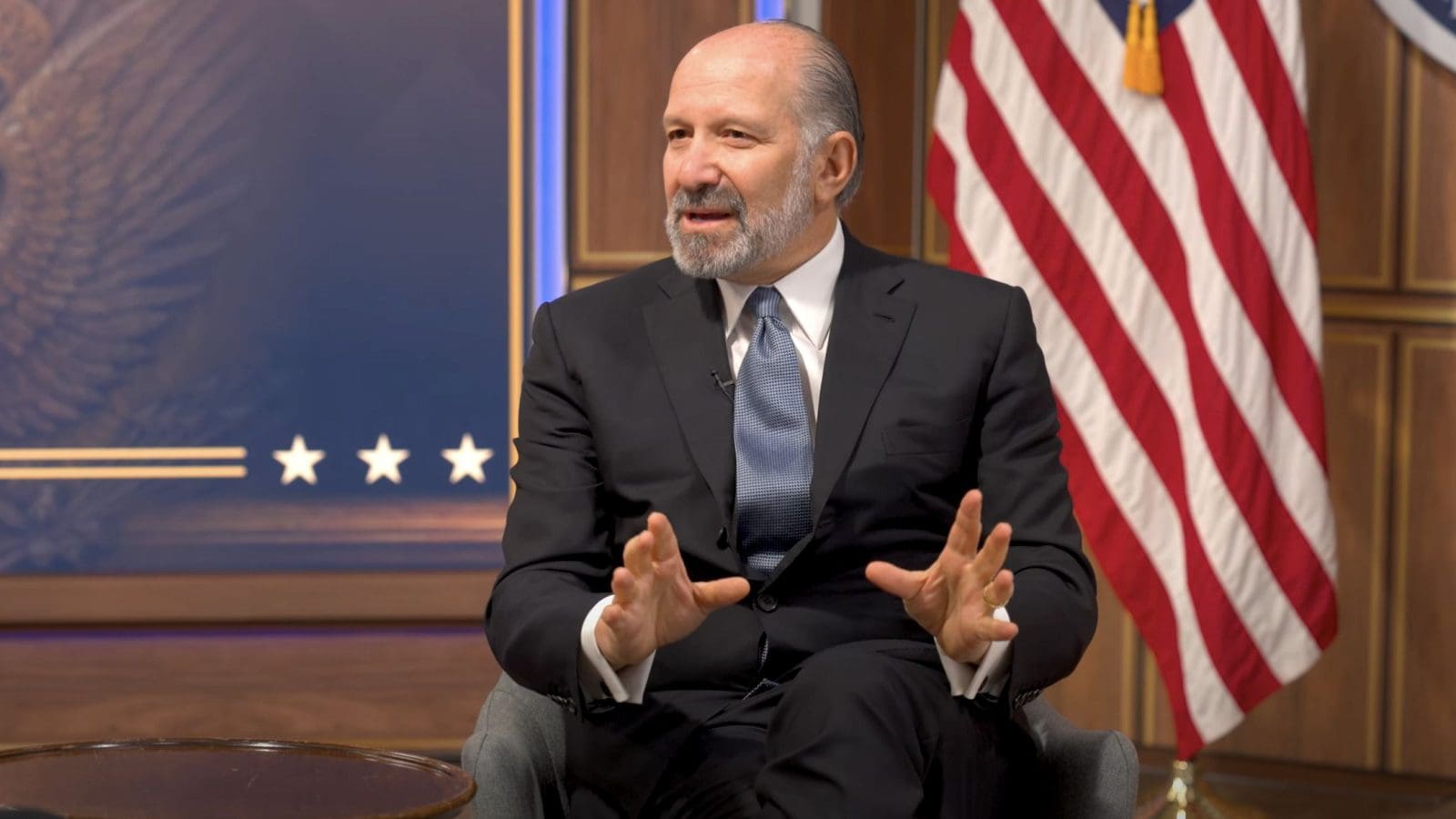
Commerce Secretary Howard Lutnick was on the All In podcast recently for a sit-down interview with Chamath and Frieberg (good choice to leave Calacanis home) and it was so incredible I have to show you the whole thing.
So many things absolutely blew my mind in here and if you have any doubts about anything in the Trump Administration (I’m not saying you do, but if you do) this should go a long way to clearing those up.
Why?
Because the level of competence here is astounding!
Remember back in 2016 when President Trump said he knew all the best people? Total killers?
I think he was talked out of bringing many of those people in by wolves in sheep’s clothing who were surrounding the President back then, but with those people gone and with President Trump having 8 years of FULLY understanding how D.C. works under his belt (let’s be honest, the man is a quick study and he didn’t need 8 years, but that’s what he got), President Trump is now fully unleashed and doing 120% of what he wanted to do back in 2016.
I didn’t know much about Howard Lutnick before he was appointed Commerce Secretary but it’s clear this man is one of those “killers” President Trump referenced back in 2016.
In other words, this is the type of guy you want fighting for you and on your team.
But many other things struck me in this interview…
First was just how far back all of the planning started from the Trump Team for this second term.
Back when President Trump was not even leading in the polls, his team was acting as if they knew he’d win and they were assembling people like Lutnick to join and then beginning detailed planning months and even years in advance!
We also learned how ideas are generated and how President Trump makes decisions, and it’s absolutely fascinating to see!
We learned how Elon Musk was recruited to join and how other titans of industry and tech giants are also being recruited to give their services and products for free to save and rebuild America.
We learned about the plan for Lutnick, Musk and Bessent to each generate $1 trillion (probably more) in a tri-fold attack on our debt and deficit and the plans to end the IRS by establishing the External Revenue Service.
We also learned who’s idea the External Revenue Service originally was….
I think this will absolutely blow your mind so please enjoy this and share far and wide so people can see the incredible fighters we have in office right now.
Here’s a short little clip to get you started….let this blow your mind: Lutnick reveals that just yesterday he already sold 1,000 Gold Trump Cards in one day!
Watch here:
🚨🇺🇸COMMERCE SEC LUTNICK: U.S. ALREADY SOLD 1,000 GOLD CARDS IN ONE SINGLE DAY
"By the way, yesterday, I sold a thousand. And they pay $5 million for each."
Source: @theallinpod , @chamath , @friedberg https://t.co/svCLwdMWks pic.twitter.com/f4BLuBoG3r
— Mario Nawfal (@MarioNawfal) March 21, 2025
Do the math on that and that’s FIVE BILLION DOLLARS Trump has already brought in!
On day one!
The entire interview is full of bombshells like this, you truly owe it to yourself to watch the full thing. I actually watched it twice because I kept picking up new gems.
Here’s one more snippet….
All the people claiming Elon and Trump are going to kill Social Security have no idea they’re the two guys who are actually going to SAVE it.
Watch this:
SEC LUTNICK: I find it disgusting when we're the richest country in the world, and some politician says, in order to save Social Security — rather than getting rid of the waste, fraud, and abuse — we should move retirement age to 70. How about no. pic.twitter.com/Ucn07K2IWe
— Resist the Mainstream (@ResisttheMS) March 21, 2025

Not only are they saving Social Security, but it’s a real possibility that we can ELIMINATE the IRS soon.
Clip here:
Commerce Secretary Howard Lutnick says scrapping income taxes could soon become reality.
— Libs of TikTok (@libsoftiktok) March 21, 2025
It’s all so good, but let’s just get right into it….
Watch the full interview here:
Backup here if needed:
🇺🇸 all-in takes dc part 2!@chamath and @friedberg sit down with @CommerceGov secretary @howardlutnick for another long-form interview 🔥
— insights from running trump's transition team
— creating @DOGE with @elonmusk
— fixing gdp
— tariff strategy
— how to sell 1m+… pic.twitter.com/mfmCdxhQvG
— The All-In Podcast (@theallinpod) March 20, 2025
FULL TRANSCRIPT:
Chamath: Welcome Commerce Secretary Howard Lutnick! Do you go to New York much?
Howard: Uh, never. I closed my house. Oh wow, I basically tricked my wife. You know how your wife always wants to renovate your house?
Chamath: No idea.Howard: So my wife, that’s like, my wife always wants to renovate my house, right? Every minute I’ve been alive, my wife has wanted to renovate parts of my house.
So we moved out once, a year and a half ago. Uh, we moved out for a year and a half about six years ago. And she only did half the house. And she still rued the day that she only did half the house.Friedberg: Really?
Howard: Yeah. So that was the deal. What I did is I bought a house wash and said, “You want to renovate the house?” She said, “Yeah.” I said, “Great, we hired a contractor.”
Chamath: Wait, you bought Brett Bear’s house?
Howard: No. Yeah, that’s a beautiful house. We can talk about whatever you want. By the way, I’m happy to talk about serious things, casual things.
Chamath: No, let’s just do this. Let’s roll because he’s rolling. You’re already running, right? He’s on fire.
Friedberg: All right, besties, I think that was another epic discussion. People love the interviews. I could hear him talk for hours.Chamath: Absolutely. Oh, he crushed your questions. I made it. We are giving people ground truth data to underwrite your own opinion. What do you guys think?
Friedberg: That was fun. That was great. Howard, thanks for being here.
Howard: Thanks for having me.
Chamath: Howard describes his 30+ year relationship with President Trump and his road from business to politics, joining myself and David Friedberg on the All-In podcast. I want to take a step back before we talk about today and instead talk about your friendship with the president—how it started, how you guys got to know each other, and walk us through the moment when you, you know, frankly went out on a limb a little bit, stepped up, became the campaign finance chair, and then just that evolution.
Howard: So I’ve known the president since I was 30 years old. I used to go on what we call the charity circuit in New York.Chamath: Sure.
Howard: So there’s basically a charity party every night when you live in New York—like the rubber chicken dinner. Literally, the rubber chicken. And so sort of every night you go out.
And the boss of my company, Bernie Canter, he got tired of going, right? So he didn’t want to go. So he would send me with his wife, and I would be her walker. You know, I’m the 30-year-old CEO of the company, and I’d take her to the party.
And after the party, I’d put her in a limo, and she’d go home, and DJT would say, “Well, let’s go out.” And so we’d go out. It wasn’t planned, but he was at the party. He’s 45, I’m at the party, 30. And we chase the same girls.
Okay, it basically worked out fine. And by the way, here’s the thing about Donald Trump: he was the most famous, the most fun, the most interesting person 30 years ago, 33 years ago.
I mean, here’s the best thing: he’s been on the cover of Time magazine 59 times.
Chamath: No way.Howard: And then he leans over to me and he goes, “And 20 were good.” Like, who can take that? I mean, who could take it? Like, other people, when you have a bad cover of Time magazine, you’d crumple, right? And be sand on the floor.
And he’s like, but so, Howard, is it that he’s just totally wired to understand that moment of being a public figure, or like, what is it that’s so unique about what constitutes the ability to navigate that over 40 years?
I think it adds energy to him. Right? So everybody else’s energy—what they don’t understand—is people bring negative energy to Donald Trump, right? And they’re just charging his battery.Okay, your energy around him comes to him. So when I come at him with a lot of energy, he comes back with a lot of energy. Right? It doesn’t matter. He never steps back. He just sort of takes it like a centrifuge and then hurls it back at you.
And he’s been that way always. So this is not new. This is just who he is. This is who he is. So those other people who attack him, they think they’re attacking him—they’re charging his battery.
They’re literally charging his battery. So he comes back bigger, stronger, bigger, stronger. And once you understand the man—the most intuitive person that you’ve ever met.
Yeah. And people say, “Well, okay, so people who know me, I don’t suffer fools.” And they have all these derogatory—my left liberal friends—all these derogatory statements about the guy, right?And they know me really well. Right? And they’d say, “Well, how can you work for him?” I’d say, “How can I work for him? The most intuitive person—he senses it. He knows it.”
He calls me up and he says, “Panama Canal.” That’s what he says. He goes, “Panama Canal.” It just feels wrong, right? And then he sends me on the quest to go—I didn’t do anything, I just start the quest to go look at it. Right?
The mouth that’s east is a deep water port by the Chinese. The mouth that’s west is a deep water port by the Chinese. They’re building bridges over it. So our ships and our military ships should go under, right?In our hemisphere, a Chinese bridge. So then I said, “Okay, let’s go prove it.” So I have a friend of mine—he owns a big shipping company. I said, “Take two iPhones, put them on a stand, and just go through the Panama Canal.”
You know, the Panama Canal, they sort of drag ships through like this. And I said, “Just go video both ways.” No, just video both ways—70% of every letter is Chinese.
Then I’m talking, like, the sides of containers, ships, the stores—like, I’m not talking like signage, just random signage, like you’re riding on a road. It’s all Chinese.
And then I do the research, and I call him back, and I say the magic words between me and him: “I have your path,” which is I’ve done it. I’ve done the legal work. I’ve done everything. Right?So when you start talking about it, you have a foundation. It’s not just you talking. So people think he’s just talking—he’s never just talking.
He has people behind him who bring him his foundational structural outcome. And then what does he do? He went and played golf that afternoon.
He called me at 7:00 in the morning. He said, “What do you got?” We talked from 7:00 to 8. He went and played golf, right? And that afternoon, there’s the American flag in the middle of the Panama Canal in some, you know, truth he puts out, right?
And that’s the fun part, right? So you work for the most intuitive guy. Yeah, unbelievably smart, unbelievably thoughtful, who knows what he’s doing. So it’s so fun for me.Chamath: Howard, let’s just go back one second. So you have this deep relationship with him. You guys are friends. Scott Bessant told us the story that about 18 months ago, though, he saw all this data about what was happening under Biden, and he was just so concerned that these deficits and debts were getting so out of control, he went to the president and said, “How can I help? Can I help?” That’s a story. But was there a moment for you that was rooted in something other than friendship—like, was there something on the ground where you said, “Hold on a second, this is a train wreck, and we need to do this?” You were the finance chair for the campaign.
Howard: Well, no, I wasn’t the finance chair. I was the transition chair.Chamath: Transition, okay.
Howard: So I ran transition, which we’ll talk about. But so, let’s go through. So I’m friends with him, right? But I’m building my business—young guy building my business.
And then 9/11 happens. Yeah. Okay. So I’m friends with the guy. I’m just friends with the guy. But then 9/11 happens—kind, sweet, calls me all the time. Just good human being. Nice, warm, caring, good human being. Right?
But then I’m knocked out. So what do I do next? I try to rebuild my company, take care of the families of 9/11. You know, I lost 658 people who worked for me.
And we had a policy: we want to work with people that we like. So when we had an opening, we didn’t use headhunters. We would say to everybody at the firm, “Does anybody know anybody who’d do this job?”
No. And so, you know, a young lady works for me says, “You know, my best friend is an HR person.” They have to have capacity. Yeah. But once they have capacity, imagine we hire that person.ADVERTISEMENTYeah. Now what happens is, it’s not one big happy family. Yeah. But people really, really care about the company, and that’s our company—that’s on the top five floors of the World Trade Center on 9/11 when the plane hits it.
Kills everybody at the office. My brother Gary—he dies at 36. My best friend Doug—he dies at 39. I had just turned 40 that summer. I had a party—65 couples. It’s my 40th birthday.40th birthday. Yeah. Right? 27 people at my party get killed. Jesus. My friends. These are my friends. So I’m driven to take care of the families of the people who died.
And I commit 25% of all of our profits. But the company’s destroyed. So we go from making a million a day—I was a rich guy, right? What’s the definition of a rich guy? No personal debt, no corporate debt—Canter Fitzgerald, no debt.
So how do you survive 9/11? If you don’t owe anybody any money, the only money you’re losing is your money. So we survive, and we take care of our friends’ families, and then we build the company back up.
So you could see, like, I’m a special guest on the Celebrity Apprentice, the first season of Celebrity Apprentice. Piers Morgan wins.
Chamath: Did he fire you?Howard: No, no, I wasn’t a contestant. I’m a little beyond being a contestant. I was a special guest. I’d come in—like, if you see during the auction, I’m standing next to him at the auction, you know, and I’m helping him.
Like, I’m just his friend, sort of as an extra all along the way, you know, every once you kept the friendship going as you’re rebuilding.
We’re friends all the way, but I’m rebuilding my company. Yeah. And then, so I’m not interested in politics. Okay. I don’t do anything in politics because I’ve got my head down. Right?
We had the financial crisis—Canter Children’s great in the financial crisis. Had you ever donated to candidates at all or not?
Yeah, New York candidates. Okay. Right, New York. So think about it—you’re in New York. You try to pick social liberals, fiscal conservatives, right? If that even exists anymore. Right?But if you’re in New York, you have to pick. And look, I grew up in New York, so I’m socially liberal. What else could I possibly be? Yeah. So, you know, early when Chuck Schumer was young, before he became what the president now calls a Palestinian, you know.
You know, I raised him—you know, I raised him money and gave him money. Donald Trump gave him money.
Chamath: Same. I did too.
Howard: Yeah, I mean, because he was—he was a social liberal, fiscal conservative, and so I—you know, we’d all give to those kind of candidates, but mostly giving to get along, right?
And to be able to, you know, ask him a question if you needed to ask him a question. But there was really no—I had no drive, right, in that.
Like I said, the first four nights I slept in Washington in the last 20 years—when Donald Trump was elected. I had never slept here. I’d come down, visit a little, go home, go home. What am I staying here for?So he calls me at the end of October ’23. Okay. So he’s already had his first term. You didn’t support or get—
No, I was—so I gave him money, and I gave Hillary money.
Chamath: You gave Hillary money in the first term?
Howard: Yeah, because Hillary was incredibly helpful to me post-9/11. Remember, she was a senator, right? And New York needed help, right?
And Hillary was incredibly helpful, and I was driving the team to help New York rebuild because I had relationships with a whole bunch of congressmen, and they were going to do nice things.
Like Bill Young ran House Appropriations, right? Bill Young was my friend, right, through a whole variety of things that had to do with—I used to go to Bethesda Naval Hospital, and I used to walk around, and I would bring music there for the men who got hurt from the military who were in Bethesda Naval Hospital.
And we would walk around. I’d go with my wife, and then I would engage the young man with music. I’d give him music and ask him what CDs he wanted—this is when CDs were there—and I’d bring up a Walkman.And my wife would pull the family outside, and she’d pay a year of their mortgage and all their expenses because what people don’t realize is your son loses his leg, right?
Dad and mom come flying in, and they’re going to stay by his bedside. What job do these people have that allows them to be at their son’s world? And their world is falling apart ‘cause their son lost his leg.
So the world is falling apart, but at home, their world is falling apart—falling apart. And so my wife would just try to figure out how much money it was and just give them a check. Yeah.
And no form, no nothing—just give them the money. Yeah. And help them. So I would bump into Bill Young and his wife, who were—they were just—they ran defense appropriations, and they were there just being good human beings.
And so we became friends. And he said to me once, he said, “Is there anything I could ever do to help you?” I’m like, “Look, you’re like a congressman from Florida who does defense appropriations, and I’m like a Jewish guy from New York who’s in finance.”
If there ever were two skews that were never going to meet, these are two ships going, like, right—we got nothing. So I said to him, “Look, we’re just going to be friends, right? We’re never going to do anything.”And then he runs House Appropriations. And so when New York needs money to rebuild after 9/11, they go see Bill Young to try to get a bill passed. And he said, “How can you come see me without Howard?” Yeah.
You know, this is post-9/11. So I’m running New York, and Hillary does a really nice job. Okay. For New York. Yeah.
And I told—I told DJT—I call him DJT because I’ve known him for always—I said, I told him that I can’t forget. Yeah. I’m just not the person who’s gonna forget.
Of course I gave him money, right? But I give it—and by the way, he still tortures me for it. So, like, and you know what the best part is? A good friend does. Yes. Right?
You know what the point is? See, other people would sort of curl back. Yeah. Right? So here, right after he gets elected, okay, here’s a story for you.
So right after he gets elected, he has a dinner in New York, right? So he invites me to the dinner in New York ‘cause I’m his friend. And then, while he’s giving his talk to his first dinner in New York, he goes, “Wait, wait—Hillary’s supporter,” and he points at me, right?So I stand up, I go, “Hey, everyone,” and I sit down. You know, he’s just sassing me, okay? ‘Cause I gave him tons of dough. He knows I love him, and it’s fine.
Okay, so we’re 2023. So we’re 2023, and he calls me, and he says, “Will you help me?” Yeah. And I had not thought politics.
Now, I gave him money in 2020 re-election. Yeah. Probably gave him 10 million bucks. I raised him 15 million bucks. So I was, you know, once I’m on a side, the whole way through, I’m raising him money in ’17, ’18, ’19, ’20.
While he’s president, I’m totally on his side. Yeah. And I’m—but I’m just his friend. I’m not engaged. Yeah. Okay. Because I’m still rebuilding my life. Yeah. Okay.
And then 2023, he calls me, says, “Will you help me?” And I actually thought about it—like, and that was the first time I really thought politics. And then I said, “Yes.”
And I gave him 10 million bucks right then and there. And then I started talking to him. I started going on the campaign trail. I started doing research. I started doing knowledge.I wanted—I talked to him about everything. I talked to him all the time about everything.
Chamath: Did you love it? ‘Cause our friend Sachs—we were talking at dinner last night—he seems to love it.
Howard: Like, there’s nothing not to love. As Donald Trump says, this is a thousand Super Bowls, right? For him, and for me, it’s only a hundred Super Bowls.
I mean, if you’re dedicated to America and you’re willing to wear America’s clothing and to stop worrying about yourself and only care about America—yeah—and have no objective post—
The president hates when these people have, like, they raise money post from people they’ve met in here. So I’m never going to work again. Okay. I’m never going to work.
This is all I care about—I’m just going to help America. So he asked me to help him, and I start thinking about it. I start studying everything, and I read everything, and I read everything about the White House, and I read everything about everything I can possibly read because I’m just that way.
And then I start helping him. Yeah. Right? And I went to learn how he picked the judges, right? And the Supreme Court, and why it didn’t.And I’m just very detailed. And so I started studying what transition is, right? Right. And I started studying it, and I started studying tariffs ‘cause he wanted to talk about tariffs.
And he’s always thought the trade deficit was wrong and basically a ripoff of America. And I started studying everything about it. Yeah. And so he and I would talk about it, and we knew everything about it.
And then he picked me to run Transition. Okay. So we’re going to talk about tariffs in a sec, but so, double-click into Transition. What did you find that was so interesting? Like, what’s—
I’ll give you an example. So there’s a book called The Gatekeepers that was written that people gave me—“Oh, you should read this book.” And it’s about chiefs of staff. Okay.
And basically, there’s another way to call it—it’s called The Jerks, right? Because what they do—imagine you’re the gatekeeper. Yeah. You’re the gatekeeper of what? Yeah—of the man who was elected president of the United States of America, that he needs the gates kept from him.
And if you listen to Nixon tapes, you hear him scheming to try to learn anything because what happens is the chief of staff—everybody reports to the chief of staff, and the chief of staff reports to you.So you can’t get on Air Force One without asking the chief of staff. You can’t get a document unless you have the chief of staff. No one can come see you unless you have the chief of staff.
And if they take your phone away, you know what you are? You’re imprisoned. And that’s the gatekeepers. So I said to Donald Trump, I said, “Look, you fired Reince Priebus, who was your chief of staff.”
Then you fired John Kelly as the chief of staff. Then you fired Mick Mulvaney as chief of staff. Then you would have fired Meadows, but you didn’t get a chance ‘cause the next election.
So I said, “Why don’t you fire the job? What you need is a chief of staff who’s actually your chief of staff—not who’s the gatekeeper.” Right? Right.
And so that was an example of how I changed it. And so Susie Wiles is perfect for Donald Trump. You know why? She lets him be him.
John Kelly took away his phone, right? So he couldn’t communicate with anybody. Whereas Susie embraces who he is, helped him get elected, ran a great campaign—she’s perfect for him in this role.And so that’s what I brought. So I brought an understanding of him, right? And an understanding of the role, right? Right.
And that’s why I convinced your friend David Sachs. Every time he said, “I can’t do it,” yeah, I would call him and say, “It’s an emergency. It’s an emergency. I need to see.”
He’d fly and go, “What is it?” I go, “You need to join the administration.” He goes, “That’s what the emergency was?” I go, “Of course.”
Chamath: And was—and Howard, was that when you conceived originally DOGE in that initial—was that during the transition?
Howard: All right, so DOGE, yeah, we should talk about DOGE and tariffs. Okay, so DOGE comes—it’s October of, uh, before the election. Okay. Early October—October 2024.
October 2024. Yeah. Like the beginning. Yeah, of October 2024. And I called the president, and I said, “I need, uh, I need to spend an hour with you because I have my big ideas.” Yeah. Right?
So he gives me—he says, “Look, I’m not sure what to do October 7th, right? Why don’t we figure out what I should be doing October 7th?”So we decided we’re going to go out to the Ohel, which is, uh, a super religious, uh, Hasidic Jewish, um, Messiah—you know, the people who wear black hats think he’s the Messiah.
And they have a crypt for him where you write a note and you put a note in. All right. And so we agreed we’d go out to that gravesite, and we’d probably win 60,000 of those kind of voters, which is pretty cool for a day.
And then we drove there and back together, the two of us. So I had an hour and a half, just he and me, talking. And I said, “I want to balance the budget in the United States of America.”
And this is the way we’re going to do it. We—no one’s ever checked the just under four trillion dollars of entitlements. Every politician thinks what you have to do is you have to take the retirement age from 65 and make it 70, right?
And you have to do this and this and this and this because they never think about the money. Totally. But people like us totally would say, “What’s the first thing you do? What’s the value I’m getting for my money?” Totally, right?
And what you find is, if nobody ever—like, as in ever—like, I could say the word “ever” 12 times—has looked at where the money goes. Totally.And so there’s not even a process to get it back when you send it to the wrong person. You just send another one out. Yeah. Like, think about it—you just—
Well, I sent it accidentally—or accidentally—notice how it’s “accidental.” It’s always accidentally sent to the wrong person. Really?
You wouldn’t ever say the 5.9 million people who work for the government—there could be some crooks in there, right? No, no, no—it’s all accidental.
What a load of nonsense this is. There’s some percentage of this—but you would say—and you would say, “No, just zero-base it and let’s figure out where it’s got to be—25%.” Yeah.
We’d all say, “If it’s never been checked, how could it not be 25%?” How could it not be? And the answer is, that’s a trillion dollars a year, right? Okay.
So I said, “I think we’re going to cut a trillion dollars a year in expense, and then I think we can, through tariffs and other means, we’re going to get revenues—have a trillion dollars incremental revenue—incremental revenue—and we’re going to balance the budget.”But all—but, sorry, let me just ask one question—how do the tax cuts, the extension of the tax cuts—there, they’re—there is zero basis that means where I was yesterday and where I am tomorrow, like, “Oh, it’s a tax cut.” No, it’s not.
It’s the exact same thing as yesterday as today. To say continuing yesterday tomorrow is, like, silly.
Chamath: So let me ask you—let me ask you on tariffs. Having studied it yourself, when there’s higher tariffs, people purchase less—things cost more.
Howard: No, we’ll talk about tariffs. Let’s—let’s just finish—let’s just finish, uh, DOGE. So I’m in the car with him, right? And I said, “We’re going to balance the budget.”
And I said, “I have one favor to ask of you. If we can balance the budget for you, will you agree to waive all income tax—I see—for every person who makes less than $150,000 a year for the United States of America, which, by the way, is about 85% of America?” Right? Right.
And the reason you want to work for Donald Trump is he looks at me, he goes, “Sure.” You realize the president of the United States said, “If you balance the budget, sure.”
And he’s not lying. He’s not kidding. He’s like, “Yeah, that seems—that seems like a great idea.” Right? Right.
And so—and then I tell him, “Okay, I’m going to go recruit Elon because Elon’s all in.” Yeah. Right? He’s already said he’s all in. He’s already said he’s going to Pennsylvania. Yes. Right?So I call Elon, and I don’t know Elon. I don’t know. But he’s perfect for this. So I use my superpower, which is I call everybody else I know who knows him, and they arrange, and I’m texting with him, and he agrees to meet me on October 14th.
So I fly down to Brownsville, Texas. Uh, he’s going to catch the rocket on October 14th. Right? So that’s what he invites me down for—the rocket catch. That’s right.
Having nothing—he’s not inviting me for the rocket catch. He’s just inviting me down—that’s a good day for me to meet him. So I fly down. I see the rocket catch, which is awesome. Yeah.
Awesome, awesome, awesome, awesome. And then I expect to meet him. By the way, very pivotal day in the campaign, if you remember—Biden sort of didn’t pay as much attention to it.Trump was pretty engaged. Elon was supportive of Trump. So when he actually caught the rocket, the media was almost, like, frozen, waiting for it to fail, and it didn’t fail, and it worked, and it was just incredible.
I was waiting for Elon. Okay. So I flew down to see Elon, and, uh, with my son, and, uh, so we watched the rocket, right? And then they say, “Okay, he’s gonna go hang out with his engineers and party with them.”
Seems reasonable—it’s, like, an hour, hour and a half. And then he just goes dark. You’re still waiting—I’m just sitting there waiting.
And then they take me, and I go to, like, the equivalent of a Margaritaville, you know, where you have, like, a basket, and you can get quesadillas and get—and you get a Diet Coke in a red sort of plastic thing that’s about this tall.
It’s got, like, 4,000 ounces of Diet Coke in it that comes with this big—but now, to his credit, he sends me all the executives from SpaceX are hanging with me, but he’s dark.And what happened is he took a nap. He was up all night doing the engineering, and he went to sleep. So then when he finally wakes up—so I’m just sitting there, like, you know, doing the, like—I don’t know him really.
So I’m just doing the thumb twiddle. I’m going, “Okay, you know, this guy’s got a couple—I’m hoping he sees me,” right? So then he wakes up. He says, “Come to my house, right? I’ll see you in my house.”
So his house is 1,200 feet. It’s got the furniture in it that I had when I graduated from college. Yeah. Right? Okay. I’m not kidding. I’m not kidding—it’s 1,200 feet, and it’s got the furniture—plastic chairs—and—
Okay. So I say, um, “We’re going to balance the budget. I need to cut a trillion.” He’s like, “I’m in.” He says, “I think we should cut 80% of the federal government because the essential employees—if the government shut down, essential employees are 450,000.” Yeah.
Okay. And there’s 5.9 million people who work for the government. How can 450,000 be essential, and there’s 5.9 million? So he says, “Like Twitter, I think we should cut 80%.” Yeah.And I say, “I know how to cut 50.” And he says, “I want to cut 80.” I said, “I know how to do 50.” He goes, “Are you with me or against me?” I go, “I know how to legally do it. What do you have?”
And my son says it was like two alpha dogs just, like, fighting with each other for the first half hour. And then—and then, um, so then X comes in, right? And then he’s got to walk X—he’s got to walk his son X out.
So he walks his son X out. And I’m thinking maybe the meeting’s over, right? Because we’ve been together a half hour, 40 minutes, and maybe it’s over because he got up and he walked out.
He comes back, and he sits down. He goes, “Har, this meeting is right.” That’s what he says—this meeting—and we sit down, and we map out the plan.
I tell him what a gratis vendor is. Yeah. Because I designed—‘cause I was not going to go into the government. I was doing transition. What is a gratis vendor?
A gratis vendor is, uh, an approved vendor for the United States of America that gives product to the government—doesn’t sell it. Okay.
So therefore, I don’t have to go through the whole process of becoming a proper vendor because you’re giving it to us. And then if you give it to Article Two, which is the president’s stuff, then the president can accept it, right?
Because it’s—sorry, how—what’s an example of this? Like, just to make—I write some software. You write some software. I write some software for the Commerce Department to do a better job of XYZ.Mhm. You just give it to me, and then I do QA on it, and I can take it. If you sell it to me for $1, we go into government hell, right? The whole rigmarole, right?
But if you give it to me, right? And then I set up—you know, so I said, “I’m calling it DOGE, and I registered the name DOGE.” You said that, of course.
And were you familiar with Dogecoin and Elon? It’s Elon. So what happens is, in the Defense Production Act in World War II—yes—in order to get all the great executives—yes—of America to help with production, they named everything after jazz singers or the things that—of the people who were on the committee—that it would make them laugh and smile. Okay. Right?
So I picked DOGE so he would laugh, and he said, “Get the f out of here.” Like, when I said we’re going to name it DOGE—the Department of Government Efficiency—which I didn’t think of. It was on the internet, sort of floating around in June. Yes. Right?
But I literally registered it, right, as the Department of Government Efficiency—like, make it a real thing—as a gratis vendor. And I said, “This is how I’ve done it for me.” Yes.So that I can run Cantor Fitzgerald, you can run SpaceX, right? You’re not—you don’t have to sign the conflict form and all this stuff because you’re not working for the government. You’re just giving stuff to the government.
You are literally giving of yourself, right? But you’re not looking for anything. You’re not taking any money. You’re not owning anything. You’re not doing anything. You’re not on that side of the wall—you’re on this side. You’re outside. Yeah. Right?
And so we had fun. We talked for two hours. And then on my Twitter feed, I took a picture of me and Elon outside, and I put up, “Welcome to DOGE. We are going to rip the waste out of our $6.5 trillion government and balance the budget. We must elect Donald J. Trump president.” Yeah. Right?
And I posted that with my—I probably at the time had 25,000 viewers, and I got 45 million views. Wow. Right? So it was me and Eli. Yeah.
And that was the beginning of DOGE. Yeah. Right? Then I ran transition, which is—so for the transition, we had—I had a room in Mar-a-Lago. Yeah. Okay.
Big conference table in the middle, four 85-inch screens on one side and mirror four 85-inch screens on the other side, so that you and I could talk to each other.
So the president sat across from me. Yeah. Elon sat—oh, and then I’ll tell you one other story about Elon. So he wins the election—president wins the election.
He accepts it, like, Wednesday at 2:00 in the morning, right? Elon’s not on stage. If you see, I’m on stage. Elon’s way in the back of the room.
There’s a thousand people in the room—2,000 people. He’s way in the back. He goes home. Thursday afternoon, I call—I’m doing a dry run of the launch of my transition, right?
And the president is superstitious. He’s never had one conversation with me about transition. He totally trusts me. He wins the election—now he’s got to look, you know.
I said on—Jess—he hasn’t talked to you ahead of time about who—about one job, about one thing. So until the election—because he’s superstitious, like, “Don’t waste your time. Don’t jinx it,” right? Just go win. You got to go win.So what happens is—so I’m doing a dry run. So I call Elon, and I said, “Where are you?” He goes, “What do you mean? I’m in Austin, Texas, or whatever.”
I go, “What are you doing? I mean, what is the point of you spending three weeks living in Pennsylvania, helping the guy get elected, if you’re not going to help him pick the cabinet? Like, come on.” Right?
Because the way President Trump works—he makes decisions by orchestra. He likes lots of views and opinions. He likes them.
And anybody who says, “Oh, the last person who sees him gets them”—that’s because they don’t know him at all. Right? Right. The answer is, it’s an orchestra. Right?
And I would say, “Okay, I’m the first violin,” you know, at the time. I would say I would describe myself as second violin. Yeah. Right? So this is an orchestra.
So the president’s not going to make a decision with me and him alone. Yeah. No, no. He’s gonna have—so he—so it went like this: president sitting across from me, right, at the conference table.
Elon to his left, Susie to his right, right? J.D. to my left, Linda McMahon, who was my co-chair, right? But she wrote all those EOs that he did—that was—she was responsible for—and I was responsible for personnel, but she was with me for personnel.ADVERTISEMENTSo she’s sitting to my right. J.D. sitting to my left. Don Jr., right? Stephen Miller—and he—there was always 12 people in the room. They were never, like, me and him hushed in the corner doing this and that. Never.
And what we would do is I would put eight candidates on one screen. Right? Right. And then—big candidate on each screen—most beautiful AI picture you’ve ever seen. Right?
And people would walk in and go, “Where’d you get that photo?” I’m like, “What do you think I did? I took three of your photos.” I’ve heard secondhand stories of this room during the transition—that you walk in, and everyone’s photo is up on the screen.
Everybody’s in the room. And so that’s a candidate for a role. And then you guys would debate it. And so what happened was—a big picture of the person, yeah—their key highlights of the resume—not boring—their education, right?
And then you would click a button, and you’d see them speaking—20 seconds at a time—four of them, right? So it’s about 80 seconds, and you’re not speaking about the job—just, like, how do you present? Totally.
And what you can see is his whole cabinet can talk. Totally—all of them. Totally. Because he picked them knowing, “I need you to be able to talk—to be able to present our ideas and our concepts out there,” and that’s key to him.
And what I would—the way I would joke to people is say, “How do you do it?” I go, “Watch—pitch. So you throw him a curveball, he wouldn’t swing. You throw him a fastball, he wouldn’t swing.”You throw him a slider—he hits the ball, hits it to my glove. I go, “Here you go.” You go, “Well, how do you know that?” I go, “Because I know the guy for 33 years. I know what he wants.”
And he loved the process. And you know what happened? You saw what happened, right? First—eight candidates, 12 jobs—national security. Okay.
He says, “What do you want?” I go, “Eight to four.” I put up eight candidates. I recruited everybody—I had 150 of the best Republicans in the United States of America.
They each gave me five people, who then gave me 10 people. I had thousands of people to pick from. The whole government was set up to pick from. And then we picked candidates—I had eight for every job. Yeah.
Eight, eight, eight, eight—8 to 4. That’s Friday. Sunday comes in—4 to 2 in the morning. I fly everybody in for the two. I prep them. We go in and meet them.
Two to one—final interview. Give him the job. Wow. Bang, bang, bang, bang, bang—Monday. Monday—we’re done with national security. Okay.
Now we’re rolling on. And it just pounds out. Why? Because he had every candidate. Everybody knew it. Everybody was prepped. Everybody was aware. Everybody was done.You know, that’s why I had to beat the heck out of David Sachs—because I needed David Sachs to be in the government. I recruited David. I pounded on David.
You can ask David, right? I beat him and beat him and beat him until he finally said, “Okay, I’m going to do it.” Right? And I did that for everybody. Yeah. Right?
And I made sure he had the greatest choices. And then every once in a while, he would call me at night and say, “Throw this guy in. Throw this guy in. Throw this guy in.”
We did a vet on everybody. But I didn’t take out anything negative—I am not a negative person. You can tell—I’m positive. So why would I discuss anything negative about any candidate until I get picked?
There was no game theory. A lot of people speculated there was game theory—that we’ll put a mix of people that will assume some won’t make it out of committee, and then we’ll end up with the ones that we do want.
Everyone was the number one choice—only one, only one, only one. And that was Matt—Matt—what happened—what happened with Matt, Howard? How did that process—
He was tortured by his attorney general in the first term, and we were not going to have that ever again. Right? So we needed strong backbone, strong capacity—of which Matt Gaetz has it. Yeah.
And I know Matt Gaetz, and he has it. Right? But we did not know what that vet was going to say from that report from Congress. So here was the idea: we fight for him, and we fight for him to get through, and then we read the report.
The report’s not bad. Remember, the president’s been tortured by people blaming him for stuff that never happened—“Oh, 30 years ago, he raped this woman in the dressing room of Bloomingdale’s.” I mean, what a load of crap, right?
It’s just not true. None of it’s true—it’s ridiculous. So he comes at this saying, “I know you’re going to get tortured with ridiculous,” right? So then he says, “If it’s ridiculous, then we support Matt, and if it’s not, we have Pam right here right now.”
So that was lined up so that everybody knows it’s right here right now. And it’s 3D chess. So we read it—Pam. Okay. It’s, like, Pam in a hundredth of a second, right?
And Pam is a rock star. And you could argue that you would say, “Well, why didn’t you pick her first?” You know what? He’s the president. He plays 3D chess. He did it his way.And you know what? But there was no candidate up there—yeah—who wasn’t right. Yeah. Right? And we could talk about all the detail and how we thought about it—what it went—but it was so thoughtful, so intuitive, and so right.
And what does it produce? The greatest cabinet ever—the most capable, thoughtful, best able to communicate. I mean, it’s so fun to be in a room with these people because these are world-class people—the best ever in government.
We shouldn’t betray confidence, but I mean, we were in a room earlier this week with several of them, and everyone had a moment to speak—it was unbelievable.
I mean, look—every single one of them, you’re like, “Could have been a leader of the country.” Like, they’re all great. That’s the point—he picked—he picked greatness.
Now, I was the recruiter. So I was a recruiter and chief, but I can understand why now, by the way—well, but think about it—if you take someone like me, yeah, and you say, “Just be a headhunter.” Yeah.
I swear to you, I can be the greatest headhunter ever to live. Because think about it—what’s the odds of saying, “Okay, Howard, your whole job is just be a headhunter—find the best guys.”
I promise you, I’ll be really good. Okay.Chamath: Can we go back to DOGE? So you talked about the gratis vendors—maybe there’s other stuff that you can do with executive action—the president can do with DOGE, etc. Can we talk about congressional budgets? How do we actually balance a budget without bringing Congress along? And is the plan to bring Congress along?
I’ve asked this of Bessant—I’ve asked this several times since we’ve been here—and it’s the thing that gives me the most heartache and the most headache—is I worry about whether this actually gets there, given congressional interests.
Howard: I think Congress works with something called scoring. Yeah. Right? That if it comes from their pen, it counts. If it doesn’t come from their pen, it doesn’t count.
But the fact is, money always counts. It just doesn’t count for their scoring. But their scoring is only part of the game, right? The outcome of the game is what matters to me, Elon, our cabinet, and Donald Trump. Okay.
The outcome of the game. And I’m telling you, the outcome of the game—by me and Elon. Now, a funny part of it is—so I invite Elon to Madison Square Garden.
He doesn’t want to leave Pennsylvania, right? Because, you know, Elon—he’s committed to Pennsylvania. Yeah. So I convince him—he’s got to come, and we have a plan.
I’m going to say to him—so I—everyone else gets introduced by the voice of God. I’m the only one who introduces Elon. So Elon comes on stage with me.
There’s the two of us on stage in Madison Square Garden—the only time the two of us are on stage. I’m the fourth speaker. He’s the third from the end.
J.D. is second from the end, and Donald Trump is last. Okay. So he’s supposed to say—when I say to him, “How much are you going to cut?”—the deal was he’s going to cut $1 trillion.And then he’s supposed to say, “And how much are you going to earn?” And I’m supposed to say, “$1 trillion.” And then we’re supposed to say, “Together, we’re going to balance the budget of the United States of America.” That’s the little sort of thing.
So I ask Elon, “How much you going to cut?” And he—because he said—he said two trillion. Well, because we’re in front of 22,000 people, and the place is erupting—he says two trillion.
And then I’m sitting there going—and I’m like—I think I said, “All righty then,” or something like that, you know—like, what was I supposed to say, you know?
So later—when he walks back to a trillion—no, you were—you were caught off guard—but I mean, it’s quite—how much you going to earn? No, ‘cause he said two trillion—I got it all, don’t worry—like, I said, “All righty then,” and that was that.
So then I walked off stage, and, you know, he said two trillion, so, like, what am I going to say? But the answer was always, right, that 25% of the waste, fraud, and abuse is a trillion dollars, right?
And he’s got to cut and find the waste, fraud, and abuse of a trillion dollars. Okay. Okay. And that—my job is to raise $1 trillion of exogenous new revenues—new revenue—for the government.And we—right—I’m telling you, I’ve been here now two months. Yeah. Right? I am more confident it’s going to happen and more excited.
Chamath: Tell us how it happens.
Howard: Well, hold on a second. So, Howard, let’s—let’s finish this, and then we’ll move to tariffs and revenue generation. So there’s a lot of domestic terrorism—is that the response to try to slow down the expense side of the house?
Is it—is it basically to put fear into people that are trying to find this waste and fraud? Is that—is that what that is—the burning of the dealerships—the—
If you’re—I describe it to people this way: let’s say Social Security didn’t send out their checks this month. My mother-in-law, who’s 94—she wouldn’t call and complain. Mhm.
She just wouldn’t. She’d think something got messed up, and she’ll get it next month. Yeah. Mhm. A fraudster always makes the loudest noise—screaming, yelling, and complaining.And if all the guys who did PayPal—like, Elon knows this by heart, right? Anybody who’s been in the payment system and the process system knows—the easiest way to find the fraudster is to stop payments and listen. Yeah.
‘Cause whoever screams is the one stealing. Yeah. ‘Cause my mother-in-law is not calling—I mean, come on. Your mother—80-year-olds, 90-year-olds—they trust the government.
They trust—okay, maybe it got screwed up. Big deal—they’re not going to call and scream at someone. But someone who’s stealing always does.
So what happens is, we need to get to—so the people who are getting that free money—stealing the money, inappropriately getting the money—have an inside person who’s routing the money.
They are going to yell and scream. But real America is going to be rewarded because—here’s the key benefit of the doubt—not one penny should stop going to—we’re the richest country on earth. Yeah.
Here’s the way I say it—I said, “We have—we have a $6.5 trillion budget. We have $4.5 trillion of revenues.” Yeah. Okay. We lose $2 trillion a year.
We have a $29 trillion GDP, right? Which people don’t understand, and which I’ll explain a little bit. And we have 36 trillion in debt. Yeah.
What number didn’t I say to a business person? What’s our balance sheet worth? Right? Right. I say 500 trillion. Right? The president says a quadrillion.
But at 500 trillion or a quadrillion—36 trillion—we’re rich. We don’t have to take one penny from someone who deserves Social Security—not one penny for someone who deserves Medicaid, Medicare.What we have to do is stop sending money to someone who’s not hurt, who’s on disability for 50 years—it’s ridiculous—and they have another job.
And do we have to monetize our assets? We—we need to be smart. That’s all we need to be. And I’m going to tell you things that are just smart—they’re not, “Oh my God, this is the most brilliant thing ever.” This is just smart.
There are so many smart things we can do—like, you know, we’ll talk about the post office, right? Think about this—the post office has 625,000 people who work there, and they go to your house every day.
You know what the census does? The census hires 625,000 people, trains them, teaches them, has interviews—2 million people—trains and teaches them, hires cars. How about this—you’re genius.
That’s pretty smart, Howard. Right? Okay—like, obvious, right? But here’s what it is—I’ll tell you what I’m—I’m really good at pattern recognition. Okay.
Here’s one—like, tell me 625 of one, and I can point out 625 of another. This is the genius I bring to the government—seriously, this is—this is core fun.
By the way, you’re responsible for all the core data collection as well, aren’t you? Isn’t Commerce responsible for generating a lot of the GDP—for economic—
Oh, that’s—I get to talk about GDP and how I’m going to—how I’m going to clean up the nonsense in GDP. You know, I can explain that—if you make a tank, and someone buys a tank, that is GDP. Yeah.
But a thousand people thinking about buying a tank, right, who take your tax money, and I give it to them, and they go, “I wonder, should we buy a tank or not?”—that’s not GDP, right?You’re saying government spending should not be counted in GDP? No—government spending to buy a tank, right, should be, right? Government spending that’s nonproductive—nonproductive.
This is so important—I don’t think—I don’t think a lot of people realize this—how—how much of GDP is nonproductive government spending?
How about we do one thing? Yeah. GDP—D means domestic, P is production—domestic production. It’s not consumption. Right?
If I go out and buy a Toyota, right? Right—that’s not GDP. Right? If I buy a Chevy that’s made in America, that’s a D. Right? So people think it’s, like, a consumption model, right? That’s not it.
And you could check—another one is—is there’s gross domestic income, right? That’s also good. So, by the way, they’re about—they grow about the same rate—it’s kind of fun.
So the key for me is to take out the part that—if I cut nonproductive—a million government employees who are nonproductive, meaning they don’t make tanks. Right? Right.
If I take that out, it’s going to look like our GDP declined. But you’d say, “But what really happened?” No—our expenses went down.Chamath: This is so important, by the way, because people talk about a recession, and a lot of people create a lot of red lights and alarm bells about, “We’re going to go into a recession if we cut all this spending.”
But the follow-on effect of cutting nonproductive spending is that the workforce and those dollars flow into more productive parts of the economy—where we make more things, we create more jobs, we create higher wages.
And that’s the theory that you guys are trying to execute against—I don’t think a lot of people in the general public fully understand that—is so important to kind of explain and get across here.
Howard: Okay—if we put three people behind us, and they sat behind us, and they did nothing, and each of us gave them $125,000—just like this—here you go—and they just sat there, right?
What is that, right? That’s not GDP. That’s actually me taking my money and giving it to them—we produced nothing. We’ve no purpose on the earth—it was my money.
The income, however—I earned my income—was mine, and I just gave it to them. They didn’t really earn income—it’s really a transfer pricing model that is currently considered in GDP, and it’s nonsense.
So if I stopped paying them, okay, right? What would I do? The first thing you’d say is, “Well, then why am I paying so much tax?” Bang. Okay.ADVERTISEMENTSo now we’re in the concept of—where, Howard, do you have an intuition on what the actual GDP number is—I’m sure you—if you take out nonproductive spending—yeah—but I’m not going to talk about it until we release it because that’s the proper way to do stuff. Got it. Right?
But—and I’m going to break that out—I think it’s 25%, and I’m going to break it out, and I’m going to break it out for the last 20 years, and what you’re going to see—15%—every time—the quarter just before an election—all the government spending happens right then and there.
And all of a sudden, you have this jump in GDP, right? Total lie, right? Total lie—they basically—they just take all this money, and they jack it into the quarter so that we have that, and you’ll see it.
It goes whoop—and then—what do you think the first quarter is? Whammo—or the second quarter is whammo—why? Because you pre-spent it. Right? Right? Right.
And then you have this whole—and it’s—it’s gross. Yeah. Okay—that’s the only way to us—you’re like, “Really?” But it’s so manipulated.
Chamath: Let me ask—and the answer is—I mean, and to your point—the game that’s being played is we’re going to take taxpayer dollars that people don’t understand—once you give it to the government—we’re going to create these waves of fake growth that try to tip elections so that then the grift and the waste and all the fraud can then continue for as many years until the jig gets replayed over and over again.
And it seems like the buck is stopping with you guys because you’ve exposed it.Howard: It’s going to—and that’s the idea. The idea is to take a trillion of waste, fraud, and abuse out—yeah—and then make a trillion from having other people—resetting global trade—and once you understand global trade and how it makes sense and where it came from—yeah.
Chamath: Can you explain that to us?
Howard: Sorry—before—before we get there, I want to ask one last question on—on the cuts. Can we speak in—do we need to speak in a more empathetic way—because that trillion dollars of spending flows into someone’s pocket—some percentage of that pays people a salary, and they live on that income?
And I think a lot of the—okay—I think this is important for you to highlight because a lot of people are reacting to Elon and DOGE and the budget cuts, saying, “You’re destroying jobs. You’re taking money away from people that need their jobs.”
Why are you—why rich people are taking away—I’m going to give you a sad example—and so, like, help us understand—are people going to lose their jobs?
I’m going to give you a sad example. We all remember during the—there was the PPP money. Yeah—remember that? Yeah—totally.
So it was proven that 200 billion of the 1.2 trillion was going to Chinese fraud gangs. What? Why that proven?
You just make up a company, right? You know—Joe’s Deli. Yeah. You make it up—Joe’s Deli, right? Say you’re in trouble—file—and they sent you money. Yeah.
So why wouldn’t Chinese gangs do that? Come on. So we show—not we—but people showed the government—those people—that money—and instead of stopping, they said, “Yeah, but we can’t stop because there are real people who need the money.”
And so what happens is—because there’s no—no one’s ever been fired—ever—for sending money to the wrong place—people send it on purpose.
I’m not saying everybody sends it on purpose—I’m saying there are some people who send it on purpose, some people who are complete morons, and an enormous number of people who work for the government who are awesome—I mean, amazing people, right?
But what percentage—okay—if there’s 5.9 million people who work for the government—you’re like, “Wow, that’s, like, so many, and we’re paying them all—and how many do you really need?”I mean, if the answer is 2 million—wow. And we could talk about how we understand it and how we’re going to retrain society for the AI industrial revolution is coming—which is going to create the greatest set of jobs and greatest set of growth ever—ever. Okay.
But that—but then—and we can talk about that—but the key is—stop sending money to the wrong place—so we can make sure we can always defend sending money to the right place.
I would never allow—if I can stand it—to not pay somebody who retired at 65 their benefits. I find it disgusting when we’re the richest country in the world, and some politician says, “To save Social Security—rather than getting rid of the waste, fraud, and abuse—we should move it to 70.”
Yeah—how about—how about no? How about we’re rich enough to give people the benefit of the bargain? Yeah. Mhm—of being a great American—but let’s put great people in charge.
Chamath: That’s really well said—I think that—that’s really well said. Okay—let’s put a pin in—let’s put a pin in this because—so, let’s—Howard, explain to us global trade as you understand it—and then the context of tariffs—and maybe historically—and what role they played—now.
Howard: So I remind people that on the earth, there was the Dark Ages. So the Dark Ages meant that the world knew how to read, and then, because of religious and other actions, they burned all the books. Yeah. Right?
And literally, the earth stopped learning how to read for 500 years—or 400 years. We didn’t know how to read—and we knew how to read before. So how could you forget?
So America was built on tariffs with no income tax—no income tax till 1913—none—greatest, richest country in the world.So when Donald Trump says, “Make America great again,” what he’s talking about is from 1880 to 1913—when the country had so much money that we had blue-ribbon commissions—which you guys would have been on—yeah—right?
To try to figure out how to spend the money. Right? Right. And no income tax. Then we put in the income tax in 1913—why? Because we’re entering World War I. Yeah.
And don’t we all need to contribute to protect democracy and to protect our way of life? Right? Then what happens is—the world goes into chaos—we come out of chaos, right?
And then we’re starting to think of, “What do we do? What do we do?” And then 1929—the stock market crashes, right? 1933—we start to say, “Oh, oh God—we forgot—we need to do tariffs.”
1933—how can you do tariffs when the markets crash? The world’s going into depression, and you’re going to do tariffs in 1933? You can’t charge the rest of the world money unless the rest of the world’s okay—that’s right.
So it was too little, too late, right? So then we come out of World War II—it’s 1945—we need to rebuild the world. Okay.
So we decide—we’re going to take our tariffs down, and we’ll let them—here’s the key—we’ll let them have tariffs be up, and we will export the power of our economy to let them rebuild—and we’ll let them rebuild—and that’s what happens.So 1945—we have the Marshall Plan, right? And we do it in Japan, of course, because they need to be rebuilt—what’s the difference, right? So they need to be rebuilt.
And then what happens? We have the ‘50s, and we have the Korean War—so we let them rebuild—which means low tariffs here, high tariffs there—low tariffs here, high tariffs there.
Then we have the Vietnam War, right? So now, all of a sudden, we have all of Southeast Asia—low tariffs here, high tariffs there.
You know what the best example I can give you to make it crystal clear? Kuwait—we spend what—almost a hundred billion dollars freeing Kuwait. Mhm. Right?
You know who has the highest tariffs against the United States of America—the number one country with the highest tariffs against the United States of America? Kuwait.
And you think—what? That’s it—but—here’s what it is—if you go back to this understanding—the way America thinks—you need to be rebuilt. You were just destroyed, right?
All their oil wells—you remember Red—something—and he was the guy who capped all the—there were fires in all the oil wells, and he capped them all, and it was amazing.
So we let them put up high tariffs—but you know what the problem is? Then we forget, right? And we let it go. Yeah.
So Donald Trump comes in and says, “It’s got to stop.” Okay—so that’s an incredible context now for tariffs—it’s like—it was a long-term strategy that essentially says, “Okay, great—there’s rebuilding to be done—sort of almost out of the largesse of America—we’re going to enable that to happen.”
So we’ll lower tariffs here, and we’ll support the high-tariff regimes over there—we let it happen—we let it happen on purpose—but—it’s an incredible thing you’re also saying, though—which is that it’s inexorably linked to this repetitive machinery of war—because those create these boundary conditions over and over again—always—where there’s so much destruction abroad that America then feels compelled to have to do this—correct—that’s exactly—that’s exactly right.So what happens is—and then you say to yourself—okay—I get the ‘40s, I get the ‘50s, I get the ‘70s, right? But—‘80s, ‘90s, 2000, 2010—what—time out—20.
So Donald Trump gets elected 2016—who understands this? Okay—let me give you a hint—Donald J. Trump—who else? Nobody—nobody. Yeah. Right?
You’d say, “Wow—he understands.” And how long’s he been talking about it? 40 years—why? Because in the ‘80s, he’s saying, “What are you doing?”
Well—let me give you the economist’s counter—which—and then you can respond to it—which is—tariffs on imports in the United States will ultimately pass to the consumer—higher prices—inflationary—so the things that our consumers—that our citizens—are buying gets more expensive, and as a result, they buy less, and it’s recessionary.
It shrinks the economy—it shrinks spending—it shrinks consumption—can you kind of respond to the—you know—that’s the—the typical economist refrain on this—independent—and maybe they’re isolating the imbalance.
Okay—India has a 50% tariff on average—50—we have, on average, four—okay—I would say to the person who said that—can I ask you a question—what are you talking about?
They’re 50 and four—here’s what you’re talking about—when we’re all equal, and everything is free and fair—if you raise tariffs, and they raise tariffs—isn’t it bad for society?
The answer is—of course it is—but—there’s two differences—number one—let’s do human beings first—before we go to the math—let’s go to human beings.
Once upon a time, we had an auto industry in Detroit—okay—and in Ohio—but Detroit—then some genius named Bill Clinton signs the North American Free Trade Agreement—or corporations—you can screw Americans and go get cheap labor in Mexico and break the unions by going to Canada.
Now—if you were a General Motors—I’d say it’s like my birthday—yeah—but if you’re a worker who comes from Michigan or Ohio—they just signed—you know what they signed?
Worst statistic I’m going to tell you today—average life expectancy of high school-educated workforce—so, by the way—United States of America—two-thirds is high school-educated—one-third is college-educated.
The difference today of average life expectancy between those two categories is seven years—seven-year average life expectancy—it’s not the air—it’s not the food—it’s not the medicine—it’s despair.
My grandfather worked in the auto factory—my father worked in the auto factory—I have a good life—I’m going to do Friday Night Lights and football—I mean, it’s gonna—it’s going to be a good life.
I have a good middle-class life—I’m a member of the United Auto Workers—life is going to be good—the factory moves to Mexico—and I am just screwed—because the government of the United States of America didn’t care about industrial policy and didn’t protect me at all—and let cheap labor in Mexico—
I’m sure the Mexican people went from $4 an hour to $5 an hour, and they’re kicking it—but I destroyed you—and that is incredible failure of industrial policy—which nobody wants to talk about.
But you talk about it at average life expectancy—and you’re talking about it about reassuring and building the life for the people who are America—that’s why you elect Donald Trump president—you elect him because—
I didn’t spend one minute doing politics until he asked me to help him—but when he asked me to help him—I started spending time with him—when did I learn this—and who taught me this—the president of the United States.
This is not me teaching him—you understand—this is him teaching me—and you can see him talking about it in the ‘80s—right—right—he’s been talking about this for—and what it does is—it means reshore.So—number one—we have to care about human beings—that’s a globalist view—yes—if I take my production and move it to Mexico—it’s better for me—Mr. Corporation—okay—but it’s not better for me—Mr. U.S. citizen of the United States of America—who’s working at a car plant—that’s bad news for him—okay.
And that’s number one—and now let’s go to number two—which is the math of it all—if we say free and fair trade—I want to remind you—there ain’t no such thing.
There is no country in this world that is free trade—zero—and we are the lowest—and the dumbest—because everybody else is higher and more protective—yeah—so they protect their farmers.
Here—I’m sitting at the dinner—Modi comes to town—and I say to him—when Donald Trump—we have dinner—and after the niceties—Donald says, “Go ahead—go ahead, Howard.”
And I said, “You have 1.4 billion people, and you brag to us how amazing your economy is—why won’t you buy a bushel of our corn? We’ll buy a bushel of our corn—so our farmers can’t go to him, but his, of course, can come at us, right?”
Why is that okay?—you know—and we can go into all the stuff that—oh—I mean—I don’t even want to go into it because—if I had another hour—I could retell you stories that are fun with that—but—just address the pricing inflation that arises from tariffs.
Talk to the average person who says, “The cost of a toy at Walmart just went up by 50%.”
Inflation comes from printing more money—okay—let’s say the United States of America had $1 trillion—that’s all we had—that’s it—no more—okay.
And I want to buy a bottle of water, and you want to buy a bottle of water—one came from America, and the other one came from Fiji—right?
Then—and I tariff Fiji—then that water is a dollar and a quarter, and this water’s a dollar—yeah—that’s not inflation—that means that one’s more expensive, but I can choose to buy this one—right—okay.
So you’re right—this toy might be more expensive, and that toy is not—I get it—but that’s not inflation—here’s inflation—snap my fingers—now we have 2 trillion—right?
That water is $1.50—that water is a dollar and a quarter—yeah—everything’s more expensive—that’s inflation—okay—so inflation without tariffs is—everything’s a buck and a quarter.
Now—what inflation with tariffs is—a buck and a quarter, right—and a buck fifty—and so you have to understand—inflation doesn’t come from tariffs.
Certain products—if I put a tariff on a mango—right—we can’t grow mangoes in America—we just can’t grow a mango—if you put a tariff on a mango—the mango would be more expensive—yes—okay.
But if the president chose to put a tariff on a mango—then the mango is more expensive—that’s just becomes a consumption tax—it’s like a sales tax—yes—right?
It’s a consumption tax—if I want to buy a mango—it costs more money—and you can offset that with a reduction in—but that’s—so then—that’s just like another version of income tax—how do you—how do you—okay—so the idea is to not do that—yeah—that’s the idea.
The idea is to—is to choose things that are going to reshore—yeah—exactly—come here—this is so important—hire my people—yeah—bring it home—yeah.
And—by the way—I want to just speak as an entrepreneur—I see the economic incentive—when I see the price for certain things go higher because you have to import and pay a tariff—I’m like—why don’t we make that here?
We should be doing that—and there’s going to be a lot of that kind of entrepreneurial opportunity that will arise from making things—and it—this is just how the markets work.
Someone will say—two trillion so far—I mean—he’s been in office—right—like—seven weeks—eight weeks—yeah—$2 trillion of committed domestic production coming back because of his tariffs.
TSMC saying—I’ll build—you know—semiconductor wafers—yeah—um—you know—everything we do—they’re going to build it here—that word is never coming—yeah—yeah—unless the tariff.
So what happens is—you bring it here—you create the jobs here—and then they avoid the tariff—and—by the way—those jobs are better-paying—and they’re more productive than the government-funded—
What do you—what do you want to do about—like—the narrow set of products that are more high-value than the mango—that maybe can’t be made here—or at least can’t be made here in the next 5 to 10 years?
So—TSMC can make chips—I think that’s great—ASML—who makes the extremely complicated lithography machines—as an example—can’t necessarily do that for another five or six years here.So there’s these narrow cases where tariffs can exploit a market—or perturb a market—where there is no multi-vendor solution—right—but that’s still critical—how do you think about that set of stuff?
You know—the beauty of putting Donald Trump in the White House is—it’s—it’s giant three-dimensional chess—yeah—okay—so—we all have Stockholm syndrome for the Internal Revenue Service.
We think we like the Internal Revenue Service—and we don’t say it—but when we say—we’re going to charge a tariff—and other countries who lean on us—who rely on us—who bleed on us—who can’t live without the oxygen that is our economy—
‘Cause—remember—the thing about our economy is—while we have a $29 trillion GDP—we are the consumer of 20 trillion—yeah—right—and this is the key thing—we buy everybody’s stuff.
So—who’s more important—the—let’s say they have an economy that produces stuff—and we have an economy that buys stuff—yeah—the customer is always right.
We all know—the customer is always right—because if no one buys it—they can’t produce it—right—so everybody needs our economy—when—now—I mean—to the fact that China consumes less than 10 trillion—and primarily tries to figure out how to sell it to itself—yeah—right?
So they don’t buy anybody else’s stuff—right—so—we are the world’s consumer—we’re the world’s customer—right—right—so—that’s point number one—so—we want them to come here—and if they can’t come here—what if you pass—
Okay—now—let’s say there was a 20% tariff—and in order to sell his goods—he knows he can raise the price 10%—but he can’t really sell it—raise it 20—so he eats 10—and the price goes up 10.
Let’s just say that 20 goes into the coffers of the United States of America—from the president of the United States—who said—we’re going to balance the budget—and then his goal is to drive down income tax—United States of America—including waving tax.said so far with that in his pocket—knowing that this is what we’re going to try to do—what does he announce—no tax on tips—no tax on overtime—no tax on Social Security—why is he saying those things—right?
Because he knows that he’s got Elon’s going to cut—and Howard’s going to raise—and he’s going to have the tools to deliver on his promise—more money for folks to spend—and they’ll have more money to spend—right?
So—if you—if you actually get the External Revenue Service—right—which—of course—I named—you know—I named it—but—you know what the funny part is—I came up with the name—I wrote a truth—right?
And I sent it to DJT—and I wrote—this is my huge idea—you know—with one of those things that goes like this—yeah—you know—on the—like—my huge idea—right?
And because it’s the External Revenue Service—but—it only matters because I work for him—mhm—because if I worked for Joe Biden—or anybody else—they wouldn’t care at all.
So the fact that he loves a great idea—the minute you say it—and it becomes his idea—my idea is useless—a good idea in his hands—okay.
So—speaking of all the value in the world—so the External Revenue Service—if it—if we went back to Make America Great Again—yeah—which is pre-1913—which is—let them pay—you don’t pay.And what that means is—let them pay—try to waive—balance the budget—try to waive tax on everybody who makes less than 150,000—yeah—right?
And look what you did for America—holy moly—look what you—by the way—labor costs come smashing down—because it’s tax-free—yeah.
So—if their earnings are tax-free—right—then they’re happy to work—because they get the money—right—so what happens is—cost of labor comes down—because we’re run correctly as a government—this is what I’m trying to do.
Chamath: Speaking of potentially great ideas—can you tell us about the Trump Card? Sure—so—whose idea was that—and how did that come about?
Howard: John Paulson had a call with Donald Trump—and was talking to Donald Trump—and was kicking around the idea of—we should sell—right—why do we give away visas—we should sell them.
And they’re talking about it—uh—Donald Trump calls me—gets me on the phone—right—we all talk about it—right—and then we go from there—and then my job is to figure out—like I always figure out—how to do it—what’s the path—let’s go figure it out.
Of course—about two weeks from today—it goes out—okay—Elon’s building me the software right now—yeah—right—and then out it goes—and—by the way—uh—yesterday—I sold a thousand.
Chamath: Oh—you did—I got a Polymarket—I created—on how many are you guys going to sell this year—so—yeah—curious to see how many—that’s fantastic—do you want to tell people just the rough terms?Howard: Okay—yeah—so—if you’re a U.S. citizen—you pay global tax—yeah—okay—so you’re not going to bring in outsiders going to come in to pay global tax—so—if you have a green card—which used to be a green card—now gold card—you’re a permanent resident of America.
You can be a citizen—but you don’t have to be—and none of them are going to choose to be—what they’re going to do is—they’re going to have the right to be in America—they pay $5 million—and they have the right to be an American.
They have the right to be an American—as long as they’re good—as long as they’re good people—and they’re vetted—and they’re vetted—and they can’t break the law—we could always take it away if they’re—like—evil—or mean—or bad—or something.
Not mean—but—you know—if they do something horrible—you could take it away—right—but—but the idea is—if I was not American—and I lived in any other country—I would buy six—one for me—one for my wife—and my four kids.
Because—God forbid something happens—I want to be able to go to America—and I want to have the right to go to the airport—to go to America—and them to say—“Hello, Mr. Lutnick—hello, Mr. Lutnick—and the Lutnick family—welcome home.” Right?
That’s what I want to hear—I don’t want to hear—I can’t come here—when there’s a—you know—a horrible war—a horrible whatever—right—I want to be able to go home—right?
And once I’m home—I might as well build a business—yeah—so—you have the most productive people in the world going to start spending time here—they’re going to have a family office—they’re going to hire some people.
And you’re not going to tax their external worldwide income—I only tax the money they make in America—which is what we do now—but their global income stays out—and they pay 5 million.
Chamath: And how many people do you think there are that could qualify in the world—how many?
Howard: There are 37 million people in the world who are capable of buying the card—in case you were wondering—37 million—that’s a lot more than ChatGPT told me—who are capable of buying—who are capable of buying it.
Now—I’m not saying they will—but they’re capable of buying—how many do you think he’ll sell—uh—the president thinks we can sell a million—so—five trillion—trillion dollars—I think a million is reasonable.
I mean—look—as an outsider who came in—and got his green card—and then got his citizenship—and now pay global tax every which way known to man—if this were available 15 years ago—after the Facebook IPO—that’s what I would have done.
It would have been much better for me—theoretically—now—I’m happy—I’m happy to pay the tax—so—the idea—so the idea is—um—and it’s going to go fast—meaning—you apply—right?
We take your money—and—you know—the way computers work now—they have these cool things—like these computer things—they’re amazing—you—like—you know—you put stuff in—and they actually check everything—it’s—it’s fantastic.I don’t—you don’t even have to plug them in anymore—it’s amazing—like—they get them—they get the information through the air—I mean—you could do a better vet—yeah—than anybody in government has ever done it before—in one second—right?
Better than they’ve ever done it before—so—I’ll—I mean—I’ll tell you a quick story—Monday night—Elon was telling us about this—Nian Sachs—and one of the things he was saying is—he’s been helping you build this site—these builders.
But one of the most difficult parts of it is—it turns out—like—all of the CBP infrastructure—to do all these checks—it’s like a lot of COBOL mainframes—and the amount of technology that has to get rewritten.
And so this is a question—big opportunity—it’s incredible that the most advanced nation in the world deployed systems in 1970—which—at the time—probably felt very cutting-edge to everybody in the room at the time—but—to your point—has not evolved in the last 50 years.
It’s always—there’s always a reason—okay—and the reason is—it’s a great reason—which is that—uh—in the mid-’70s—we changed the way government accounts for software—we took a 10-year contract—and you have to take the contract up front.
So—if I—if I’m signing a contract with you for 10 years—a million a year—I have to take it against my budget for 10 million—so I’m not doing it—see—I’m only here for four years.So what happens is—when was the last time we bought software—1975—where—everywhere—yeah—why—‘cause it’s illogical—now—what I’m doing is—I’m saying—okay—I got to collect tariffs—right?
So—I go to one of the great software companies of the earth—and I say—I want you to give me—you’re going to build for me—for America—you’re going to build the greatest customs processing ever.
We’re going to take a photograph—it’s going to know what it is—it’s going to go through AI—it’s going to know what it is—it’s going to know what the tariff is—it’s going to determine the percentage—it’s going to know the weight.
So when you weigh the thing—plus the package—you’ll know what it weighs—you don’t even have to open it—it’ll weigh exactly the right amount—and you’ll do this and that—and these are all things that I know—and all things I could figure out.
‘Cause—you know—the way gold works—like—a gold bar is about 40 pounds—you know the way I know that gold bar is—they weigh it—and they weigh out 13 digits of decimals.
So—basically—if you touch the thing—it’s not going to be 13 digits of decimals—so—you have a perfect scale—and you weigh it—and that’s—like—the code—yeah—right?
Because you can’t touch—if you touch it—you’ll change the—and you can’t get it right out 13 digits—it’s just not possible—so—that’s what we do with stuff—you know what it weighs—right?Three t-shirts on a—if you send in the same three t-shirts—they always weigh the same—but—what’s incredible is—you’re convincing these companies to—basically—like—do right for America—and build this software for you.
You think that’s going to be a movement throughout the government—or is that—here’s the idea—I say—“Build it for me for free.”—yeah—I put it in for free—I don’t know what other countries in the world you think going to buy now—right?
If it works for us—well—remember—you have to—you have to connect to me—yeah—so—every country is going to buy—right—and it’s a great business model—right—right?
If the greatest customer in the world says they’ll take it—yeah—life’s good—right—so—what should the greatest customer in the world get—I don’t know—a good deal—yeah—right?
And you got a guy like me there—you know—everybody else is like—Howard—you have to change how government operates if you’re going to scale that—you can’t go negotiate every contract out there for every department.I mean—it’s not that hard—when you say it free—you know—free is like—not that hard—I mean—you—yes—it is—and then what I do is—I get the head of that technology company—yeah.
Because I then—I use my superpower—which is my friendship with Donald Trump—and then I go in the Oval Office—and we call him together—right—and we call the CEO together—and make him promise the president.
Promising Howard is like—really nice—right—promising DJT—that’s something else entirely—so—I get these guys to promise Donald Trump that they’ll build it—right—now—let’s see him renege—yeah.
It ain’t going to happen—so—you know—when you get Elon to say—“I’m going to build it for you”—and he says it in front of the president—like—how great is that?
You got—like—the greatest technologist—the richest guy in the world—he says—“I’ll build it for you”—you’re like—“Thank God”—right—and then—I get—you know—I go to the heads of Google—and Microsoft—and Amazon.
They’re all for America—building for us—right—for free—right—to make America better—because they are great American companies—and—in exchange for that—we’re going to help them through all sorts of things that are towards fairness.
Just towards fairness—because—I—you can’t get me to do something outside the world of fairness—but—I tell you what—if it’s unfair—I’ll be on your side—as hard and as positive as I possibly can be.
Chamath: Talk to us about some of the hot-button markets that you’re going to have to navigate—you know—you are in charge of export controls—which is a very important thing in AI.We don’t allow export licenses for the most advanced NVIDIA chips—we don’t want training—necessarily—to be done outside of the United States—we’re okay with inference happening outside the United States—in certain conditions—maybe just talk about that for a second.
How—like—how do you—how are you going to navigate AI—how do you think about that—from your seat?
Howard: All right—so—I’ll give you an example that’s sort of live right now—yeah—right—so—we have DeepSeek—we have Qwen—we have DOBA—yeah—right?
And—and—I don’t think we should be having apps in America—and I don’t think we should have their website in America—because they all go back home—okay—but—it’s open source.
And I want our American companies—including college students—to be able to download it—and build on it—right—but—I want to make sure that there’s no part of it that says—send it home to Dada—right?
Or—or—store now—and analyze later—right—right—so—I need that out—so—what I want to do is—I’m going to embrace what you guys know—you guys are used to product evaluations—yeah.
So—let’s do security eval—exactly—right—and say—your industry—and you can’t let it get overrun by Chinese—because—what happens is—if there’s a policy—right—all of a sudden—a 100,000 people from China come in—and they say they’re John—John Smith—and—and—and Todd Peterson—right?But they’re not—and then you think the vote is this way—yeah—and it’s easily manipulated—so—we have to be very careful—but—my first instinct is to lean on—and that—and that’s why I see—it’s important to have David Sachs as my partner—right?
Someone who knows it—and—and someone who can live and breathe the industry—right—and—so—what we’re going to have is—we’re going to have security evaluation—and say—if the security evaluation model says that this is a good model—then people can download it—yeah.
But—it’s—smell like—what we’re good at—I don’t want to create—like—oh—this is what I don’t want to do—I want us to do it—but—I’ve got to figure out the right way to do that—right—and that’s important.
Articulate the standards—articulate sort of the concept—and then let a lot of these private market actors kind of help fill in the gaps—and compete—the only thing I—I think I really need to do—and that’s with regulatory—is post-quantum cryptography—yeah—okay.
I—I think that is vital to us—that’s right—yeah—right—that—that—you know—as I would bet—this happens during this administration—he bets post—I—I know—I’m gonna put it out—because—you know—we all have passwords—right?
For those who are watching—who don’t know this—our passwords—called asymmetric—right—yours is different than mine—right—that’s the key—and cryptography is just the computing.
So—asymmetric key cryptography—you have your password—I have mine—and they’re the key—that’s right—right—obviously—the central hub has our key—duh—okay—a quantum computer—we know—can break all of them in a nanosecond—like—all of them in the whole world—including the CIA—all of them.RSA 2048—all of them—can get broken in a nanosecond—by a quantum computer—yeah—so—the defense of it is called post-quantum cryptography—right—we know how to do it—and we’ll come out with a rule that says—America’s got to protect itself.
New standards—and—by the way—there are—because—every once in a while—you need to have a new standard—that says—it’s coming—we know what it is—please—God—go put it in—because we need to have it in—we need America to deliver.
Chamath: Great segue—let’s—let’s sort of segue now to a couple things that we can enjoin together—in this concept—crypto—obviously—Bitcoin—you guys announced the strategic Bitcoin reserve—but—broadly speaking—you also announced sort of this idea of the sovereign wealth fund.
Can we talk about that—sort of—what is the—what is the vision behind that—how do you want that to be executed—how do you think it should be run—what assets are on the table—what assets and strategies maybe should never be on the table—how are you thinking about it?
Howard: The greatest customer in the world—the United States government—the most powerful—the greatest customer—buys stuff—we walk in—we’re gonna buy—here’s the example I like to use—we’re gonna buy two billion COVID vaccines.
When we buy it—Pfizer and Moderna stocks are going to triple—they’re going to triple—because then we say—everyone’s got to have this vaccine—if I were—after Jared Kushner negotiated the best deal he could—if Howard Lutnick walked in the room—
Howard Lutnick would say—“What do you think—20% warrants—right—20% warrants—right—right—what—so—we’d make $50 billion off of who—nobody—we didn’t take from anybody—we didn’t do—okay—the shareholders of Pfizer—who we’ve just tripled them with our order—right?
Now—how many of my customers in my life have required that from me—all of them—all of them—like—this isn’t like—oh—Howard—this is the greatest new idea ever—this is just business—proper.
So—I don’t view risk of the sovereign wealth fund—I view the first couple of years of the sovereign wealth fund—or Scott Bessant and I making money—Monday—Tuesday—Wednesday—Thursday—and Friday.
Say—well—but you can’t invest and lose—don’t you lose money—no—why—well—if I have big daddy of the United States of America behind me—right—and I’ll give you—I’ll give you an example—we buy missiles—episodically.
Launch a missile—buy a missile—launch a missile—buy some missiles—right—the people who sell us missiles have bad quarterly earnings—or good quarterly earnings—but they’re episodic—yeah.
Here we go—I will sign a contract with you—10-year contract—cancel it at the end of five years—to buy X amount of missiles—and I’ll pay you quarterly—then they can take that contract—they can go finance it.
Their financing costs go—their earnings are steady—and their multiple improves—and their stock doubles up—yeah—and I say—in exchange for that reasonable thought—how about a little warrants—right?Give me stock—just—for people that don’t understand—give me some stock—give me a little bit of your stock—but—but—don’t give me some stock—just give me the upside—if I—if I help your stock go up—just a little bit—I get to share it.
And—you know what I do—wipe my beak a little bit—and then I take the money—yeah—for the United States of America—and I put it into the Social Security system in the United States of America—okay.
So—why have—and then—all of a sudden—right—so—the Social Security system says it’s 4 trillion in the hole—yeah—okay—if we cut the waste—fraud—abuse out—it becomes—uh—1.5 trillion.
And—by the way—Frank Bisignano—the greatest executive—the greatest payments executive ever—to join the U.S. government—is about to get confirmed—and take over the Social Security system—okay.
Frank ran Fiserv—$120 billion public payments company—and when Donald Trump asked him in his interview—can you handle Social Security—it’s 1.3 trillion a year—he goes—well—see—I—I handle 500 billion a day.
So—uh—Wednesday—right—and he goes—my whole life—my whole life—all I worry about is getting rid of waste—fraud—abuse—that’s all I care about—every single day—$5—$2—$1—he goes—“This is going to be the most fun I’ve ever had”—yeah.
I mean—this—yeah—like—this is a Donald Trump administration—this is something—that’s another planet—now—of course—I recruit Frank—and—you know—I get to have my piece in the game.
But—if we get rid of a couple hundred billion—then it’s only a trillion-four in the hole—we make a trillion-four—yeah—that baby’s—that baby is finished—forever.
Chamath: Is the sovereign wealth fund a balance sheet for Social Security—does Social Security become more than what it is today—does it—over time—offer bigger—greater benefits—and—is it—basically—a pool that holds equities?
Historically—and we talked about this on our show—it’s only ever held treasuries—but it’s really kind of a fake treasury—it’s got 2.7 trillion today—but—if we bought the S&P in 1971—when we went off the gold standard—with the cash flows that have come in and gone out of Social Security—we’d have a $15 trillion interest in the S&P today.Howard: But you’d have that—that would have had you have Donald Trump be the president the whole time—which was not a thing—right—okay—but—is that—is that the objective—is that the sovereign wealth fund is—basically—for the benefit of retirees in this country—and it becomes—like—a sovereign wealth fund—that—
We have a $36 trillion budget deficit—I mean—debt—debt—yeah—to the United States of America—and we—we have a budget deficit of two trillion—so—Donald Trump wants to knock down the two trillion—yeah.
And then he’s focused on the 36 trillion—of which the Social Security is part of it—yeah—so—how he allocates it—he was elected president of the United States—I was not—yeah—okay.
I like the Social Security idea—because it’s really easy to explain to people—and sell to people—and so they understand it—but—the fact is that—it’s the same money—if I put it in Social Security—or I put it on the debt of the United States of America.
And I’m going to let Donald Trump make that decision—you know why—because it’s all he’s like—and none of it’s not mine—so—he will decide that—okay—and he will play it his way.But—but—Scott Bessant and I will make more than a trillion dollars for the United States of America during our term—which is pretty darn cool—right—and we’ll use that—and—if that reduces our debt—right?
But—that’s not the policy of how we’re going to balance the budget—we’re going to balance the budget—Trump Card—tariffs—getting rid of scams—I’ll give you a scam example.
Every boat you’ve ever seen—like—every single cruise ship—super tanker—container ship—you’ve never seen an American flag—ever—in fact—you ever think about the flag—you’ve actually seen—all of you would say—“I have no idea what that flag is.”
Like—why is it some flag I never heard of—Liberia is number one—and you go—what—no one even knows where Liberia is—because—the answer is—it’s a flag of convenience—they sell the flag for—like—10 grand.
Like—they literally—here—you can have a flag—and you pay no tax—so—what happens is—a cruise ship in the United States of America—picks up American passengers—goes in the Caribbean—comes back to America—and treats the port as an expense—and all the profits are made in the Caribbean—where it pays no tax.
That’s what I call a tax scam—yeah—I mean—it’s unfair to America—we’re going to fix that in America—we’re going to try to fix a whole bunch of these tax scams—Ireland is my favorite.The country of Ireland—last year—had a $60 billion budget surplus—so—we lose $2 trillion—and they make 60—you’d say—Ireland—what do they do—oh—they have all of our IP—for our great tech—all the tech companies.
And great pharma companies—and pharma—yeah—they all put it there—because it’s low tax—and they don’t pay us—they pay them—so—that’s got to end—so—when those things end—tariffs—Trump Card—getting rid of tax scams—to get fair tax—that’s my trillion.
Elon’s got to do his trillion—so—whenever I see him getting off the rails—he and I go out—and we have a strong conversation together—that—you’ve got to do your trillion—so—you got to focus—not on small potatoes—right?
Big—big—big—big—big—I need you to do your side of the trillion—now—as it turns out—I’m going to do more than a trillion—‘cause I’m me—Elon’s probably going to do more than a trillion—because he’s him.
And then—what we’re going to do—is going to—our objective—is to smash down the Internal Revenue Service—and change America—and then—imagine America—this is just an imagination moment—okay.
We have a balanced budget in the United States—we’re starting to knock down the deficit of America—we can cut tax—and we have a gold card—a Trump Card—that you can come to America.
Which entrepreneur have you ever met—who wouldn’t buy one—yeah—and wouldn’t start building businesses—when they think the tax rate here is going to come down—and—eventually—it’s going to come down to 20%—and eventually—it’s going to come down to 15%.
You won’t be able to find a plot of land in America—you know what I predict will happen—I predict the—just like in the medallion industry—for taxi cabs—there’ll be a financing industry—that’ll build up around these—uh—these gold cards—or these Trump Cards—that great entrepreneurs—great executives—will be able to finance their purchase.
Along with someone getting venture capital interest—or equity interest—in their business—but—I’m going to—we’re going to take that money—we’re gonna—we—so—we’ll sell them every year—yeah—right?
So—they’ll knock down our budget deficit—and then—eventually—right—if—if Donald Trump is right—and ultimately—we can sell 7 million cards—mhm—you realize—there is no debt in America.
No debt in America—is a trillion dollars a year—in debt coverage—right—trillion dollars a year in debt coverage—you know what that changes—that changes the Internal Revenue Service—you—you start to rethink—and—I just want to remind you—right?We are the richest country on earth—our balance sheet is 500 trillion—I give you an example—what’s the court system of America worth—right—right—what’s it worth?
Well—how can NVIDIA be worth three trillion—without a court system that protects it—right—there’s no such thing—so—just our—everything about us—the infrastructure—is awesome.
And—you know what happens—we—we—we actually—like—we get beaten upon—and we actually believe it—yeah—you could ask Doug Burgum about how undervalued a lot of our real estate is in this country—and the potential for it.
We think about—Biden closed 635 million acres—this is—this is electing Joe Biden head of Saudi Arabia—and he closes the oil wells—yeah—and—all of a sudden—Saudi Arabia falls off the face of the earth—broke.
Like—what are we doing—like—we care about Americans—yeah—let’s make Americans’ lives great—Howard—we want clean water—we want clean air—okay—we do it better than everybody else.
But—if we don’t—here’s the one—like—the hypocrisy—right—we won’t mine lithium in America—to make a battery—yeah—but—so—we—so—the Australians mine it with coal—and it’s messy—because they do it—like—you know—they do it messy.
By the way—we breathe the air in 3.4 days—but who’s counting—right—then—we take it—we put it on a truck—we take—put the truck—and put it in a super tanker—we drive this super tanker—that pollutes the living heck out of the world—across 12,000 miles of ocean—puts it in a truck—and gives it to Elon—to make an electric car.
Why don’t we mine the lithium in Nevada—right—and—by the way—we’d mine it cleaner—right—and—by the way—it’s not just lithium—almost anything that we could possibly conceive of needing—over the next couple of decades—exists in the continental United States.
We just have had no incentive—or no structure—regulatory-wise—that enables the development of it—which is—this is—we need to care for us—make America—you know—America first—how about—there’s another way to say—well—maintaining clean environmental first?
Well—maintaining environmental standards—yeah—don’t look—we’re never going to do something that’s not—like—a hundred times cleaner than everybody else—‘cause we care about clean water and clean air.
There’s none of us who don’t care about clean water and clean air—but—you know—like—someone gives you a pill—and says—“This will save you”—and then you look at the statistic—and it saves one in a million people—and you’d say—“Uh—why am I taking this pill?”
You say—“Well—it’ll—it could save your life”—you’d say—“Yeah—but it’s like—one in a million”—right—that’s not logical—right—that’s the point—you know—there’s a regulation—that’s the right thing—yeah.
And there’s a regulation—that’s—that’s the one-in-a-million pill—like—why do we give a baby—a baby—a hepatitis B vaccine—do you realize—we have a brand-new baby—and we hold it up—and we give it a hepatitis B vaccine.
You realize—the only way you get hepatitis B is from unprotected—uh—sex—or a needle—like—why are we giving them to a baby—like—why—and—you know what it is—you know what the answer is—corruption.
That someone in the government got paid—to put that in the rules—and because there’s no justification—there’s no—I haven’t met a medical doctor—who says—hepatitis B vaccines on brand-new babies make sense.Because—by the way—you know what the worst part is—they only last 10 years—you need a booster in 10 years—so—the baby’s going to be 10—we’ve got to really be fair to ourselves—and be fair to Americans.
And—I think we can be—and—I think that’s why I’m so excited—that’s why our cabinet is so excited—that’s why it’s so much fun to work for Donald Trump—because—I am just speaking from his playbook—right?
Because—if you had met me—before he said—“Will you help me?”—and he went out to dinner with me—and said—“So—tell me about government”—I’d say—“Uh—government—you mean I pay them taxes?”—like—that’s it.
Chamath: Are you having the time of your life—the most fun ever—because—I have—every idea—either gets blown up—or shot down—okay—meaning—I come up with lots of ideas—and he says—“Nah—too complex.”
And—you know what—that’s fine—yeah—but—when I come up with the External Revenue Service—and he says—“Great idea”—and then—he speaks of it in his inaugural address—right—it’s his idea—yeah.
Because—I can’t do anything with it.
Chamath: Howard—last question—as we wrap—tell us about your family—your kids—how do they think about all of this—your son’s running Cantor now—how’s that going—just give us the lay of the land—how—how’s the Lutnick family?
Howard: All right—so—I have—I have the best wife—I’ve been married 30 years—uh—she lets me be me—and she’s gorgeous—spectacular—I love my girl—um—she agreed—I mean—imagine this—
I’m not—I’m not joining the government—I’m not joining the government—I’m doing this DOGE thing with Elon—I’m not joining—I’m not joining—honey—we got to move—like—honey—we got to move—two weeks after election day—I’m like—we’re moving.
And—uh—we’re going to—in five weeks—we’re going to live in Washington—okay—and—like—so—the fact that that wasn’t unsettling—would be the understatement of a lifetime—but—she’s been the most supportive—and fantastic.
I have four kids—uh—my oldest son—about to turn 29—I was taking him to kindergarten—so that’s why I’m alive—my second son—Brandon—I dropped him off in nursing school—and then took my oldest son to kindergarten.
Um—so—the two oldest boys—are running Cantor now—until I—Deb asked—is it going well—I don’t know—oh—you—of course—you’re not supposed to know—you—it’s kind of fun—I would love to talk to them about it.
You have no idea—but—I’m not allowed—like—I—I literally am not allowed—and—you know—we all know the phones—yeah—so—since the phone’s always with me—and I assume the phone is listening—you know—ever since we couldn’t take our battery out of our phone—you know—the phone is listening.
So—you know—I’m not—no—so—I never talked to my son—so—uh—I’m sure they’re happy—but—I don’t know how it’s going—guys—if you’re listening—he’s doing great—as you can tell—but—
And then—my—my daughter—is going to go to med school—yeah—and she’s on a gap year now—and my youngest son—also on a gap year now—and he’s going to—uh—start Duke in the fall—right?
So—I have the best kids—uh—my kids have lived with me—and they lived with this kind of energy—and this positive sort of momentum—and—and my wife being just a spectacular mom—just keeping them—
What we taught our kids—which is a fun one—is—uh—I taught them two things—uh—I would sit down with my kids—and say—how great is your life—and this is only—maybe—something that people like we can say—but—I’m talking to my kids.I say—how great is your life—they go—great—‘cause they came home—and they—hey—I got a bad grade—teacher doesn’t like me—it’s a classic line—right—yeah—and I said—well—how good’s your life?
Really good—I go—could it be any better—no—well—do you realize—your teacher has given up her whole life—yeah—and she makes how much money—yeah—and she’s given her whole life—to teach you—yeah?
So—can I ask you a question—is it her job to like you—or is it your job for her to like you—who’s failing—in what you just said—right—it’s your job—to have her like you.
So—when she says—raise your hand—raise your hand—right—and the other thing is—do me a favor—color inside the lines—okay—in high school—if she says—this guy is orange—the answer to the test is orange.
When you get to college—you can argue with the professor all you want—high school—color inside the lines—give the teacher what she wants—make sure she loves you—and you’re getting a good grade—that’s the rules of life—yeah.
And my wife beat that into my children—so that they would have it in their souls—in their moral character—yeah—of someone who’s fighting for you—needs to have your love—and respect—back.
If you take them for granted—if you treat them badly—if you treat them like—“Oh—aren’t I so great?”—then—you deserve what you get—and my wife has taught that moral fiber into my children—and it—it resides in them.
And the other thing my kids have—is they have empathy—which is a very unusual thing for young people—and it’s because they’re—they were raised with their father crying every day—I cried every day—until October 21st—2004—wow.
Every day—because I thought of someone I hadn’t thought of—you know—or someone would say—658 people died—and I—I just—there was—you can’t process all of that death—yeah.
Without crying—and—and the only reason I remember—is ‘cause—as I fell asleep—I told my wife—that I didn’t cry today—and she wrote it down—that’s the only reason I remember—so—um—my kids are—are fantastic.
They’ve been incredibly supportive—and—uh—and my wife’s the best—and she lives with me in Washington—we bought Brett Bear’s house—so I have a nice house—big enough for my ego to expand—very important.
Tomorrow hasn’t found one that big yet—to look at—Howard—you’re an incredible American—thank you very much for everything—this was really fun—in coming to talk.
Honestly—this is—this has been one of my—I mean—my favorite conversation we’ve had—absolutely—I mean—like—he’s like this all the time—I mean—not just—like—we have dinner at—like—
Nikesh’s house—who’s a good friend of ours—runs Palo Alto Networks—and Howard’s like—you just push the button—and you can just sit—and just listen—you can listen to him for hours.
By the way—I will say—I’ll echo the point you made earlier—I think every member of this cabinet is an incredible storyteller—I mean—you’re like—on another level—but—like—the storytelling—I think—is what’s so powerful about this cabinet—and this administration.
And—I think it’s going to take some time—to get the message out—but—man—is—are there incredible ambassadors to do so with—they are so capable—yeah.
Each of them is so capable—so thoughtful—I mean—I—I am honored—to be on this cabinet with them—but—we all get to work for Donald Trump—who can intuitively tell you—“Go fix eggs”—yeah—yeah.
And then—Brooke goes—fix eggs—and eggs are down—like—40%—and Brooke fixes eggs—I mean—how awesome is that—right—and gas is down 40 cents—right—and he’s only just begun—if we get—if we get the Constitution Pipeline in New York passed.And I sat with him—while Donald Trump lectured Governor Hochul—on the unbelievable oil—in fracking—that they have in New York—and the wealth that New York could have—if they unleashed it—but—they refused to unleash it.
So—he’s going to force the Constitution Pipeline—which—by the way—will drop gas on the East Coast of the United States of America—in half—m—I mean—this is—and that’s—you know—then you got—that’s Chris Wright—that’s Doug Burgum.
You got Brooke Rollins—I mean—you could just go—you know—Scott Bessant—you know—so thoughtful—and elegant—I mean—he’s—he just—step-by-step-by-step—and you have—really—the most fun cabinet.
Working for the most intuitive—smartest guy—to ever sit behind the Resolute Desk—and we’re going to make America great again—not as a slogan—but—we’re going to balance the budget—we’re going—change America—thank you—Howard—thanks—[Music]
Chamath: Howard—I’m going all in—
Please share!

Join the conversation!
Please share your thoughts about this article below. We value your opinions, and would love to see you add to the discussion!