

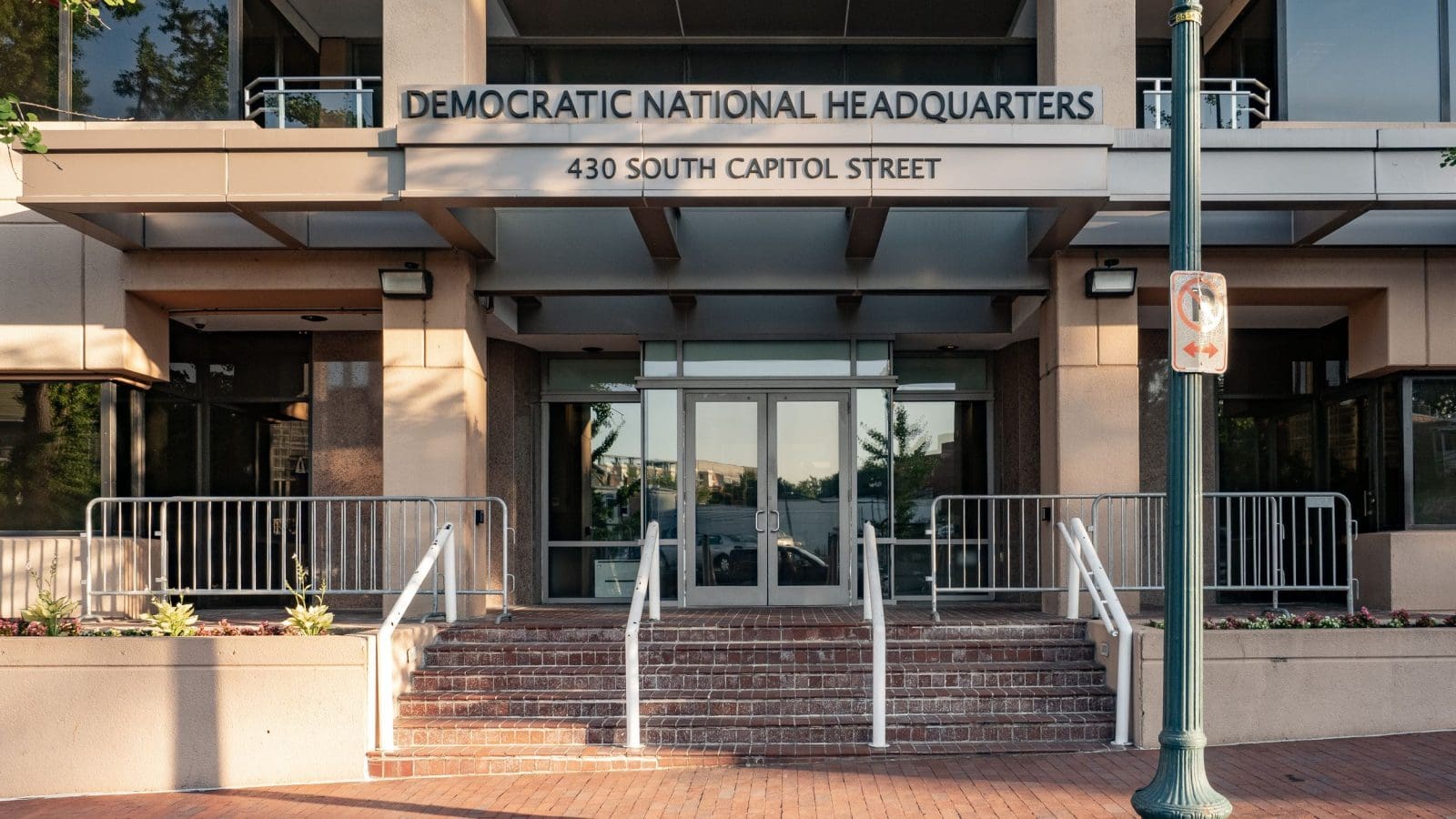
For generations, Democrats have sought to divide the American people along arbitrary racial, gender, and socioeconomic lines.
While that strategy arguably worked at certain points in the nation’s history, the broad coalition that voted to send President Donald Trump back to the White House provided evidence that it is no longer effective and might now be counterproductive.
That’s why Jerel Ezell, a professor at the leftist University of California at Berkeley, is calling on the Democratic Party to eliminate one phrase that has become ubiquitous in recent years.
As Fox News reported:
“The 2024 presidential election left the Democrats’ multiracial coalition in tatters,” Ezell wrote. “Nonwhite people voted in higher percentages for Trump in 2024 than they did in 2020, in some cases by double-digit increases. Democrats are now in the thick of a come-to-Jesus reckoning over these losses, and it should begin with this obvious truth: There is no deep cultural, social, economic or political linkage between Black, Latino, Indigenous and Asian Americans — at least not one that can be leveraged by the party for votes.”
“In November, Latinos swung hard for Trump, and the former president had a notable hike in support from Asians,” Ezell continued. “Indigenous voters, crucial in helping Biden win Arizona and Wisconsin in 2020, had no such effect in the vital swing states this go-round, although a majority still voted for Democrats. Black voters remained Democrats’ bulwark, albeit a compromised one, with Kamala Harris netting 8 out of 10 Black voters, down from Biden’s 9 out of 10 in 2020.”
Ezell wrote that if Democrats were at all “surprised” by those poll results, it may be because liberals who use the term “people of color” have learned to think that “nonwhite voters are far more culturally alike — and politically aligned — than they actually are or have been in recent memory.”
“The bottom line is that the Democratic Party’s ‘people of color’ rhetoric overplays solidarity between different racial groups, a solidarity that reached its height in the civil rights era but has long been on the wane,” Ezell wrote.
A number of polls have shown how much progress Trump and the GOP in made in attracting voters from various demographic blocs that previously had shown broad support for Democrats:
NBC: Trump has made a 19-point gain with Latino voters since 2020.
— Benny Johnson (@bennyjohnson) September 29, 2024
"BLACK VOTES FLOCKED TO PRESIDENT TRUMP! 25% OF BLACK MEN IN GEORGIA VOTED FOR TRUMP!" @stinchfield1776 shares the data among black votes for Trump! pic.twitter.com/EYagtaAwYH
— Real America's Voice (RAV) (@RealAmVoice) November 7, 2024
22-year-old Gen Z was a Trump Hater who let the media get to her and is now voting for Trump pic.twitter.com/k1V7XQ18L0
— 🔥⭐️Edwin⭐️🔥 (@Nuked4Every1) July 21, 2024
Although Ezell didn’t express any praise for the president, he did go on to acknowledge that non-White voters don’t seem to see Trump or his supporters as the sort of dangerous racist that many on the left insist they are.
As he wrote for Politico:
This error was evident in 2024, when immigration reemerged as an issue that mobilized large swaths of the electorate, but not in the ways many Democrats forecast. In the last three election cycles, Democrats assumed that the vast majority of racial and ethnic minorities would reject Trump due to his anti-immigration rhetoric — which he typically aimed at Mexicans, Central Americans and Middle Eastern Muslims.
But Trump got more support among those groups than Democrats expected. My reading of this is that many in those groups and in Black America don’t regard Trump or many of his followers as “real” racists, but rather as what I call “ambient” racists. This means, at worst, they believe Trump and his acolytes traffic in the casual racism that most racial minorities at least periodically experience, but not in the sensational cross-burning, white-hood-wearing brand of racism that Democrats and liberal media have sometimes pinned on Trump and the MAGA movement more broadly. The conventional definition of racism is that one must deeply dislike (perhaps even despise or hate) members of a particular race due to a perception that this race is highly inferior. Definitionally speaking, it would be untenable for a racist to interact with, let alone seek votes from, a race they genuinely believe to be inferior. But what I consider “ambient” racism is less binary than “real” racism. Alabama’s openly and defiantly segregationist Gov. George Wallace was a “real” racist and perceived to dislike all Black people. You could argue that Trump, in contrast, is an ambient racist and is perceived to have animus, but not hate, toward some Black people.
Moreover, nonwhite voters may view ambient racism as simply one dimension of Trump’s character, rather than it infecting his entire being. In the same ways that people retain affection and connection with loved ones who lack certain social graces, so too do many voters with political candidates, especially when the candidate is able to make their upside clear.
Here’s some additional coverage of the demographic gains Trump made during the most recent election cycle as well as evidence that Democratic Party policy priorities failed to resonate with many voters:

Join the conversation!
Please share your thoughts about this article below. We value your opinions, and would love to see you add to the discussion!