

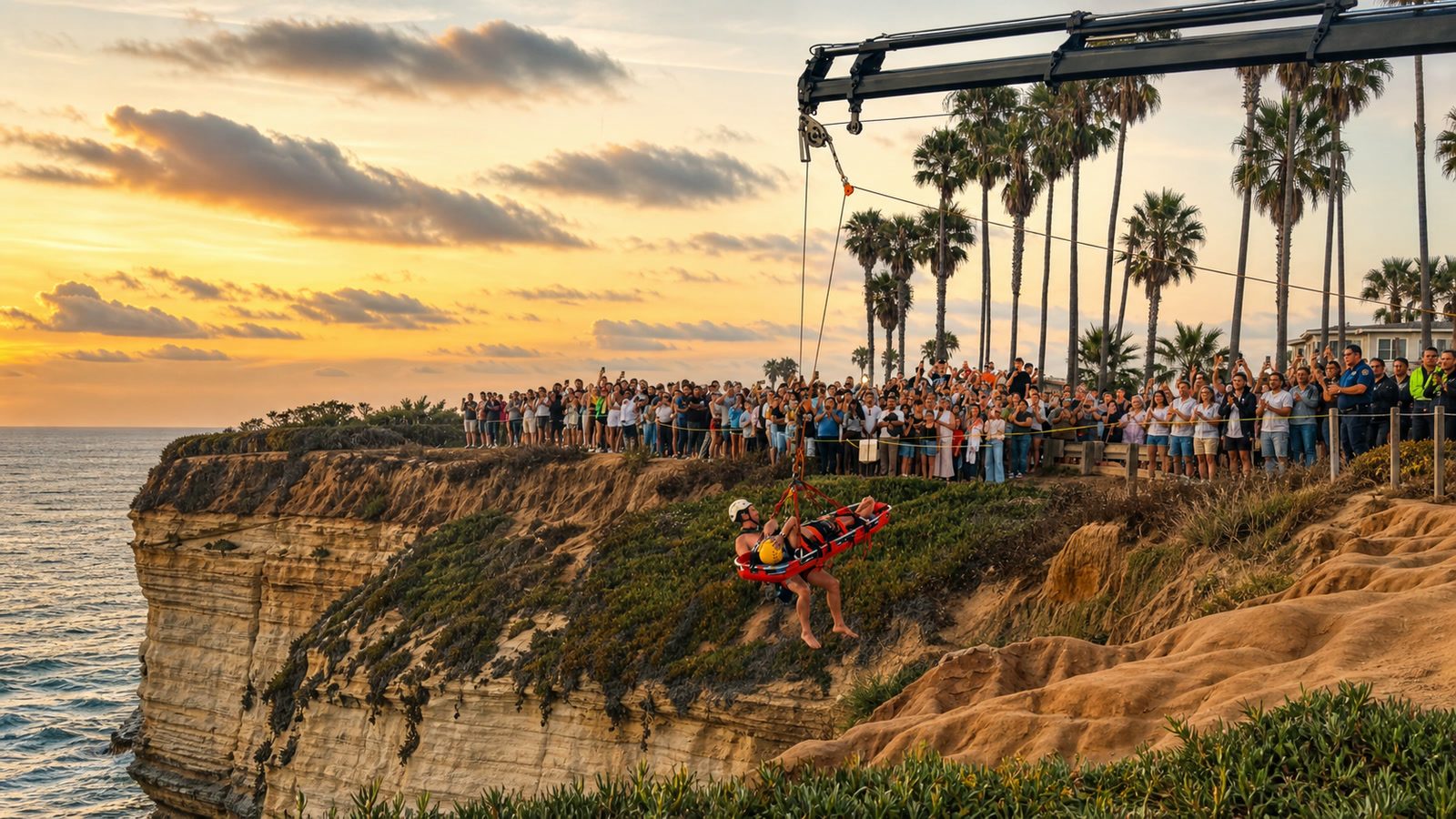
A crowd gathered along San Diego’s Sunset Cliffs as rescuers used heavy equipment to bring an injured person back to safety.
The footage is dramatic on its own. The timing makes it worse.
This rescue unfolded only days after a 17-year-old struck the rocks during an illegal cliff jump at the same stretch of coastline and was taken to a hospital.
Watch the latest rescue scene:
BREAKING: Another person has been sent to the hospital after falling off a cliff at Sunset Cliffs in San Diego, a popular spot for illegal cliff jumping pic.twitter.com/MtokEWVUvA
— Daily Loud (@DailyLoud) July 30, 2026
Two Rescues In One Evening
The viral post describes another person being hospitalized after falling at Sunset Cliffs, but local reporting shows that two separate rescues unfolded Tuesday evening. That distinction matters because the available reports do not establish that the person in every circulating clip suffered the same injuries.
NBC 7 San Diego reported that one person was seen climbing the cliffs near Sunset Cliffs Boulevard and Froude Street before falling onto hard rock and ricocheting into the ocean. The extent of that person’s injuries was not immediately clear.
At roughly the same time, first responders were handling a separate rescue a short distance away near Ladera Street. A man there had injured his leg, was located by rescue crews, and was airlifted to a hospital.
His condition was not immediately released.
The local report placed both emergencies on Tuesday evening, only two days after video of the teenager’s earlier cliff jump began spreading online. Images from the response showed a crane hoisting one person from the cliff area while a San Diego Fire-Rescue helicopter handled the separate airlift near Ladera Street.
That means the viral footage is part of a larger rescue surge, not a replay of the teen’s accident and not necessarily a complete record of the other Tuesday victim’s medical condition.
The San Diego Fire-Rescue Department logged the Ladera Street call as incident FS26137770. It was reported at 7:16 p.m. on July 28, with the first unit arriving about ten minutes later.
The official record shows just how much manpower a single cliff rescue can consume. Twenty-seven personnel were assigned, along with three engines, a truck, a helicopter, a rescue unit, a medic unit, and lifeguards.
The incident was closed at 8:54 p.m. after a response lasting more than an hour and a half.
The department’s fact sheet classifies the call as a closed historical incident and notes that details may remain incomplete depending on the severity of the emergency and available resources. It does not list a confirmed fatality count, injury total, or number of patients transported.
That official uncertainty is another reason not to attach a more specific diagnosis to a victim than authorities have released.
The Warning Had Barely Finished Echoing
Only days earlier, a 17-year-old attempted a jump from the cliffs and failed to clear a lower rock ledge.
Video showed him strike the cliff before landing in the water. At least six people rushed in to help pull him to safety, and rescuers later transported him to a hospital with a leg injury.
The impact was captured in another clip that spread rapidly online:
OUCH! Teen hospitalized after hitting rock while cliff jumping at San Diego’s Sunset Cliffs pic.twitter.com/Bnvas9OR3t
— Breaking911 (@Breaking911) July 27, 2026
NBC 7 San Diego reported that the teenager remained conscious and was sitting on a cliff ledge before lifeguards reached him.
San Diego Fire-Rescue Lieutenant Charlie Knight said the teen was fortunate to escape with only a leg injury.
Knight warned that a slightly different impact could have caused paralysis, death, unconsciousness, or drowning.
Yet the warnings did not stop the jumping. NBC’s reporter saw people pause when a police car passed, then resume once officers were gone.
One swimmer openly acknowledged that the group avoids jumping only when authorities are close enough to make an arrest.
This Is Illegal For A Reason

San Diego Municipal Code section 63.20.23 prohibits jumping or diving into the Pacific Ocean or Mission Bay from any natural or man-made point connected to land that sits more than five feet above the water.
The cliffs make the danger obvious. The ledges are uneven, the rock can crumble, the water depth changes, and a jumper who miscalculates by only a few feet can strike stone before ever reaching the ocean.
The danger does not end with the person taking the risk.
Bystanders may jump into rough water to help, while lifeguards must reach victims from below. Firefighters and technical-rescue crews may need helicopters, cranes, ropes, and dozens of personnel to move one injured person safely.
The City of San Diego says its lifeguards respond to approximately 50 cliff rescues every year. Some of the city’s coastal bluffs rise as high as 300 feet and consist of unstable terrain surrounding popular beaches.
San Diego lifeguards have served as the city’s primary cliff-rescue agency since the 1940s. Their instructors train both lifeguards and Fire-Rescue personnel in the technical rope work needed when ordinary access is impossible.
The city says its cliff-rescue instructors are certified through organizations that include the California State Fire Marshal, Rescue 3 International, Rigging for Rescue, and Peak Rescue Institute. Those instructors also train public-safety personnel from outside San Diego.
That specialized system exists because a coastal rescue can demand far more than an ambulance and a ladder. Unstable rock, sheer drops, waves, darkness, and limited access can turn one bad decision into a highly technical operation.
A Viral Cycle With Real Consequences
Sunset Cliffs has become a social-media spectacle: crowds gather, cameras come out, someone takes a risk, and the resulting footage travels far beyond San Diego.
But the video usually ends before the full cost appears.
It does not show the hours of emergency response, the hospital treatment, the rescuers placed in danger, or the public resources pulled toward an accident that did not need to happen.
Tuesday’s back-to-back rescues arrived while the previous teen’s fall was still circulating online. The warning was fresh, the danger was visible, and people returned anyway.
That is the part of this story that should be hardest to ignore: the cliffs did not change, the law did not change, and the next rescue was already underway.
RELATED REPORT:
WATCH: Teen Sprints Toward A San Diego Cliff’s Edge And Makes A Terrifying Miscalculation
The running start lasts only a few seconds.
A teenager charges toward the edge of a towering San Diego cliff, plants his foot, and launches himself toward the Pacific.
Then the camera catches the awful miscalculation.
The 17-year-old does not clear the rock shelf below him. He strikes the side of the cliff before dropping into the water as horrified witnesses begin moving to help.
WARNING: The video below is disturbing. It shows a minor striking the cliff edge and falling into the ocean.
Watch the jump and the immediate response from people gathered at Sunset Cliffs:
NBC 7 San Diego independently confirmed that the person in the video was a 17-year-old boy and that the dangerous jump happened at Sunset Cliffs over the weekend.
The local outlet reported that the teenager struck the cliff edge before hitting the water. At least six people then entered the water to help him as the rescue unfolded.
San Diego lifeguards ultimately pulled the boy from the ocean and transported him to a hospital. Video later appeared to show him conscious and sitting on a lower ledge with several people around him before rescuers arrived.
The extent of his injuries remained unknown in the latest report. The footage is alarming enough on its own, and unverified medical claims would only distort what officials have said.
At full speed, the impact can be hard to see. A careful replay shows the jumper aiming beyond the cliff face while a lower shelf projects farther out than his path can carry him.
That leaves almost no room for recovery. Once his foot leaves the upper ledge, there is no second chance to correct course.
The City of San Diego Municipal Code directly addresses this kind of jump in Section 63.20.23, titled “Jumping Into Pacific Ocean or Mission Bay.”
The law prohibits jumping, diving, or attempting either from a natural or human-made point connected to land when that point is more than five feet above the water. The rule applies to both the Pacific Ocean and Mission Bay.
The same section defines anyone under 18 as a juvenile and includes a separate provision for parents who knowingly permit, or fail to exercise sufficient control over, a juvenile violating the rule. The teenager shown in this video falls within that age definition.
The five-foot threshold turns the warning into an enforceable rule. San Diego wrote that specific height into law because the coastline can turn one bad decision into a rescue emergency in seconds.
ABC 10News San Diego examined the same location after another rescue in 2024 and reported that lifeguards are called to save people who jump from that area several times a year.
San Diego Fire-Rescue lifeguard Rick Strobel described shallow reefs, large breaking waves, and strong rip currents around Sunset Cliffs. Those dangers can stack on top of one another before a swimmer has time to understand what is happening.
The cliffs may look like a clean launch point from above, but the waterline can hide rock shelves and shallow reef. Even someone who clears the visible wall can still enter violent surf with little control over where the waves carry him.
Strobel warned that people unfamiliar with the area can get into trouble very quickly. The new footage shows exactly how little time separates a running start from a full emergency response.
Several bystanders entered the water immediately after the impact. Lifeguards then completed the rescue and got the teenager to medical care.
Hopefully, the next update brings good news about his condition.
But the warning is already clear. At Sunset Cliffs, one split-second miscalculation can erase the distance between a dare and disaster before the jumper ever reaches the water.

Join the conversation!
Please share your thoughts about this article below. We value your opinions, and would love to see you add to the discussion!