

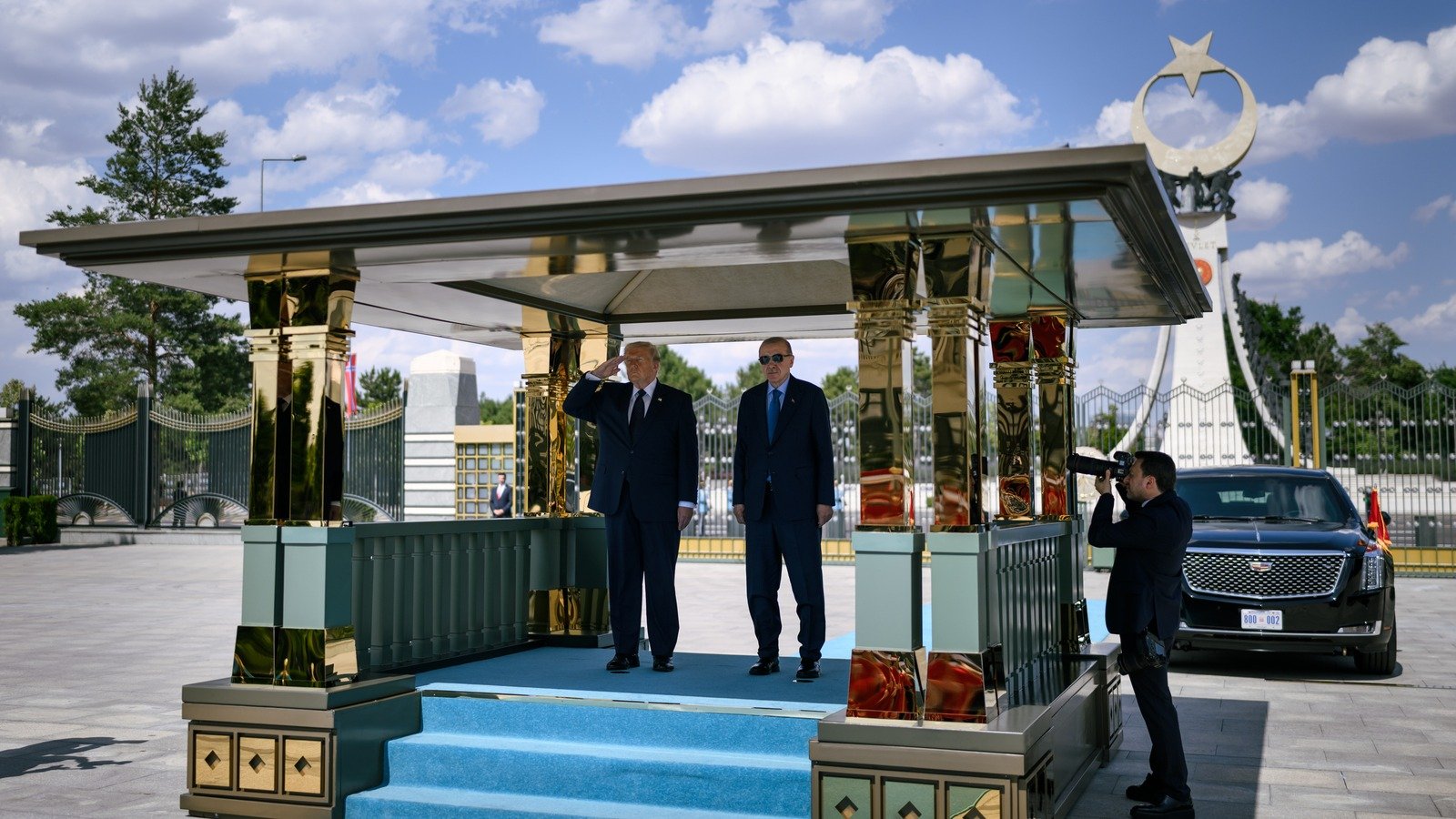
President Trump touched down in Ankara, Turkey, on July 7, 2026 for the NATO Summit, and allied defense spending is once again the fight at the center of the room.
This is the same argument Trump has been winning since his first term. For years, too many allies leaned on American taxpayers while pleading poverty on their own defense.
Now the goalposts have moved, and they moved because Trump moved them.
NATO members committed at the 2025 Hague Summit to invest 5 percent of GDP on defense annually by 2035. Trump arrived in Ankara to make sure nobody games that number.
President Donald J. Trump arrives in Ankara, Turkey and is welcomed by Turkish President Recep Tayyip Erdoğan ahead of NATO Summit.
America is back on the world stage. 🇺🇸 pic.twitter.com/rAuG4x8GSL
— The White House (@WhiteHouse) July 7, 2026
The New York Post reported July 7 that Trump planned to warn NATO countries against using “funny math” on defense spending as leaders gathered for the summit.
The report put the warning inside the larger fight over whether allies are moving from the old 2 percent benchmark to the new 5 percent promise with real military spending, public proof, and timelines allies can be judged against.
His concern is specific. Some countries pad their totals with non-military or questionable expenses so the top-line number looks respectable without buying real capability.
The Post noted that all 32 NATO countries technically hit the old 2 percent target in 2025. That was the floor, and it took American pressure just to get everyone to the floor.
The bigger 5 percent target is a different story. The report identified the UK, France, Italy, and Spain as lagging or resisting larger increases.
Poland and the Baltic states are among the strongest spenders, driven by the Russia threat on their doorstep, while Germany has laid out a path to 5 percent by 2030.
The distance between those two groups is exactly what Trump is pressing on in Ankara.
The fight is practical: a spending pledge only helps the alliance when it turns into trained forces, ammunition, air defense, ships, aircraft, logistics, and industrial capacity that can survive a real crisis.
The official NATO page lays out what the 5 percent actually requires, and it is more than one soft headline number.
The commitment breaks into at least 3.5 percent of GDP for core defense requirements and up to 1.5 percent for broader defense- and security-related investments like critical infrastructure, networks, civil preparedness, resilience, innovation, and the defense industrial base.
That 1.5 percent bucket is where the funny math can hide. Trump’s point is that the core 3.5 percent for real military capability has to be real.
NATO says allies also agreed to submit annual plans showing a credible, incremental path toward the 3.5 percent core-defense goal. Plans on paper are how you prove the money is aimed at defense and not creative bookkeeping.
The same NATO page shows the pressure is producing results. European allies and Canada increased defense expenditure by over $90 billion in 2021 prices, nearly $139 billion in nominal terms, in 2025 compared with 2024.
They invested a combined total of more than $571 billion in defense in 2025 in 2021 prices.
That money did not appear because allies suddenly discovered generosity. It appeared because Trump refused to let them freeload.
Trump to warn NATO countries against using 'funny math' on defense – as key allies struggle to do the minimum https://t.co/KEqWvBv1aS pic.twitter.com/6nTK8D08A2
— New York Post (@nypost) July 7, 2026
The NATO Summit page lists the Ankara meeting as a July 7-8 gathering of NATO heads of state and government and key partners, with defense investment listed as a central issue.
That official framing matters because the summit is built around the question of follow-through after last year’s Hague commitments, especially on defense investment and production.
The official agenda says the summit is meant to review progress since the 2025 Hague Summit and set a roadmap to keep delivering on NATO objectives through the next phase of allied planning.
It highlights defense investment, defense industry, and support for Ukraine, with a direct note that Ankara is about making sure allies are investing more and investing in the right capabilities.
That setting matters because the Ankara meeting is where last year’s promises start becoming this year’s proof.
The summit is about whether those totals turn into readiness, production, and credible plans allies can actually execute.
“The right capabilities” is the phrase that matters. Trump is not chasing a bigger number for its own sake.

He wants tanks, munitions, industrial capacity, and readiness, not line items that vanish under scrutiny.
The White House lists the NATO spending deal among the administration’s national-security wins.
The page frames the agreement as part of a broader national-security rebuild built around readiness, defense modernization, supply chains, defense industrial capacity, and alliance accountability after years of weak burden-sharing.
It says Trump secured a transformational agreement requiring NATO members to raise defense spending from 2 percent to 5 percent of GDP, turning a long-running complaint into a concrete benchmark.
The same page ties the second-term agenda to rebuilding readiness, modernizing defense capabilities, restoring the American defense industrial base, and demanding accountability across alliances so allies cannot treat U.S. protection as a blank check or a substitute for their own militaries.
That is the Trump doctrine in one sentence: America can lead the alliance without being the alliance’s endless ATM.
The page also puts the spending win inside a broader national-security push that includes readiness, defense modernization, supply chains, and industrial production. In other words, the administration is treating burden-sharing as part of a larger rebuild of deterrence, not as a diplomatic talking point to be filed away after the summit.
Allies who want U.S. protection now have to show real money, real capability, and real plans.
The old routine of flattering Washington while American taxpayers carried the load is under pressure.
Trump forced the 5 percent commitment onto the books. Now he is in Turkey making sure allies deliver the capability behind it instead of dressing up soft spending to hit a headline figure.
This is a Guest Post from our friends over at 100 Percent Fed Up. View the original article here.

Join the conversation!
Please share your thoughts about this article below. We value your opinions, and would love to see you add to the discussion!