

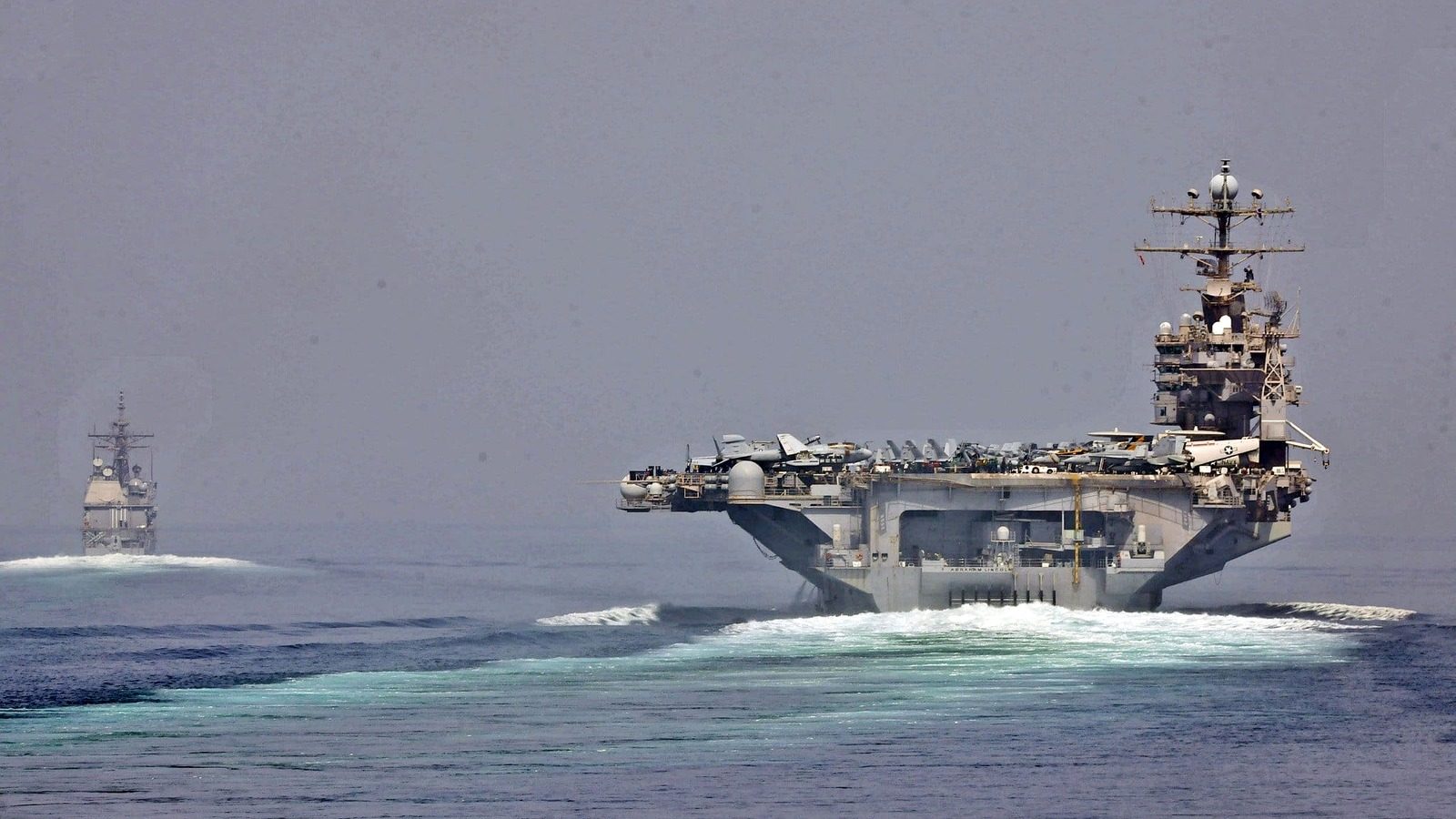
A tanker caught fire near the Strait of Hormuz, and that is how a fragile understanding starts to come apart.
U.S. officials say Iran attacked three commercial ships in 24 hours in and near the Strait of Hormuz.
The reported strikes land less than three weeks after Iran signed on to halt exactly this kind of attack, and they put Tehran directly against President Trump’s pressure campaign.
Axios updated its reporting on July 7 with a blunt headline: Iran attacked three ships in 24 hours, according to the U.S.
Two U.S. officials told the outlet that Iran’s military fired at least two missiles at commercial ships transiting the strait on Monday night. Both vessels suffered significant damage, but a U.S. official said there were no casualties.
A U.S. official said the IRGC then attacked a third commercial ship Tuesday morning.
Axios reported the strikes threaten to unravel a memorandum of understanding signed less than three weeks ago, under which Iran agreed to stop attacks in the Strait of Hormuz. The attacks also came after a separate one-week U.S.-Iran halt on attacks expired, and after indirect talks in Doha ended without much progress.
JUST IN: Iran resumes attacks in Strait of Hormuz, U.S. says. https://t.co/8jLwW9Q1Gc
— Axios (@axios) July 7, 2026
The official maritime record backs up that something serious is happening in those waters, even as investigators work out the details.
UKMTO Warning 080-26, issued July 6, reported an incident 8 nautical miles east of Limah, Oman. A tanker reported being hit by an unknown projectile on its port side, causing a fire as it traveled southbound.
No casualties or environmental impact were reported. Authorities were investigating, and vessels were advised to transit with caution and report suspicious activity.
UKMTO later reported another tanker in the strait struck by an unidentified projectile and believed to have structural damage, again with no casualties or environmental impact.
A third UKMTO alert cited military authorities on a further tanker incident in the strait. That vessel was struck by an unknown UAV, took minor structural damage, and continued on to its next port.
UKMTO WARNING 080-26 – ATTACK
Click here to view UKMTO Products⤵️ https://t.co/Oc7hGsk3Do#MaritimeSecurity #MarSec pic.twitter.com/uK8cm9a76M
— UKMTO Operations Centre (@UK_MTO) July 6, 2026
One government is not waiting for the investigation to name a culprit.
Qatar’s foreign ministry spokesman Majed Al Ansari posted July 7 that the targeting of the Qatari vessel Al-Rekayyat near the strait was an unacceptable attack on international maritime navigation and global energy supplies, and a grave violation of international law.
Al Ansari said Qatar demands Iran stop practices that undermine regional security or threaten maritime navigation, and that Qatar holds Iran legally responsible for the attack and its consequences.
Al-Rekayyat is the vessel now at the center of Qatar’s public condemnation, and the timing matters because Qatar has been a mediator in the U.S.-Iran negotiation track.
The targeting of the Qatari vessel "Al-Rekayyat" while transiting near the Strait of Hormuz constitutes an unacceptable attack on the security & safety of international maritime navigation, the security of global energy supplies, & a grave & explicit violation of international…
— د. ماجد محمد الأنصاري Dr. Majed Al Ansari (@majedalansari) July 7, 2026
The Strait of Hormuz is one of the world’s most important routes for oil and LNG.
Renewed attacks there hit energy prices, inflation, and global shipping all at once.
The New York Post reported at least two missiles fired at commercial vessels, two ships significantly damaged with no casualties, and a possible British or Qatari tanker catching fire near Limah, Oman.
The Post identified Al-Rekayyat as an LNG tanker tied to Qatar Gas Transport Company, and reported that the vessel was hit near the engine room in the Gulf of Oman.
The Post also tied the attacks to the wider ceasefire fight, noting that recent U.S.-Iran peace talks ended without significant progress and that President Trump warned Iran the United States would either reach a deal or finish the job.
That warning is the whole context for what Iran just did. Tehran signed on to stop attacking ships, let a separate halt lapse, and then U.S. officials say three commercial vessels were hit in 24 hours.
Iran is testing the deal, the shipping lanes, and President Trump at the same time.
The regime has now put a lot of chips on the table in the exact spot where American firepower already proved it can reach. Tehran may have just talked its way back into finding out.

Join the conversation!
Please share your thoughts about this article below. We value your opinions, and would love to see you add to the discussion!