
It’s official: Jerome Powell’s time as Federal Reserve Chair is over!
Earlier this month, President Trump’s nominee Kevin Warsh was confirmed by the Senate in a vote of 54-45.
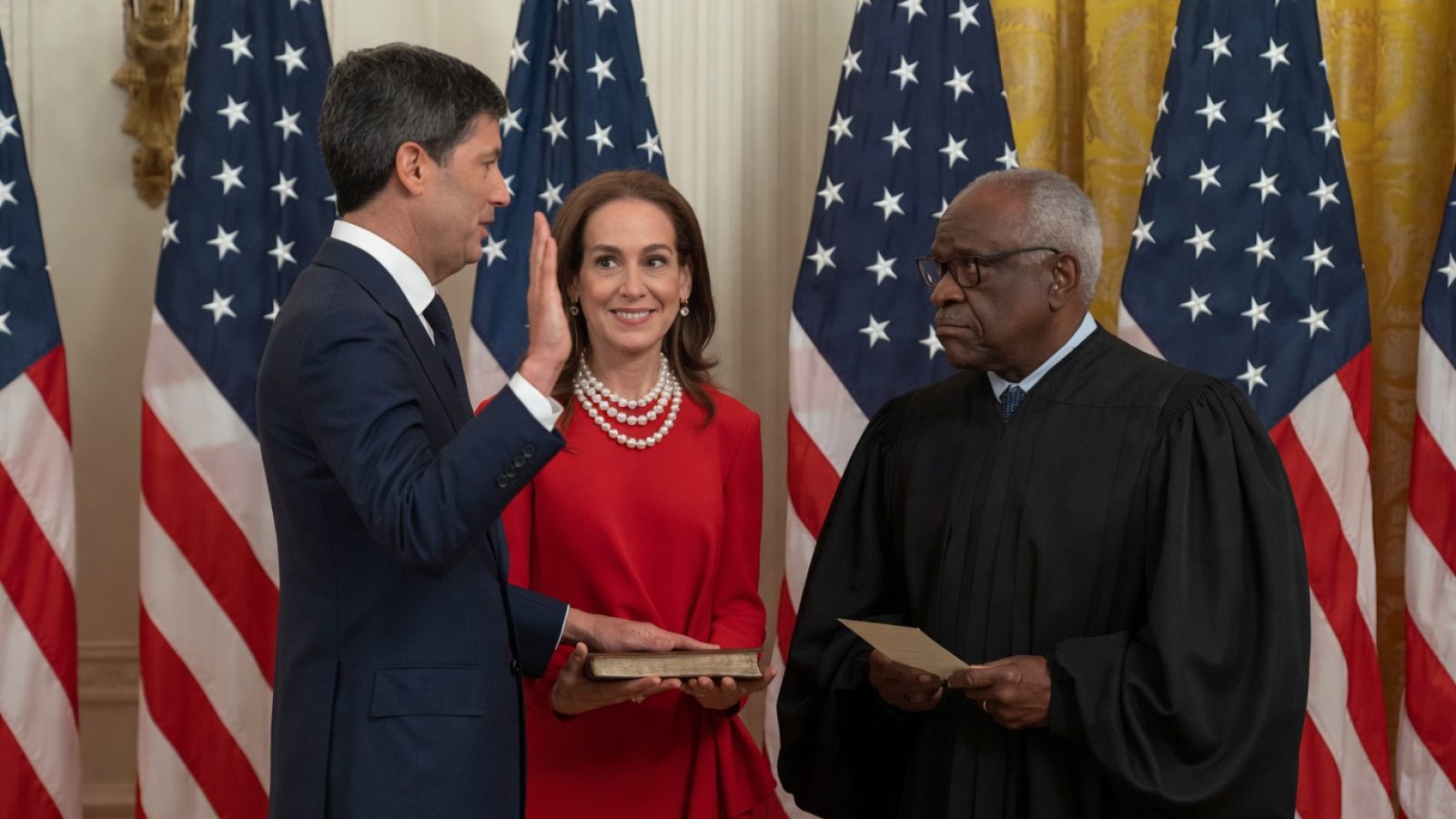
And today, he was sworn in as the new Fed Chair by Supreme Court Justice Clarence Thomas.
Watch that moment here:
Backup here if needed:
🚨 BREAKING: Supreme Court Justice Clarence Thomas has just SWORN IN Kevin Warsh as Federal Reserve Chair — JEROME POWELL IS OUT
Clarence is the pure GOAT, we love him 🇺🇸
Good riddance, Powell!
Warsh will be a great replacement 🔥 pic.twitter.com/hiXaIYv4Nk
— Eric Daugherty (@EricLDaugh) May 22, 2026
Watch the speech Kevin Warsh gave at his swearing-in here:
🚨 Fed Chair Kevin Warsh just delivered remarks full of HUMILITY at his swearing-in
HUGE step up from that egotistical ass Jerome Powell
"These duties are now mine, Mr. President, because of the TRUST you have placed in me. I accept them with gratitude and will strive every day… pic.twitter.com/Sf48GoqKy0
— Nick Sortor (@nicksortor) May 22, 2026
Fed Chair Kevin Warsh just delivered remarks full of HUMILITY at his swearing-in
HUGE step up from that egotistical ass Jerome Powell
“These duties are now mine, Mr. President, because of the TRUST you have placed in me. I accept them with gratitude and will strive every day to serve our fellow citizens well.”
“My goal now is to create an environment in which the best people can do their life’s best work and to face every challenge in the spirit of common purpose and devotion to the national interest.” 🇺🇸
ADVERTISEMENT
President Trump expressed full support for Kevin Warsh at today’s ceremony, saying that he fully believes he will go down as a “truly great” Fed Chair.
USA Today reported further:
The 56-year-old former finance executive and adviser to President George W. Bush was sworn in on May 22. He previously served on the Fed’s Board of Governors from 2006 to 2011 — a period when the central bank had to navigate the fallout from the 2008 financial crisis. He rejoins the Fed, whose goal is stable prices and maximum employment, at a time when inflation is surging as a result of the Iran war and concerns linger about stagnation in the job market outside select industries.
“It’s the honor of a lifetime to be called back into public service, and with this oath, I’ve accepted a high and solemn responsibility,” Warsh said during a ceremony at the White House. “My goal now is to create an environment in which the best people can do their life’s best work, and to face every challenge in the spirit of common purpose and devotion to the national interest. In a word, to excellence.”
Warsh replaces Jerome Powell, who has served as Fed chair since 2018 and who said he intends to keep “a low profile” as a Fed governor after Warsh was confirmed. President Donald Trump nominated Powell to his first term as chair in 2017. By the following year, the president was criticizing him, telling the Washington Post he was “not even a little bit happy” with his appointment. In his second term, Trump has pressured the Fed to lower its benchmark interest rate and acted to exert influence over the central bank, prompting concerns about the institution’s independence.
At the ceremony, Trump said he expects Warsh will go down as one of the Fed’s “truly great” chairs and that his nominee will have “full support” from his administration.
“Honestly, I really mean this. This is not said in any other way. I want Kevin to be totally independent. I want him to be independent and just do a great job. Don’t look at me. Don’t look at anybody,” Trump said. “Thankfully, unlike some of his predecessors, Kevin understands that when the economy is booming, that’s a good thing.”
This change in leadership comes at a pivotal moment for the Fed.
Kevin Warsh has been a longtime critic of the Federal Reserve and is expected to make some big changes in the coming weeks and months.
Hopefully, we’ll finally get those lower interest rates that President Trump has been pushing for!
Here’s a look at some other changes that Kevin Warsh has signaled may be coming:
- Smaller Fed footprint in markets: Shift from using the balance sheet as a regular tool for influencing financial conditions to reserving it primarily for crises and market dysfunction.
- Balance sheet reduction: Aggressively shrink the Fed’s ~$6.8 trillion balance sheet (viewed as “bloated”), moving toward a “scarce reserves” regime (pre-2008 style) instead of the current “ample reserves” system.
- New policy framework: Greater reliance on the overnight repo market as a key policy transmission mechanism (vs. heavy dependence on the federal funds rate).
- Clearer rules for intervention: Establish explicit frameworks/guidance on when and how the Fed uses quantitative easing (QE) or tightening (QT), reducing market expectations of automatic support.
- Communication reforms: Less forward guidance to avoid market pre-positioning and politicization; focus on clearer, less anticipatory messaging.
- Inflation and rates approach: Support for lower interest rates paired with balance sheet shrinkage; views AI-driven productivity as potentially disinflationary; critical of excess liquidity inflating assets (gold, stocks, crypto).
- Banking/regulatory tweaks: Support for easing some regulations and adjusting what counts as reserves to improve liquidity management.

Join the conversation!
Please share your thoughts about this article below. We value your opinions, and would love to see you add to the discussion!