

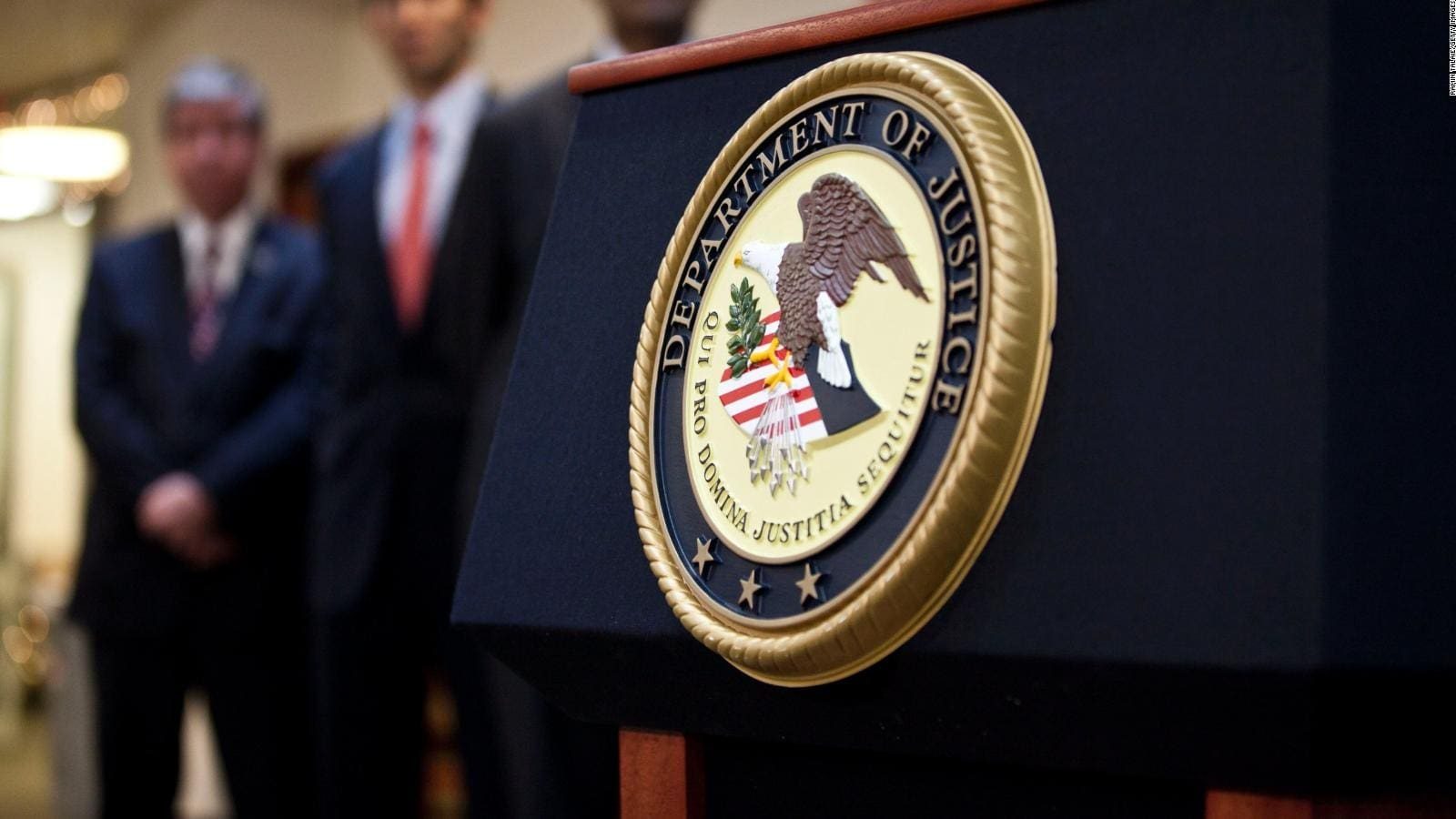
The Justice Department unsealed an indictment this week charging two Chinese nationals with conspiracy to commit money laundering tied to some of the deadliest drug cartels on the planet.
Ruhuan Zhen and Hongce Wu were charged in the Eastern District of Virginia in connection with alleged laundering for the Sinaloa Cartel and the Cartel de Jalisco Nueva Generacion, also known as CJNG.
Both defendants remain at large.
The DOJ’s Criminal Division posted the announcement on May 22, 2026:
An indictment returned in the Eastern District of Virginia was unsealed yesterday charging Ruhuan Zhen and Hongce Wu, both Chinese nationals, with conspiracy to commit money laundering in connection with transnational criminal organizations, including the Sinaloa Cartel and the… pic.twitter.com/oWxRed5Pf1
— Criminal Division (@DOJCrimDiv) May 22, 2026
Prosecutors say the alleged conspiracy ran from at least November 2016 through April 2025.
That is nearly a decade of alleged cartel-linked financial activity.
According to the Department of Justice, the indictment alleges the scheme used mirror transfers, foreign bank accounts, encrypted communications applications, a serial-number verification system, and trade-based money laundering to move cartel cash:
The Justice Department announced that an indictment from the Eastern District of Virginia was unsealed charging Ruhuan Zhen and Hongce Wu, both Chinese nationals, with conspiracy to commit money laundering tied to transnational criminal organizations, including the Sinaloa Cartel and CJNG. DOJ says the alleged scheme ran from at least November 2016 through April 2025 and used mirror transfers, foreign bank accounts, encrypted communications, a serial-number verification system, and trade-based money laundering.
The department says the alleged conspiracy operated across the United States, Mexico, Latin America, China, and elsewhere, and involved narcotics proceeds or funds represented as narcotics proceeds from the importation and sale of cocaine and fentanyl.
Prosecutors say Zhen and Wu were indicted by a federal grand jury in Alexandria, Virginia on April 24, 2025, and remain at large. If convicted, each defendant faces a maximum penalty of 20 years in prison.
DOJ also says the DEA Special Operations Division’s Bilateral Investigations Unit investigated the case, with assistance from multiple DEA offices and international-facing units.
The department lists the matter as part of Operation Take Back America, its initiative aimed at cartels, transnational criminal organizations, illegal immigration, and violent crime. An indictment is an allegation, and defendants are presumed innocent unless proven guilty beyond a reasonable doubt.
An indictment is an allegation, and all defendants are presumed innocent unless proven guilty beyond a reasonable doubt in a court of law.
If convicted, each defendant faces a maximum penalty of 20 years in federal prison.
The DOJ says the case was investigated by the DEA’s Special Operations Division, Bilateral Investigations Unit, with assistance from multiple DEA offices and international-facing units.
Prosecutors list the matter as part of Operation Take Back America, the department’s initiative targeting cartels, transnational criminal organizations, illegal immigration, and violent crime.
This indictment is a window into a much larger problem.
According to FinCEN, Chinese money laundering networks pose a serious threat to the U.S. financial system and are being actively used by Mexico-based drug cartels, including cartels designated as foreign terrorist organizations:
FinCEN warned in its 2025 advisory package that Chinese money laundering networks pose a serious threat to the U.S. financial system and are being used by Mexico-based drug cartels, including cartels designated as foreign terrorist organizations. The agency said those networks help cartels move illicit proceeds while also touching other crimes such as fraud, human trafficking, and human smuggling.
FinCEN said it reviewed 137,153 Bank Secrecy Act reports filed from January 2020 through December 2024 that were associated with suspected Chinese money laundering network activity. Those reports involved roughly $312 billion in suspicious transactions, showing that the problem is not a small side operation.
The agency described the cartel-CMLN relationship as a mutual-use arrangement: Mexico-based cartels need to move large amounts of U.S. dollar proceeds, while Chinese nationals and businesses may seek U.S. dollars outside China’s currency controls.
The agency also flagged methods that line up with the DOJ case, including trade-based money laundering, money mules, mirror transactions, social-media advertising, shell companies, and insiders at financial institutions. That context makes the new indictment part of a much broader federal push against cartel finance, not an isolated paperwork case.
ADVERTISEMENT
$312 billion in suspicious transactions over a five-year period.
That number gives you a sense of the scale federal investigators are dealing with.
A China-focused analyst also flagged the charge summary:
🇨🇳 nationals Ruhuan Zhen and Hongce Wu have been charged with conspiracy to commit money laundering in connection with transnational criminal organizations, including the Sinaloa Cartel and the Cartel de Jalisco Nueva Generación. Zhen and Wu were indicted on Apr 24, 2025, by a… pic.twitter.com/xj5IeA9GpK
— Byron Wan (@Byron_Wan) May 22, 2026
The DEA identifies the Sinaloa Cartel and CJNG as the two Mexican-based cartels at the center of the synthetic drug crisis in the United States:

The DEA identifies the Sinaloa Cartel and the Jalisco New Generation Cartel as two Mexican-based cartels driving the synthetic drug crisis in the United States. DEA says both cartels were designated foreign terrorist organizations in February 2025 and remain central threats to American public safety, public health, and national security.
DEA describes CJNG as a major supplier of illicit fentanyl to the United States and one of Mexico’s most powerful and ruthless transnational criminal organizations. The agency says CJNG is involved in fentanyl, methamphetamine, cocaine, and a broad money laundering operation tied to its financial arm and other cartel factions.
DEA also says CJNG factions use Chinese money laundering networks, cryptocurrency exchanges, bulk cash smuggling, trade-based money laundering, and other methods to launder drug-related proceeds. For the Sinaloa Cartel, DEA says the group is one of the world’s oldest and most powerful drug cartels, trafficking fentanyl and other drugs into the United States while using money laundering, weapons trafficking, human smuggling, extortion, and violence to protect its criminal empire.
The cartel-China financial pipeline is a concrete enforcement problem. It is the plumbing that keeps fentanyl flowing into American communities.
Every dollar laundered is a dollar that funds the next shipment.
Targeting the money networks behind the cartels, alongside the drugs at the border, is exactly the kind of enforcement that actually disrupts the supply chain.
Two defendants are still at large, and this case is far from over.

Join the conversation!
Please share your thoughts about this article below. We value your opinions, and would love to see you add to the discussion!