

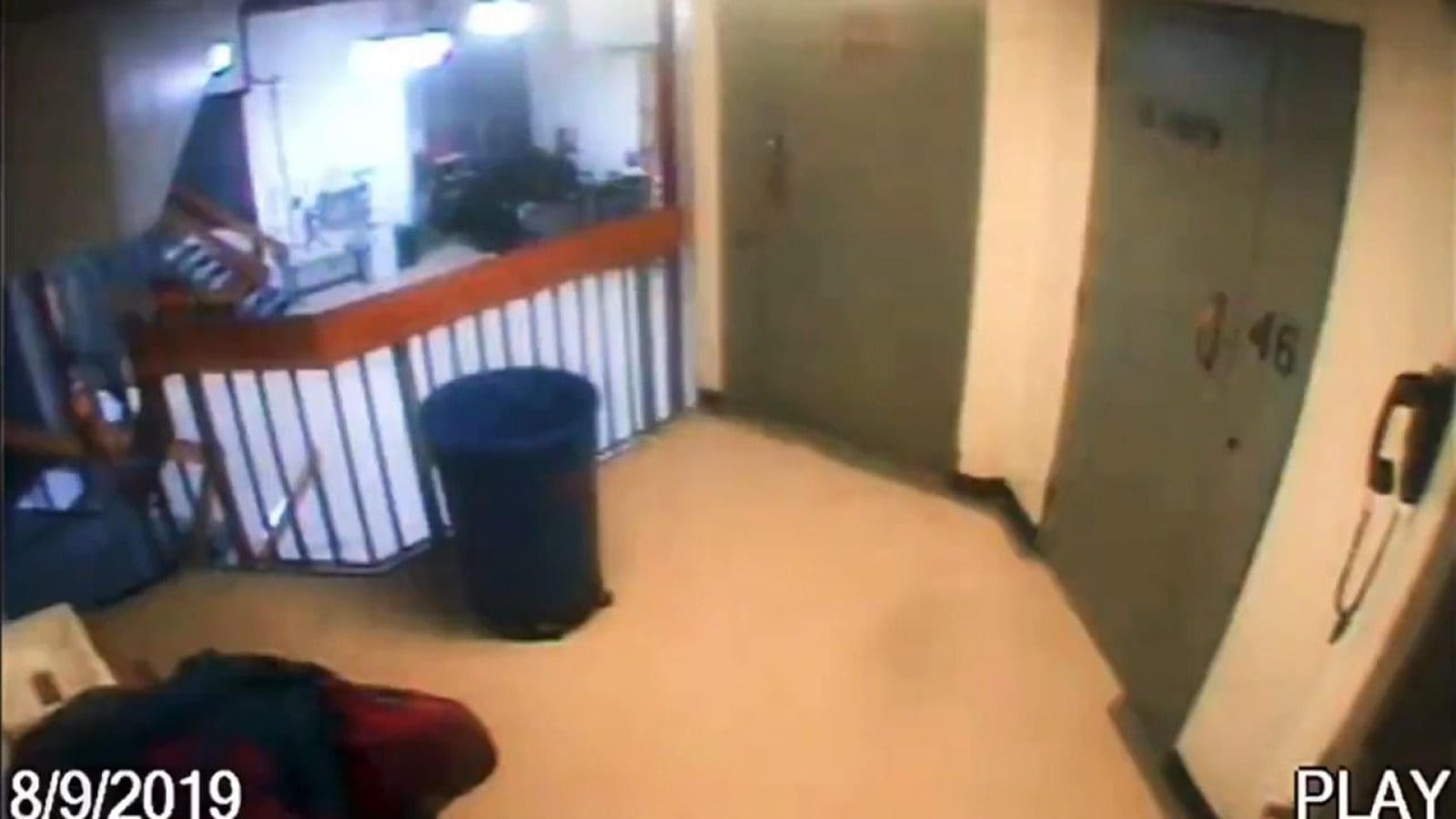
When the DOJ dropped an 11-hour long surveillance video from outside Jeffrey Epstein’s jail cell earlier this week, they expected it would serve as evidence to the public that he did, in fact, kill himself that night.
However, everything we’ve learned since about that video has only made the circumstances surrounding Epstein’s death even more suspicious than they already were.
First of all, the video didn’t even show Epstein’s actual cell, so it doesn’t actually prove anything at all.
2/25
Only a tiny sliver of staircase leading to Epstein’s wing can be seen.
This is what they argue “proves” no one approached his cell that night, despite it being almost entirely out of frame.
“Stairway to L Tier” in the second image is what leads to his block. pic.twitter.com/HKTUgbtZQE
— Adam Cochran (adamscochran.eth) (@adamscochran) July 7, 2025
Secondly, we learned is that there is a full minute missing from the footage around midnight. It appeared to be edited out.
AG Pam Bondi tried to explain that away by claiming that it’s just part of how the cameras work and a minute is missing from every piece of surveillance footage the jail has.
However, this new piece of information pokes a hole in Bondi’s claim…
You see, technology experts pulled the metadata of the footage.
And, it reveals that the so-called “raw” footage was actually edited using the software Adobe Premier Pro and saved four times.
It appears that the footage was actually originally two clips that were stitched together, which could definitely explain that one minute gap.
Here’s what we know:
🚨 BREAKING: Metadata reveals the DOJ’s “raw” Epstein prison video may have been edited using Adobe Premiere.
The FBI says the 11-hour clip was a direct export from surveillance cameras at MCC the night before Epstein was found de*d in his Manhattan cell.
But forensic experts… pic.twitter.com/4SlIyKlqdt
— Hank™ (@HANKonX) July 11, 2025
BREAKING: Metadata reveals the DOJ’s “raw” Epstein prison video may have been edited using Adobe Premiere.
The FBI says the 11-hour clip was a direct export from surveillance cameras at MCC the night before Epstein was found de*d in his Manhattan cell.
ADVERTISEMENTBut forensic experts say the file was not raw. It was stitched together from at least two separate clips and processed four times using Adobe software.
The user account that handled the edits? “MJCOLE\~1” — not a prison tech, not a federal investigator, but an unidentified Windows user.
Digital forensics expert Hany Farid said the altered metadata and handling of the footage would never meet the standard for court evidence.
“If a lawyer brought me this file and asked if it was suitable for court, I’d say no. Go back to the source. Do it right. Do a direct export from the original system—no monkey business.”
The comes amid reports that FBI Deputy Director Dan Bongino took the day off following a heated clash with AG Pam Bondi over how the Epstein prison footage was handled.
Now, just because the footage was edited doesn’t necessarily mean there is anything malicious going on here.
However, what is incredibly suspicious is how the DOJ presented this to us as raw, direct footage from the surveillance tapes at the jail that night.
They were not transparent about the fact that it was edited.
Why hide that fact from the public unless there’s something to cover up?
The original report from WIRED dove deeper into the details of what was edited:
Working with two independent video forensics experts, WIRED examined the 21-gigabyte files released by the DOJ. Using a metadata tool, reporters analyzed both Exchangeable Image File Format (EXIF) and Extensible Metadata Platform (XMP) data to identify signs of postprocessing.
The “raw” file shows clear signs of having been processed using an Adobe product, most likely Premiere, based on metadata that specifically references file extensions used by the video editing software. According to experts, Adobe software, including Premiere and Photoshop, leaves traces in exported files, often embedding metadata that logs which assets were used and what actions were taken during editing. In this case, the metadata indicates the file was saved at least four times over a 23-minute span on May 23, 2025, by a Windows user account called “MJCOLE~1.” The metadata does not show whether the footage was modified before each time it was saved.
ADVERTISEMENTThe embedded data suggest the video is not a continuous, unaltered export from a surveillance system, but a composite assembled from at least two separate MP4 files. The metadata includes references to Premiere project files and two specific source clips—2025-05-22 21-12-48.mp4 and 2025-05-22 16-35-21.mp4. These entries appear under a metadata section labeled “Ingredients,” part of Adobe’s internal schema for tracking source material used in edited exports. The metadata does not make clear where in the video the two clips were spliced together.

A UC Berkeley Professor and expert on digital forensics told WIRED that this piece of footage from the DOJ does not meet the standards to be accepted by a court as evidence.
He also noted how the aspect ratio in the video suddenly changes.
Hany Farid, a professor at UC Berkeley whose research focuses on digital forensics and misinformation, reviewed the metadata at WIRED’s request. Farid is a recognized expert in the analysis of digital images and the detection of manipulated media, including deepfakes. He has testified in numerous court cases involving digital evidence.
Farid says the metadata raises immediate concerns about chain of custody—the documented handling of digital evidence from collection to presentation in a courtroom. Just like physical evidence, he explains, digital evidence must be handled in a way that preserves its integrity; metadata, while not always precise, can provide important clues about whether that integrity has been compromised.
“If a lawyer brought me this file and asked if it was suitable for court, I’d say no. Go back to the source. Do it right,” Farid says. “Do a direct export from the original system—no monkey business.”
Farid points to another anomaly: The video’s aspect ratio shifts noticeably at several points. “Why am I suddenly seeing a different aspect ratio?” he asks.
Farid cautions that while the metadata clearly shows the video was modified, the changes could be benign—for example, converting footage from a proprietary surveillance format to a standard MP4.
ADVERTISEMENT
So, this begs the question: what was edited and why did the DOJ try to hide the fact that is was edited in the first place?
What are they trying to cover up?
Something like this?…
The missing minute from Epstein’s jail cell video. pic.twitter.com/7SxhVGv7fZ
— Brett Pike (@ClassicLearner) July 10, 2025
What’s your take?

Join the conversation!
Please share your thoughts about this article below. We value your opinions, and would love to see you add to the discussion!